Titanium is usually the better choice when minimum packed weight and corrosion resistance dominate the brief, while aluminum is often better when buyers prioritize even heating, cooking control, broader shapes, and cost efficiency. Neither material is automatically safer or more durable as finished cookware. The correct decision depends on the exact alloy, wall construction, surface treatment, handle design, intended stove, food, cleaning method, and verified compliance evidence.
Titanium vs aluminum camping cookware: the short procurement answer
A material name is only the beginning of a specification. A thin titanium mug, a formed titanium pot, a bare aluminum pan, and a hard-anodized aluminum pot can behave very differently even when their catalog dimensions appear similar. Buyers should compare complete samples at the intended fill level, heat source, recipe, and cleaning cycle rather than turning “titanium” or “aluminum” into a universal quality grade.
For solo boiling, dehydrated meals, and weight-sensitive backpacking, titanium can support a compact proposition because less mass may be carried for a sufficiently stiff vessel. For simmering, frying, family portions, and retail programs that require multiple sizes, aluminum often provides more forgiving heat distribution. Those are design tendencies, not guarantees; a product drawing, alloy declaration, construction description, and production-intent sample must confirm the actual offer.
| Decision point | Titanium cookware tendency | Aluminum cookware tendency | Evidence a buyer should request |
|---|---|---|---|
| Packed-weight objective | Often selected for very light, thin-wall solo vessels | Can be lightweight but dimensions and construction drive the result | Finished-piece mass, drawing, tolerance and sample measurement |
| Heat distribution | More localized heating is common in simple thin walls | Generally spreads heat more readily, which can help simmering and frying | Defined stove-and-recipe trial on the production-intent sample |
| Surface system | May be supplied as uncoated metal, but grade and finish still matter | May be bare, anodized, hard-anodized or coated; each requires separate control | Alloy identity, finish specification and applicable food-contact file |
| Denting and deformation | Depends on wall, geometry, forming and handle load | Depends on alloy, temper, wall, geometry and heat exposure | Critical dimensions before and after agreed handling trials |
| Cooking proposition | Strong fit for boil-focused, minimalist kits | Strong fit for broader cooking tasks and larger formats | User profile, recipe matrix, fill volume and compatible stove statement |
| Commercial decision | Material and processing can support a premium lightweight story | Often supports wider assortment and value positioning | Itemized quotation tied to alloy, construction, finish, packaging and quantity |
What current primary evidence can—and cannot—prove
The ASTM B265-25 scope covers specified titanium and titanium-alloy strip, sheet, and plate, including chemical-composition and mechanical requirements for listed grades. The ASTM B209/B209M-21 scope addresses aluminum and aluminum-alloy sheet and plate in specified alloys and tempers. These standards help define input material, but a raw-material certificate alone does not prove that a finished camping pot is food-contact compliant, well formed, easy to clean, or suitable for a buyer’s stove.
For EU-bound food-contact articles, Regulation (EC) No 1935/2004 establishes the framework requirement that materials should not transfer constituents at levels that endanger health, cause an unacceptable change in food composition, or deteriorate organoleptic characteristics under normal or foreseeable use. It also includes traceability obligations. The framework is not a shortcut to a universal “EU certified” claim, and a buyer must determine the applicable national or specific measures for the finished metal article and destination market.
For a practical construction lens, the FDA Food Code 2022 describes characteristics expected of multiuse utensil and food-contact materials, including safety, durability, corrosion resistance, adequate thickness, smooth cleanable surfaces, and resistance to damage under normal use. The Food Code is a model for retail and food-service regulation rather than a product certificate. It is useful for forming buyer questions, not for declaring a pot compliant without the appropriate product evidence.
Why cooking behavior is more than a material ranking
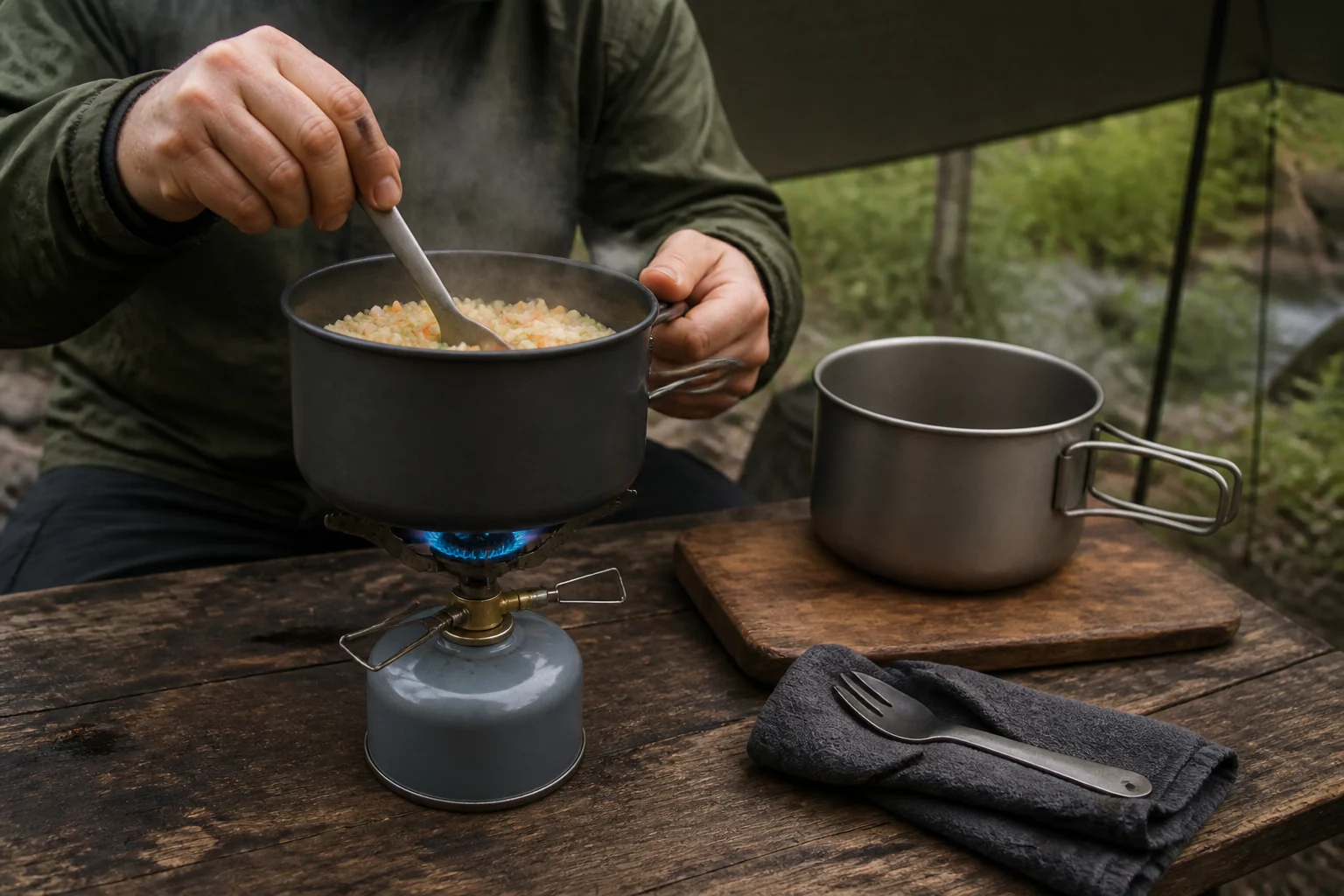
Heat moves through the vessel, across the base, into food, and away through the sidewall and surrounding air. Aluminum’s higher thermal conductivity relative to titanium generally helps distribute a burner’s concentrated heat across a wider area. That is why an aluminum pan or pot is commonly considered more forgiving for sauces, grains, eggs, or meals that need controlled simmering.
Titanium’s lower heat spreading can suit tasks where the buyer mainly needs to boil water quickly with a compact burner and wants to minimize carried mass. The same localized heating can make thick foods easier to scorch if the flame is too concentrated, the pot is insufficiently stirred, or the vessel is run nearly dry. A headline boil-time result does not answer simmer control, hot spots, handle temperature, stability, fuel use, or cleanability.
Buyers should therefore write a cooking protocol around real use. Define the stove, burner diameter, fuel, ambient conditions, water or food load, lid position, stirring interval, and endpoint. Record observations without turning one uncontrolled demonstration into a scientific claim, and repeat the protocol on production-intent samples when a decision materially depends on it.
Do not compare different constructions as if they were only different metals
A narrow titanium mug and a wide aluminum saucepan do not provide a clean material comparison. Base diameter changes stove stability and heat flux; wall height affects stirring and evaporation; lid fit affects energy loss; handle geometry affects usable capacity and handling. If a buyer wants a meaningful comparison, the samples should be close enough in capacity, base area, wall profile, lid configuration, and intended duty to isolate the decision.
Construction can also change performance inside one material family. Rolled, stamped, drawn, welded, riveted, folded, and machined features create different stress points and inspection needs. The specification should name the feature that matters rather than asking the supplier to promise that “titanium is stronger” or “aluminum cooks better” in the abstract.
Weight, stiffness and durability must be checked on the finished item
Titanium’s attractive strength-to-weight reputation can enable a low-mass pot, but buyers purchase a finished vessel, not a database property. Thin walls can flex, lids can distort, rolled rims can become uncomfortable, and handle brackets can concentrate load. A well-designed lightweight pot balances wall profile, rim stiffness, base stability, handle attachment, nesting clearance, and the realistic filled weight users will lift.
Aluminum cookware can also be light, especially in small formats, while wider or thicker constructions can improve cooking behavior and dent resistance at the cost of mass. Alloy and temper affect formability and mechanical response. A generic material declaration that omits alloy and temper is insufficient for repeat purchasing because the buyer cannot relate the incoming material to the approved sample or drawing.
Durability claims need a defined failure condition. Cosmetic rubbing, a dent that does not affect use, a warped base that destabilizes the pot, a loose rivet, and a cracked folding handle are not equivalent. Agree which conditions are critical, major, or cosmetic, then connect inspection methods to the buyer’s sales channel, warranty promise, and field environment.
Surface treatment changes the aluminum decision
“Aluminum cookware” may mean an unfinished alloy surface, conventional anodizing, hard anodizing, or a separate applied coating. Those are not interchangeable specifications. Anodizing intentionally grows an oxide layer on the aluminum surface, while an applied coating introduces its own chemistry, adhesion, curing, thickness, damage modes, use limits, and documentation requirements.
A buyer should require the supplier to identify the actual system and every food-contact layer. Color alone cannot establish that a vessel is hard-anodized, and a marketing term cannot replace a process specification. Where a coating is present, the evidence file should cover the coating formulation or declaration appropriate to the project, the substrate, intended food types, time and temperature conditions, cleaning method, and any stated restrictions.
Surface appearance also needs controlled language. Normal rack marks, shade variation, contact points, abrasion from nesting, and stains from field cooking may be commercially important without automatically being safety defects. Establish limit samples and viewing conditions so a factory inspection does not confuse harmless variation with functional damage—or excuse a real defect as “normal aluminum.”
Titanium grade and finish still require verification
Titanium is not one single input. ASTM B265 lists multiple unalloyed and alloy grades for sheet and plate, and those grades have different chemistry and mechanical requirements. A buyer should request the declared grade, the applicable input-material specification, traceable records, and confirmation that the declaration matches the formed food-contact vessel.
An uncoated titanium surface can reduce the number of intentionally applied layers in the construction, but “uncoated” does not eliminate procurement controls. Residues from forming, polishing, cleaning, or packaging must be managed; welds and crevices must be cleanable; the rim must be smooth; and the finished article still needs evidence appropriate to its intended market and conditions of use.
Finish affects both perception and maintenance. Brushed, blasted, polished, or as-formed appearances show fingerprints, abrasion, heat tint, and field wear differently. The approved sample, drawing, finish description, and packaging method should agree so that production does not drift toward a visually similar but technically different surface.
Choose by scenario, not by a universal winner
Solo backpacking and boil-focused meals
A compact titanium pot can be a rational choice when the user primarily boils water, carries every gram, accepts attentive flame control, and values a small nested kit. Buyers should still verify stove stability, useful volume below the rim, lid retention, folding-handle clearance, and whether a fuel canister or cup can be nested without damaging the surface.
The product page should avoid implying that low mass makes the pot suitable for every recipe. Clear use guidance can explain compatible heat sources, maximum fill, handle precautions, and the need to avoid unattended heating. If the brand’s customer support routinely receives cooking questions, those instructions become part of the product system rather than an optional afterthought.
Two-person trekking with real meal preparation
When users simmer pasta, grains, soup, or one-pot meals, aluminum’s heat spreading can provide a more forgiving experience. A wider base can also improve stove stability and stirring access, although it may pack less efficiently. The selection should compare meal volume, windscreen arrangement, burner compatibility, and handling with the pot filled—not only catalog capacity.
A useful buyer trial includes the messiest credible meal because cleanability is part of field performance. Observe residue at the base and corners, access under rim features, drying, odor retention from nonmetal components, and abrasion caused by nested utensils. Do not publish a performance number unless the method and result are documented and repeatable.
Family car camping and base-camp cooking
For family portions, packed weight may be less important than capacity, even heating, stable handles, and a coordinated assortment. Aluminum often supports wider pots, frying pans, and larger nesting systems suited to this job. The commercial brief should include serving count, meal types, packed dimensions, washing facilities, storage crate size, and whether replacement lids or handles are needed.
Some buyers mix materials across a set instead of forcing a single answer. A compact titanium boiling vessel might serve one premium backpacking SKU, while anodized aluminum cookware serves the base-camp range. If the assortment follows this logic, product names, packaging, comparison copy, and instructions must prevent customers from assuming identical use conditions.
Limitations and risks buyers should state plainly
Both metals conduct heat into rims, lids, and handles, even if their rates and constructions differ. Folding handles can become hot, especially when flame extends around the vessel or a windscreen reflects heat. Instructions should require appropriate handling and should never suggest touching a handle is safe merely because it has a sleeve or because the pot material has a lower conductivity.
A cookware vessel should not be heated empty unless the specific design and instructions allow it. Excessive heat can damage finishes, distort components, degrade handle sleeves, or create localized stress. A broad “campfire safe” claim is especially risky because flame geometry, ember contact, soot, suspended loading, and temperature are uncontrolled; treat open-fire suitability as a separate verified design claim, not a default property of titanium or aluminum.
Acidic and salty foods, storage duration, surface damage, cleaning chemicals, and abrasion can change exposure conditions. Compliance testing must reflect intended foreseeable use rather than a generic test chosen for convenience. A report for a different alloy, coating, thickness, or supplier cannot automatically be transferred to the current article.
Finally, cookware and dinnerware should remain distinct in the catalog. The guide to the best material for camping dinnerware addresses plates, bowls, and service items, while the separate explanation of titanium cookware safety for camping focuses on cooking-vessel evidence and use boundaries. Cross-linking these pages helps buyers understand the system without treating a dinner plate as a pot.
Material-neutral project review
Send the target user, market, stove, recipes, capacity, packed-size goal, surface system, and evidence expectations. Naike Dinner can review the brief and identify which capabilities require verification before any supply claim is made.
Request a specification reviewA procurement process that prevents false comparisons
Step 1: freeze the use case
Describe who cooks, where, how many portions, which stove is used, and whether the main task is boiling, simmering, frying, or reheating. State the highest credible food load and how the vessel will be lifted. Without this context, suppliers may optimize different products against different assumptions while using the same headline capacity.
Step 2: identify every material and layer
Request the titanium grade or aluminum alloy and temper, plus the lid, handle, fastener, sleeve, coating, seal, and accessory materials. Require a construction description that separates the food-contact surface from nonfood-contact components. This is particularly important when marketing shorthand such as “titanium set” refers to only part of an assembly.
Step 3: lock the drawing and specification
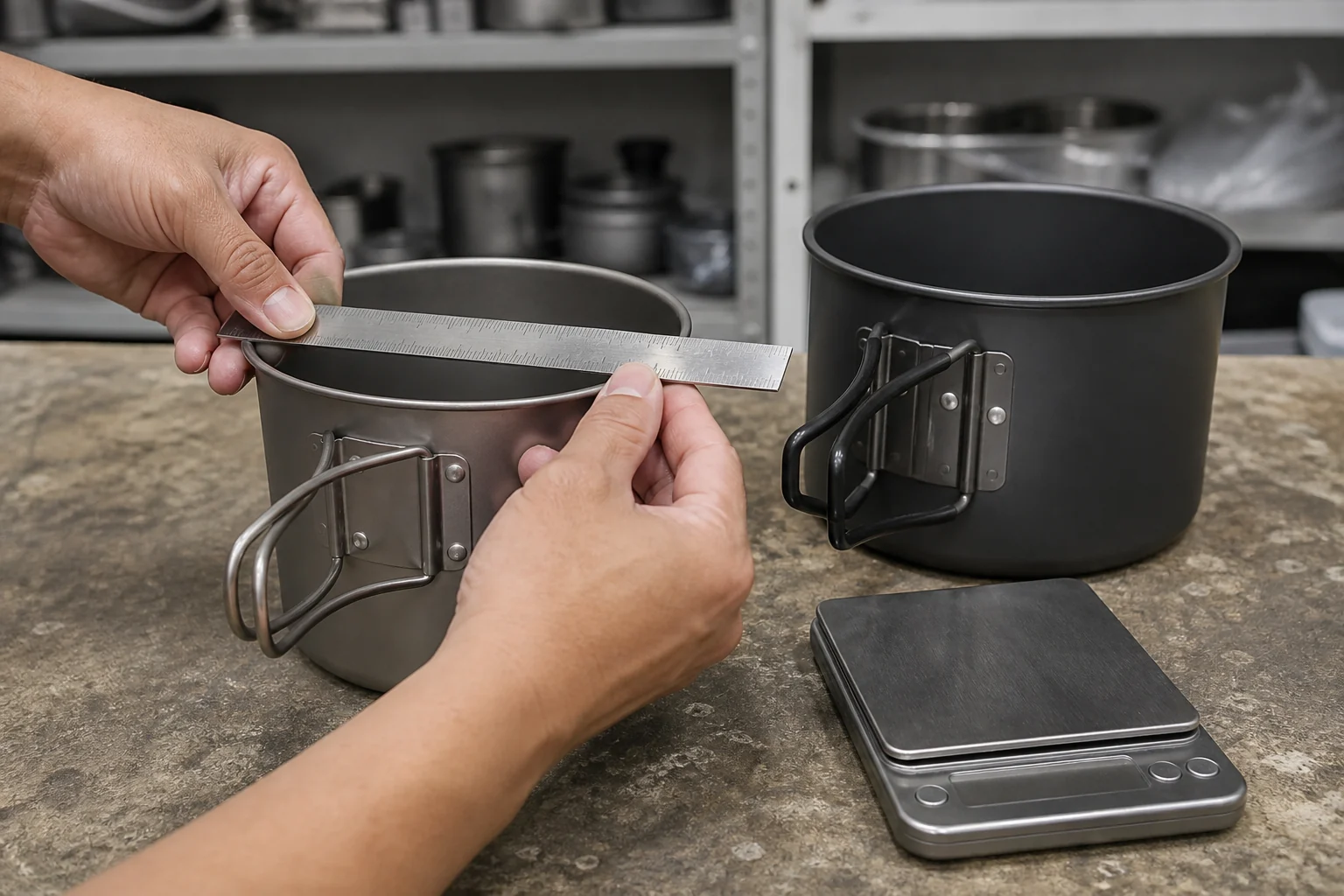
A controlled drawing should include overall and useful capacity, critical diameters, wall or mass control appropriate to the process, base flatness, rim profile, handle geometry, attachment method, lid fit, nesting clearance, and finish. Tolerances must be realistic for the chosen forming process. When measurement method matters, define it rather than arguing over two instruments after production.
Step 4: assemble the evidence file
Link input-material records to the finished article and production lot. Add applicable food-contact documentation for the destination market, test scope, sample identity, conditions of use, and any coating or accessory declarations. Review report dates, model references, photos, laboratories, methods, conclusions, and whether the tested construction actually matches the quotation.
Step 5: test production-intent samples
Inspect dimensions, mass, finish, rim, handle movement, fasteners, lid retention, nesting, stability, and cleanability. Run the agreed cooking scenarios on compatible equipment without exceeding the instructions. Record deviations and corrective actions; do not silently approve a visually attractive sample that lacks the evidence or construction defined in the brief.
Step 6: connect approval to production control
Retain a signed or otherwise controlled approval sample and final documentation set. Establish incoming-material verification, in-process checks, final inspection, change notification, and traceability. The existing camping tableware manufacturer checklist provides a broader supplier-control framework that can be adapted to a verified cookware project.
Decision-Stage B2B Buyer Checklist
| Check | Question | Why It Matters |
|---|---|---|
| Product boundary | Is this cookware intended for a specified stove, or dinnerware only? | Prevents unsafe burner claims and category confusion. |
| Material identity | What titanium grade or aluminum alloy and temper is quoted? | Makes the material declaration traceable and repeatable. |
| Surface system | Is the food-contact surface bare, anodized, hard-anodized, or coated? | Determines documentation, use limits, and damage checks. |
| Finished geometry | What are the base, useful volume, wall profile, rim, and lid tolerances? | Controls cooking behavior, stability, packability, and usability. |
| Handle system | How are handles attached, locked, insulated, and load checked? | Reduces burn, loosening, and lifting risks. |
| Evidence scope | Do reports identify the exact finished construction and intended conditions? | Stops unrelated certificates from being reused. |
| Sample protocol | Which stove, load, meal, cleaning, and nesting trials will be repeated? | Turns subjective demonstrations into comparable approval checks. |
| Change control | Must alloy, supplier, coating, process, or dimensions be approved before change? | Protects the evidence file and approved performance after launch. |
Use this checklist to structure an RFQ instead of asking for a generic “best titanium price” or “food-grade aluminum pot.” A comparable quotation should state the construction and documentation assumptions behind it. For a documented quotation format, send the project brief to Naike Dinner and request explicit confirmation of verified scope.
Eight Follow-Up Questions for Cookware Buyers
1. Is titanium always lighter than aluminum camping cookware?
No. Titanium can enable very light thin-wall designs, but finished mass depends on size, wall profile, base, lid, handles, reinforcements, and accessories. Compare the same useful capacity and intended task, verify the mass tolerance on the drawing, and weigh the approved production-intent sample.
2. Which material is better for boiling water?
For a minimalist boil-focused kit, titanium is often attractive because weight and packability can dominate the decision. Aluminum can also boil effectively and may spread heat more evenly. Stove compatibility, base diameter, lid fit, wind, fill level, and user technique can change the outcome more than a catalog material label.
3. Which is better for frying or simmering?
Aluminum is generally the more forgiving starting point because it spreads heat more readily, but construction still controls actual performance. A wide, stable base and controlled wall thickness matter. Buyers should trial the intended recipe and burner rather than converting a material tendency into an unconditional marketing promise.
4. Is hard-anodized aluminum the same as coated aluminum?
No. Anodizing modifies the aluminum surface through an electrochemical process, whereas an applied coating is a separate layer with its own formulation and performance controls. A supplier must identify the system precisely; color or the phrase “premium finish” is not enough to establish construction or compliance.
5. Can titanium or aluminum cookware be used on an open campfire?
Only when the specific finished product is designed, documented, and instructed for that use. Do not infer open-fire suitability from the base metal. Handles, coatings, geometry, suspended loading, uncontrolled flames, and thermal exposure create separate risks that a normal canister-stove statement does not cover.
6. What evidence should an importer request?
Request material identity and traceability, the finished construction, applicable food-contact documentation for the destination, sample identity, test scope and conditions, drawings, surface-system information, instructions, and change-control commitments. Review whether every report matches the quoted product rather than accepting a supplier’s certificate bundle at face value.
7. Can one test report cover a family of pot sizes?
Possibly, but only with a defensible technical rationale and the acceptance of the applicable compliance framework. Changes in alloy, surface-area-to-volume ratio, coating, process, geometry, or conditions of use can affect representativeness. The buyer and competent testing or compliance specialist should define the family before testing, not after a failure.
8. Does Naike Dinner currently supply titanium or aluminum cookware?
This guide does not establish that capability. Product availability, material, process, capacity, MOQ, lead time, and compliance scope must be verified for the individual project. Naike Dinner should only be presented as a supplier after that review confirms the relevant company records and production route.
Turn the material comparison into a verifiable RFQ
Share your market, customer, stove, recipes, useful capacity, packed dimensions, target mass, construction, surface system, accessories, packaging, and evidence needs. We will review the specification boundary, flag unsupported assumptions, and confirm what must be verified before samples or a documented quotation can be offered.
Request a project reviewOpen the supplier checklist