
A camping tableware manufacturer checklist should verify the supplier’s legal identity, actual production scope, material traceability, food-contact evidence, process controls, approved sample, inspection method, packaging and change-control system. Do not approve a factory from a catalog, certificate image or attractive prototype alone. Build an evidence chain that connects the quoted SKU and intended use to the production site and repeatable shipment controls.
Camping Tableware Manufacturer Checklist: The 12-Control Overview
Begin with a risk map, not a factory tour itinerary. Outdoor tableware can combine plates, bowls, cups, cutlery, pouches and sometimes cookware, while each component may use a different material and process. One commercial “set” can therefore involve molding, stamping, forming, welding, polishing, coating, printing, sewing and packing at several locations.
The checklist below converts that complexity into twelve control points. A buyer should mark each point as verified, open or not applicable, attach the supporting record and name the person responsible for closing gaps. A verbal assurance is useful context, but it is not evidence until it is tied to the proposed SKU, revision and destination market.
| Control | What the buyer verifies | Acceptable evidence direction | Red flag |
|---|---|---|---|
| 1. Identity | Legal entity, site address and commercial counterparty | Current registration and matching quotation details | Different names with no written relationship |
| 2. Scope | Processes performed on-site versus subcontracted | Process map and named production locations | “Full factory” claim without route detail |
| 3. Product boundary | Dinnerware, drinkware, cutlery and cookware separated | Component list with use limits | Direct-flame language copied onto dinnerware |
| 4. Materials | Grade, formulation, colorant, coating and source | Controlled bill of materials and supplier records | Generic “food grade” statement |
| 5. Compliance | Evidence matches market and conditions of use | Scoped declaration and supporting reports | Unrelated sample, factory, color or date |
| 6. Sample control | Prototype route versus production route | Revision-controlled production-intent sample | Hand-finished sample treated as mass-production proof |
| 7. Process control | Parameters and checks at critical steps | Work instructions and actual records | Inspection only after all units are packed |
| 8. Capacity | Real constraint for the proposed configuration | Line, tooling and shift assumptions | Unsupported monthly output number |
| 9. Inspection | Defects, sampling, tools and release authority | SKU inspection specification | “Standard QC” with no definitions |
| 10. Traceability | Link from finished lot to material and process records | Lot coding and retrieval demonstration | Code exists but records cannot be retrieved |
| 11. Packaging | Completeness, protection and carton configuration | Approved pack-out specification | Carton planned before final nesting is tested |
| 12. Change control | Buyer approval before material, site or process changes | Written notification workflow | “Equivalent” substitutions allowed silently |
Check 1: Establish Who Is Making and Selling the Product
Record the legal name on the quotation, the bank beneficiary, the manufacturing address and the exporter or trading entity. These can legitimately be different organizations, but the relationship should be explained before money, tooling or controlled artwork moves. Confirm which party owns the commercial obligation, which site controls production and who can authorize a corrective action.
During a remote or on-site audit, compare the stated address with the entrance, production floor and shipping records that are reasonably available. Look for continuity rather than theatrical proof: the same product family moving through logical steps, workers using consistent tooling and a responsible manager able to retrieve the SKU file. A single staged workstation or video montage should not carry the decision.
Ask whether the quotation is factory-direct, coordinated through a related export company or assembled from several specialist suppliers. None of those models is automatically unacceptable. The risk comes from an undisclosed chain in which the buyer cannot identify who controls material, testing, final release or changes.
Start with a documented scope check
Send Naike Dinner the target market, component list, material direction, intended foods, cleaning conditions, branding and pack-out. Request a written response that separates verified capability, open questions and processes requiring outside confirmation.
Request a manufacturer-scope reviewCheck 2: Map the Real Production Route
A supplier can be competent without performing every process internally. What matters is control. Ask for a simple route from incoming material through forming or molding, trimming, surface finishing, decoration, assembly, cleaning, inspection and packing. Mark every step as on-site, related-site or subcontracted, and identify where product ownership and release authority sit.
Then walk the route in the order a unit travels. Check whether work-in-progress is separated by model, color and status; whether rejected pieces can re-enter the line; and whether tools, fixtures and samples correspond to the quoted product family. For a set assembled from mixed materials, verify how components arriving from different sources are reconciled before final pack-out.
This is different from choosing an assortment. The earlier guide on how to choose camping tableware for a brand starts with users and product requirements. A manufacturer audit starts after that brief exists and asks whether a specific supply route can reproduce it under control.
Check 3: Separate Dinnerware from Cookware
Write the function of every component beside its name. Plates, bowls and eating utensils are dinnerware; cups are drinkware; pots and pans designed for heating are cookware. A mess kit may contain all three, but inclusion in one pouch does not give every item the same heat exposure, cleaning method or warning language.
Challenge direct-flame and burner claims item by item. A metal-looking plate is not automatically cookware, and a plant-fiber composite bowl must never be described as suitable for a stove or campfire without product-specific evidence. The guide to titanium cookware safety for camping explains why grade, construction, handles, stove stability and use instructions matter even when the base metal has a strong reputation.
Confirm that catalog copy, carton text, care instructions and lifestyle photography respect the same boundary. A factory may correctly state a bowl is for serving, while a marketing image incorrectly places it above a flame. Treat visual claims as part of product review, not as decoration outside the audit.
Check 4: Trace Every Food-Contact Component
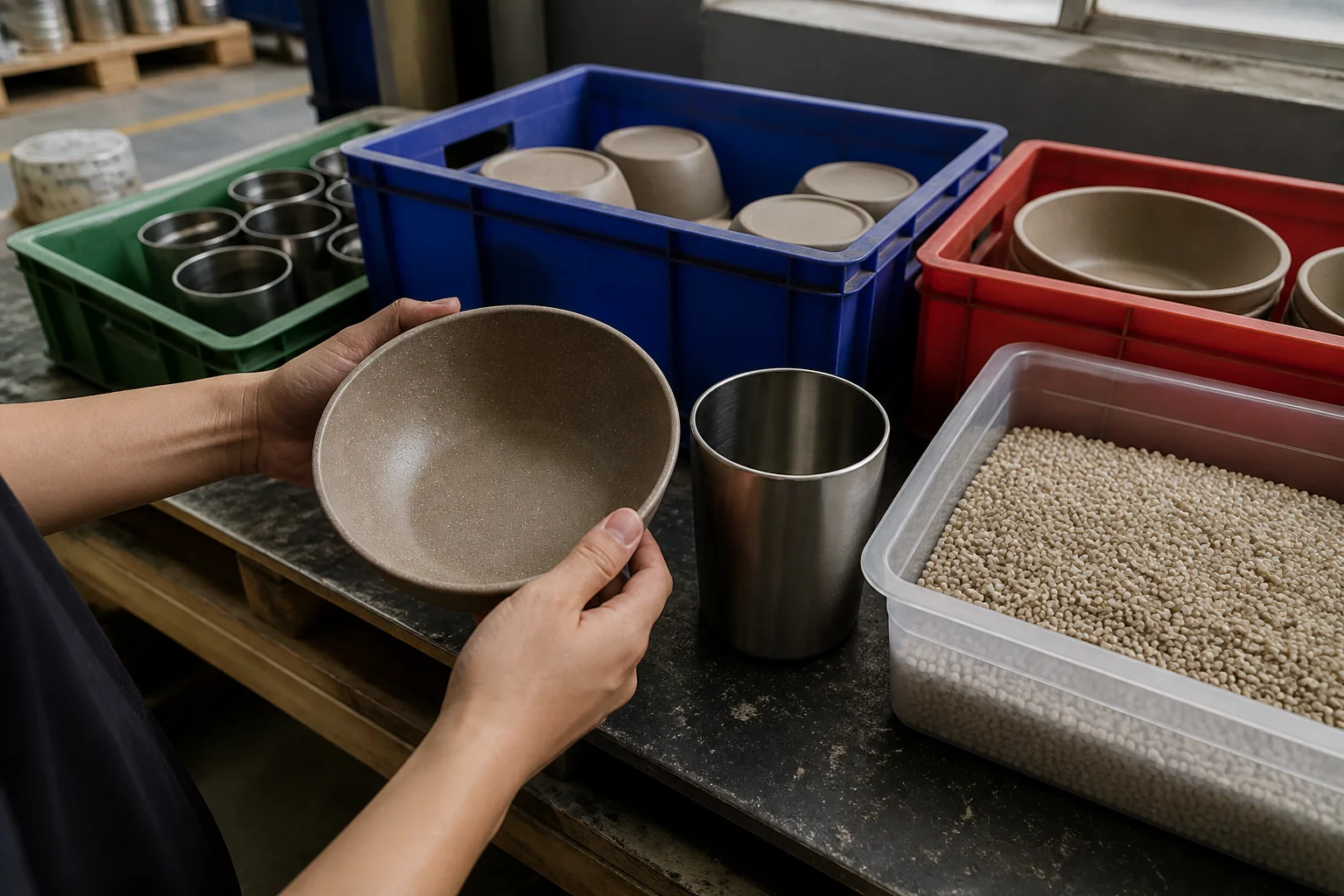
Ask for a controlled bill of materials that covers the finished article, not only the headline substrate. For molded products this can include resin or composite formulation, fiber, colorant, processing aids and printed or coated areas. For metal products it can include alloy, coating, joining material, handle insert and surface treatment. Packaging that touches the product may also matter to odor, abrasion and cleanliness.
The U.S. FDA states that the regulatory status of a food-contact material depends on each substance that comprises the article and on the applicable specifications and conditions of use. Its official guidance on determining the status of food-contact components also explains that some authorizations are manufacturer-specific. A supplier should therefore connect evidence to the actual source and formulation rather than present a random resin certificate.
During the audit, test retrieval. Select a recent finished lot or a production-intent sample and ask the team to identify the corresponding incoming material batch and approved material record. The objective is not to photograph confidential formulas; it is to prove that the factory can follow its own traceability route within a reasonable time.
Check 5: Scope Food-Contact Evidence to the Intended Use
Define the destination market, food types, temperature, contact duration, repeated-use pattern and cleaning method before reviewing reports. Hot soup, oily meals, acidic foods, room-temperature snacks, freezing and reheating are not interchangeable conditions. An evidence file is credible only when its sample identity and test scope cover the product the buyer intends to sell and the claims the buyer intends to make.
The European Commission identifies tableware and kitchenware as food-contact materials and explains that EU products must comply with the framework rules and good manufacturing practice, with additional material-specific and national requirements where applicable. Buyers should use the Commission’s current food-contact materials overview as a routing source, then obtain qualified advice for the exact material and market.
Review the report’s laboratory, date, applicant, manufacturer, sample description, color, construction, photographs, methods and conditions. Do not infer that a report for one color, thickness or coating automatically covers another. If a supplier relies on a family rationale, request the written technical basis and identify which change would require re-evaluation.
Check 6: Control the Sample-to-Production Transfer
Identify what kind of sample is on the table. A catalog sample can show a supplier’s general workmanship; a concept sample can confirm proportions; an engineering sample can test interfaces; and a production-intent sample should use the proposed materials, tooling, processes, decoration and pack-out. Approving one type as if it proves another creates avoidable surprises.
Create a signed sample record with model, revision, component count, dimensions, mass, capacity, color reference, surface condition, artwork position and packaging configuration. Store the associated digital drawing and evidence index under the same revision. Where color or texture naturally varies, approve a range or boundary samples instead of one unrealistic ideal.
Ask how the golden sample reaches line inspectors and what happens if it ages, fades, chips or goes missing. A well-run factory may keep a sealed master and a working reference. The buyer or third-party inspector should retain an independent reference when the program’s risk justifies it.
Check 7: Look for Process Control Before Final Inspection
Final inspection cannot manufacture quality into a finished lot. Identify the characteristics created at each step and the control that prevents drift. Molding may require stable material preparation and cycle conditions; metal forming may require tool condition and edge control; decoration may require surface preparation, curing and position checks; assembly may require fixture and force control.
Ask operators what they check, what tool they use and what they do when a result falls outside the limit. Their answers should align with the visible work instruction and actual record. A perfect binder in the office is weak evidence when the production team uses an undocumented rule or cannot distinguish a hold lot from a released lot.
Examine rework and scrap routes. Reground material, polishing, repainting, reprinting or component substitution may change appearance or food-contact assumptions. The supplier should define which rework is allowed, how it is identified and when buyer approval or renewed evaluation is required.
Check 8: Validate Capacity Without Accepting a Headline Number
Capacity is configuration-specific. A line that produces a simple single-color plate efficiently may slow considerably for multi-component sets, frequent color changes, tight decoration, complex polishing or manual pouch packing. Ask the supplier to build an estimate from tooling cavities or forming stations, cycle time, planned shifts, yield and the bottleneck operation.
Discuss maintenance, spare tooling, critical utilities, seasonal loading and dependence on one operator or subcontractor. A credible answer can include uncertainty. A large unsupported monthly figure is less useful than a transparent calculation showing what changes when the order mix, color count or inspection level changes.
Do not invent a universal lead time. Separate material procurement, tooling, sample approval, production, testing, packing and transport. Confirm which stages can overlap and which require buyer approval before the next stage begins.
Check 9: Define Inspection in Product Language
Translate requirements into observable defects. Critical concerns may include a sharp edge, unstable cookware handle, wrong material, contamination or a missing safety warning. Major defects may include severe warp, failed nesting, loose joints, leakage, wrong component or unusable decoration. Minor defects may include limited cosmetic variation that does not impair function.
The U.S. National Institute of Standards and Technology explains that acceptance sampling is a lot-disposition method rather than a complete estimate of lot quality. An AQL plan does not replace safety controls or process capability. The buyer still needs a defined lot, sample size, defect classes, acceptance numbers and unambiguous inspection method.
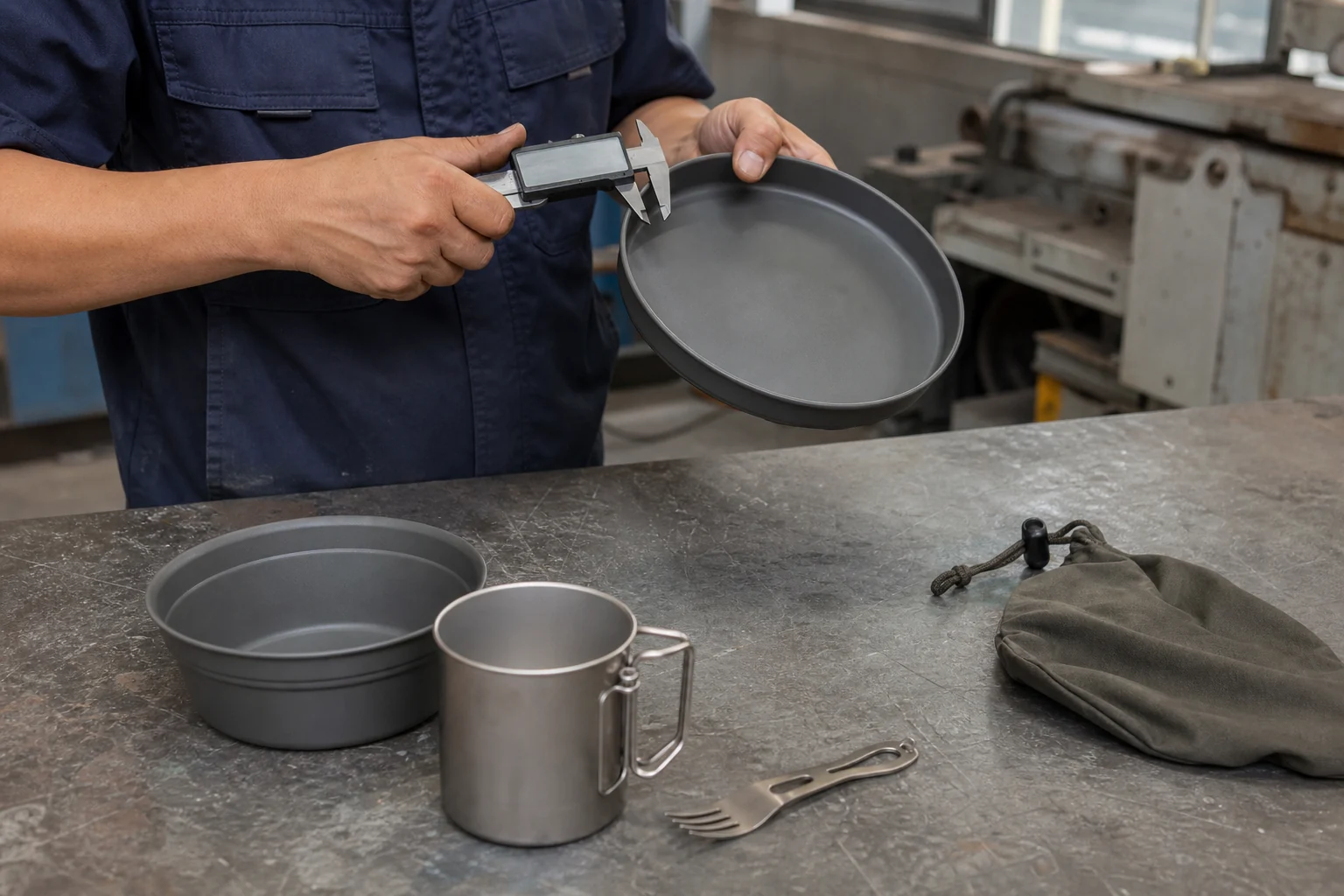
List the measuring equipment and fixtures required for dimensions, capacity, mass, fit, closure, handle movement, decoration position and pack-out. Confirm calibration or verification appropriate to the decision. A digital display in a photograph is not proof; the useful evidence is a controlled method, competent user and retrievable result associated with the lot.
Check 10: Test Traceability and Complaint Readiness
A traceability code is useful only if it retrieves records. Choose a finished carton or sample and ask the factory to trace backward to packing date, inspection release, production batch and relevant incoming materials. Then test the forward path: if one material batch were placed on hold, could the team identify affected finished lots and their shipment status?
Review the complaint workflow without asking for customer-confidential data. The process should receive evidence, identify the product and lot, contain remaining stock, investigate the mechanism, assign corrective action and verify effectiveness. Replacing units may satisfy a customer, but it does not prevent recurrence.
For buyers placing products in the EU, the General Product Safety Regulation is the authoritative legal source for general product safety, traceability and economic-operator obligations. A factory audit should help the buyer collect product and supply-chain information, while market-specific legal responsibility must be reviewed by qualified parties.
Check 11: Audit Pack-Out as a Manufacturing Process
Use the approved component checklist during packing. A visually attractive set can still fail if one spoon, lid, cup or pouch is missing. Verify component orientation, nesting pressure, separator placement, closure, unit identification, master-carton quantity and any protection against rim abrasion, coating rub or trapped moisture.
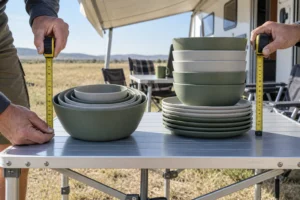
Compare actual packed dimensions and weight with quotation and logistics data. Handles, fabric folds and separators create real volume that a drawing may ignore. Check whether the pack can be reopened for inspection and resealed without damage, and whether mixed colors or models can be detected before cartons close.
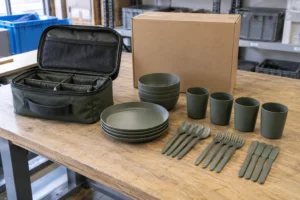
The published camping mess kit component checklist can help procurement teams define completeness before the inspection specification is written. It does not replace an SKU-level packing standard, because shared cookware, serving pieces and individual dinnerware vary by program.

Check 12: Require Change Notification Before Substitution
List changes that require written notice and approval: production site, subcontractor, material source, formulation, recycled content, colorant, coating, adhesive, ink, thickness, tooling, forming route, heat treatment, decoration, packaging and test method. “Equivalent material” is not a sufficient description when compliance, appearance or field performance could change.
The notification should state the reason, affected SKUs, proposed timing, technical comparison and recommended validation. The buyer then decides whether a document review, sample, limited trial or renewed testing is appropriate. Emergency supply pressure should not silently lower the approval standard.
Confirm document retention and revision access. Purchasing, quality, factory engineering and the inspection party should work from the same released files. Old artwork or instructions must not remain available at the line after a revision becomes effective.
B2B Buyer Checklist for a Factory Visit
| Check | Question | Why It Matters |
|---|---|---|
| Commercial identity | Do the quotation, beneficiary and responsible manufacturer relationships match? | Prevents unclear accountability and payment risk. |
| Site scope | Which exact steps are on-site and which are subcontracted? | Shows where process and change control must extend. |
| Product boundary | Which components are dinnerware, drinkware or cookware? | Stops unsupported flame and heat claims. |
| Material chain | Can one finished lot be traced to controlled material sources? | Connects evidence to the commercial article. |
| Evidence scope | Do reports match SKU, market, food and use conditions? | Reduces reliance on irrelevant certificates. |
| Approved sample | Was the reference made by the intended production route? | Limits prototype-to-production drift. |
| Process discipline | Can operators explain limits, records and reaction plans? | Demonstrates control before final inspection. |
| Capacity logic | What is the bottleneck for this exact set and finish? | Makes timing assumptions auditable. |
| Release inspection | Are defect classes and methods specific to the SKU? | Creates consistent shipment decisions. |
| Pack-out | How are component count, nesting and carton protection verified? | Prevents incomplete or transport-damaged sets. |
| Change control | Which changes need written buyer approval before use? | Protects evidence, appearance and performance. |
| Corrective action | Can the factory contain, investigate and prevent recurrence? | Shows readiness beyond replacement promises. |
How to Score the Manufacturer Without Hiding Risk
Use three dimensions: evidence quality, control maturity and consequence of failure. A fully documented low-risk packaging detail may need routine follow-up, while an unresolved food-contact formulation or sharp-edge hazard should block approval regardless of the total score. Do not let many easy green items mathematically cancel one critical red item.
Assign an owner and deadline to each open point. Define what closes it: revised specification, source document, production-intent sample, process observation, test, corrective action or commercial clarification. Record limitations explicitly so that an approved supplier is not assumed to be approved for every material, process and product family.
Naike Dinner’s verified public product scope centers on reusable wheat-straw composite tableware. This manufacturer checklist does not claim that Naike Dinner produces titanium, stainless steel, aluminum, enamel, silicone, PP, Tritan or cookware. Buyers considering those directions should request a written project-scope response and independent evidence before treating any capability as confirmed.
Frequently Asked Buyer Questions
1. Is a factory audit certificate enough to approve a camping tableware manufacturer?
No. A management-system or social-audit record may be useful within its stated scope, but it does not prove that the proposed SKU, material, food-contact evidence, performance or pack-out is acceptable. Combine facility-level review with product-specific documentation, samples and controls.
2. Should a trading company be rejected automatically?
No. A capable trading or export partner can coordinate specialist processes and communication. The buyer should know the actual production sites, confirm how the partner controls them and define who owns specifications, evidence, inspection, corrective action and change notification.
3. How many factory samples should be reviewed?
There is no universal number. Review enough production-intent units to expose variation in the important characteristics, then use a defined sampling and approval plan for the lot. One perfect hand-finished sample is not evidence of repeatability.
4. Can one food-contact report cover every color and size?
Not automatically. Coverage depends on formulation, construction, sample selection, test scope and the technical justification for a product family. Ask the supplier to identify the worst-case rationale and the changes that would trigger new evaluation.
5. What is the most important question during a production-floor visit?
Ask an operator what characteristic is being controlled, what limit applies and what happens after a failure. That answer reveals whether the documented system reaches daily production. It should then be checked against the released instruction and actual record.
6. Does AQL inspection guarantee that a shipment has no defects?
No. Acceptance sampling supports a decision about a lot using a defined sample; it does not inspect every unit or make a hazardous design safe. Critical risks require appropriate prevention, testing and acceptance rules beyond a generic AQL label.
7. When should the buyer repeat due diligence?
Repeat the relevant review after material, site, process, tooling or subcontractor changes; after serious quality events; and when entering a new market or use condition. Routine supplier reviews should also confirm that the evidence and controlled files remain current.
8. What should be sent before asking for a quotation?
Send the component list, target market, intended users, food and temperature conditions, material direction, dimensions, artwork, pack-out, inspection expectations and demand scenarios. The more controlled the input, the easier it is to compare quotations without invented assumptions.
Request a documented manufacturer review
Prepare the twelve control points above with your component list and target market. Naike Dinner can review the brief against its verified scope, identify unanswered evidence and specification questions, and prepare a documented quotation path where the requested product and process are supportable.
Request a project reviewReview the sourcing workflow


Reusable sourcing asset
Vendor Comparison Scorecard for Outdoor Tableware
Use a weighted scorecard so price does not hide specification risk. A practical first review can allocate 20% to material traceability, 20% to sample-to-bulk consistency, 15% to tooling and drawing control, 15% to food-contact evidence, 10% to inspection records, 10% to packaging validation and 10% to delivery communication.
- Mess-kit suppliers: verify nesting, rattle control, component count, replacement policy and packed dimensions.
- Molded PP/composite suppliers: verify resin, masterbatch, filler, tooling ownership and color tolerance.
- Metal suppliers: verify grade, thickness, finished weight, rim/handle construction and surface finish.
Ask every shortlisted supplier to quote the same specification and evidence list. For a category-specific brief, review camping mess kit configurations; for a broader program, use the custom outdoor tableware RFQ route.