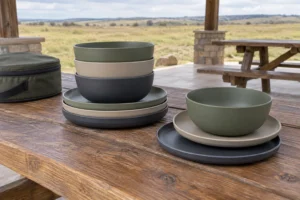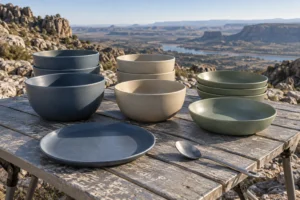
Is titanium cookware safe for camping? It can be when the exact finished pot or pan uses a traceable grade, is designed for the stated heat source, and has food-contact evidence and instructions covering its construction. The word “titanium” alone is not proof. Buyers must verify grade, wall design, handles, coatings, food conditions, heating limits and production consistency.
Is Titanium Cookware Safe for Camping? The Decision Tree
A camping buyer should answer three questions before discussing weight or price. Is the item actually designed as cookware for the named burner or heat source? Can the supplier connect the finished article to a traceable material and construction specification? Does the compliance and performance evidence cover the exact food, temperature, duration and repeat-use conditions?
If any answer is unknown, the product is not ready for a safety claim. A titanium bowl sold only for serving cannot inherit a stove-use claim from a visually similar pot. A metal cup shown beside a flame is not automatically designed to sit over one, and a raw-material certificate cannot describe a handle, weld, coating or finished surface added later.
This distinction also protects the wider outdoor assortment. The guide to what a camping mess kit is separates cooking, serving, eating, drinking, cleaning and carrying functions. Use the same component-level language on drawings, packaging, product pages and care instructions.
| Safety question | Acceptable buyer evidence | Warning sign | Decision |
|---|---|---|---|
| Is it cookware? | SKU-specific heat-source and use instructions | Only outdoor lifestyle images or a generic “camping set” label | Do not approve direct heat without explicit scope |
| Which titanium? | Named grade, specification and traceable material record | “Pure titanium” with no grade or document link | Request identity and lot traceability |
| What else contacts food? | Complete bill of materials, finish and coating declaration | No disclosure for welds, rivets, coatings or printing | Review the complete article |
| Which foods and temperatures? | Finished-product evidence matched to intended conditions | One report used for every food and heating scenario | Define scope before testing |
| Can the user handle it safely? | Grip, stability, lid, steam and handle assessment | Weight claim without burn or spill evaluation | Test the assembled system |
| Will production match? | Controlled sample, drawings, inspection and change control | Uncontrolled substitutions after sample approval | Lock critical characteristics |
Check 1: Confirm the Product Is Designed as Cookware
Cookware is intentionally exposed to heating during food preparation. Dinnerware receives or serves food after preparation, while drinkware and utensils have their own functions. Material identity does not erase these boundaries: titanium dinnerware remains dinnerware unless the exact component has been designed, assessed and instructed for cooking.
Define the allowable heat source in the specification. A compact gas stove, induction surface, electric hot plate, wood fire and glowing coals create different heat concentration, support geometry and user risks. “Campfire safe” is too broad when the product instructions do not define distance, flame contact, maximum input, empty heating and handle position.
Buyer photography must stay within the same boundary. If a serving bowl is placed directly on a burner for visual drama, customers may interpret the image as a use instruction. Approve artwork alongside the technical file, and remove heat imagery from components that are not verified cookware.
Check 2: Identify the Exact Titanium Grade
Titanium is a family of commercially pure grades and alloys, not one uniform recipe. ASTM B265-25 covers multiple titanium and titanium-alloy grades in strip, sheet and plate form. Its official ASTM B265-25 scope shows why a purchase order should name the applicable grade rather than stop at “titanium.”
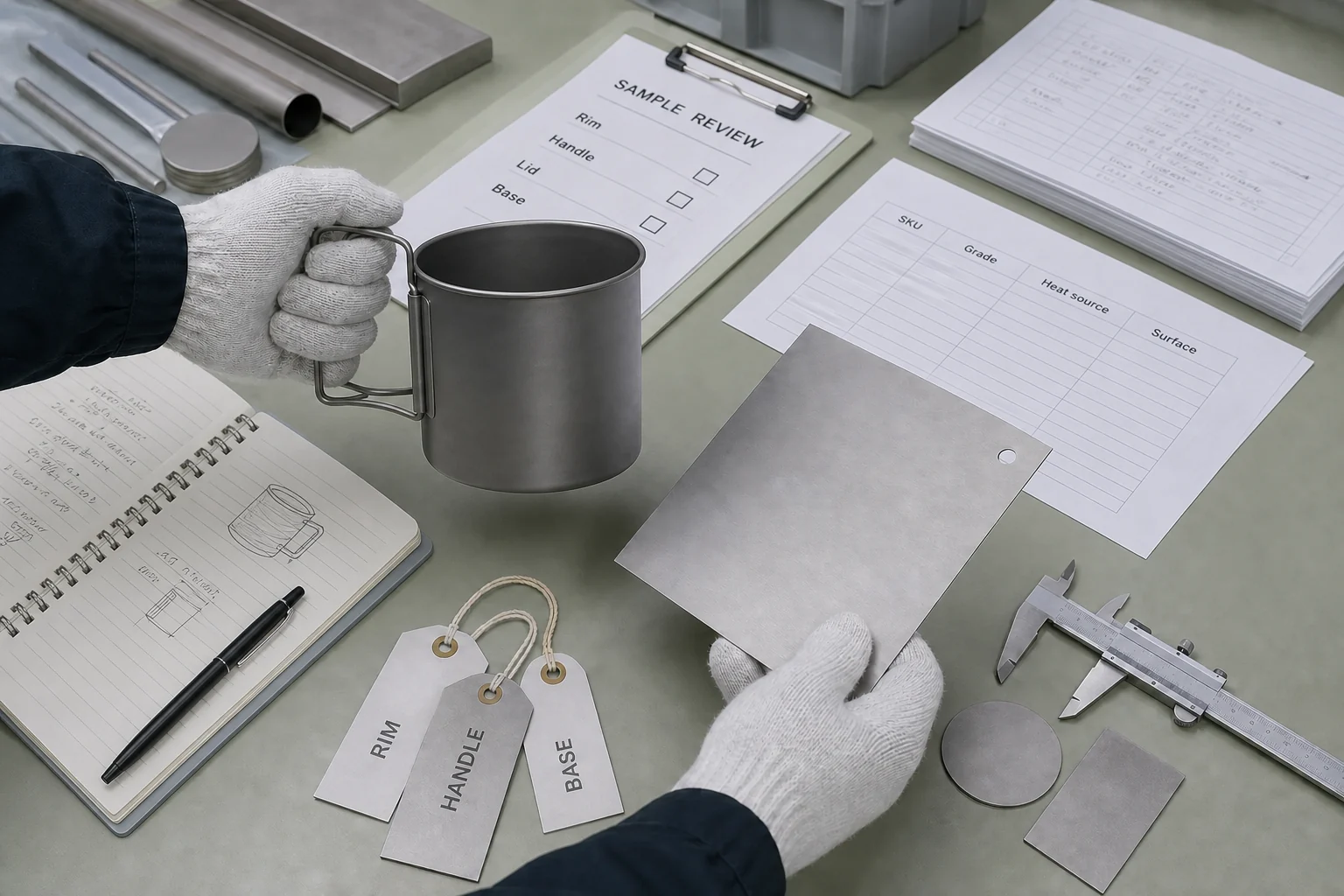
A material specification is valuable for chemical composition and incoming identity, but it is not a finished cookware safety certificate. Forming, welding, polishing, cleaning, coating and assembly occur after the sheet is produced. The supplier must connect the incoming lot to the pot or pan delivered under the commercial SKU.
Request a material certificate or equivalent traceable record appropriate to the procurement program. Check that the document, purchase order, drawing and internal lot code agree. If a supplier changes grade, source, thickness or forming route, the buyer should determine whether sample approval, performance work and food-contact evidence need renewal.
Check 3: Review Every Material in the Finished Article
A pot described as titanium may include stainless fasteners, a different metal handle, silicone grips, polymer knobs, weld material, surface treatments, measurement marks, printing or a storage coating. Each relevant component can affect the food-contact or heat-use assessment. Build a complete bill of materials instead of reviewing only the largest metal surface.
Uncoated and coated products require different questions. For an uncoated article, verify the titanium grade, finished surface, residues and cleaning. For a coated article, identify the coating chemistry, application, cure, adhesion, edge coverage and maximum use conditions; do not assume titanium underneath validates an unknown surface.
Examine rivets, folds, welds and seams where cleaning solution or food can remain. A strong base material cannot compensate for sharp burrs, incomplete weld finishing or inaccessible crevices. The controlled sample should define both broad surface appearance and these small high-risk details.
Check 4: Match Food-Contact Evidence to Real Use
European food-contact decisions begin with the finished article and its foreseeable use. Regulation (EC) No 1935/2004 requires materials and articles to be manufactured so that they do not transfer constituents to food in quantities that endanger health, unacceptably alter food composition or deteriorate organoleptic properties under normal or foreseeable conditions.
The EDQM’s official food-contact materials overview records publication of the second-edition technical guide for metals and alloys. That framework treats metal release as a material- and condition-specific matter. It does not turn the phrase “food-grade titanium” into blanket approval for all constructions and cooking conditions.
Ask which finished SKU, surface, food or simulant, temperature, contact time and repeated-use sequence a report covers. Heating can concentrate exposure at the cooking surface and introduce conditions that a room-temperature storage report never addressed. The technical reviewer should select the applicable destination-market work, not reuse an unrelated report because the material name matches.
For the United States, FDA distinguishes the food-contact material from the finished food-contact article. The agency’s official food packaging terms help buyers keep substance, material and finished-article claims separate. Request a documented regulatory rationale for the precise construction and intended conditions instead of asking for a vague “FDA certificate.”
Need a cookware evidence scope before testing?
Send the intended market, titanium grade, pot construction, food types, heat source, temperatures, contact duration, handles, coating and care claims. Naike Dinner can help structure the buyer questions without claiming titanium manufacturing or supplying an unverified product.
Request an evidence-scope reviewCheck 5: Understand Heating Behavior and Hot Spots
Titanium’s low weight is attractive to backpackers, but lightweight cookware often uses thin walls. The cooking experience therefore depends on wall thickness, base geometry, burner diameter, food moisture, stirring and flame control as much as on the alloy. Thin construction can respond quickly to concentrated heat, making technique and instructions important.
ATI’s commercially pure titanium data sheet lists a representative density of 4.51 g/cm³ and clearly states that typical data should not be treated as maximum or minimum design values. Use the ATI commercially pure titanium technical data as raw-material context, never as proof of a finished pot’s weight, safe temperature or cooking performance.
Do not invent a universal safe flame setting. Validate the precise bottom geometry and the intended stove supports, then write use instructions that address preheating, empty heating, flame diameter and food movement where relevant. A product may be suitable for boiling water and wet meals yet perform poorly for dry frying; marketing should reflect the verified cooking task.
Check 6: Test Handles, Lids, Steam and Stability
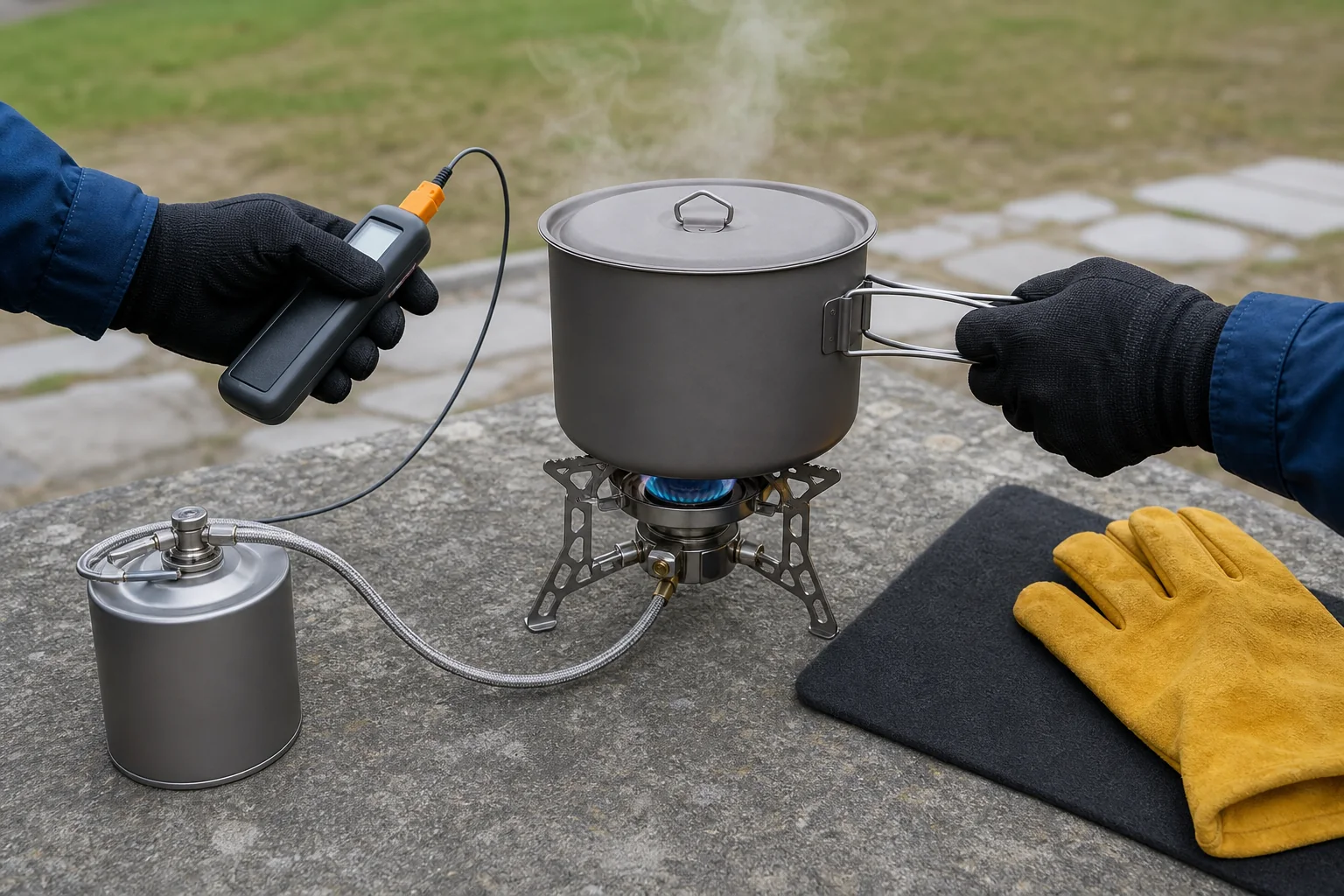
Many field incidents are mechanical or ergonomic rather than chemical. A small pot can tip when its handle extends beyond a narrow stove support, a folding handle can collapse or pinch, and a lid can release steam toward the user. Test the complete assembly with representative fill volumes and the intended stove geometry.
Measure handle movement, locking engagement, clearances and grip temperature under a defined protocol. Inspect rivets or welds before and after repeated heating and cleaning. If the design uses detachable grips or silicone sleeves, state whether they must be installed, removed or repositioned during heating.
Lids need a stable fit and a controlled way to vent or remove them. A tight lid is not automatically better when pressure, steam and hot condensate are involved. Consumer instructions should show safe orientation using the exact production design rather than generic cookware diagrams.
Check 7: Validate Cleaning, Surface Wear and Field Storage
Camping cookware meets abrasive soil, limited water, soot, sand, metal utensils and damp pack storage. Establish a realistic cleaning method and inspect for residue, roughness, discoloration, coating change, burrs and inaccessible debris. A cosmetic change may be acceptable, but it should not hide a functional defect or contradict a premium finish promise.
Do not promise dishwasher suitability because the main body is titanium. Handles, coatings, printing and joined parts may respond differently. When dishwasher language matters to a retail program, assess the complete finished SKU under defined cycles and record the permitted detergent and loading conditions.
Field storage instructions should require cleaning and drying before nesting where appropriate. Check whether the pot rubs against utensils, stove parts or fuel containers inside the kit. The related camping mess kit component checklist helps buyers identify storage pieces that affect the product even when they are not sold as cookware.
Check 8: Lock Production Controls and Change Management
Approve a production-intent sample, then translate its important features into measurable controls. Include grade, material source or traceability method, dimensions, thickness, mass tolerance, bottom flatness, rim profile, handle geometry, weld or rivet criteria, surface finish, markings, lid fit and pack-out.
Inspection should focus on failures relevant to cooking: unstable bases, sharp edges, handle movement, incomplete joints, surface contamination, mismatched lids and unauthorized substitutions. Define sampling and acceptance with a qualified quality professional. A generic cosmetic checklist cannot replace safety-related functional checks.
Write a change-control rule that names the modifications requiring buyer notice. Grade, thickness, supplier, forming, weld, handle, coating, printing, cleaning chemistry and instructions can all change the evidence picture. The commercial team should not accept “equivalent material” without technical review.
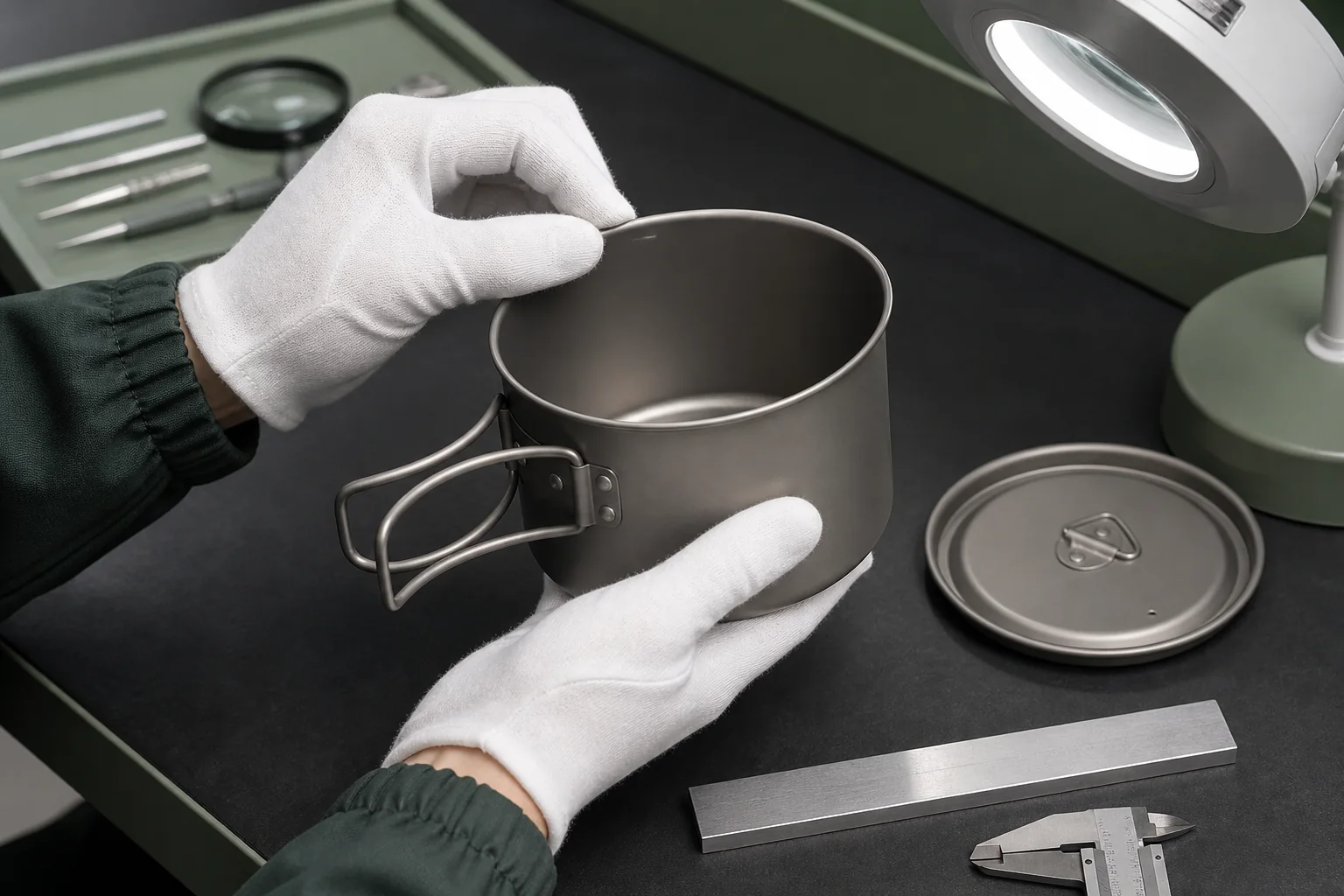
Titanium vs Stainless Steel vs Aluminum Cookware
No material is universally safer or better. Titanium often supports a premium low-mass system; stainless steel can support a familiar robust value proposition; aluminum can support efficient lightweight forming and heat distribution. Finished thickness, base design, handles, coatings, evidence and intended cooking tasks determine the useful result.
| Buyer factor | Titanium tendency | Stainless-steel tendency | Aluminum tendency |
|---|---|---|---|
| Weight-led positioning | Often the strongest premium starting point | Usually heavier at comparable geometry | Often attractive for light formed cookware |
| Heat response | Highly dependent on thin-wall design and burner control | Highly dependent on thickness and layered construction | Often selected for heat-spreading potential, construction dependent |
| Grade question | Name the titanium grade | Name the stainless designation | Name alloy and temper |
| Surface question | Uncoated, coated, blasted or polished | Finish, welds and possible layered base | Bare, anodized or coated condition |
| Main approval proof | Finished cookware evidence and heat-use validation | Finished cookware evidence and corrosion-relevant validation | Finished cookware evidence and surface/release validation |
| Commercial fit | Premium backpacking | Family, fleet and broad retail | Lightweight value or performance programs |
Compare products with the same volume, lid, handle function, pack-out and evidence scope. A cheap quote without testing and packaging cannot be compared directly with a complete quotation. The existing titanium versus stainless-steel tableware guide covers eating pieces; do not transfer its dinnerware conclusions to pots without cookware-specific review.
Applicable Camping Scenarios
Ultralight solo boiling systems
Titanium may fit when the primary tasks are boiling water and preparing wet meals, and every gram is carried. Buyers should validate capacity markings, lid handling, stove stability and the exact packed weight. Do not broaden a successful boil test into an unsupported frying claim.
Family and car-camping meal preparation
Minimum mass may matter less than even cooking, grip comfort, capacity, cleaning and price. Compare titanium with stainless and aluminum constructions using the same menu. A larger stable pot may be a better family product than the lightest possible vessel.
Guided expeditions and rental fleets
Replacement parts, counting, repeated cleaning and handle durability can dominate. Require component codes and a replenishment plan. The most premium metal is not automatically the lowest-risk fleet choice when one damaged lid makes an entire kit unusable.
Outdoor retail private-label programs
The technical story must survive packaging and marketplace copy. Link every weight, grade, food-contact and heat-use claim to the controlled SKU and evidence file. If the product is sourced from a specialist titanium cookware supplier, keep that supplier identity and scope distinct from Naike Dinner’s verified wheat-straw composite tableware capabilities.
Limitations and Risks Buyers Should State Clearly
Titanium does not make cookware nonstick, immune to hot spots or suitable for every stove. A low-mass pot may require different cooking technique from a heavier multi-layer pan. Users need honest expectations for food type, stirring, flame size, preheating and cleaning.
“Pure titanium,” “medical grade,” “aircraft grade” and “FDA approved” are not sufficient finished-product statements. Replace them with named material identity, intended conditions, market-specific rationale and SKU-linked documentation. Do not advertise a certificate that belongs to a raw sheet, different factory or different construction.
Naike Dinner does not use this article to claim verified manufacture or supply of titanium cookware. It provides a neutral B2B decision structure and can review outdoor dinnerware briefs within verified scope. The broader camping dinnerware material guide helps brands decide whether metal cookware and reusable eating pieces should be sourced as separate modules.
How to Run a Production-Intent Cooking Validation
Build the protocol from the consumer task backward. Select representative foods, fill volumes, burner geometry, flame settings, heating time, stirring method and cooling sequence. Include the smallest and largest stated fills because stability, handle temperature and local heating can change across the usable capacity range.
Use samples that represent intended production material, thickness, forming, joints, handles, lid, surface and markings. Record mass and critical dimensions before exposure, then inspect the base, rim, surface, attachments and lid fit afterward. Where a laboratory or regulatory assessment is required, have a qualified specialist define the method and acceptance criteria rather than presenting an internal demonstration as a compliance test.
Repeat the cooking and cleaning sequence enough times to address the intended reusable claim. Observe rocking, permanent distortion, loose hardware, sharp changes, finish transfer, difficult residue, unexpected odor and instructions that users cannot reasonably follow. Photograph each stage, but keep measurements, lot identity and written observations as the controlling record.
Finally, reconcile the result with marketing. If one configuration passed a defined boil-and-simmer sequence, approve that wording and its limits; do not expand it to every stove, recipe or open fire. Store the protocol, sample code, report and approved claims together so a future product change triggers an evidence review instead of silent reuse.
B2B Buyer Checklist for Titanium Camping Cookware
| Check | Question | Why It Matters |
|---|---|---|
| Function | Is this exact SKU verified cookware for the named heat source? | Prevents dinnerware imagery from becoming a direct-heat claim. |
| Grade | Which titanium grade and raw-material specification apply? | Replaces a generic metal label with traceable identity. |
| Construction | What thickness, bottom, rim, weld, rivet, lid and handle design is controlled? | Finished geometry drives handling and heat-use performance. |
| Other materials | Which coatings, grips, fasteners, markings or liners are present? | Safety review must cover the complete article. |
| Food contact | Does evidence match the SKU, foods, temperature, time and repeated use? | Prevents transfer of unrelated reports. |
| Heat use | Which burner, flame, preheating and empty-heating limits apply? | Turns outdoor claims into usable instructions. |
| Ergonomics | Are handles, lid, steam path and stove stability validated when filled? | Addresses common mechanical and burn risks. |
| Cleaning | Which field and dishwasher methods are supported? | Protects surfaces, joints and care claims. |
| Inspection | Which defects trigger rejection and how are they sampled? | Connects the approved sample to production. |
| Change control | Which material or process changes require buyer approval? | Keeps later production aligned with the evidence file. |
Buyer FAQs About Titanium Cookware Safety
1. Is pure titanium cookware non-toxic?
A generic purity claim is not enough to approve a finished product. Buyers should verify the named grade, full construction, food-contact conditions, surface, manufacturing residues and destination-market evidence. The supplier must connect those records to the commercial SKU.
2. Can titanium cookware be used over a campfire?
Only if the exact pot or pan is designed and instructed for that heat source. Campfires produce uneven, changing heat and may expose handles and coatings differently from a controlled stove. Never infer campfire suitability from the metal name alone.
3. Does titanium react with acidic food?
The buyer should not answer this from reputation alone. Review product-specific metal-release or food-contact evidence for the relevant grade, surface, acidic food conditions, temperature, contact time and repeat use. Added coatings or joined materials require separate consideration.
4. Is titanium better than stainless steel for cooking?
Titanium often favors carried weight and premium positioning, while stainless constructions may favor familiar use and robust value. Cooking performance depends on thickness, layered construction, bottom geometry, food and burner. Test like-for-like finished products with the intended menu.
5. Why does food burn in thin titanium pots?
Concentrated burner heat, thin walls, limited liquid, insufficient stirring and high flame can create local overheating. The product instructions should match its tested cooking tasks. A boiling-oriented ultralight pot should not be marketed as an all-purpose frying pan without evidence.
6. What documents should an importer request?
Request grade identity and traceability, finished specifications, complete bill of materials, market-relevant food-contact rationale or reports, controlled sample records, heat-use instructions, inspection criteria, packaging details and change-control commitments. Verify that every document identifies the actual SKU and revision.
7. Can Naike Dinner supply titanium cookware?
This article does not establish that capability, and buyers should not infer it. Naike Dinner’s verified website scope is centered on reusable wheat-straw composite tableware. Contact the company for a documented project-scope review before placing any material-specific inquiry.
Approve the Evidence Pack Before the Alloy Story
For buyers asking “is titanium cookware safe for camping?”, the defensible answer is conditional. Confirm that the exact item is cookware, identify the grade and every component, match food-contact work to real heating, validate handles and stability, and lock the production specification.
That evidence pack is more valuable than a broad material slogan. It lets product, quality, compliance and marketing teams describe the same use boundary. When a claim cannot be linked to the SKU and its controlled evidence, remove the claim or complete the missing review before launch.
Build a SKU-specific titanium cookware evidence request
Send the target market, intended stove or fire source, foods, temperature, duration, grade, construction, handles, coating, pack-out and claims. Naike Dinner can organize the buyer-side evidence questions and identify where specialist titanium supplier proof is required.
Request the evidence checklistSubmit a project scope