
Complete Wheat Straw Dinnerware Product Line: Build Guide
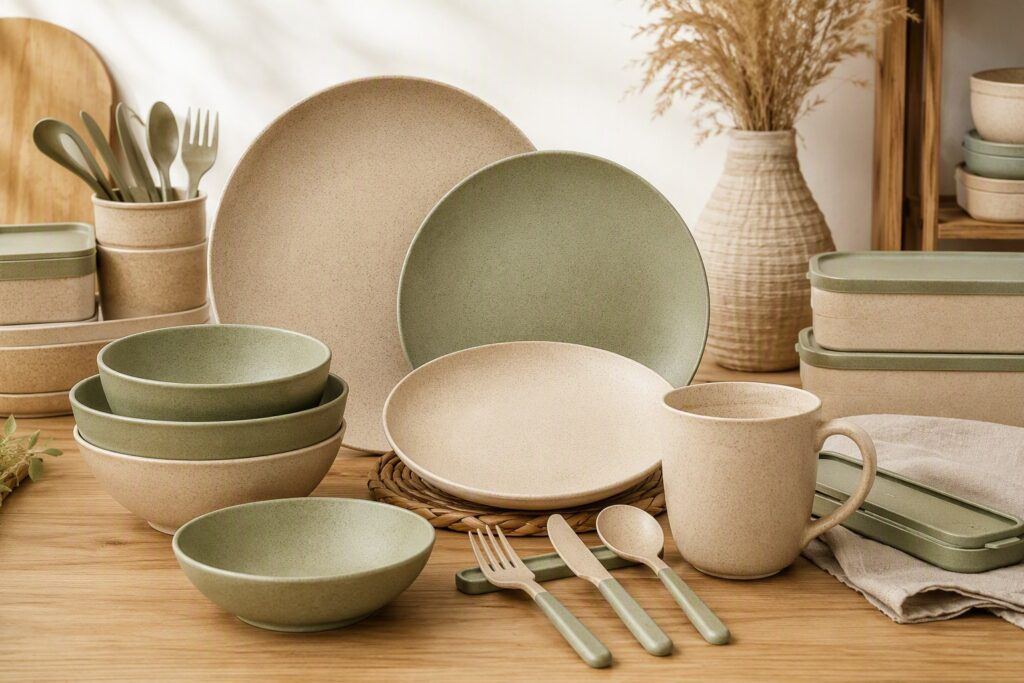
I remember the first brand owner who came to us with a single product in mind.
She wanted one wheat straw plate design. Just one plate, she said, because that was all her budget allowed.
I asked her one question: “What happens when a customer buys the plate and needs a bowl to go with it?”
She paused. She had not thought about the customer journey beyond the first purchase.
Eight months later, that same brand owner came back. Her single plate had sold well, but customers kept asking for matching bowls and cups. She was now placing a rush order for the accessories she should have launched with.
That story captures the central insight of this guide: a complete wheat straw dinnerware product line sells more than the sum of its individual products.
Why a Full Product Line Beats a Single SKU
A single product is a transaction. A complete product line is a brand.
When a customer buys a wheat straw plate and cannot find the matching bowl, they buy the bowl from a competitor — and they remember that competitor.
When a customer buys a coordinated set — plate, bowl, cup, and cutlery — they perceive a complete brand experience.
The data from our OEM partners supports this. Brands with a complete line of five or more matching SKUs report average order values 22-30% higher than brands selling single products.
They also report higher repeat purchase rates, because customers return to complete their sets.
The Three Purchasing Patterns
A complete tableware assortment captures three distinct purchasing patterns:
Pattern 1: The Set Buyer. The customer wants a full matching set — 16, 24, or 40 pieces. They compare complete sets across brands. A brand with a complete line wins this customer; a single-product brand loses them entirely.
Pattern 2: The Set Completions Buyer. The customer already owns your plate and returns to buy the matching bowl, cup, and cutlery. This is the highest-margin customer — no acquisition cost, high loyalty.
Pattern 3: The Gift Buyer. The customer buys a coordinated set as a gift. Gifts require complete sets, not single plates. Our corporate gift program guide shows how complete lines drive the gifting channel.
The 5-SKU Foundation: Your Minimum Complete Line
A complete wheat straw dinnerware line needs a minimum of five core SKUs to serve the standard dining scenarios.
| SKU | Purpose | Standard Specs |
|---|---|---|
| Dinner plate (10″) | Main course, everyday dining | 250-260mm, 2.5mm wall |
| Salad/dessert plate (8″) | Side dishes, bread, dessert | 200-220mm, 2.2mm wall |
| Cereal/soup bowl (6″) | Breakfast, soup, salad | 450-600ml, 2.5mm wall |
| Mug or cup | Beverages | 300-400ml, with or without handle |
| Cutlery set | Fork, spoon, knife | 3-piece set, matching finish |
These five SKUs cover every standard dining occasion: breakfast, lunch, dinner, and beverages.
Without any one of them, your line has a visible gap that sends customers to competitors.
The Matching Requirement
The five SKUs must match visually and materially.
The color must be consistent — the same sage green plate and bowl in the same finish.
The surface texture must match — the same satin matte with the same fiber spec density.
The logo placement must follow a consistent brand system across all pieces.
A line that does not match visually is a collection of unrelated products, not a brand.
For color consistency across your line, our custom color matching guide covers the Pantone matching and Delta-E control that keeps every SKU visually identical.
Beyond the Foundation: Optional Line Extensions
Once the five core SKUs are established, line extensions increase average order value and capture additional occasions.
Extended Product Categories
Snack/side plates (7″). A smaller plate for appetizers and children’s portions. Adds 0.40−0.40−0.60 to the per-unit cost but captures the snack occasion.
Pasta/soup deep plates (9″). A wide plate with raised rims for pasta, ramen, and bowl meals. This is one of the fastest-growing categories in modern dining.
Mug variations. Handleless mugs for the Nordic aesthetic, or handled mugs for traditional markets. Two mug options capture different consumer preferences.
Storage/lunch containers. Lidded containers for meal prep and packed lunches. The lid requires a silicone seal, adding complexity but opening the lunch market.
Snack cups and placemats. Small accessories that complete the family dining experience. Low cost, high perceived value, natural add-ons.
Set Configurations to Offer
With a complete SKU range, you can offer standard set configurations:
- 16-piece set: 4 plates + 4 bowls + 4 cups + 4 cutlery sets — the entry-level complete set
- 24-piece set: 6 of each — the family set
- 40-piece set: 8 of each plus serving pieces — the premium set
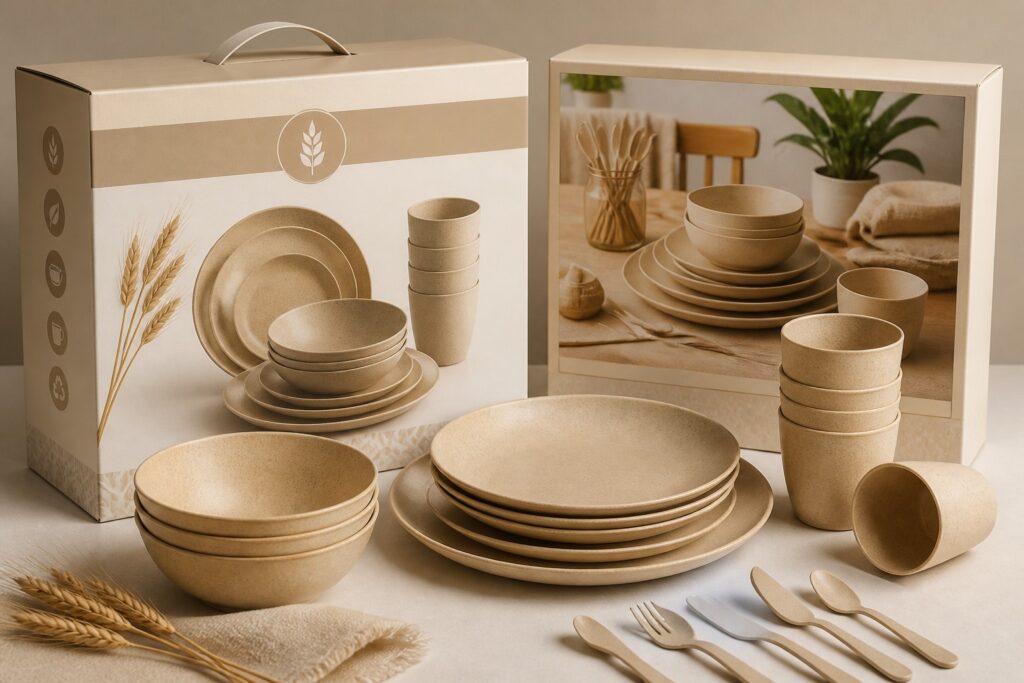
Our premium 24-piece wheat straw dinnerware set demonstrates how a coordinated assortment is packaged for retail.
SKU Planning and Assortment Strategy
Building a complete line is a planning exercise before it is a manufacturing exercise.
The Tableware Assortment Rationalization Matrix
Evaluate every potential SKU against two dimensions: sales potential and complexity.
| SKU Type | Sales Potential | Production Complexity | Decision |
|---|---|---|---|
| Core plate/bowl/cup/cutlery | High | Low (standard molds) | Launch first |
| Mug variations | Medium | Low | Launch in phase 2 |
| Deep plates/pasta bowls | Medium-High | Medium | Launch in phase 2 |
| Lidded containers | Medium | High (silicone seal) | Launch in phase 3 |
| Serving pieces/platters | Low-Medium | Medium | Evaluate after launch |
The rationalization matrix prevents over-expanding before demand is proven.
Launch the five core SKUs first. Add extensions only after sales data shows which directions customers are pulling.
Color Strategy
A complete line works best with 2-3 coordinated colors.
One neutral base color (natural beige) plus 1-2 seasonal accents (sage green, terracotta) gives customers choice without fragmenting your inventory.
Every additional color multiplies your test report requirement. A line of 5 SKUs in 3 colors needs 15 compliance test reports.
For guidance on managing color across a full line, our wheat straw dinnerware catalog shows coordinated color families.
Production and MOQ Planning
A complete product line changes the manufacturing math.
MOQ Economics Across the Line
The MOQ per SKU is typically 500-1,000 units for standard designs.
For a 5-SKU line, this means a minimum order of 2,500-5,000 units total.
However, ordering the full line together often qualifies for volume pricing per SKU.
Production Scheduling
When all SKUs are ordered together, the factory can sequence production efficiently.
The same raw material, the same color masterbatch, the same packaging supplier serve all five SKUs.
This reduces changeover costs and shortens the total lead time compared to five separate orders.
The Custom Mold Decision
If you are developing a proprietary line, consider the “family mold” approach.
A family mold produces multiple related products — plate, bowl, cup — from one mold base with interchangeable cavities.
This reduces tooling cost by 20-30% compared to separate molds per product.
Packaging the Complete Line
Packaging a full line requires more planning than packaging a single product.
Retail Set Packaging
Complete sets are typically sold in:
- Color gift boxes for 16-40 piece sets
- Sleeve packaging for individual SKUs displayed together
- Display-ready PDQ trays for supermarket shelves
The Display Logic
When individual SKUs are sold separately, they must sit together on the shelf.
The packaging design should use a consistent visual system: the same color family, the same logo placement, the same font.
A customer should instantly recognize that the plate, bowl, and cup in different packaging belong to the same brand.
For packaging that survives ISTA drop testing, verify the set packaging has been tested at full weight — a 40-piece set box is far heavier than a single plate box.

Channel Strategy: Where Your Complete Line Sells
A complete product line opens distribution channels that single-SKU brands cannot access.
Amazon and E-commerce
Complete lines perform strongly on Amazon because customers search for coordinated sets.
The “frequently bought together” feature naturally pairs your plate, bowl, and cup.
A complete line also qualifies for Amazon’s set-related search terms like “wheat straw dinnerware set 24 pieces.”
Supermarket and Retail Chains
Retail buyers fundamentally prefer complete lines.
A single plate is a category placement. A complete line is a supplier relationship.
Retail chains allocate shelf space to brands that can fill a segment — not to brands with one product.
Our retail channel guide covers the retailer onboarding requirements for complete lines.
Wholesale Distribution
Distributors prefer complete lines because they simplify their own assortment planning.
A distributor can order your entire line and serve multiple customer segments with one supplier relationship.
The Corporate Gifting Channel
Corporate gift programs require coordinated sets.
A single plate cannot be a corporate gift. A complete 24-piece set in a branded gift box can.
The gifting channel typically commands the highest margins in the entire tableware market.
Case Study: From Single SKU to Complete Line
A distributor we work with launched with a single wheat straw dinner plate in 2024.
The plate sold well on their marketplace, generating approximately 800 units per month.
However, the marketplace’s “related products” algorithm kept showing competitors’ bowls and cups next to their plate.
Customers bought the plate from them and the matching bowl from a competitor — repeatedly.
In early 2025, they expanded to the five-SKU core line: plate, salad plate, bowl, mug, and cutlery.
The results over the following six months were measurable:
| Metric | Single SKU | Complete Line |
|---|---|---|
| Average order value | $14.90 | $21.40 |
| Repeat purchase rate | 11% | 19% |
| Marketplace ranking | Category 40 | Category 12 |
| Monthly revenue | $11,900 | $24,300 |
The complete line more than doubled monthly revenue — without a proportional increase in marketing spend.
The difference was entirely in conversion: customers found the matching pieces they wanted and bought them from one brand.
Production Quality Control for a Complete Line
A complete line means managing quality consistency across multiple products simultaneously.
The Cross-SKU Color Audit
When plates, bowls, cups, and cutlery ship together, any color difference between SKUs is immediately visible.
Your quality control checks should include a cross-SKU color audit: place all five SKUs side by side and verify they match within Delta-E 3.0.
A line that looks mismatched on the shelf fails the “complete brand” perception that justifies the set price.
The Set Assembly QC
When sets are packed, the QC process must verify that each box contains the correct pieces.
The most common set-packing error is a mismatched color or a missing piece.
Your inspection protocol should include opening a sample of every assembled set and verifying the contents against the packing specification.
The Restock Consistency
The critical long-term QC challenge is restock consistency.
A bowl ordered in month 12 must match the bowl ordered in month 1 — in color, texture, and dimensions.
This requires the supplier to maintain the same masterbatch formula, the same mold condition, and the same process parameters across production runs.
Require your supplier to keep the “Golden Samples” of every SKU on file and to compare every new production batch against them.
Margin Optimization Across the Line
The complete line is a margin strategy, not just a product strategy.
The Hero and Profit SKUs
Not every SKU needs the same margin target.
The hero SKU — typically the dinner plate — drives traffic and sets the brand price anchor. It may carry a lower margin.
The profit SKUs — bowls, cups, and accessories — carry higher margins because customers add them to complete the set.
A classic assortment strategy: price the hero plate at 12.99andthematchingbowlat12.99andthematchingbowlat9.99. The bowl has a 60% higher margin percentage while feeling like a natural add-on.
The Set Discount
Offer a modest discount (5-10%) when customers buy the complete set rather than individual pieces.
The set discount increases the average order value and reduces per-order fulfillment costs.
Our custom dinnerware sets page explains how set configurations are priced for wholesale distribution.
The Restock Model
A complete line creates natural restock demand.
Customers break or lose individual pieces and buy replacements to maintain the set.
This ongoing replacement demand provides predictable recurring orders — the foundation of a stable wholesale business.
B2B Buyer Checklist: Building Your Wheat Straw Dinnerware Product Line
| Check | Item | Acceptance Criteria |
|---|---|---|
| ☐ | Five core SKUs defined | Dinner plate, salad plate, bowl, mug, cutlery set — all matching |
| ☐ | Visual consistency confirmed | Same color, texture, and logo system across all SKUs |
| ☐ | Set configurations planned | 16/24/40-piece set options defined with pricing |
| ☐ | Color strategy locked | 2-3 coordinated colors maximum, test reports budgeted per color |
| ☐ | MOQ math completed | Total line MOQ (2,500-5,000 units) fits your budget |
| ☐ | Production scheduling confirmed | All SKUs sequenced in one production run |
| ☐ | Packaging system designed | Consistent retail packaging across the line |
| ☐ | Hero and profit SKUs priced | Margin targets set per SKU, not just per line |
| ☐ | Barcode compliance verified | Each SKU and each set has a unique GS1-registered barcode |
| ☐ | Compliance documentation per SKU | Each color and SKU has current migration and safety test reports |
Common Line-Building Mistakes to Avoid
Four mistakes repeatedly appear in wheat straw dinnerware line development. Each one is avoidable with proper planning.
Mistake 1: Launching without a matching system. Some brands launch a plate from one factory and a bowl from another, expecting customers to see them as a set.
The products never match — different fiber densities, different beige tones, different finishes.
Customers notice immediately and the brand looks unprofessional.
Source all SKUs from one supplier with one masterbatch formula to guarantee visual consistency.
Mistake 2: Over-expanding before proving demand. A brand launches 15 SKUs in 6 colors before selling a single unit.
The inventory cost, test report cost, and storage cost consume the working capital the brand needs to grow.
Launch the five core SKUs in one color. Expand only after sales data shows which directions customers pull.
Mistake 3: Ignoring the set-completion customer. Some brands treat every product as an independent purchase.
They do not offer set configurations, do not cross-sell matching pieces, and do not track which customers bought partial sets.
The set-completion customer is your highest-margin, lowest-acquisition-cost segment.
Structure your catalog to make set completion obvious: offer set bundles, show matching products on every page, and send set-completion offers to partial-set buyers.
Mistake 4: Neglecting restock consistency. A line that matches in the launch batch but drifts in color after six months destroys the brand.
Require your supplier to retain Golden Samples of every SKU and verify every new batch against them.
Include a cross-SKU color audit in your pre-shipment inspections.
B2B Buyer FAQ: Product Line Development
How many SKUs should a new wheat straw dinnerware brand launch with?
Start with the five core SKUs — dinner plate, salad plate, bowl, mug, cutlery. Five is the minimum for a credible complete line. Launching fewer creates visible gaps; launching more before demand is proven ties up capital in untested products.
Should all SKUs use the same color?
Yes, at launch. One neutral base color (natural beige) is the safest starting point. Add a second accent color only after the first color proves demand. Each additional color multiplies your test report budget and inventory risk.
What is the total MOQ for a five-SKU line?
At 500-1,000 units per SKU, the line MOQ is 2,500-5,000 units. Ordering the full line together typically unlocks volume pricing per SKU and streamlines production scheduling.
Do I need separate test reports for each SKU?
Yes. Each SKU — and each color within each SKU — requires its own migration and safety test reports. A report for the dinner plate does not cover the bowl, even in the same color, because the surface area and volume differ. Budget for one full compliance test per SKU per color.
How long does a complete line take to bring to market?
Using existing molds with custom color and logo, a five-SKU line can ship in 25-35 working days from approval. With custom molds for all five SKUs, add 35-50 working days for tooling. The sample approval guide covers the timeline in detail.
Should the cutlery match the plates and bowls in color exactly?
The cutlery should use the same color family and finish, but it does not need a perfect Delta-E match to the plates.
Cutlery is held in the hand and viewed at a different angle, so small color differences are less noticeable.
However, the finish — matte or satin — must match exactly. A glossy fork next to a matte plate looks wrong.
How do I price the complete line competitively?
Use the hero-and-profit model described in this guide.
Anchor the dinner plate at a competitive price to win the traffic. Carry higher margins on bowls, cups, and cutlery.
Offer a 5-10% set discount to incentivize complete-set purchases. Compare your set price against the sum of your individual SKU prices — the set must always be cheaper to drive conversion.
What happens if one SKU in my line becomes a bestseller?
A bestseller SKU is the trigger point for custom mold investment.
When a single ODM SKU exceeds 10,000 units per year, the amortized cost of a custom mold becomes lower than the ODM premium.
Commission the custom mold for the bestseller while keeping the rest of the line on ODM. This hybrid approach, covered in our OEM vs ODM guide, protects cash flow while building differentiation.
Conclusion: Building Your Complete Wheat Straw Dinnerware Product Line
A complete wheat straw dinnerware product line is the difference between selling products and building a brand.
The five-SKU foundation — plate, salad plate, bowl, mug, cutlery — captures every standard dining occasion and creates natural set-completion purchases.
The matching requirement turns individual products into a cohesive collection that customers recognize and trust.
The margin strategy — hero SKU for traffic, profit SKUs for margin, set discount for order value — makes the line commercially sustainable.
And the restock model — customers replacing individual pieces to maintain their sets — provides the recurring demand that every wholesale business needs.
A well-planned tableware assortment is not just inventory. It is a customer acquisition system, a brand identity, and a recurring revenue engine.
Ready to Build Your Complete Product Line?
Tell us the SKU range you are considering. We will provide per-SKU pricing, set configuration options, and a production schedule for your complete wheat straw dinnerware line.
Request a Full Product Line Quotation
Browse the Premium 24-Piece Complete Dinnerware Set
Discuss Your Project
Tell us about your project.

Rental-Fleet Sets: How Many Spares Should Be Held?
Calculate rental camping dinnerware spare parts with buyer-entered loss, damage, deployment, review-cycle, buffer, stock and pack-multiple inputs.

Plan Replacement Pieces for a Portable Dinnerware Line
Plan replacement pieces for a portable dinnerware line with a service matrix that controls demand, compatibility, evidence, packaging and revision risk.
Which Camping Dinnerware Add-Ons Belong in the Base Set?
Use a buyer-side decision table to keep essential camping dinnerware functions in the base set and move optional, channel-specific or unverified add-ons into separate bundles.

Build Good–Better–Best Camping Set Tiers by Function
Build good, better and best camping dinnerware tiers from functional upgrades buyers can verify, rather than cosmetic changes or unsupported claims.

What Makes a Camping Tableware RFQ Quotable?
Use a complete camping tableware RFQ checklist covering controlled components, use conditions, decoration, packaging, commercial terms, evidence and approval fields.

Calculate Landed Cost Without Hiding Replacement Parts
Use a buyer-entered landed-cost model that keeps replacement parts, freight, duty, fees and channel costs visible instead of hiding them in the base set.