
OEM vs ODM Wheat Straw Tableware: Which Model Wins?
The first question every new brand owner asks me is not about colors or materials.
It is: “Can you just put my logo on one of your existing products?”
That question defines the fundamental choice in wheat straw tableware sourcing. You are either an OEM buyer — paying for your own mold, your own shape, your own intellectual property.
Or you are an ODM buyer — selecting from the factory’s existing catalog and adding your brand identity through logo printing, custom color, and packaging.
Neither model is “better” in the abstract. But one model is better for your specific brand, budget, and timeline.
Choosing the wrong model is the single most expensive mistake a first-time private label supplier relationship can make.
This guide gives you the comparison framework to make the right choice. We will examine cost, timeline, MOQ, IP ownership, brand differentiation, and scalability — not as abstract concepts, but as decisions that show up on your profit-and-loss statement.
OEM vs ODM Wheat Straw Tableware: The Core Definitions
Before we compare, we need precise definitions. In the wheat straw tableware industry, the terms OEM and ODM are frequently misused by both buyers and suppliers.
What OEM Means for Wheat Straw Tableware
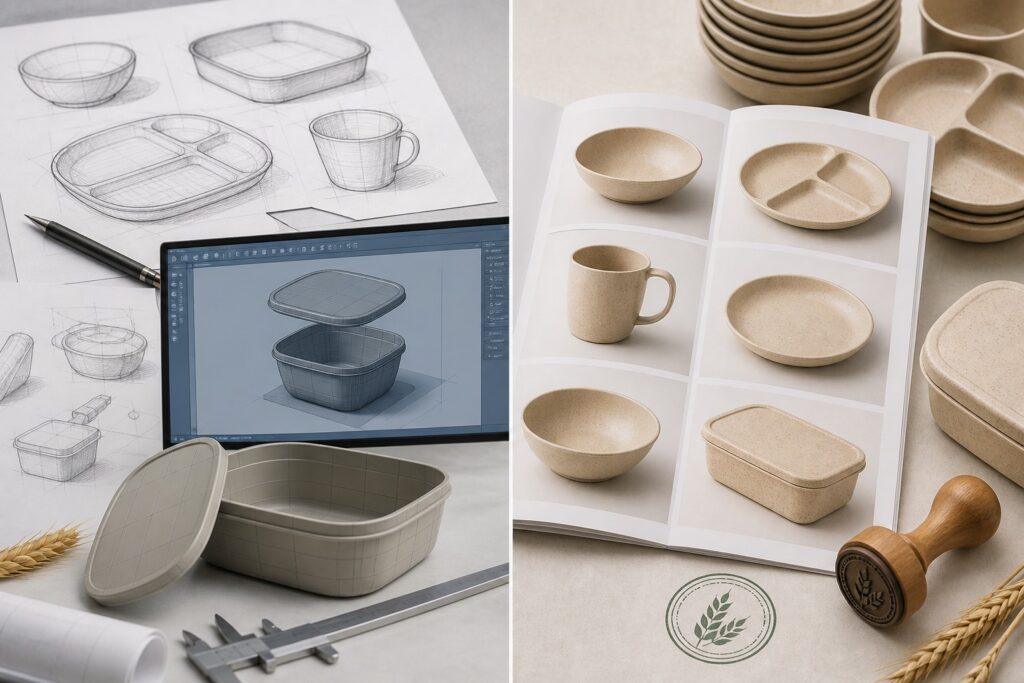
OEM — Original Equipment Manufacturing. You provide the design. The factory manufactures it.
For wheat straw tableware, this means you create — or commission — the product design: the plate diameter, the bowl depth, the rim profile, the handle shape.
The factory builds a custom mold from your design, injects your product, prints your logo, and packages it in your branded box.
You own the mold. You own the design.
If you leave the factory after three years and take your mold to a different supplier, that mold produces your product — a shape that exists nowhere else in the market.
The unit cost is typically higher because the factory must stop production, change the mold, and run a smaller batch. But the product is proprietary.
What ODM Means for Wheat Straw Tableware
ODM — Original Design Manufacturing. The factory provides the design. You select from their catalog.
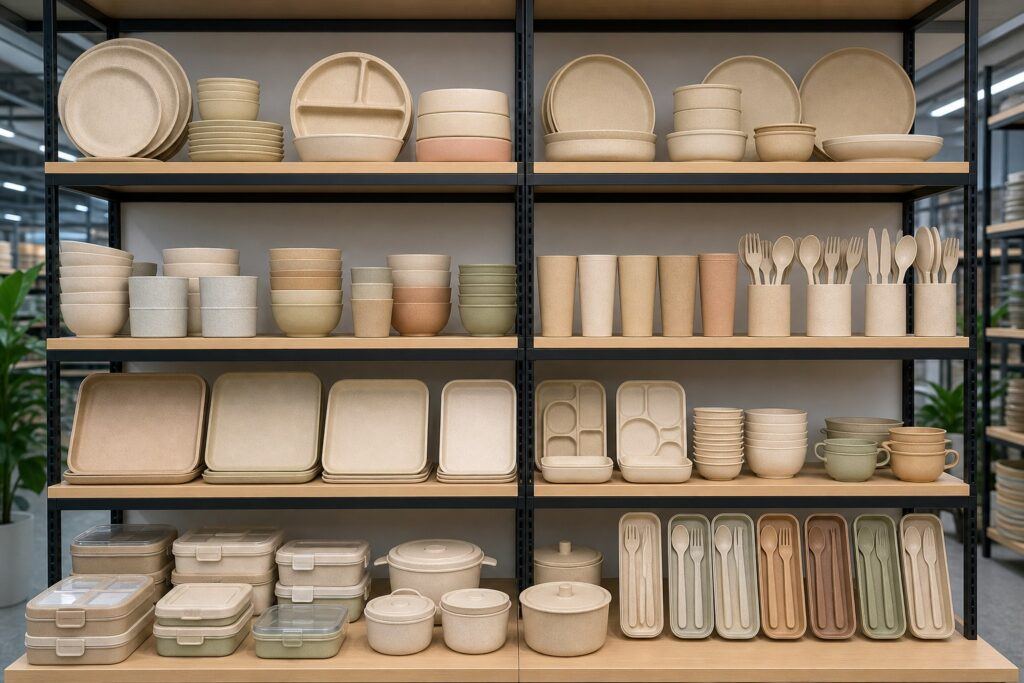
For wheat straw tableware, the factory already has molds for plates, bowls, cups, and cutlery.
You choose the shapes you want, specify your logo, select your color from the factory’s palette (or pay for a custom Pantone match), and choose your packaging.
You do not own the mold. You do not own the design.
The same plate shape may appear under ten different brand names on Amazon, in ten different retail chains, at ten different price points.
The unit cost is typically lower because the factory runs the same mold continuously for multiple buyers. But the product is a commodity — differentiated only by your logo, your color, and your packaging.
The distinction matters because it determines everything downstream: your investment, your timeline, your competitive position, and your exit strategy.
Decision Matrix: OEM vs ODM Compared Across 8 Dimensions
| Dimension | OEM | ODM |
|---|---|---|
| Upfront investment | 1,200−1,200−4,500 per mold, plus sample development | $0 mold investment; sample cost only |
| Time to market | 35-50 working days (mold design + machining + trial + production) | 15-25 working days (color/logo approval + production) |
| Minimum order quantity | 3,000-5,000 units per SKU (to amortize mold cost) | 500-1,000 units per SKU |
| Unit price | Higher (smaller batches, mold changeover time) | Lower (continuous runs, shared mold utilization) |
| IP ownership | Buyer owns the mold and the design | Factory owns the mold; buyer owns only the logo and packaging |
| Product differentiation | Unique shape — no competitor can match exactly | Shared shape — competitors can sell identical product |
| Scalability | Add new shapes by commissioning additional molds | Scale by ordering larger quantities of existing shapes |
| Exit flexibility | Mold is portable to another supplier (with contract clause) | Switching suppliers means starting from a different catalog |
This comparison makes clear that OEM and ODM serve fundamentally different brand strategies.
OEM is an investment in differentiation. ODM is an investment in speed and flexibility.
For immediate product access with zero tooling cost, browse our wheat straw dinnerware catalog — every product shown is available for ODM branding with your logo and custom color.
You can be in production within 15 working days of color and logo approval.
Scenario Analysis: Choosing Between OEM and ODM
Abstract comparisons are useful. Concrete scenarios are better.
Here are four real-world sourcing situations and the model that fits each one.
Scenario 1: First-Time Amazon Seller Choosing a Sourcing Model
A new Amazon seller wants to launch a wheat straw dinnerware brand. Budget is $10,000 total.
The seller needs four SKUs — plate, bowl, cup, and cutlery set — and plans an initial order of 1,000 sets.
If the seller chooses OEM, four custom molds at 1,500averageconsume1,500averageco sume6,000 of the $10,000 budget — before a single unit is produced.
The remaining $4,000 buys approximately 3,000 units across four SKUs, which is not enough volume to test the market.
If the products do not sell, the molds are sunk cost.
If the seller chooses ODM, the $10,000 budget purchases approximately 6,000-8,000 units across four SKUs with logo printing and retail packaging.
The seller tests four products with meaningful inventory, collects real sales data, and identifies which SKU sells fastest.
The next order can then commission a custom mold for the winning shape.
Recommendation: ODM. For a first product launch with limited capital, speed and inventory depth beat product uniqueness.
The brand is differentiated by logo, packaging, photography, and listing quality — not by a proprietary plate shape that customers do not search for.
Scenario 2: Established Retail Brand Selecting OEM vs ODM
A home goods brand with 50 retail locations across Europe wants to add a wheat straw dinnerware line to their existing product portfolio.
The brand has an established visual identity, loyal customers, and a budget for custom development. They plan an initial order of 10,000 sets across six SKUs.
ODM would give them products faster and cheaper.
But six months after launch, a competing brand — possibly a private-label offering from one of their own retail accounts — could sell the identical plate shape at a lower price, because they source from the same factory catalog.
OEM protects the brand’s investment. A proprietary dinner plate with a distinctive rim profile, a bowl with a unique curve, and a cup with an ergonomic handle designed specifically for this brand cannot be copied without the competitor commissioning the same molds.
Most competitors will not spend 10,000onmoldstocopyaproductwhentheycanspend10,000onmoldstocopyaproductwhe theycanspe d0 to sell a different catalog shape.
Recommendation: OEM. For an established brand launching a new category where existing distribution and customer trust justify the upfront investment, proprietary design is a competitive moat.
Scenario 3: Corporate Gift Program with a Fixed Timeline
A promotional products distributor is pitching a corporate holiday gift program.
The corporate client wants 3,000 branded wheat straw gift sets delivered to 12 office locations by November.
The order is confirmed in August. Timeline is 12 weeks.
For the OEM path, mold design and machining alone would consume 5-7 weeks of the 12-week window.
That leaves only 5 weeks for production and shipping — insufficient for 3,000 custom-molded sets with branded packaging.
For the ODM path, production begins immediately after color and logo approval, consuming 3-4 weeks.
That leaves 8 weeks for production, inspection, shipping, and split-location delivery. The timeline is comfortable.
Recommendation: ODM. When the timeline is fixed and the order is seasonal, speed determines whether the order ships or the corporate client cancels.
The corporate recipient cares about a professional gift that arrives on time — not whether the plate shape is proprietary.
Scenario 4: Private Label Brand Scaling to Wholesale Distribution
A successful Amazon brand selling wheat straw dinnerware for two years wants to expand into wholesale distribution to independent kitchenware stores.
The brand currently sells ODM products and faces two problems.
First, wholesale buyers compare prices with other ODM sellers of the same shapes.
Second, Amazon competitors increasingly sell identical products at lower prices.
The brand has proven demand — 20,000 units sold in the past year — and the cash flow to invest in differentiation.
Transitioning the top three SKUs to OEM molds costs approximately 4,500andincreasestheunitcostby4,500andincreasestheunitcostby0.15-$0.25.
But the wholesale catalog now features proprietary shapes that no competitor can match.
The brand can also enforce a minimum advertised price because no identical product exists on the market.
Recommendation: OEM transition. Use ODM sales data to identify which shapes justify the mold investment.
Convert the top performers to OEM while continuing to sell ODM for lower-volume accessories.
This hybrid approach protects cash flow while building differentiation. Our custom reusable plates page shows the OEM development process from concept to production.
The Hybrid Model: When to Mix OEM and ODM
Most successful private label brands do not choose between OEM and ODM for their entire product line. They choose by SKU.
The high-volume hero product — the 10-inch dinner plate that generates 40% of revenue — justifies a custom mold.
The matching bowl, cup, and cutlery set — lower-volume accessories that complete the customer’s table setting — can remain ODM without diluting the brand.
This hybrid approach optimizes the cost/differentiation equation.
The brand’s proprietary plate gives wholesale buyers a reason to choose this brand over cheaper ODM competitors.
The ODM accessories keep the average order value high without adding $4,500 in mold costs for products that sell at lower velocity.
At Naike Dinner, we support hybrid programs routinely.
A brand might commission a custom mold for a signature dinner plate while selecting bowls and cups from our wheat straw cup manufacturer page and bowl collection.
The entire set ships together in matching packaging, and the consumer perceives a cohesive brand — even though only the hero product is proprietary.
The IP Ownership Question in OEM vs ODM Tableware
In an OEM vs ODM wheat straw tableware decision, intellectual property ownership is the issue that matters most five years from now.
That is when your brand may be worth selling, licensing, or passing to a successor.
Under a properly structured OEM contract, the buyer owns the mold and the design.
The mold is the buyer’s property, stored at the factory, used exclusively for the buyer’s production.
If the buyer switches suppliers, the mold transfers to the new factory.
The design — the specific dimensions, curves, and surface texture — is the buyer’s intellectual property, protected by the mold itself as the physical embodiment of the design.
Under an ODM arrangement, the buyer owns nothing except the logo and packaging artwork.
The factory can sell the identical product shape to any other buyer.
If your brand succeeds with an ODM product, the factory’s incentive is to sell that same shape to your competitors — because the factory, not you, owns the mold.
This is not a theoretical concern.
I have watched Amazon sellers build successful brands on ODM products, only to see the factory introduce the same shapes to competing sellers at lower prices once the brand demonstrated demand.
The brand owner had no legal recourse because they never owned the product design.
The protection against this scenario is not a contract clause — it is a custom mold.
A factory cannot sell your proprietary shape to a competitor because the mold exists only for you, and the mold belongs to you.
For brands planning to exit through acquisition, OEM molds are assets on the balance sheet. ODM products are not.
A practical note on enforcement: the mold ownership clause in your contract is only as strong as your willingness to enforce it.
I recommend photographing your mold — with the mold number and your brand name clearly visible — during every factory visit or inspection.
Some of our OEM partners also request that we stamp the mold with their brand name directly into the steel during machining, making unauthorized use immediately identifiable.
Key Contract Clauses: What to Protect in Each Model
The commercial agreement you sign protects different assets depending on the model.
These are the clauses our compliance team reviews with every OEM and ODM buyer.
For OEM agreements. The mold ownership clause is the heart of the contract.
It must state: the mold belongs to the buyer, the buyer may request transfer at any time, the factory will release the mold within 30 days of written request, and no release fee will be charged.
Add a mold replacement clause specifying the rated shot count (typically 300,000-500,000) and the factory’s responsibility for repairs caused by manufacturing defects.
Include a confidentiality clause covering the product design.
Your dimensions, wall thicknesses, and surface texture are trade secrets — the factory should not share them with any third party without written consent.
Also include a minimum exclusivity period during which the factory may not offer your proprietary design to any other buyer.
For ODM agreements. The brand protection clauses matter most.
A logo exclusivity clause prevents the factory from selling the same shape with a similar logo to your direct competitors.
A packaging design clause reserves your packaging layout and color scheme as your property.
And a “first right of refusal” clause — where you get the first option to match any lower price offered to another buyer of the same shape — protects your margin on high-volume ODM products.
Many buyers assume these protections are standard. They are not.
Factories include them only when the buyer requests them in writing.
Transitioning from ODM to OEM: The Upgrade Path
The most common question we hear from growing brands is: “When should I convert my best-selling ODM product to a custom mold?”
The answer follows a clear trigger point.
The volume trigger. When a single ODM SKU exceeds 10,000 units per year, the mold amortization math changes.
A 2,000moldspreadacross10,000unitsadds2,000moldspreadacross10,000unitsadds0.20 per unit in year one. Spread across 30,000 units, it adds $0.07.
At the same time, the 0.15−0.15−0.25 per-unit premium you pay on ODM products starts to exceed the amortized mold cost — making the custom mold the cheaper option within 12-18 months.
The competitive trigger. When you find identical products from competitors in your search results or retail aisles, the differentiation cost has become a competitive necessity.
Every additional month on the shared mold erodes your ability to justify a premium price.
The launch trigger. When introducing a new shape you believe will become a hero product, skip the ODM trial for that specific shape and commission the mold directly — but only if you have validated the category demand with your existing ODM sales data.
The transition itself is straightforward when your supplier already manufactures your ODM products.
The same factory has your sales history, your color formulations, and your packaging specifications.
Commissions a mold, approve the pre-production sample, and your existing product line upgrades without changing suppliers.
For brands considering this step, our custom mold development guide covers the full tooling process, timeline, and risk controls.
B2B Buyer Checklist: Making the OEM vs ODM Decision
Work through this checklist before committing to either model. Four or more “yes” answers point to OEM. Two or fewer point to starting with ODM and transitioning later.
| Check | Decision Question | What “Yes” Means |
|---|---|---|
| ☐ | Proven product-market fit? | Sold at least 5,000 units of a similar product and confirmed demand. |
| ☐ | Budget for mold plus inventory? | Mold at 1,200−1,200−4,500, plus working capital for a 3,000-unit run per SKU. Keep mold cost under 30% of total launch budget. |
| ☐ | Channel rewards differentiation? | Wholesale, retail chains, and premium e-commerce reward unique products. Discount channels reward lower prices — ODM’s advantage. |
| ☐ | Competitors using the same catalog? | Identical products in your search results mean a price war you cannot win without proprietary shapes. |
| ☐ | IP important long-term? | Brands planning to sell, license, or raise investment need owned assets. |
| ☐ | Comfortable with 3,000+ unit MOQs? | If your forecast is uncertain, ODM’s lower MOQ protects you from overcommitting. |
The Cost of Choosing Wrong
I end this guide with a factory-floor observation, not a theory.
The brand that chose OEM too early writes off the mold cost and sells a fraction of the planned volume at a loss.
The brand that stayed with ODM too long watches its winning shapes get copied by competitors who undercut on price.
Both mistakes are visible in the sales data long before they become fatal.
The brands that get this right share one habit.
They start with ODM to test the market, collect real sales data, and build cash flow.
They identify the one or two shapes that generate the most revenue.
They commission OEM molds for those shapes — and only those shapes — while continuing to fill the rest of their catalog with ODM products.
That sequence minimizes upfront risk while building differentiation one proprietary product at a time.
It is not the fastest path. It is the most reliable one, and in B2B tableware, reliability is what keeps your brand alive past year three.
For brands ready to explore the OEM path, our custom dinnerware sets page includes the full design-to-production workflow, mold specifications, and per-SKU cost estimates.
For a deeper understanding of IP implications, about Naike Dinner explains our approach to buyer mold ownership and design protection.
Conclusion: Choosing Between OEM and ODM Tableware
The OEM vs ODM wheat straw tableware decision is not about which model is superior. It is about which model aligns with your brand’s current position and future trajectory.
ODM gives you speed, low upfront cost, and market testing capability.
OEM gives you differentiation, competitive protection, and owned assets.
The brands that succeed in the long term treat these not as a binary choice but as a strategic sequence — ODM to validate, OEM to differentiate, hybrid to scale.
A private label supplier who understands this distinction is worth far more than a factory that simply quotes a unit price.
The right supplier helps you decide which shapes justify the mold investment, manages the transition from ODM to OEM for your hero products, and protects your intellectual property through clear mold ownership terms.
Ready to Choose Your Sourcing Model?
Tell us your product concept, target channel, and budget.
We will recommend the OEM or ODM path that fits your specific situation — and quote both options so you can compare the numbers yourself.
Request OEM & ODM Quotations for Your Product Line
Browse Ready-to-Brand ODM Dinnerware Catalog
Explore the Premium 24-Piece Wheat Straw Dinnerware Set
Read: Custom Mold Development — Cost, Timeline & Risk Control
Discuss Your Project
Tell us about your project.

Rental-Fleet Sets: How Many Spares Should Be Held?
Calculate rental camping dinnerware spare parts with buyer-entered loss, damage, deployment, review-cycle, buffer, stock and pack-multiple inputs.

Plan Replacement Pieces for a Portable Dinnerware Line
Plan replacement pieces for a portable dinnerware line with a service matrix that controls demand, compatibility, evidence, packaging and revision risk.
Which Camping Dinnerware Add-Ons Belong in the Base Set?
Use a buyer-side decision table to keep essential camping dinnerware functions in the base set and move optional, channel-specific or unverified add-ons into separate bundles.

Build Good–Better–Best Camping Set Tiers by Function
Build good, better and best camping dinnerware tiers from functional upgrades buyers can verify, rather than cosmetic changes or unsupported claims.

What Makes a Camping Tableware RFQ Quotable?
Use a complete camping tableware RFQ checklist covering controlled components, use conditions, decoration, packaging, commercial terms, evidence and approval fields.

Calculate Landed Cost Without Hiding Replacement Parts
Use a buyer-entered landed-cost model that keeps replacement parts, freight, duty, fees and channel costs visible instead of hiding them in the base set.