
Wheat Straw Lifecycle Claims: Marketing Without Greenwashing
In 2026, an eco-friendly tableware brand cannot afford a single inaccurate sustainability claim on its packaging. EU regulators have escalated enforcement of the Green Claims Directive. Amazon has suspended hundreds of listings for unsubstantiated environmental assertions. And consumer class-action lawyers are actively scanning e-commerce product pages for terms like “biodegradable” and “plastic-free” when the product contains polypropylene binder.
If you are a B2B buyer or brand owner importing wheat straw tableware, the words you print on your retail box, your Amazon listing, and your wholesale catalog are now legal documents. The greenwashing risk is real — not in the abstract, distant sense, but in the immediate, invoice-level sense of regulatory fines, delisting, and reputational damage.
Our team has worked on the manufacturing side of this industry since 2008. I have watched brands make claims they could not substantiate, and I have watched regulators close the gap between what sounds good in a marketing meeting and what holds up in a laboratory test report. This guide is not a philosophical essay on sustainability. It is a practical compliance manual for wheat straw lifecycle claims — which claims you can make with evidence, which claims will get you into trouble, and how to build a marketing language that is both commercially effective and legally defensible.
Why Regulators Are Targeting Green Claims in 2026
The regulatory environment has shifted from “guidelines” to “enforcement.” Three developments in particular matter for wheat straw tableware importers and brand owners.
The EU Green Claims Directive, adopted and now being transposed into national law across member states, requires that any environmental claim — verbal, symbolic, or implicit — must be substantiated by recognized scientific evidence and verified by an independent third party. A claim like “eco-friendly” on a product page without a linked life cycle assessment is now legally vulnerable in Germany, France, the Netherlands, and Scandinavia.
At the same time, the EU Directive on Empowering Consumers for the Green Transition has amended the Unfair Commercial Practices Directive to add specific greenwashing practices to the blacklist. Claims that a product is “biodegradable” when it requires industrial composting facilities — or claims that are based on carbon offsetting without clear disclosure — are now explicitly prohibited across all EU member states.
In the United States, the FTC Green Guides are undergoing their first major revision in over a decade. The proposed updates, expected to be finalized in 2026, tighten the standards for “recyclable,” “compostable,” and “renewable materials” claims. The FTC has already issued warning letters to over 30 consumer brands for unsubstantiated environmental marketing.
What does this mean for a B2B wheat straw dinnerware brand? Your marketing department can no longer write sustainability copy based on intuition. Every claim must map to a specific test report, a verified material composition, or a published standard. Before we examine the claims themselves, it helps to understand the material you are marketing. Our how to verify wheat straw tableware claims guide covers the laboratory evidence every safe claim requires.

The Green Claims Hierarchy: Safe, Conditional, and Dangerous
After reviewing over 50 product listings, Amazon pages, and wholesale catalogs in the eco-tableware category, I have classified the most common wheat straw lifecycle claims into three tiers. This classification is based on our experience with EU and US regulatory audits and the documentation our compliance team maintains for every product SKU.
Tier 1: Safe Claims (Market Freely With Evidence)
These claims are factually accurate for properly manufactured wheat straw composite (35% fiber, 65% food-grade PP) and can be substantiated with standard test reports:
- “Made with 35% natural wheat straw fiber” — substantiated by material composition certification and batch production records. This is our most recommended claim because it is specific, measurable, and impossible to dispute.
- “BPA-free” — substantiated by an ISO 17025-accredited lab test report showing non-detectable levels of Bisphenol A, BPS, and BPF.
- “Reduces virgin plastic use by 35%” — mathematically derivable from the material composition. If you claim a specific number, you must be prepared to show the calculation.
- “Dishwasher safe for 300+ cycles” — substantiated by EN 12875-1 mechanical dishwasher resistance testing at an accredited laboratory.
Tier 2: Conditional Claims (Require Specific Qualification)
These claims are technically true but require careful language to avoid misleading consumers. The qualification is everything:
- “Recyclable” — wheat straw + PP composite is technically recyclable as a Grade 5 (PP) plastic. However, this claim requires the disclaimer: “Check local recycling facilities. Not accepted in all municipal programs.” Without this qualifier, you risk misleading consumers in regions without PP recycling infrastructure.
- “Made from renewable resources” — the wheat straw fiber (35%) is renewable. The PP binder (65%) is fossil-fuel-derived. Claiming “made from renewable resources” without specifying the percentage is a misleading statement in most jurisdictions. The accurate version: “Made with 35% renewable wheat straw fiber.”
- “Lower carbon footprint than ceramic” — supportable with a comparative life cycle assessment following ISO 14040/14044. But you must be able to produce the LCA if challenged.
Tier 3: Dangerous Claims (Avoid Completely)
These claims appear frequently on low-quality listings and will expose your brand to regulatory action:
- “100% biodegradable” — never true for wheat straw + PP composite. The PP binder will not biodegrade in any environment — soil, marine, or landfill. This is the single most common greenwashing violation in our industry. A product labeled “biodegradable” that contains PP is fraudulent marketing in the EU, US, and Australia.
- “Plastic-free” — false. The PP binder is a plastic. “Made with reduced plastic” is accurate. “Plastic-free” is a lie that Amazon and EU regulators will penalize.
- “Compostable” — only applicable if the product uses PLA or PBAT as the binder, not PP. Standard wheat straw + PP composite is not compostable in any facility — home or industrial.
- “Chemical-free” or “toxin-free” — meaningless under food contact regulations. All materials contain chemicals. Food-grade PP is a regulated chemical formulation. The accurate framing: “Formulated to meet EU Regulation 10/2011 and FDA 21 CFR food contact standards.”

How to Verify Your Marketing Claims Before Publishing
Every claim you print on a retail box or publish on a product page should survive a three-question test. If the answer to any of these questions is “no” or “I’m not sure,” you are carrying unmanaged greenwashing risk.
- Can I point to a specific, named document that proves this claim? “Our supplier said so” is not a document. The document must be a dated laboratory test report, a material composition certificate, or a published standard with a traceable reference number. Generic marketing assertions without a document reference are the leading cause of Amazon listing suspensions.
- Is the document dated within the last 12 months from an ISO 17025-accredited laboratory? Test reports age. Material formulations change. A BPA-free certificate from 2023 does not cover a product batch manufactured in 2026. Auditors and retail buyers expect current documentation.
- Would the literal, non-marketing meaning of this claim be true to a regulator reading it? Regulators do not interpret marketing language generously. If you write “eco-friendly,” they ask: “Compared to what standard? What specific environmental benefit? Where is the evidence?” The safest claims are the most boring — specific, numerical, and sourced.
For brands developing new packaging or product pages, we recommend building a Claims Register — a simple spreadsheet that lists every environmental claim on your packaging, the document that substantiates it, the document date, and the expiration date for re-verification. This single document converts a legal liability into a managed process.
If you are preparing your first retail-ready packaging, our 12-piece wheat straw dinnerware set product page shows the exact claims language we use — you can benchmark your own copy against it.
Regional Regulatory Comparison: What Is Enforceable Where
The legal risk of a wheat straw lifecycle claim depends heavily on geography. A claim that passes in one market may be illegal in another.
| Claim | EU (Green Claims Directive) | USA (FTC Green Guides) | Australia (ACCC) |
|---|---|---|---|
| “Biodegradable” | Prohibited for products containing PP | Requires “competent and reliable scientific evidence” + time/environment disclosure | Prohibited unless certified to AS 4736 or AS 5810 |
| “Recyclable” | Requires proof that 75%+ of consumers have access to recycling facilities | Requires “substantial majority” of consumers have access; must disclose if limited | Must not be misleading about local facility availability |
| “Made from renewable materials” | Requires % disclosure + identification of renewable vs. non-renewable components | Requires clear qualification if mixed with non-renewable materials | Must disclose the percentage and source |
| “Compostable” | Must specify industrial vs. home compostable per EN 13432 | Must clearly qualify composting environment and time frame | Must be certified to Australian standards |
| “Reduced environmental impact” | Requires comparative LCA per ISO 14040 | Requires specific basis of comparison | Must disclose the basis of comparison |
For European importers, the EU Single-Use Plastics Directive adds an additional layer: certain single-use plastic items are banned outright, and reusable alternatives — including wheat straw composite — must not be marketed with claims that imply disposability.
The European Chemicals Agency (ECHA) also maintains a database of substances of very high concern (SVHC). If any component of your product — including pigments, stabilizers, or processing aids — contains an SVHC above 0.1% by weight, you must disclose it under REACH, regardless of what your marketing claims say.
For brands shipping multi-market containers, we coordinate the compliance documentation for each region. Browse our wheat straw dinnerware sets category to see which products ship with EU, US, and Australian certification packages.
The 8 Specific Claims Every Wheat Straw Brand Should Avoid
Drawing from enforcement actions, listing removals, and regulatory guidance in 2025 and 2026, here are the specific phrases that create the highest legal exposure:
1. “Biodegradable” (any variant). This is the most-litigated word in eco-marketing. Wheat straw + PP composite is not biodegradable. Remove it from every product listing, every retail box, and every wholesale catalog immediately. Replace with: “Made with 35% natural plant fiber.”
2. “Plastic-free” or “Zero plastic.” The PP binder is plastic. This claim is factually false and easily disproven. Replace with: “Reduced plastic content — 35% natural wheat straw fiber.”
3. “Compostable” without certification. Only PLA-blend or PBAT-blend products can claim industrial compostability, and only when certified to EN 13432 (EU) or ASTM D6400 (USA). Wheat straw + PP products should never use this term. Replace with: “Recyclable as Grade 5 plastic where facilities exist.”
4. “Eco-friendly” or “Environmentally friendly” without qualification. These are the highest-risk generic terms. The EU Green Claims Directive specifically targets broad environmental benefit claims that lack specific substantiation. Either delete them entirely or replace them with a specific, sourced claim like “Manufactured with 35% agricultural byproduct fiber — see our material certification.”
5. “Sustainable” as a standalone adjective. Sustainability is a system-level concept, not a product-level property. A plate is not “sustainable” in isolation — only in the context of a verified sustainable supply chain. Replace with: “Manufactured in an ISO 14001-certified facility.”
6. “Carbon neutral” or “Climate positive.” Unless you have a certified, audited carbon offset program with an internationally recognized standard (Gold Standard, Verra VCS), avoid these terms. The FTC and EU regulators have made carbon neutrality claims an enforcement priority.
7. “Natural” without qualifying that the product contains 65% synthetic polymer. European and Australian regulators consider “natural” misleading when applied to products that are majority synthetic. Replace with: “Natural wheat straw fiber surface with visible plant texture.”
8. “Ocean-safe” or “Marine degradable.” No wheat straw + PP composite product degrades in marine environments. This claim is scientifically false and increasingly targeted by environmental NGOs.
Building a Defensible Sustainability Marketing Strategy
The solution to greenwashing risk is not silence. It is precision.
A defensible sustainability marketing strategy for wheat straw tableware has three components:
1. The Claims Register. A single spreadsheet listing every environmental claim across every product variant and every sales channel, with a hyperlink to the specific page of the specific test report that substantiates it, and a renewal date. Our OEM partners who maintain this document have never lost an Amazon listing to a greenwashing complaint.
2. The Lab Report Library. Organize your test reports by SKU, by color, and by claim type. When a retail buyer or a platform compliance team requests evidence, you should be able to produce the relevant report within 60 minutes — not two weeks of frantic emailing.
3. The Qualified Language Protocol. Every marketing claim should be reviewed by someone who understands both the regulation and the material. At Naike Dinner, every packaging proof goes through a compliance review before it is approved for print. We check every adjective against the technical data sheet.
Many brands find that the approved claims — specific, numerical, modest — actually perform better in B2B sales than the vague superlatives. A procurement manager at a European retail chain is not persuaded by “eco-friendly.” They are persuaded by “35% natural wheat straw fiber, verified by SGS test report #SG-2026-XXXX, renewable annually.”
For brands starting from scratch with sustainability marketing, our cutlery set category page demonstrates the approved claims format we recommend for product descriptions, retail boxes, and wholesale catalogs.
B2B Buyer Checklist: Audit Your Marketing Claims in 30 Minutes
Before you publish any product page, retail box, or wholesale catalog, run every environmental claim through this checklist:
- Specificity check:Does the claim state a number, a percentage, or a standard? If it uses only adjectives (“green,” “eco,” “natural”), rewrite it.
- Substantiation check:Can I produce a PDF report within 60 minutes that proves this specific claim? Note the report number and page.
- Currency check:Is the substantiating document dated within 12 months of the product’s manufacture date?
- Danger-word scan:Does the text contain “biodegradable,” “compostable,” “plastic-free,” or “chemical-free”? If yes, remove immediately.
- Geographic check:Is the claim legal in every country where the product will be sold? If not, create market-specific packaging variants.
- Qualifier check:If the claim is conditional (“recyclable,” “renewable”), is the qualifier language present and visible — not hidden in 6-point type on the bottom of the box?
For the full import and compliance framework, see our guide to importing wheat straw tableware from China.
B2B Buyer FAQ: Lifecycle Claims and Compliance
Can I say my wheat straw plates are “better for the environment than plastic”? You can, but only if you define “better” specifically. The safest formulation: “Uses 35% less virgin plastic than standard PP tableware.” This is specific, comparative, and measurable. “Better for the environment” without quantification is a greenwashing claim under the EU Green Claims Directive.
What documentation does Amazon require for eco-friendly claims? Amazon requires all sustainability claims to be substantiated by third-party certification or testing. For wheat straw products: a material composition certificate, a BPA-free test report from an ISO 17025-accredited lab, and for recyclability claims, evidence of consumer access to PP recycling facilities in the target market. Amazon’s compliance team has significantly increased enforcement since mid-2025.
If a supplier provides a biodegradability certificate, can I use that claim? Verify what the certificate actually tested. Many factories test only the wheat straw fiber component in isolation under laboratory conditions. This does not prove the finished composite product — fiber plus PP binder — is biodegradable. If the certificate does not test the exact finished SKU under real-world disposal conditions, the claim is invalid.
How do ISO 14040 and 14044 relate to lifecycle claims? ISO 14040 defines the framework for life cycle assessment (LCA). ISO 14044 specifies the requirements. Any comparative environmental claim should be supported by an LCA conducted according to these standards. Without an ISO 14040/14044-compliant LCA, a comparative environmental claim is legally vulnerable in the EU.
My competitor uses “100% biodegradable” on their wheat straw product page. Should I match them? No. They are taking a regulatory risk you should not follow. Their listing will eventually be flagged or removed. Position your product with accurate, verifiable claims. When their listing disappears, your substantiated page remains — capturing their search traffic. Many of our OEM partners have built brand authority precisely by being the accurate alternative in a category where competitors over-claim.
If you are developing packaging for multiple markets, our unbreakable tableware set page shows the multi-region claims format for products shipping to the US, EU, and Australia.
Conclusion
The era of vague wheat straw lifecycle claims is over. In 2026, every environmental statement on your product packaging is a regulated communication subject to the same legal scrutiny as your financial disclosures and your food safety certifications.
The brands that will thrive in this new environment are not the ones with the most ambitious sustainability messaging. They are the ones with the most verifiable sustainability data. Specific percentages beat adjectives. Lab reports beat intuition. And “35% natural wheat straw fiber, verified by SGS” will always outsell “eco-friendly” with the procurement professionals who write the purchase orders.
Managing greenwashing risk is not a marketing problem. It is a documentation problem, and documentation problems have solutions. Start with the Claims Register. Back it with the Lab Report Library. And review every packaging proof — every single one — against the checklist in this guide.
Ready to Build Compliant Sustainability Marketing?
Our compliance team reviews every OEM packaging proof for regulatory accuracy before production begins. We provide the test reports, the material certifications, and the claims language that protects your brand across every market you serve.
Request Compliant Claims Language for Your Product Line
Browse the 24-Piece Unbreakable Wheat Straw Dinnerware Set
CONTACT US
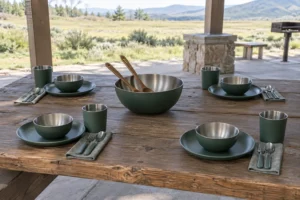
Shared Serving Pieces vs Individual Place Settings for Group Camping
A procurement framework for deciding which camping dinnerware components should be issued per person and which should remain shared across a group.
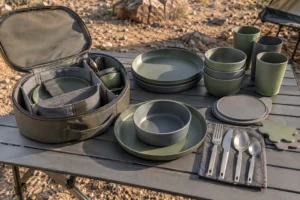
How to Prevent Rattle in a Nested Camping Dinnerware Set
A practical diagnostic for finding and controlling movement, impact and rubbing inside nested camping dinnerware sets without hiding problems behind unsupported claims.

How to Calculate Pack Volume for Camping Tableware
A practical procurement worksheet for measuring the complete camping tableware sales unit, calculating its external cube and separating real pack efficiency from unsupported freight claims.
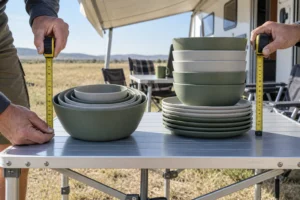
Nesting vs Stacking: How the Two Designs Change Pack-Out
A buyer-focused geometry and pack-out comparison for choosing nested, stacked or hybrid camping dinnerware systems without confusing compact appearance with approved performance.
What Makes Camping Dinnerware Truly Stackable?
A procurement acceptance framework for reviewing stack rise, contact interfaces, separation, stability, mixed-component order, drainage and retained pack-out.

Deep Bowls vs Shallow Bowls for Outdoor Meal Sets
A procurement decision table for selecting deep and shallow camping bowl profiles by meal function, user access, stability, cleaning and packed-set architecture.