
Wheat Straw Bowls Wholesale Buying Guide: Sizes, Shapes, Packaging and Use Cases
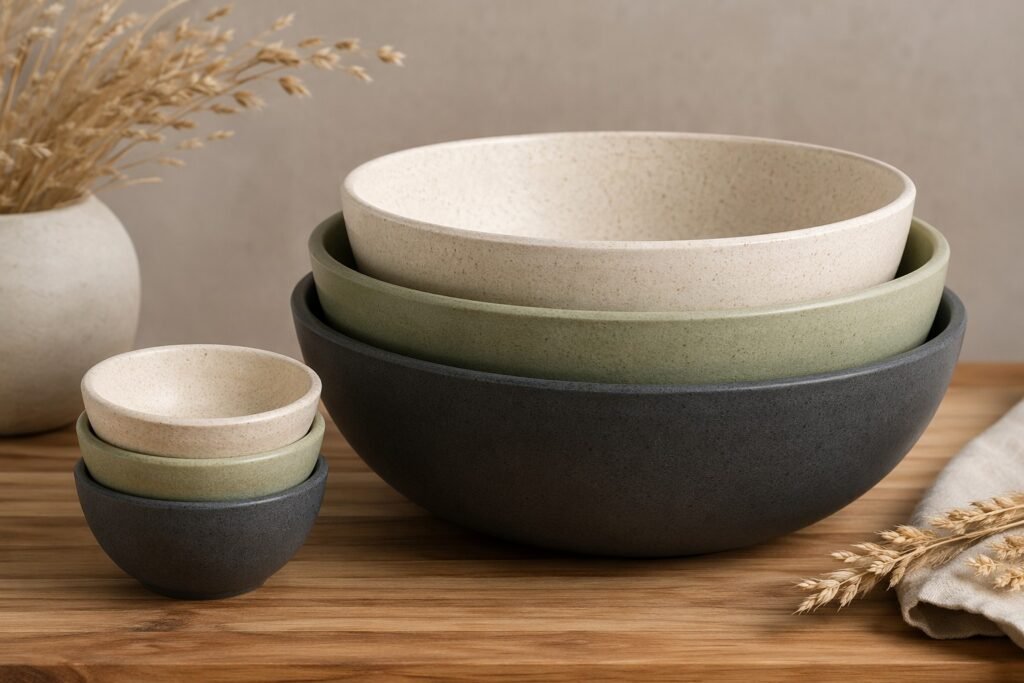
If you are a category manager for a retail chain or a distributor in the home goods sector, you’ve noticed a shift. The humble bowl—once a generic commodity—has become a frontline soldier in the war against single-use plastic. Among the alternatives, wheat straw bowls wholesale have emerged as the clear winner for B2B buyers who need a product that balances environmental credentials with unbreakable performance.
However, from a manufacturing perspective, “a bowl is not just a bowl.” When you are ordering 50,000 units for a supermarket promotion or a private-label launch, a 50ml difference in capacity or a 2mm difference in wall thickness can be the difference between a high-selling “must-have” and a clearance-rack failure.
As a factory insider who has overseen the production of millions of pieces of wheat straw tableware, I’ve seen B2B buyers make the same mistakes repeatedly: choosing the wrong shape for the market, underestimating the importance of bowl packaging for logistics, and failing to verify the material ratio before signing the contract.
This exhaustive guide is designed to help you navigate the complexities of sourcing wheat straw bowls. We will break down standard dimensions, explore the ergonomics of bowl design, and look at the logistics of high-volume wholesale orders.
1. Decoding Sizes and Capacities: A B2B Capacity Chart
In the world of wheat straw bowls wholesale, “Large” means something very different in North America than it does in Japan. For a professional buyer, you must speak the language of milliliters (ml) and fluid ounces (oz).
The Standard Sizing Matrix
| Bowl Type | Typical Diameter | Typical Capacity | Best For |
|---|---|---|---|
| Small Dip / Condiment | 80mm – 100mm | 100ml – 200ml | Dipping sauces, nuts, small snacks. |
| Standard Cereal Bowl | 120mm – 150mm | 450ml – 600ml | Breakfast, yogurt, side salads. The #1 Best Seller. |
| Large Soup / Pasta Bowl | 160mm – 180mm | 700ml – 900ml | Hearty soups, ramen, main-course pasta. |
| Family Salad Bowl | 200mm – 250mm | 1500ml – 2500ml | Shared salads, fruit displays, serving pieces. |
| Kids Divided Bowl | 130mm – 150ml | 300ml (total) | Toddler feeding, snack portioning. |
The “Fill Line” Reality
One common trap in B2B sourcing is the difference between “Total Volume” and “Usable Volume.” Many factory catalogs list the capacity to the absolute brim. For consumer safety and usability, the “usable” capacity is typically 15-20% lower. If your marketing claims a “600ml bowl,” ensure your customers don’t spill soup on their laps the moment they lift the spoon.
2. Shape Dynamics: The “Ergonomics of Eco-Tableware”
The shape of a wheat straw bowl isn’t just about aesthetics; it dictates how the product performs in a dishwasher, how it stacks in a container, and how it feels in the consumer’s hand.
A. The “Coupe” Shape (Curved Walls)
The coupe bowl has no distinct rim. It features a continuous curve from the base to the edge.
- B2B Benefit: Excellent for automated cleaning and industrial dishwashers.
- Consumer Appeal: Minimalist, “Nordic” aesthetic.
- Logistics Note: Excellent “nestability.” You can fit more coupe bowls in a 40HQ container than any other shape.
B. The Tapered Shape (Straight Walls)
Tapered bowls have straight sides that widen toward the top.
- B2B Benefit: Provides a very stable base, reducing the “topple risk” in restaurant environments.
- Consumer Appeal: Classic, traditional feel.
- Logistics Note: Tapered bowls can “lock” together if the nesting angle is too steep, making them difficult for store associates to separate on the shelf.
3. Engineering the Perfect Bowl: Design Factors for OEM Buyers
When we work on custom mold development for a private-label client, the design of a bowl involves significant engineering. It is a 3D structural problem.
Center of Gravity and Stability
A bowl must remain stable even when filled with liquid. For wholesale orders destined for the hospitality sector, we calculate the “Base-to-Height Ratio.” If the base is less than 50% of the top diameter, the bowl is prone to tipping. For high-velocity retail, we aim for a 65% ratio to ensure a sturdy, quality feel.
Rim Reinforcement
The rim is the most vulnerable part of a wheat straw bowl. In our factory, we use Double-Injection Reinforcement at the rim edge. By increasing the thickness of the rim by just 0.5mm compared to the sidewall, we increase the “Chip Resistance” by nearly 40%. This is critical for restaurant suppliers whose products face rough handling.
The “Draft Angle” Secret
The draft angle is the slope of the bowl’s walls that allows it to be ejected from the mold.
- The Standard: 1-2 degrees.
- The Premium Standard: 5-7 degrees. A larger draft angle allows for tighter nesting. If you are trying to minimize your freight costs per unit, a larger draft angle is your best friend. It allows you to fit 12 bowls in the space normally occupied by 8.
4. Material Quality: Beyond the Marketing Name
We have covered the chemistry of wheat straw composite material in our detailed material science guide, but for bowl buyers, one factor is paramount: Thermal Stability.
Because bowls are frequently used for hot liquids (soups, oatmeal) and microwave heating, the PP-to-fiber ratio must be locked.
- The “Safety Standard”: For wholesale orders, ensure the material is 100% virgin food-grade PP combined with natural fiber.
- The Risk: Low-cost suppliers often use “regrind” plastic to lower the price of wheat straw bowls wholesale. Regrind can contain impurities that lead to “hot spots” in the microwave, causing the bowl to blister or melt locally.
Verification Tip: Ask for a Pre-Production Sample and perform a “Heat Deformation Test.” Submerge the bowl in 100°C water for 15 minutes. If it becomes pliable or soft, the binder quality is insufficient for a professional brand.
5. Advanced Packaging Strategies: Protecting Your Margin
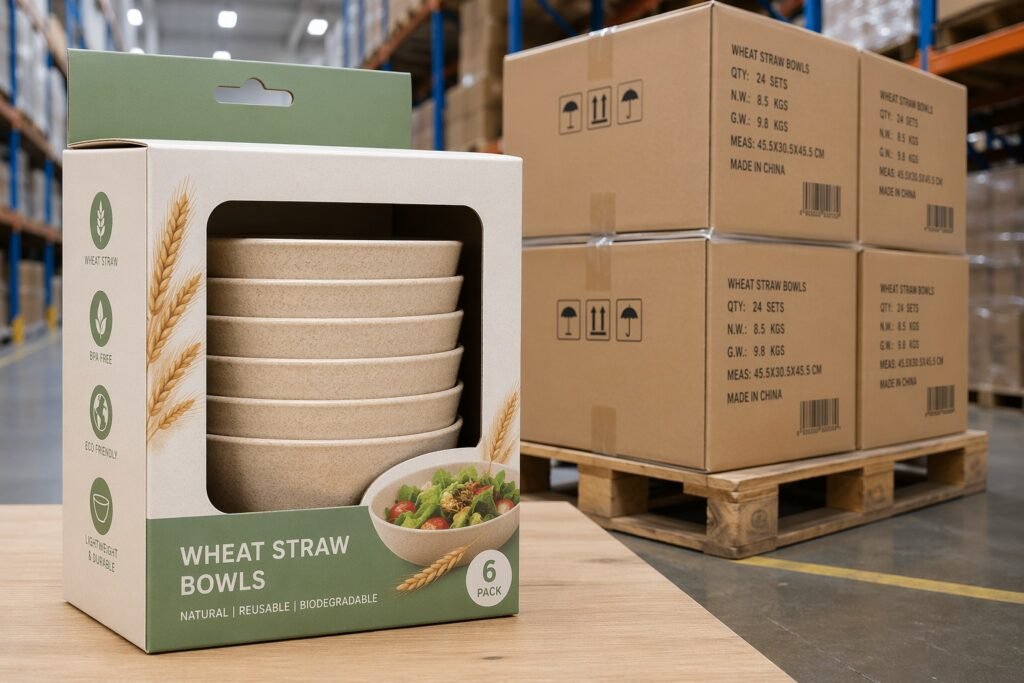
For a B2B buyer, bowl packaging is where you control your margin. Packaging affects your “Air Ratio” in shipping and your “Shelf Velocity” in retail.
A. Retail-Ready Color Boxes
Ideal for Amazon sellers and high-end boutiques.
- Features: Die-cut windows, full-color printing, and matte lamination.
- Margin Impact: Adds 0.25−0.25−0.45 per set.
- Key Check: Ensure the box includes an EAN/UPC barcode that follows GS1 standards.
B. Cardboard Sleeves (The Eco-Choice)
A simple printed cardboard band that wraps around a nested set of 4 or 6 bowls.
- Features: Minimalist, uses less paper, and lets the customer touch the material texture.
- Margin Impact: Adds only 0.08−0.08−0.15 per set.
- Retail Tip: This is currently the #1 choice for European supermarkets because it looks more “sustainable” than a closed box.
C. The E-Commerce “Drop-Test” Pack
If you are an online retailer, standard packaging isn’t enough.
- Requirements: The set must pass a 1.5-meter drop test on all 6 sides and 4 corners.
- The Solution: We use molded-pulp inserts or EPE foam corners. While this increases the bowl packaging cost by 10%, it reduces the “Damaged in Transit” rate from 5% to <0.5%.
6. Calculating Your Total Landed Cost (ROI Tool)
When sourcing wheat straw bowls wholesale, the “Unit Price” is often misleading. Use this formula to calculate your actual cost per unit:
Landed Cost = (Unit Price + Amortized Mold Fee + Packaging Cost + Freight + Duties + Warehouse Inbound Fee)
Scenario: 10,000 Cereal Bowls to Germany
- FOB Unit Price: $0.65
- Retail Packaging (Sleeve): $0.12
- Freight (Allocated per unit): $0.18
- Duty (estimated 6.5%): $0.05
- Inspection & Testing Fee: 0.02∗∗TotalLandedCost:∗∗∗∗1.02 per bowl**
Insight: If you switch to bulk packing (removing the 0.12packagingfee)andoptimizethenestingangle(reducingfreightto0.14), you drop your landed cost to $0.86—a 15% increase in your net margin.
7. Usage Scenario Deep-Dive: Matching the Bowl to the Business
As a professional retail tableware supplier, we don’t just sell sets; we solve specific business challenges. Here is how our wheat straw bowls wholesale perform in four key B2B sectors.
A. The Hospitality & Restaurant Sector
For fast-casual restaurants (Poke, Ramen, Acai), the bowl is a high-rotation asset.
- The Challenge: High breakage rates with ceramic and scratching with plastic.
- The Solution: Our premium wheat straw bowls offer a ceramic-like weight with the impact resistance of polymer.
- Operational ROI: By switching from ceramic to wheat straw, a 50-seat restaurant can reduce its annual “Smallwares Replacement Budget” by up to 65%.
B. Educational Institutions (Schools & Universities)
Cafeterias require lightweight, stackable, and safe items that can handle thousands of student interactions.
- The Challenge: Noise reduction in dining halls and strict food safety compliance.
- The Solution: Wheat straw composite is significantly quieter than melamine or ceramic when stacked. It provides a “Calmer Dining Environment.”
- Verification: Schools typically require EN 1186 compliance (European migration standard), which we provide with every bulk school-supply contract.
C. Office Pantry & Corporate Wellness
Modern tech companies are removing all single-use plastics from their HQs.
- The Challenge: Finding a product that looks “Premium” enough for a Google or Meta office while being sustainably sourced.
- The Solution: We provide matching Wheat Straw Mugs and Cutlery in “Cool Grey” or “Navy Blue” for a sophisticated, uniform office pantry look.
D. Corporate Gifting & Subscription Boxes
Subscription box curators (e.g., “Eco-Home” boxes) love bowls as a “Hero Item.”
- The Challenge: Packaging that fits inside a shipping box without increasing freight weight.
- The Solution: We offer Ultra-Lightweight Nesting Sets specifically for the gift industry, ensuring you don’t pay “Shipment Penalties” for heavy tableware.
8. The Chemistry of Clean: Maintaining Bowls for 500+ Cycles
B2B buyers often ask, “How long will these bowls actually look new?” The answer depends on your cleaning protocol.
Dishwasher Compatibility
Wheat straw bowls are top-rack safe up to 120°C. However, for high-volume wholesale buyers (hotels/hospitals), we recommend avoiding “High-Phosphate” detergents. High phosphates can strip the natural oils from the wheat straw fibers over time, making the surface look dull.
- Factory Tip: Use a “Eco-Friendly” liquid detergent for maximum surface longevity.
Stain Removal Protocol (B2B Maintenance)
If your bowls are used for turmeric-heavy curries or strong tomato sauces, micro-staining can occur.
- The Solution: We advise our hospitality clients to perform a “Baking Soda Soak” once every 3 months. A simple 10-minute soak in warm water and sodium bicarbonate restores the original luster without using harsh abrasives like bleach.
9. Regional Market Intelligence: Who Prefers What?
If you are a global importer, your wheat straw bowls wholesale strategy must adapt to local culture.
| Market | Preferred Bowl Size | Color Trend | Key Requirement |
|---|---|---|---|
| North America | 24oz – 32oz (Large) | Matte Black / Terracotta | Microwave Certification |
| European Union | 500ml – 700ml (Med) | Sage Green / Beige | Full LFGB Documentation |
| Japan & SE Asia | 400ml – 550ml (Small) | Natural / Clear Pastel | Dishwasher Durability |
| Middle East | Large Family Sizes | Vibrant Jewel Tones | BPA-Free Assurance |
The US “Bento-Bowl” Trend
In the US market, we are seeing a massive surge in Lidded Wheat Straw Bowls. These hybrid items serve as both a dining bowl and a meal-prep container. If you are an Amazon seller, adding a silicone-sealed lid to your bowl set can increase your retail price by 30% while only adding 10% to your wholesale cost.
10. Virtual Factory Tour: The Bowl Production Line
When you audit Naike Dinner as your eco-friendly bowl manufacturer, here is the 4-step quality control journey every bowl takes.
Step 1: Compounding & De-Moisturizing
Natural wheat straw arrives with 8-12% moisture. We use industrial desiccant dryers to bring this down to <0.05% before injection. If the moisture is too high, the bowl will have internal air bubbles, making it structurally weak.
Step 2: The “Balanced Injection” Phase
We use high-precision molds with central gates. This ensures the wheat fibers flow evenly from the center to the rim. Unbalanced injection (side gating) is the #1 cause of warped bowls in the wholesale market.
Step 3: Flash Trimming & Surface Finishing
Fresh out of the mold, every bowl is hand-trimmed by experienced technicians. We then use a “Flaming” process or a light polish to seal the edges, ensuring a smooth, premium mouthfeel for the end consumer.
Step 4: Sensory Audit
Every 2 hours, our QC team pulls a bowl and performs a “Hot Water Test.” We fill the bowl with 95°C water and let it sit for 10 minutes. A technician then performs a “Sniff Test” to ensure no acrid binder smells are present.
11. The Cost of Failure: Why Cheap Bowls Are Expensive
I’ve seen B2B buyers save 0.10ontheunitpriceonlytolose0.10o theunitpriceo lytolose2.00 per unit in hidden costs.
A. The “Brittle” Recall
Low-cost factories use high fiber content (60%+) and low-grade recycled PP. These bowls are brittle. If a student drops a tray in a cafeteria and the bowl shatters into sharp shards, you face a liability lawsuit.
- Naike Standard: Our bowls are engineered to Bounce, Not Break.
B. The “Amazon Suspension” Risk
If a customer reports a “Chemical Smell” on Amazon, your listing can be suspended within 24 hours. Recovering a suspended listing costs thousands in lost sales and legal fees.
- Strategy: sourcing from a manufacturer with ISO 9001 and BSCI certification is your best defense against platform takedowns.
Understanding the end-use case helps you specify the right quality level.
1. Supermarket and Retail Chains
- Focus: Color curation and price point.
- Requirement: High-velocity colors (Sage, Grey, Beige) and Private Label Branding.
2. Hospitality and Food Service
- Focus: Durability and stackability.
- Requirement: Must pass rigorous dishwasher testing (500+ cycles) and be “Commercial Grade.”
3. Corporate Gifting and Promotions
- Focus: Branding real estate.
- Requirement: Large surface area for logo printing and “Gift Set” presentation.
12. Supplier Audit Checklist for Bulk Bowl Buyers
Before you place your next order for wheat straw bowls wholesale, use this checklist to audit your manufacturing partner.
- Material Traceability:Can they provide the COA (Certificate of Analysis) for the PP resin and the wheat fiber batch?
- Mold Maintenance:Are the parting lines on the bowl edges smooth? (Rough edges = old molds).
- Color Matching:Do they supportPantone matchingwith a Delta-E tolerance of < 3.0?
- Compliance Docs:Is there a recent (last 12 months)LFGB or FDA report?
- Logistics Plan:Have they provided a loading plan for a 20GP or 40HQ container?
13. Common Pitfalls in Wholesale Bowl Orders
Pitfall 1: The “Scratch” Issue
Because wheat straw composite is slightly softer than ceramic, it can be prone to “Micro-Scratching” during transit if packed too tightly without protection.
- Solution: Insist on a PE divider or tissue paper between every nested bowl in the wholesale master carton.
Pitfall 2: The “Bottom-Heavy” Freight
Importers often order only bowls. Bowls are dense. A container full of nested bowls can hit the weight limit before it hits the volume limit.
- Strategy: Mix your bowl order with lighter, bulkier items like Wheat Straw Cutlery Sets or cups to balance your freight weight-to-volume ratio.
14. Life Cycle & Circularity: The Marketing Evidence
In 2026, saying a bowl is “Eco-Friendly” is not enough. You need evidence for your BPA-free tableware claims.
The “Wheat-to-Plate” Story
Every batch of our bowls comes with a Sourcing Ledger. This ledger tracks the agricultural region where the wheat straw was harvested. This “Agricultural Provenance” is a high-value marketing asset for premium brands.
End-of-Life Performance
While our wheat straw bowls wholesale are primarily designed for reuse (Grade 5 PP), they are 100% recyclable.
- Factory Initiative: We offer a “Granulation Buy-Back” program for our bulk B2B clients. When your products reach their 5-year end-of-life, we can facilitate their return for granulation into industrial-grade plastic for non-food use. This turns your procurement into a Circular Supply Chain.
15. Detailed B2B Buyer FAQ: The “Bowl Edition”
Q: Can we customize the bowl surface texture to hide scratches? A: Yes. We recommend a “Textured Matte” finish (EDM grain 18-21). This creates a sophisticated, premium feel while masking 90% of micro-scratches from cutlery use.
Q: What is the lead time for 50,000 custom-color bowls? A: Standard lead time is 25-30 working days. This includes 5-7 days for color masterbatch production and 18-20 days for injection molding and packaging.
Q: Is it safe to use wheat straw bowls with boiling liquids? A: Yes, up to 120°C. For industrial kitchens (hospitals/schools) where liquids are often kept at 95°C for long periods, we recommend a slightly higher PP ratio (70%) to ensure zero thermal deformation.
Q: How do you prevent the “Natural Fiber Smell” from being too strong? A: We use a high-temperature “Vacuum Degassing” process before the material is pelletized. This removes the volatile organic compounds (VOCs) that cause the acrid smell in lower-quality products.
16. B2B Buyer Checklist: The 10-Minute Sample Audit
The market for wheat straw bowls wholesale is no longer just about offering a “green” product. It is about offering a sophisticated, retail-ready solution that stands up to the rigors of modern logistics and consumer expectations.
By focusing on the technical details—the usable capacity, the ergonomic shape, the nesting efficiency, and the compliance documentation—you move from being a “commodity buyer” to a “strategic brand owner.”
At Naike Dinner, we don’t just provide a price list. We provide a manufacturing partnership. We help you design the bowl, specify the material, and optimize the bowl packaging to ensure your project is a commercial success from day one.
Ready to Request a Bulk Bowl Quote?
Let’s build your eco-tableware line with the precision of a factory insider.
👉 Request a Custom Quote for Wheat Straw Bowls
👉 Download the 2026 Wheat Straw Bowl Collection Catalog
👉 Read: How to Import Tableware from China Safely — The 2026 Guide
CONTACT US
Shared Serving Pieces vs Individual Place Settings for Group Camping
A procurement framework for deciding which camping dinnerware components should be issued per person and which should remain shared across a group.
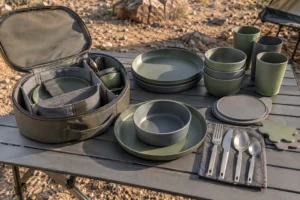
How to Prevent Rattle in a Nested Camping Dinnerware Set
A practical diagnostic for finding and controlling movement, impact and rubbing inside nested camping dinnerware sets without hiding problems behind unsupported claims.
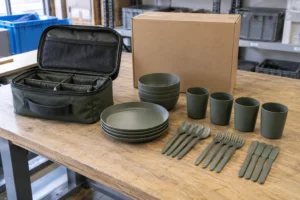
How to Calculate Pack Volume for Camping Tableware
A practical procurement worksheet for measuring the complete camping tableware sales unit, calculating its external cube and separating real pack efficiency from unsupported freight claims.
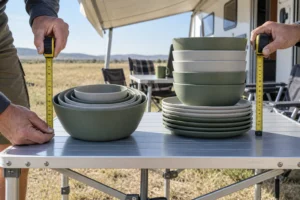
Nesting vs Stacking: How the Two Designs Change Pack-Out
A buyer-focused geometry and pack-out comparison for choosing nested, stacked or hybrid camping dinnerware systems without confusing compact appearance with approved performance.
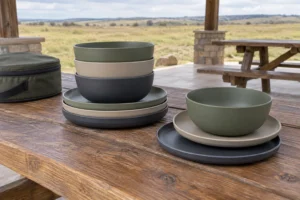
What Makes Camping Dinnerware Truly Stackable?
A procurement acceptance framework for reviewing stack rise, contact interfaces, separation, stability, mixed-component order, drainage and retained pack-out.
Deep Bowls vs Shallow Bowls for Outdoor Meal Sets
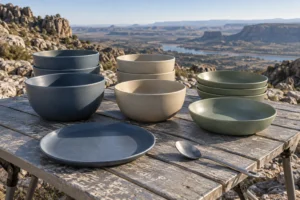
A procurement decision table for selecting deep and shallow camping bowl profiles by meal function, user access, stability, cleaning and packed-set architecture.