
Custom Color Matching for Wheat Straw Tableware: Pantone, MOQ and Production Tolerance
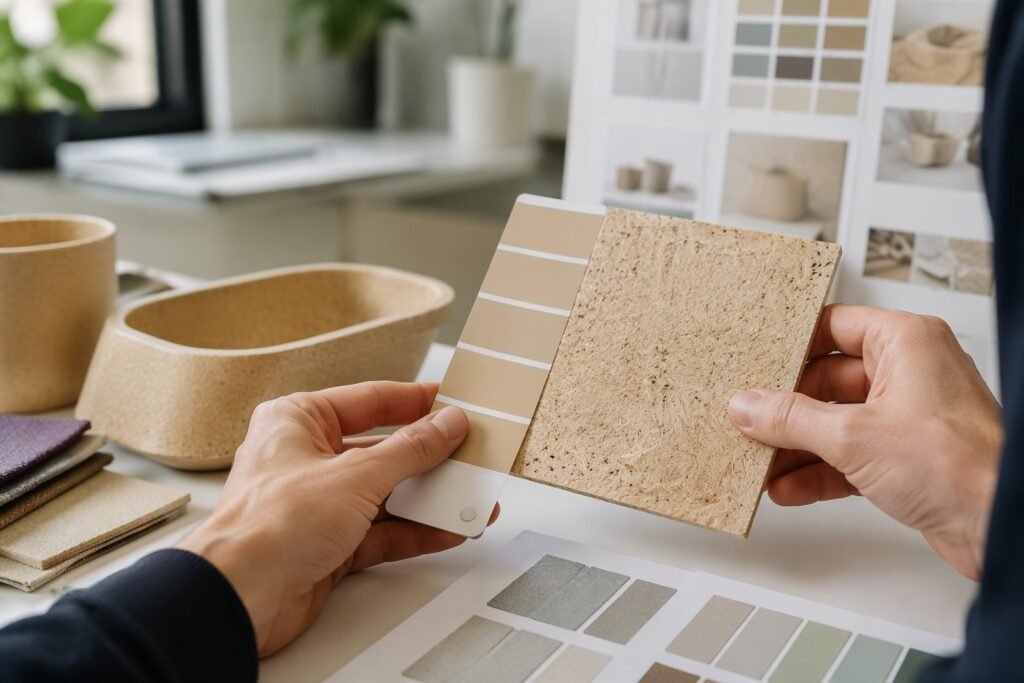
If you are a brand manager or a B2B procurement professional, you know that color is more than just an aesthetic choice—it is your brand’s fingerprint. In the competitive world of retail and e-commerce, the consistency of your “Sage Green” or “Dusty Rose” is what separates a premium brand from a generic commodity.
However, when you step into the world of OEM wheat straw tableware, the rules of color matching change. Unlike standard virgin plastics, which are translucent and neutral, wheat straw composite is an organic, variable substrate. The natural golden-beige “tint” of the wheat fiber acts as a filter that shifts every pigment you add. If you approach a wheat straw project with the same expectations as a pure PP or ABS project, you are going to face delays, rejected samples, and inconsistent bulk orders.
As a factory insider who has overseen the custom color development of millions of eco-friendly plates and bowls, I’ve seen exactly where these projects go wrong. Most buyers understand “what” they want (the Pantone color), but they don’t understand the “how” (the chemical and mechanical process of compounding).
In this exhaustive 3,000-word guide, we will explore the science and strategy of Pantone color matching for OEM wheat straw tableware. We will break down the technical factors that affect color stability, define realistic production tolerances, and look at the MOQ requirements that drive the economics of custom color development.
1. The Science of Substrate: Why Wheat Straw is a “Living” Color Base
To understand Pantone color matching for OEM wheat straw tableware, you must first understand the substrate.
Standard plastic tableware uses clear or white polymer resins as the base. This is the equivalent of painting on a white canvas—the color you see in the tin is the color you get on the wall. Wheat straw composite material (as we detailed in our deep-dive material guide) is more like painting on a brown cardboard box.
The “Base Tint” Factor
The natural wheat fiber content (typically 35%) provides a warm, earthy undertone. This has several immediate effects on color matching:
- Light Colors (Whites & Creams): Achieving a “Pure White” is nearly impossible. The fiber will always make the product look “Antique White” or “Eggshell.”
- Cool Tones (Blues & Greys): The yellow undertone of the wheat fiber will shift blues toward green (Teal) and greys toward olive.
- Transparency: Because the fibers are opaque, you cannot achieve translucent or “neon” colors in wheat straw. Every custom color will have a matte, opaque finish.
Fiber “Flecking” and Texture
Color in wheat straw is not perfectly uniform. The visible fiber specks create a “textured” color perception. In the industry, we call this Visual Metamerism—the way a color looks different depending on the angle of the fibers and the lighting.
Factory Advice: Always view your wheat straw color samples under “D65” (Standard Daylight) lighting. Avoiding LED or fluorescent office lights during the approval stage will save you weeks of back-and-forth.
2. Masterbatch vs. Dry Pigment: The Factory’s Choice for OEM
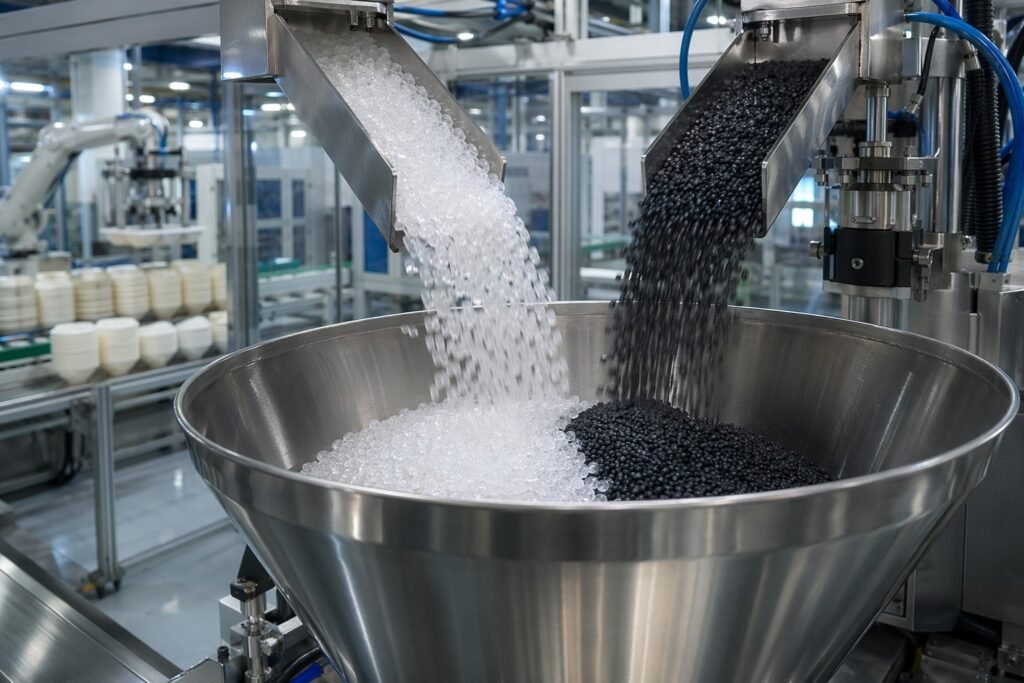
When we develop a custom color for your OEM wheat straw tableware, we have two paths: Color Masterbatch or Dry Pigment. For a high-end B2B project, the choice is almost always Masterbatch.
What is Color Masterbatch?
Masterbatch is a highly concentrated “pill” of pigment encapsulated in a polymer carrier (usually the same food-grade PP used in the plate).
| Feature | Color Masterbatch | Dry Pigment (Powder) |
|---|---|---|
| Consistency | Excellent. Precisely weighed and compounded. | Moderate. Prone to “dusting” and uneven mixing. |
| Safety | High. Pigments are locked in, reducing migration risk. | Moderate. Loose powder can contaminate the facility. |
| B2B Cost | Higher (Initial investment in batching). | Lower (Per gram price is cheaper). |
| Scalability | Ideal for orders > 5,000 sets. | Used for low-cost, short-run items. |
The “Naike Standard” for OEM Projects with Custom Color Matching for Wheat Straw Tableware
At Naike Dinner, we use only high-dispersion Masterbatch. Because wheat straw fibers are difficult to “wet” (coat with plastic), a standard masterbatch can result in “color swirls” or streaks. We work with specialized compounding partners to create a masterbatch that has an ultra-low melt flow index, ensuring that the color flows around every wheat fiber perfectly.
If you are currently evaluating a supplier, check their Pre-Shipment Inspection reports—if you see “Color Swirls” or “Marbling” listed as a defect, they are likely using low-grade dry pigments.
3. Defining Color Tolerance: The Reality of Delta-E (ΔE)
The most common source of friction between a buyer and a factory is the definition of “Correct Color.” A buyer sees a slight difference and calls it a failure; the factory calls it “Within Tolerance.”
To eliminate this, we use the Delta-E (ΔE) standard.
What is Delta-E?
ΔE is a mathematical measurement of the distance between two colors in the CIELAB color space.
- ΔE < 1.0: Human eye cannot see the difference.
- ΔE 1.0 – 2.0: Experienced observers can see a tiny difference.
- ΔE 2.0 – 3.5: Standard consumer-level difference (Acceptable for most B2B retail).
- ΔE > 5.0: Clearly different colors.
Realistic Limits for Wheat Straw
In pure plastic (like a LEGO brick), we aim for ΔE < 1.5. In wheat straw tableware, because the natural fiber content varies slightly in every harvest batch, we set the standard at ΔE ≤ 3.0.
Buyer Tip: When you sign your Private Label Approval Guide, insist on a ΔE limit being written into the contract. This protects you from the factory sending a batch that has “drifted” too far from your brand identity.
4. The OEM Development Timeline: From Pantone to Product
Custom color development is a four-stage journey. Rushing this process is the fastest way to get a “Muddy” color that ruins your product launch.
Stage 1: Color Specification (1–2 Days)
The buyer provides the Pantone Solid Coated (C) or Uncoated (U) code. Note: We recommend “Coated” codes for a satin finish and “Uncoated” for a dead-matte finish.
Stage 2: Laboratory Lab-Dip (5–7 Days)
Our lab creates three small “Color Plaques” (flat squares of material) using different pigment concentrations:
- Sample A: A “Light” match.
- Sample B: The “Target” match.
- Sample C: A “Dark” match. These are sent to you for physical approval.
Stage 3: Trial Mold Run (PPS Stage) (7–10 Days)
Once the plaque is approved, we run a small batch (usually 50 units) through the actual product mold. Why? A color can look different on a flat plaque than it does on a curved bowl with varying wall thicknesses. This is the Pre-Production Sample (PPS).
Stage 4: Production Lock-In
The PPS becomes the “Golden Sample.” We keep one, the inspector gets one, and you keep one.
To understand how these samples fit into your larger project, read our guide on the Sample Approval Process for Custom Wheat Straw Dinnerware.
5. MOQ and The Economics of Custom Color
Why do factories have an MOQ for custom colors? It isn’t just about the number of plates—it’s about the compounding cycle.
The “Purge” Cost
When we switch from a standard “Natural Beige” to your “Custom Navy Blue,” we have to stop the production line and “purge” the injection molding barrels. This involves running 20–50kg of expensive cleaning resin through the machine until all traces of the previous color are gone. If you only order 500 sets, the cost of the wasted cleaning resin is higher than the profit on the order.
Standard OEM MOQs
- Existing Catalog Colors: 500 – 1,000 sets (See our Catalog for standard colors).
- Custom Pantone Match (Single Item): 3,000 – 5,000 units.
- Custom Pantone Match (Complete Set): 1,000 – 2,000 sets.
The “Hack” for Small Brands: If you can’t hit the 3,000-unit MOQ, ask the factory for their “Season’s Run” colors. Factories often run large batches of popular tones like Sage Green or Terracotta. You can “piggyback” on these runs to get a unique look without the high MOQ.
6. Safety First: The Pigment-Compliance Connection
As a B2B buyer, you are legally responsible for the safety of the pigments used in your products. Pantone color matching; OEM wheat straw tableware development must always be tied to chemical verification.
Heavy Metal Risk
Vibrant reds, oranges, and yellows historically used Lead or Cadmium based pigments. In 2026, these are strictly banned under LFGB (EU) and FDA (US) standards.
Migration of Colorants
If a pigment is not thermally stable, it can “bleed” into food when exposed to heat or acid.
- The Factory Test: We perform an “Oil Migration Test” on all new custom colors. We submerge the colored plate in fatty simulant for 2 hours at 70°C. If the oil turns even slightly blue or pink, the masterbatch is rejected.
For more on this, see our technical guide on Composite Tableware Chemical Testing.
7. B2B Buyer Checklist: Approving a Custom Color
Before you sign off on a color sample, go through this 5-point factory-grade audit.
- Check the “Metamerism”:Look at the sample under daylight, then under a kitchen light. Does the color shift significantly? If yes, ask for a “Higher Chroma” pigment.
- Inspect the Parting Lines:Check the edges of the plate where the mold halves meet. Color often “gathers” here, making the edges look darker. Ensure this is acceptable for your retail standards.
- Verify Lightfastness:Ask the supplier for the “Blue Wool Scale” rating of the pigment. For retail housewares, you want a rating ofLevel 5 or higherto prevent fading on the shelf.
- Compare Wall Thickness Consistency:Hold the plate up to a bright light. If you see “dark patches,” it means the color is uneven or the wall thickness is inconsistent.
- Request the Masterbatch SDS:Ensure the Safety Data Sheet (SDS) of the colorant clearly states “Suitable for Food Contact.”
8. Case Study: The “Forest Green” Disaster of 2024
To illustrate why these details matter, let’s look at a real-world B2B scenario. A Nordic lifestyle brand ordered 10,000 wheat straw sets in a custom “Forest Green.” They approved the color from a digital PDF proof (CMYK) instead of a physical sample.
When the container arrived in Copenhagen, the “Forest Green” looked like “Muddy Olive.” Because of the natural yellow undertone of the wheat fiber, the blue-heavy green pigment shifted dramatically toward the yellow spectrum.
The brand had to discount the entire shipment by 40%, costing them over $15,000 in lost margin. The root cause? Ignoring the substrate-pigment interaction.
9. Comparative Analysis: Liquid Colorants vs. Powder vs. Masterbatch
As an OEM buyer, you may encounter suppliers offering different types of coloring systems. It’s vital to know the pros and cons of each for wheat straw composite applications.
A. Liquid Colorants
Liquid color is a vehicle-based pigment system. It is pumped directly into the injection barrel.
- The Pro: Exceptional color accuracy and very low loading rates (0.5% – 1%).
- The Con: It can cause “Slippage” in the injection screw when used with plant fibers. Wheat straw fibers absorb the liquid vehicle, which can lead to unpredictable migration results. Not recommended for B2B dinnerware.
B. Dry Pigment Powder
This is the “old school” way of coloring plastic—dumping powder into the resin mixer.
- The Pro: Zero setup cost and no MOQ.
- The Con: Extremely messy. The powder doesn’t always bond to the wheat fiber, leading to “Hot Spots” (points of high pigment concentration) that can fail Chemical Safety Tests.
C. Masterbatch (Naike’s Choice)
Encapsulated granules that are tumble-mixed with the resin.
- The Pro: Best dispersion, safest for food contact, and the easiest to control for ΔE tolerance.
- The Con: Requires a “Carrier Match” (the masterbatch base must be the same as the product base, e.g., PP).
| Feature | Liquid Color | Dry Powder | Masterbatch |
|---|---|---|---|
| Dispersion Quality | High | Low (Streaks) | Very High |
| Migration Risk | Medium | High | Low |
| Production Speed | Fast | Slow (Mixing) | Fast |
| Cleanliness | Messy | Very Messy | Clean |
| B2B Preference | Specialized | Low-End | Global Standard |
10. Understanding Metamerism: The “Lighting Trap” in Color Approval
Have you ever approved a sample in your office, only to find it looks completely different in your retail store? This is Metamerism.
The Science of “Matching Light”
Color is not a property of the plate; it is a property of the light bouncing off it.
- D65 (Artificial Daylight): This is the industry standard for color matching. It simulates a noon-day sky.
- TL84 (Retail Light): Mimics the cool fluorescent lights found in European and US supermarkets.
- A (Incandescent): Mimics warm home lighting.
The “Two-Source” Rule: At Naike Dinner, we don’t approve a color match unless it is consistent under both D65 and TL84. If you are a B2B brand selling into both retail and hospitality, you must verify the color under multiple sources to avoid a “Metameric Failure.”
11. Regional Color Preferences: B2B Sourcing Strategy
Color is culturally specific. If you are a global importer, your OEM wheat straw tableware palette should reflect your target geography.
North America: The “Bold & Neutral” Mix
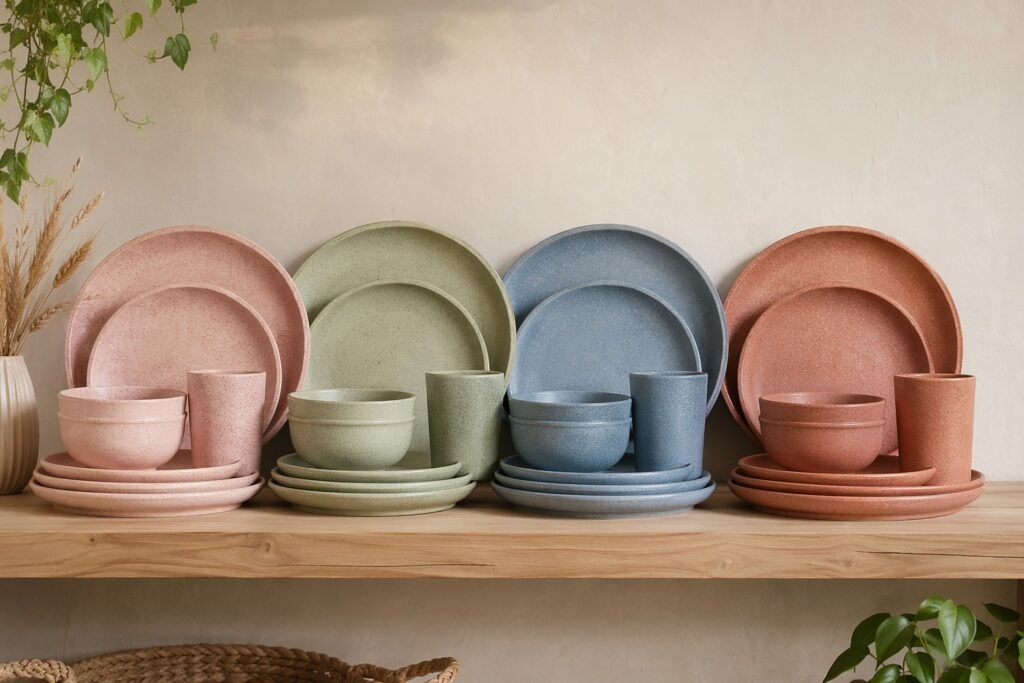
US buyers gravitate toward high-contrast palettes. We see high demand for “Matte Black,” “Navy Blue,” and “Bright Terracotta.” However, “Natural Beige” remains the #1 seller for Amazon FBA brands because it communicates the “Eco” message instantly.
Europe: The “Nordic Pastel” Dominance
Importers in Germany, France, and Scandinavia prefer muted, organic tones. “Sage Green,” “Dusty Blue,” and “Slate Grey” are the high-velocity colors. These colors complement the natural fiber specks of wheat straw perfectly, creating a “premium-organic” aesthetic.
Australia: The “Outdoor & Earthy” Palette
The Australian market (as we noted in our Australia Market Insight) loves tones that reflect the landscape. “Ochre,” “Eucalyptus Green,” and “Sand” are top performers for the camping and outdoor retail channels.
12. Troubleshooting Color Defects in Bulk Production
Even with an approved Golden Sample, things can go wrong on the production line. Here is what to watch for during your Pre-Shipment Inspection.
Issue 1: “Color Marbling”
Description: Swirls of light and dark color on the surface. Cause: The masterbatch is not dispersing correctly, or the injection temperature is too low. Solution: Increase the back-pressure on the injection screw or use a higher-dispersion masterbatch.
Issue 2: “Fiber Charring” (Dark Spots)
Description: Small black or dark brown spots that look like dirt. Cause: The wheat fiber is “burning” because the machine temperature is too high (>200°C). Solution: Drop the nozzle temperature and increase the cooling cycle time.
Issue 3: “Weld Line Discoloration”
Description: A faint dark line where the two flows of plastic meet in the mold. Cause: Pigment “Hiding”—where the fiber orientation at the weld line makes the color look darker. Solution: Adjust the gate position in the Custom Mold Design to move the weld line to a non-visible area (like the bottom of the plate).
13. The Environmental Impact of Pigments: Sustainability in Color
As a sustainable tableware manufacturer, we are often asked if our colors are “Organic.”
The Organic Pigment Myth
Many “Natural Dyes” (like beet or turmeric) are not stable at the 180°C temperatures required for injection molding. They char and turn brown. Instead, we use High-Stability Eco-Pigments. These are:
- Heavy Metal-Free: No lead, cadmium, or chromium.
- REACH Compliant: Free from Substances of Very High Concern (SVHC).
- LCA Friendly: Sourced from suppliers with low-carbon manufacturing footprints.
14. Detailed B2B Buyer FAQ: The “Custom Color” Edition
Q: Can we do “Glow in the Dark” or “Thermochromic” (color-changing) wheat straw? A: We don’t recommend it. These additives are highly complex chemicals that often fail the strict LFGB Migration Tests. For a food-safe brand, stick to standard stable pigments.
Q: What happens if I want to change the color of an existing order? A: If production hasn’t started, it’s possible—but you will have to pay for the “Leftover Masterbatch” of the previous color if it was already custom-manufactured. Custom masterbatch has a shelf life of about 12 months.
Q: Does the “Satin” vs. “Matte” finish affect the color match? A: Yes. A matte surface scatters light, making colors look lighter and more “pastel.” A glossy or satin surface absorbs more light, making colors look deeper and more saturated. Always specify your surface finish before the lab-dip stage.
Q: How do you handle “Batch-to-Batch” drift over 3 years? A: We use a Spectrophotometer to digitize your approved Golden Sample. Every new production run is measured against this digital “Master Standard,” not just a physical sample that might have faded over time.
Conclusion: Mastering the Palette of Sustainability
In the world of OEM wheat straw tableware, color is not a “set and forget” line item. It is a dynamic chemical process that requires factory-level oversight and clear B2B communication.
By providing a physical Pantone reference, understanding the ΔE tolerance of natural fibers, and respecting the MOQ requirements of Masterbatch production, you ensure that your brand looks as good on the retail shelf as it did on your designer’s monitor.
At Naike Dinner, we pride ourselves on being “Color Scientists” as much as “Plate Makers.” We help you navigate the tricky waters of bio-composite color matching, ensuring that your sustainability claims are backed by a visual identity that screams “Premium.”
Ready to Develop Your Signature Color?
Don’t settle for “stock” colors. Build a brand that stands out with a custom-developed palette that reflects your unique vision.
👉 Submit Your Pantone Color for a Free Lab-Dip Consultation
👉 Browse Our Existing Color Library (No Development Fee)
👉 Download our Guide: How to Start a Private Label Project in 2026
CONTACT US
Shared Serving Pieces vs Individual Place Settings for Group Camping
A procurement framework for deciding which camping dinnerware components should be issued per person and which should remain shared across a group.
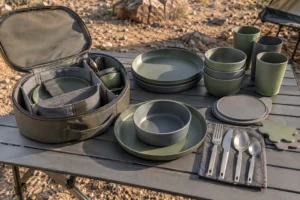
How to Prevent Rattle in a Nested Camping Dinnerware Set
A practical diagnostic for finding and controlling movement, impact and rubbing inside nested camping dinnerware sets without hiding problems behind unsupported claims.
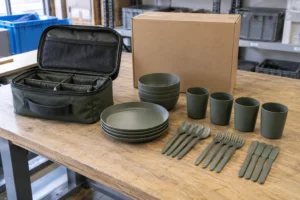
How to Calculate Pack Volume for Camping Tableware
A practical procurement worksheet for measuring the complete camping tableware sales unit, calculating its external cube and separating real pack efficiency from unsupported freight claims.
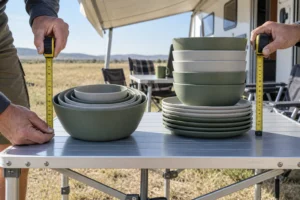
Nesting vs Stacking: How the Two Designs Change Pack-Out
A buyer-focused geometry and pack-out comparison for choosing nested, stacked or hybrid camping dinnerware systems without confusing compact appearance with approved performance.
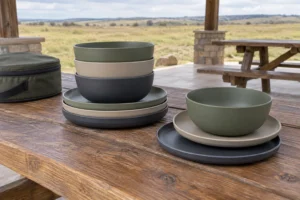
What Makes Camping Dinnerware Truly Stackable?
A procurement acceptance framework for reviewing stack rise, contact interfaces, separation, stability, mixed-component order, drainage and retained pack-out.
Deep Bowls vs Shallow Bowls for Outdoor Meal Sets
A procurement decision table for selecting deep and shallow camping bowl profiles by meal function, user access, stability, cleaning and packed-set architecture.
3 Responses