
Sample Approval Process for Custom Wheat Straw Dinnerware: What Buyers Should Check Before Bulk Orders
In the world of B2B manufacturing, there is a dangerous phrase that has ruined more import projects than anything else: “The bulk will be just like the sample.”
As a factory insider with nearly two decades in the tableware sector, I can tell you that for custom wheat straw dinnerware, the sample is not just a “preview”—it is a legal and technical contract. If your sample approval process is weak, your bulk production is a gamble. One misunderstood shade of beige, a logo that peels after two washes, or a barcode that won’t scan can turn a high-margin retail shipment into a nightmare of returns and rejected deliveries.
Wheat straw composite is a unique material. Unlike pure plastic, it has “personality”—natural fiber patterns, specific thermal expansion rates, and sensory properties that must be locked in before the injection molding machines start running for the approved production quantity.
This exhaustive guide will take you behind the factory curtain. We will break down every stage of the sample approval process for custom wheat straw dinnerware, from the initial prototype to the final “Golden Sample.” Whether you are an Amazon seller, a supermarket buyer, or a promotional gift distributor, this is the checklist you need to protect your investment.
1. The 4 Essential Types of Samples in the Wheat Straw Industry
Before you start checking dimensions, you need to know which stage of the sampling process you are in. Buyers often confuse a “Stock Sample” with a “Pre-Production Sample,” leading to massive gaps in expectations.
A. Stock Samples (Evaluation Samples)
These are “off the shelf” samples. The factory pulls them from their existing inventory.
- Purpose: To evaluate the general material quality, texture, and wall thickness.
- Insider Note: These samples were made for someone else’s order. They are good for testing the factory’s capability, but they are not the basis for your production.
B. Prototype / 3D Printed Samples
If you are developing a custom wheat straw tableware set with a unique shape, the factory will start here.
- Purpose: To check the ergonomics, size, and weight.
- Insider Note: 3D prints are usually made from resin or PLA, not wheat straw composite. They feel lighter and stiffer than the final product. Never approve color or final strength based on a 3D print.
C. Pre-Production Samples (PPS)
This is the “Boss” of the sample approval process. These are made using the actual molds, the actual wheat straw fiber ratio, and the actual color masterbatch you specified.
- Purpose: Final confirmation before mass production begins.
- Insider Note: This is your last chance to fix anything without paying for a full production rework.
D. Shipment Samples
These are pulled from the actual finished bulk production.
- Purpose: To verify that the factory didn’t “bait and switch” the material quality during the 30-day production run.
- Insider Note: If the shipment sample differs from the PPS, you have grounds to stop the shipment before it leaves the port.
2. Technical Checkpoints: The Physical Audit of the Sample
When you receive a custom wheat straw dinnerware sample, don’t just look at it and say “it looks fine.” You need to perform a systematic physical audit.
A. Material Texture and Fiber Distribution
Wheat straw composite is defined by the visible fiber specks.
- Check: Are the fibers evenly distributed?
- The Red Flag: If you see “clusters” of fiber or large dark spots, it means the material wasn’t dried or compounded correctly. This can lead to “weak points” where the plate might crack under heat.
- Texture: Run your fingers over the surface. It should feel smooth and satin-like. If it feels “powdery,” the fiber content is too high or the binder ratio is too low, making it unsafe for food (porous surface).
B. Color Consistency and Pantone Accuracy
Colors always look different on a phone screen.
- Check: Compare the sample against your brand’s physical Pantone swatch in natural daylight.
- Tolerance: Natural fibers affect the base color. A 5% “drift” from the Pantone code is normal for wheat straw. If it’s 10-15% off, the masterbatch formula needs a re-mix.
C. Weight and Wall Thickness
Use a digital caliper and a kitchen scale.
- Check: Does the plate weight match the quotation breakdown?
- The Insider Secret: Factories sometimes “thin out” the walls to save material cost. A 0.2mm difference might not seem like much, but it can reduce the impact strength by 20%. Ensure the wall thickness is consistent from the rim to the center.
D. Logo Adhesion (The “Fingernail and Tape” Test)
If you are doing private label logo printing, the logo is the most likely failure point.
- Scratch Test: Try to scratch the logo with your fingernail. It should not flake.
- Tape Test: Apply high-tack 3M tape over the logo, press firmly, and rip it off quickly. If more than 5% of the logo ink comes off, the factory didn’t use the correct ink-curing temperature.
3. Functional Testing: Putting the Sample Through Hell
A sample that looks pretty on a desk might fail in a consumer’s kitchen. You must perform “Destructive Testing” at the sample stage.
The B2B Sample Stress Test Protocol
| Test | Method | Pass Criteria |
|---|---|---|
| Microwave Test | 5 cycles of 2 minutes on high power with fatty food. | No warping, no “burnt toast” smell, no surface melting. |
| Dishwasher Test | 10 cycles in a residential dishwasher (high temp). | No color fading, no warping, logo stays intact. |
| Freezer Test | -20°C for 24 hours, followed by an immediate drop. | Material should not become brittle or shatter. |
| Drop Test | 3 drops from 1.5 meters onto a hard tile floor. | No cracking or chipping. Small bounces are a sign of good PP binder ratio. |
| Stain Test | Leave balsamic vinegar and tomato sauce for 12 hours. | Should wash off with standard soap without permanent discoloration. |
If you need to verify these against international standards, check our LFGB Testing guide for EU buyers or the FDA Food Contact Requirements.
4. Packaging and Labelling Verification
In the sample approval process for custom wheat straw dinnerware, the packaging is just as important as the product.
The Barcode Trap
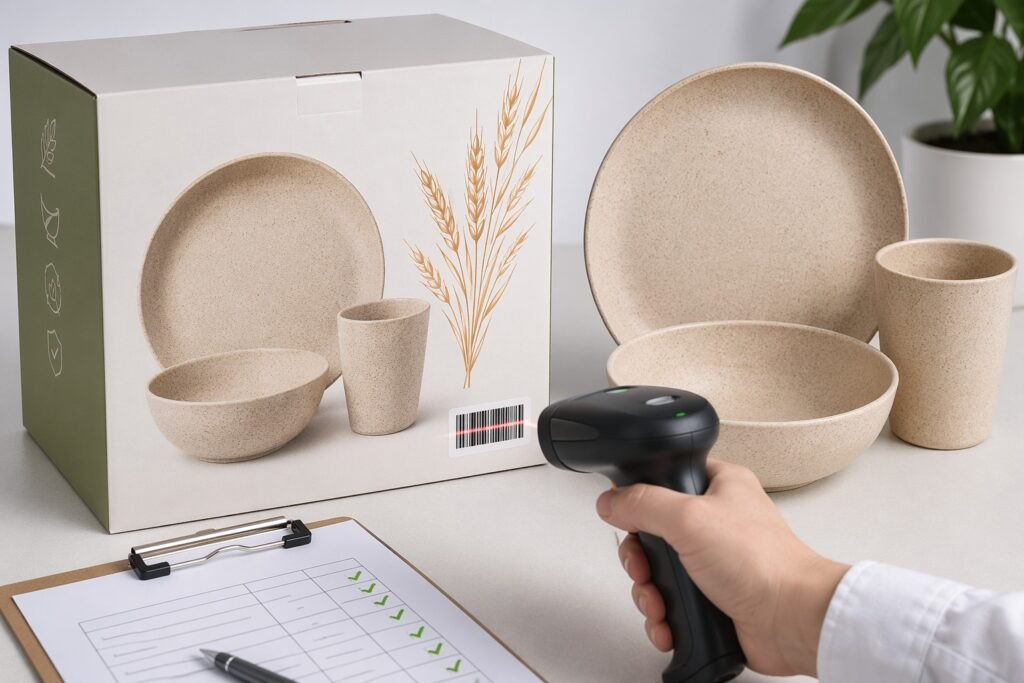
I have seen 50,000 units arrive in European warehouses with barcodes that were printed too small or in low-contrast ink. The result? The scanners couldn’t read them. The cost to re-label 50,000 boxes is often more than the profit on the order.
- Verification: Use a professional barcode scanner app on your phone. If it takes more than 1 second to read, it’s a failure.
Box Strength and Fit
- Fit: Does the product “rattle” inside the box? If yes, it will arrive scratched.
- Material: Is the cardboard “flute” thickness (e.g., E-flute or B-flute) what you paid for? Refer back to your Tableware Quotation to verify.
5. The Logistics of Sampling: How to Handle Timelines and Shipping
One of the most frustrating parts of the sample approval process for custom wheat straw dinnerware is the “hidden” logistics. Small delays in courier pickup or a misfiled customs form can add a week to your development cycle.
A. Sample Lead Times: The Factory Reality
Most buyers expect a sample in 3 days. However, to produce a high-quality Pre-Production Sample, the factory must:
- Compound the Raw Material: Mix the specific wheat straw fiber and PP binder ratio.
- Dry the Granules: 4-6 hours at 80°C to ensure zero moisture.
- Clean the Machine: Purge the injection molding barrel of previous colors.
- Mold the Product: Adjust the machine pressure and cooling time for the specific geometry.
- Post-Process: Trim flash and print the logo.
Real-world expectation: 7-10 working days for a fully branded set.
B. Shipping Strategy: Express vs. Consolidation
- For Urgent Approvals: Use DHL or FedEx International Priority. It costs more (40−40−80 for a set), but it gets to you in 2-3 days.
- For Non-Urgent Refinements: Ask the factory to consolidate the sample with other shipments or use a slower, cheaper “E-packet” service.
- Insider Tip: Always provide the factory with your own courier account number (if you have one). This ensures you control the tracking and the factory doesn’t “pad” the shipping cost.
C. Customs and Import Duties for Samples
Technically, samples are imported for “Evaluation Purposes.” To avoid unnecessary import duties:
- Ask the factory to declare the value as low (e.g., 10−10−20).
- The commercial invoice should state: “Samples for evaluation only, not for resale. Commercial value $0.”
- For larger sets, consider “marking” the samples (e.g., a permanent marker line on the bottom) so they cannot be sold as retail goods.
6. The “Golden Sample” Protocol: How to Lock the Contract
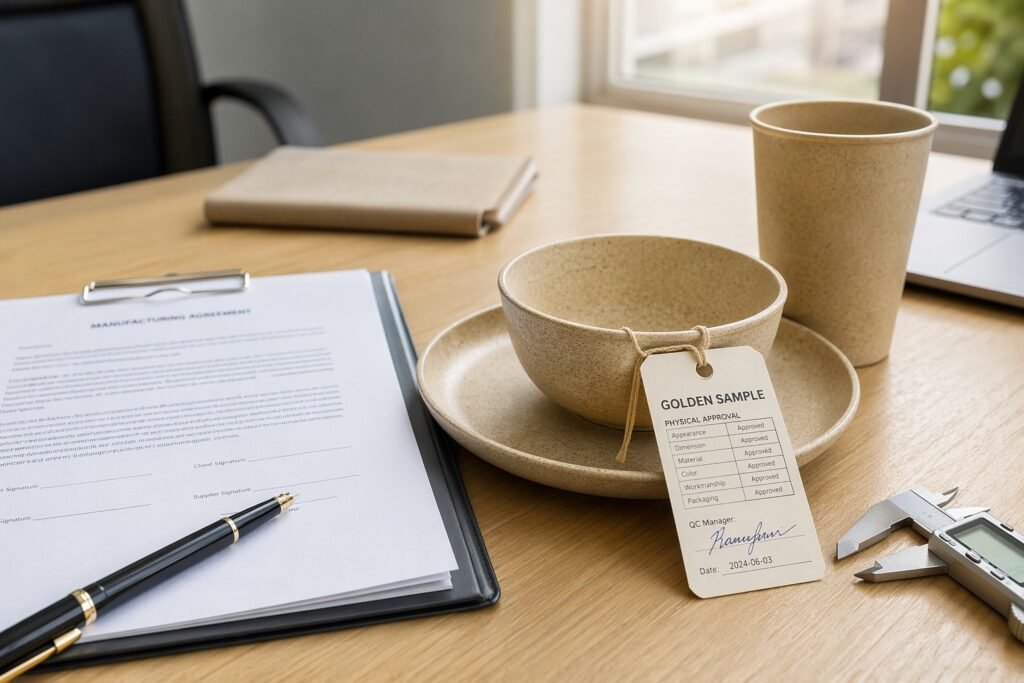
Once you are happy with the Pre-Production Sample, you move to the final stage: creating the Golden Samples.
Never approve just one sample.
Ask the factory for three identical samples of the final version:
- Buyer Sample: Kept in your office as the “Master Reference.”
- Factory Sample: Kept in the factory’s QC office. Every production shift will pull this sample to compare it against the bulk.
- Inspector Sample: Left with the factory in a sealed bag to be handed to your third-party inspector (like SGS or QIMA) when they arrive for the pre-shipment inspection.
Documenting the Approval
Don’t just say “Approved” in an email. Send a formal Approval Sheet that includes:
- Clear photos of the sample (front, back, logo, texture).
- The confirmed weight and dimensions.
- The Pantone codes.
- The date of approval.
- Crucial Clause: “Bulk production must match the Golden Sample (ID# XXXX) in material ratio, color, and finish. Any deviation exceeding AQL 2.5 standards will result in a production rework at the supplier’s expense.”
6. Common Pitfalls and How to Avoid Them
Pitfall 1: Approving the “Laboratory Sample”
Some factories make samples in a small lab environment with perfect temperature control. When they switch to mass production on a high-speed line, the quality drops.
- Solution: Ask the factory, “Was this sample made on the production line or in the lab?” Always push for production-line samples.
Pitfall 2: The “Natural Variation” Excuse
If a factory sends a bad batch, they will often say, “Wheat straw is natural, so variation is normal.”
- Solution: Define the “Acceptable Variation” in your sample approval process. Use our Composite Tableware Chemical Testing guide to set hard limits on what counts as “natural” vs. “manufacturing defect.”
Pitfall 3: Rushing the Sample Timeline
Buyers often rush the sample phase because they are afraid of missing a shipping window.
- Reality: Rushing the sample saves you 5 days but risks 60 days of production and 100% of your capital. Give the factory at least 7-10 days for a quality custom wheat straw dinnerware sample.
8. Deep-Dive into Color Matching Tolerance: Natural Fiber vs. Pantone
A common friction point in the sample approval process is when a buyer says, “The color doesn’t exactly match my Pantone card.”
With custom wheat straw dinnerware, you are working with a variable organic material. Unlike pure virgin plastic which is translucent/neutral, wheat straw fiber has its own golden-brown “tint.”
The “Color Shift” Phenomenon
- Lighter Colors (White/Cream): The wheat fiber will make them look slightly warmer or “Antique White.”
- Cooler Colors (Blues/Greens): The yellow undertone of the straw will shift the color toward the warmer spectrum (e.g., a Royal Blue might look slightly more Teal).
Negotiation Tip: Agree on a Color Tolerance Level (usually ΔE ≤ 3.0 in lab terms, or “Visual Match within 5%” in commercial terms). If your brand is extremely color-sensitive, consider choosing darker, more opaque tones that mask the natural fiber tint more effectively.
9. The Role of Environmental Testing in Sampling
In 2026, “Safety” is not just about chemicals; it’s about the Lifecycle of the product. At the sample stage, we recommend two additional audits that most buyers forget.
1. The “Ageing” Simulation
Ask the factory if they can perform an “Environmental Chamber Test” on a sample. This involves subjecting the plate to high humidity and high temperature (60°C / 95% RH) for 72 hours.
- Why? It simulates 6 months of shipping in a container through the Suez Canal. If the sample becomes “sticky” or the color bleeds after this test, the bulk order will be a disaster.
2. The Micro-Organism Resistance Check
Because wheat straw is a biological material, it can technically support mold growth if the PP binder isn’t sealing the fibers correctly.
- Check: Leave a damp sample in a sealed plastic bag for 48 hours. If it develops a “musty” smell, the material processing needs adjustment.
10. B2B Procurement Negotiation Guide: How to Get Free Samples
Many buyers ask, “Why do I have to pay 100 for a sample?”
As a factory, we don’t charge for the plate—we charge for the Interruptive Cost. To make your one sample, we have to stop a machine that is making 2,000 plates an hour.
How to get the sample cost waived:
- Deductible Clause: Negotiate that the sample fee is 100% deductible from the first bulk order deposit.
- Shared Shipping: Ask the factory to pay for the sample production if you provide the DHL account for shipping.
- Tiered Approval: For a 4-SKU dinnerware set, only request a physical sample of the most difficult item (usually the large dinner plate) and approve the others via high-res video and digital measurement reports.
11. Detailed B2B Buyer FAQ: The Sampling Edition
Q: Can I use one sample to approve multiple colors? A: No. Each color masterbatch interacts with the wheat fiber differently. You should have at least a “Color Chip” for every SKU in your range to verify the look and the chemical safety claims.
Q: How many times should I expect to redo samples? A: In a professional setup, 1.5 rounds is the average. The first round identifies 90% of the issues, and the second round (often just a “Partial Sample” of the corrected area) finishes the job. If you are on Round 4, you either have a bad spec or a bad factory.
Q: Is it okay to approve samples via high-definition video? A: Only for Stage 1 (Prototype). For the final Pre-Production Sample, you MUST have it in your hands. You cannot “feel” texture or “smell” binder quality through a Zoom call.
Q: What if the Golden Sample is damaged in shipping? A: This is why you must have three identical samples (see Section 6). If your buyer sample is damaged, you still have the factory and inspector copies as a backup.
12. B2B Buyer Checklist: The 10-Minute Sample Audit
Before you sign off on your sample, go through this 10-point checklist. If even one item is “No,” do not approve.
- Material Ratio:Does the fiber density look consistent under a magnifying glass?
- Weight:Is it within +/- 3 grams of the technical drawing?
- Symmetry:When you put the plate on a flat surface, does it wobble? (Sign of warping).
- Flash/Burrs:Are the edges smooth? Run your thumb along the rim.
- Logo Placement:Is it centered within a 1mm tolerance?
- Ink Durability:Does it pass the scratch test?
- Stacking:Do 10 plates stack perfectly straight without leaning?
- Packaging:Does the retail box have the correct recycling icons and “Made in China” labels?
- Odor:When you pour hot water into the cup, is there a strong chemical smell? (Sign of bad binder).
- Documentation:Does the factory have anactive LFGB or FDA reportfor this specific material blend?
Conclusion: Why We Obsess Over Sampling at Naike Dinner
At Naike Dinner, we don’t view the sample approval process as a hurdle—we view it as the foundation of a long-term partnership. We know that when you are sourcing custom wheat straw dinnerware, you are putting your brand’s reputation in our hands.
That is why we provide detailed “Sample Specification Sheets” with every shipment. We document the moisture content of the wheat fiber, the exact pressure of the injection molding machine, and the Pantone match percentage. We don’t just send you a plate; we send you the evidence that your bulk order will be perfect.
If you are tired of “unpredictable” quality from trading companies and want a manufacturing partner who speaks the language of technical compliance, let’s start your sampling process today.
Ready to Lock in Your Production Quality?
Don’t leave your next bulk order to chance. Start with a sample that sets the standard.
👉 Request a Pre-Production Sample for Your Custom Project
👉 Browse Our 2026 Wheat Straw Dinnerware Manufacturer Catalog
👉 Read: How to Import Tableware from China – The 2026 Complete Guide
CONTACT US
Shared Serving Pieces vs Individual Place Settings for Group Camping
A procurement framework for deciding which camping dinnerware components should be issued per person and which should remain shared across a group.
How to Prevent Rattle in a Nested Camping Dinnerware Set
A practical diagnostic for finding and controlling movement, impact and rubbing inside nested camping dinnerware sets without hiding problems behind unsupported claims.
How to Calculate Pack Volume for Camping Tableware
A practical procurement worksheet for measuring the complete camping tableware sales unit, calculating its external cube and separating real pack efficiency from unsupported freight claims.
Nesting vs Stacking: How the Two Designs Change Pack-Out
A buyer-focused geometry and pack-out comparison for choosing nested, stacked or hybrid camping dinnerware systems without confusing compact appearance with approved performance.
What Makes Camping Dinnerware Truly Stackable?
A procurement acceptance framework for reviewing stack rise, contact interfaces, separation, stability, mixed-component order, drainage and retained pack-out.
Deep Bowls vs Shallow Bowls for Outdoor Meal Sets
A procurement decision table for selecting deep and shallow camping bowl profiles by meal function, user access, stability, cleaning and packed-set architecture.
3 Responses