
Description
Last Updated:
CONFIGURABLE OUTDOOR DINNERWARE CONCEPT
Split-Drum Four-Person Camping Dinnerware Set
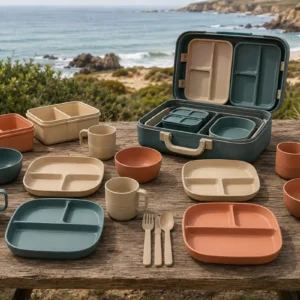
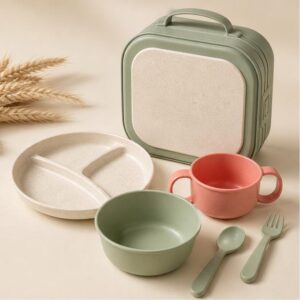
The Split-Drum camping dinnerware set is a four-person development concept built around a rigid cylindrical case that separates horizontally into two shallow staging trays. A removable central utensil mast organizes four knife-fork-spoon groups, while radially textured plates, deep grip-tab bowls, D-handle mugs and two divided lunch boxes occupy controlled sectors. It is not a verified production SKU.
- Two circular case halves become clean staging trays
- Central vertical mast separates utensils from food-contact faces
- Radial component layout creates a distinct cylindrical pack architecture
- Materials, dimensions, interfaces and performance remain project decisions
PRODUCT PARAMETER
| Product concept | Split-Drum four-person camping dinnerware set |
|---|---|
| Reference components | Two-piece cylindrical case, two shallow staging trays, removable central utensil mast, four radially textured plates, four deep grip-tab bowls, four D-handle mugs, two twin-compartment lunch boxes and four knife-fork-spoon groups |
| Material | To be confirmed for the project |
| Dimensions and weight | To be confirmed for the project |
| Color and finish | To be confirmed against approved samples |
| Logo and packaging | To be confirmed for the project |
| MOQ, price and lead time | To be confirmed for the project |
| Compatibility | Compatibility to be confirmed by project sample and drawing. |
REFERENCE CONFIGURATIONS

| Configuration | Buyer choice | Evidence before approval |
|---|---|---|
| Two-setting compact | One tray zone and selected components | Unused-volume restraint and carry balance |
| Four-setting reference | Four complete place settings around the mast | Loaded closure, removal sequence and contact map |
| Meal-container option | Two divided boxes or alternate shared format | Sector envelope, closure path and cleaning access |
| Retail program | Counts, colors, branding, insert and outer pack | Approved matrix, samples, artwork and pack-out |
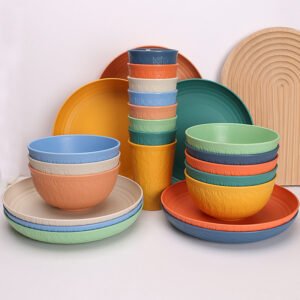
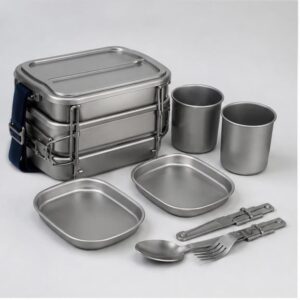
Images show a physical organization concept only. Release a configuration only after component geometry, materials and interfaces are tied to drawings and representative samples.
Use the utensil mast as the radial datum
The removable mast defines the center of the storage system and creates sectors for service pieces and containers. Buyers should define attachment, release direction, utensil-tip protection, cleanability and clearance to both case halves. The concept image is not evidence of retention, impact, compression or repeated-use performance.
Start with controlled maximum envelopes. Record plate diameter and rib height, bowl tab projection, mug handle sweep, lunch-box closure path and protected utensil length. Compare those values with the internal radius, mast channels, sector dividers and lid-clearance drawing. Compatibility to be confirmed by project sample and drawing.
Review the two case halves as staging trays
Separating the drum creates two shallow trays that can organize clean components at the table. The buyer should review edge stability, closure interfaces, drainage or cleaning access, usable surface and the risk of confusing the case halves with food-service items. No serving, food-contact or cleaning claim applies until the final material and intended use are confirmed.
The loaded review must include both carry and open orientations. Observe whether the mast releases without contacting plate faces, whether bowl tabs remain accessible, and whether mug handles create hard contact against the case wall. Log any forced movement, loose component or exposed utensil edge by drawing revision and sample ID.
The divided lunch boxes are configuration placeholders. No leakage, thermal or sealing claim is made. The project must define the closure, intended orientation, food types, contact duration and verification method before any claim is requested. This set is dinnerware and storage equipment, not cookware for direct heat.
Inspect Split-Drum storage interfaces

Control mast fixing, divider clearances, tray closure, utensil protection and component contacts through drawings and complete loaded samples. Compatibility to be confirmed by project sample and drawing.

Application concept only; not a verified customer order, factory output or production SKU.
Customization and connected procurement choices
| Control | Options to review | Dependency |
|---|---|---|
| Set composition | Two/four settings, lunch-box count and shared pieces | Sector volume, mast height and drum envelope |
| Storage architecture | Tray depth, divider pattern, mast fixing and access | Component geometry and cleaning route |
| Service pieces | Plate ribs, bowl tab, mug handle and cutlery grip | Nesting, stability and contact protection |
| Branding | Case color, component finish, logo and packaging | Approved material, process and artwork |
| New geometry | Revised shell, tray, mast or component profile | Drawings, tolerances, samples and feasibility |
B2B development controls
- Freeze the component matrix before fixing mast and sector envelopes.
- Review the complete loaded case in horizontal, vertical and open orientations.
- Protect food-contact faces from utensil tips, dividers and closure hardware.
- Check bowl-tab and mug-handle access without forced contact.
- Define lunch-box closure clearance and return path.
- Approve logo and packaging only after material and process review.
- Keep dinnerware claims separate from cookware and direct heat.
Record component codes, drawing revisions, sample IDs, observed fit, clearance issues, owners and decisions. If shell depth, mast channels, plate thickness, mug handles or packaging inserts change, repeat the affected loaded-case observations. Do not infer production capacity, tolerance, MOQ, price or lead time from the concept image.
Material and compliance boundary
The renderings establish only the Split-Drum organization idea; they cannot verify resin or metal identity, regulatory status, migration, lid sealing, loaded-case strength or suitability for sale in a destination market. Build the evidence request from intended foods, contact duration, temperature, cleaning route, decoration and the rules applicable to the buyer's market. Unresolved values remain “To be confirmed for the project.”
Review the modular component guide, retention matrix and case-fit checklist. Primary context: FDA, EU framework regulation, and NIST traceability.
Procurement FAQs
Do the case halves function as plates?
No such food-contact use is claimed. Their role and final material must be defined and verified for the project.
Is the utensil mast removable?
It is removable in the concept; attachment, retention and cleaning behavior require project confirmation.
How should a buyer specify the divided boxes?
Do not assume leakage resistance. State the closure, carrying orientation, food type, test method and acceptance boundary.
Can existing components fit the drum?
Potential reuse can be reviewed. Compatibility to be confirmed by project sample and drawing.
When are Split-Drum materials approved?
Only after material, finish, color and evidence are confirmed for the specific project.
Which inputs start a Split-Drum quotation?
Send user count, component matrix, drum envelope, storage priorities, target markets, food-use conditions, branding, packaging and evidence expectations.
Build a practical Split-Drum camping dinnerware set
Share setting count, component references, case envelope, storage priorities, target markets, food-use conditions, logo and packaging requirements. Naike Dinner will identify drawings, samples and written confirmations required before approval.
RELATED SOURCING PATHS
Compare Products and Plan Your Project
Review related product formats, then compare material, set configuration, logo, packaging, testing scope and order quantity with our B2B team.