
Kids Wheat Straw Tableware: Safety, Design & Packaging Guide
If you are a brand owner or distributor entering the children’s market with kids wheat straw tableware, you are selling to the most demanding customer segment in the entire tableware industry.
Not the child — the parent.
Parents do not compare prices first. They compare safety first, design second, and price third.
A parent who sees a faint chemical smell, a sharp edge, or a confusing warning label will reject the product instantly — and post about it to thousands of other parents.
The margin for error in children’s tableware is effectively zero.
At Naike Dinner, we manufacture safe toddler dinnerware for clients serving the EU, North America, and Australia.
The compliance requirements for children’s products are dramatically stricter than for adult tableware.
The design standards — rounded edges, divided compartments, suction bases, child-sized proportions — require specialized molds that most general-purpose tableware factories cannot produce.
This guide answers the questions we receive most frequently from B2B buyers entering the kids’ market.
We start with the questions parents will ask about your product. Then we work through the safety standards, design factors, and packaging requirements that turn a good product into a market-leading one.
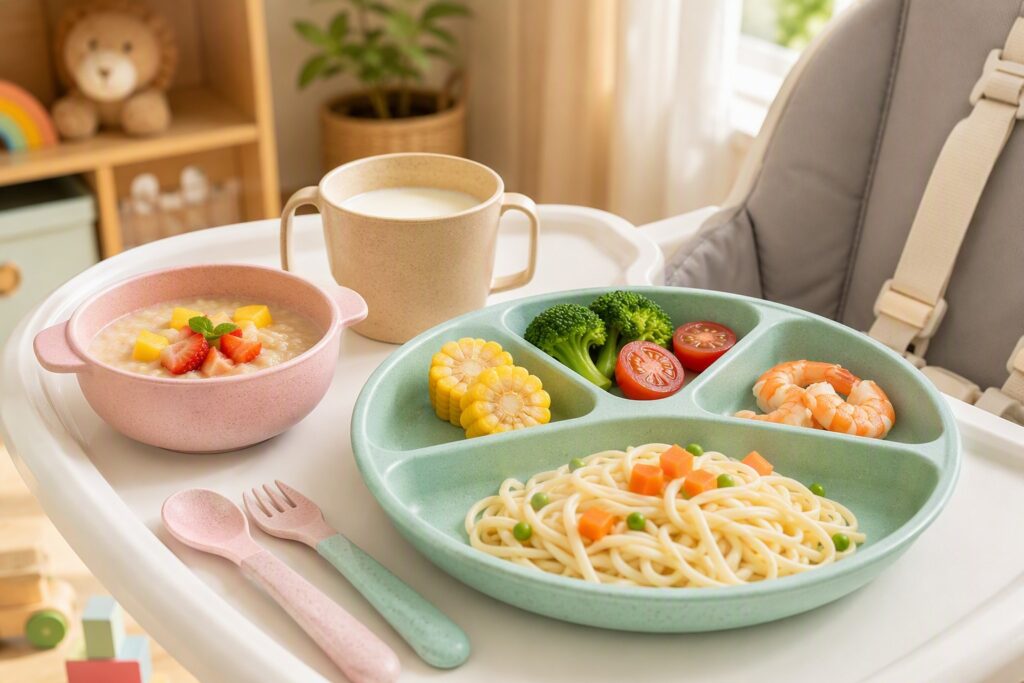
The 7 Questions Every Parent Will Ask About Kids Wheat Straw Tableware
Before you place a single order, your kids wheat straw tableware must answer these seven questions.
If you cannot answer them, the parents reviewing your product listing certainly will not buy.
1. “Is it BPA-free and phthalate-free?” This is the first question, the most common question, and the one where you need documented proof — not a marketing claim.
You must have a current (within 12 months) third-party test report from an ISO 17025-accredited laboratory covering BPA, BPS, BPF, and phthalates.
Our BPA-free verification guide explains exactly which documents to request.
2. “Is it really food-safe for my child?” Parents want to know that no harmful substances migrate into food when the plate holds hot soup or is microwaved.
Your product must pass overall migration and specific migration tests under EU Regulation 10/2011.
3. “Can my toddler use it without making a mess?” This drives the demand for divided plates with raised compartment walls (18-25mm) that keep food separated.
It also drives demand for suction bases that lock the plate to the highchair tray.
4. “Is it dishwasher and microwave safe?” Parents will put your product through the harshest conditions in their kitchen.
Your product must survive 300+ dishwasher cycles without warping, fading, or peeling the logo.
It must also be microwave-safe with fatty food simulants tested — not just water.
5. “Is it unbreakable?” Unlike ceramic or glass, wheat straw composite does not shatter into sharp shards.
A drop from a highchair onto a tile floor should produce a bounce, not a break.
The PP-to-fiber ratio must be correct (60-70% PP) to maintain impact resistance.
6. “Does it smell or taste like plastic?” Children are far more sensitive to sensory issues than adults.
A faint odor that an adult ignores will make a toddler refuse to eat.
Your product must pass the LFGB sensory test (odor and taste) at 70°C.
7. “How do I clean it properly?” Parents will search for your care instructions.
Your packaging must clearly state dishwasher settings, microwave limits, and any cleaning warnings.
Ambiguous instructions generate negative reviews.
Safety Standards for Safe Toddler Dinnerware
Safe toddler dinnerware is regulated more strictly than adult tableware in every major market.
These are the standards your supplier must meet — and the test reports you must collect before the first container ships.
EU Safety Standards for Kids Wheat Straw Tableware
The EU treats children’s food contact materials as a high-priority category.
Your product must comply with EU Regulation 10/2011 (plastic materials and articles intended to come into contact with food).
Where applicable, the Toy Safety Directive EN 71-3 also applies for migration of certain elements.
The EU food contact legislation is the authoritative reference for the full requirements.
For children’s tableware specifically, you must have:
| Substance | Required Result |
|---|---|
| BPA, BPS, BPF | Non-detectable |
| Phthalates (DEHP, DBP, BBP, DINP, DIDP, DNOP) | Non-detectable |
| Heavy metals (lead, cadmium, mercury, chromium VI) | Non-detectable |
| Formaldehyde | Below 15 mg/kg specific migration limit |
| Melamine (if resin-based components) | Below 2.5 mg/kg |
| LFGB sensory test | Pass at 70°C |
US Safety Standards for Kids Wheat Straw Tableware
The United States regulates food contact substances under 21 CFR through the FDA.
For children’s products, the Consumer Product Safety Improvement Act (CPSIA) adds strict limits on lead content in surface coatings.
The applicable requirements are:
- FDA 21 CFR compliance for food contact
- CPSIA lead content compliance for painted or coated surfaces
- ASTM F963 compliance where applicable
Australia and New Zealand Standards
The FSANZ food standards govern food contact materials in Australia and New Zealand.
For children’s products, Australian retailers increasingly require BPA-free certification as a baseline.
The Certification Package to Request
Ask your supplier for a single “Kids Market Compliance Package.”
It should contain: EU 10/2011 migration report, LFGB sensory report, CPSIA lead report, and a material composition declaration.
If a supplier cannot assemble this package, they have not produced children’s tableware for regulated markets.
For a deeper look at how certifications are structured, our BSCI, ISO and SGS guide explains the full document hierarchy.
Design Factors for Kids Wheat Straw Tableware
The design of kids wheat straw tableware is not a scaled-down version of adult dinnerware. It is a separate engineering discipline.
These are the design factors that separate a product parents love from a product parents return.
Divided plate compartments. The standard kids’ divided plate has 3-5 compartments.
The main compartment (entrée) occupies about 40% of surface area, with side compartments for vegetables, fruit, and sauce.
Compartment walls must be 18-25mm high to prevent food from sliding between sections — a feature parents actively search for in reviews.
Rounded, smooth edges. Every edge of a kids’ product must be radiused to a minimum of 0.5mm.
Sharp parting-line flash — acceptable on adult products — is a safety hazard on children’s products.
Your pre-production samples must be inspected for parting-line sharpness before approval.
Suction base compatibility. The premium tier of children’s tableware includes a removable silicone suction base that locks the plate to the highchair tray.
This requires a two-shot molding process or a mechanical snap-fit.
The suction base must withstand 5kg of upward pull and be dishwasher-safe without detaching.
Child-sized proportions. A toddler’s hands are small.
Plate diameters for children are 150-200mm, cup capacities are 150-250ml, and cutlery lengths are 120-140mm.
Using adult-sized proportions makes the product difficult for a child to handle, which creates mess — and negative reviews.
Ergonomic handles and grips. Cups and bowls need easy-grip designs for small hands.
Consider textured grip areas and wide, stable bases that resist tipping.
A cup that tips over when half-full generates frustrated parents.
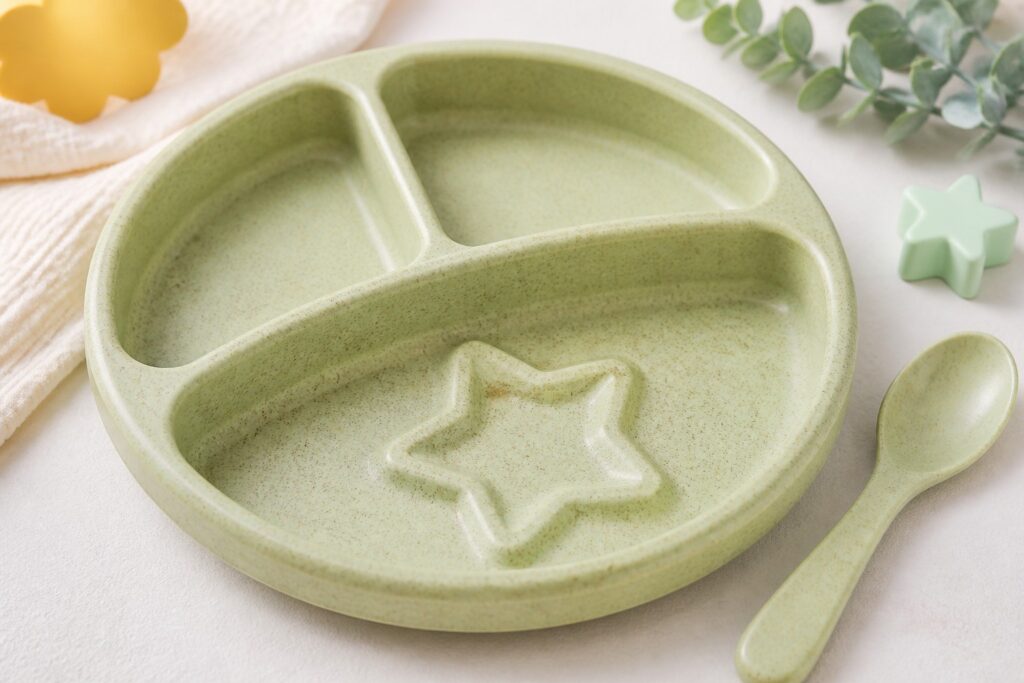
The star-compartment design. Many successful kids’ plates add a small star-shaped or heart-shaped compartment purely for visual appeal.
Children eat more happily when the plate looks playful.
Parents photograph the product for social media — free marketing for your brand.
For brands sourcing matching cutlery for their kids’ line, our cutlery set page shows the child-size specifications we manufacture with extra-rounded tips.

Packaging and Labeling for the Kids’ Market
Children’s tableware packaging must do more than protect the product.
It must communicate safety, comply with market-specific labeling laws, and convert the parent at the point of sale.
EU Labeling Requirements for Kids Tableware
- Product name and intended age range (e.g., “For children 12 months and older”)
- Manufacturer and import details
- Material composition (“Wheat straw fiber + food-grade polypropylene”)
- Care instructions (dishwasher, microwave limits)
- CE marking where the Toy Safety Directive applies
- Warning labels where applicable (e.g., “Use under adult supervision”)
US Labeling Requirements for Kids Tableware
- Product name and intended age
- Manufacturer/importer identification
- Country of origin
- CPSIA compliance statement
- Care instructions
The Parent-Conversion Elements
Beyond mandatory labeling, the packaging must convert a browsing parent into a buyer.
- Visible safety claims on the front panel: “BPA-Free,” “Food-Safe,” “Dishwasher & Microwave Safe” in large type.
- A clear age-range statement: Parents filter by age. “For toddlers 12m+” is a strong conversion element.
- Lifestyle photography: A child eating happily from the product communicates more than any bullet point.
- A sustainability message: “Made with 35% natural wheat straw fiber” appeals to eco-conscious parents.
- QR code to care instructions: Reduces post-purchase questions and negative reviews about cleaning.
Packaging Compliance Pitfall
The most common labeling failure we see in kids’ tableware is the missing age-range statement.
It is mandatory in the EU for children’s products and a strong conversion element everywhere.
Products labeled only as “kids plate” without an age range fail compliance checks and lose the age-filtered search on Amazon.
The B2B Buyer Checklist for Kids’ Tableware
Work through this checklist before confirming any children’s tableware order.
| Check | Requirement | Acceptance Criteria |
|---|---|---|
| ☐ | Compliance package collected | EU 10/2011 migration, LFGB sensory, CPSIA lead, and material reports — current, covering the exact SKU and color |
| ☐ | BPA/BPS/BPF test confirmed | Non-detectable, from an ISO 17025-accredited lab |
| ☐ | Phthalate test confirmed | All six regulated phthalates non-detectable |
| ☐ | Edge radius verified | Minimum 0.5mm on all edges; parting-line flash inspected on pre-production samples |
| ☐ | Divided plate wall height confirmed | 18-25mm compartment walls |
| ☐ | Microwave safety with fatty simulants | Tested at 70°C with appropriate simulants — not just water |
| ☐ | Dishwasher durability verified | 300+ cycles without warping, fading, or logo wear |
| ☐ | Sensory test passed | No odor or taste transfer at 70°C |
| ☐ | Age-range statement on packaging | Mandatory in EU; conversion element everywhere |
| ☐ | Suction base tested (if applicable) | 5kg pull-force resistance, dishwasher-safe, detachable |
For the complete import workflow for children’s products, our import guide covers customs classification and documentation for kids’ tableware shipments.
B2B Buyer FAQ: Sourcing Kids’ Tableware
What is the typical MOQ for kids’ wheat straw tableware?
For standard designs with custom logo and color, the MOQ is typically 500-1,000 units per SKU.
For custom molds — a unique divided plate shape or a branded suction base — the MOQ rises to 3,000-5,000 units per SKU to amortize the tooling cost.
Our 12-piece dinnerware set page shows standard kids’ configurations available for immediate branding.
How do the safety requirements differ from adult tableware?
Three additional requirements apply.
First, strict limits on phthalates — not typically tested for adult tableware.
Second, strict lead limits on any coated or printed surfaces under CPSIA.
Third, a lower threshold for sensory acceptability.
A product that passes adult LFGB standards may still fail the stricter sensory expectations of the children’s market.
Should I offer a suction base on my kids’ plates?
Yes, if your target market is 6-24 months.
Suction bases are the single highest-value feature for toddler feeding.
They significantly increase the perceived value and justify a higher retail price.
However, they add a second component (food-grade silicone) that must be separately tested and certified for food contact.
What colors work best for kids’ tableware?
Soft pastels — sage green, dusty pink, warm beige, soft blue — currently outperform bright primary colors in the eco-friendly children’s segment.
Bright reds and oranges still carry the highest heavy-metal pigment risk and are increasingly avoided by eco-conscious parents.
Neutral pastels also photograph better for e-commerce listings.
Can kids’ wheat straw tableware be sterilized?
Wheat straw composite with food-grade PP binder is steam-sterilizable at 100°C for short cycles.
However, we do not recommend repeated high-heat sterilization.
The product packaging should clearly state the recommended cleaning method: top-rack dishwasher or hand wash with mild detergent.
Steam sterilizer compatibility should not be claimed without specific testing.
How many SKUs should a kids’ tableware line include?
A complete kids’ line should include at least five SKUs: divided plate, bowl, cup, and a fork/spoon set — plus a cutlery set as an upsell.
This gives parents the option of a full matching set, increasing the average order value.
Many successful brands launch with a 5-piece starter set and add accessories like snack cups and placemats as the line matures.
Do I need separate test reports for each color in my kids’ line?
Yes. Each color uses a different masterbatch with different pigments, and each pigment has a different chemical migration profile.
A test report for the sage green plate does not cover the dusty pink plate.
Budget for one full compliance test per color per SKU.
A line of 5 SKUs in 3 colors each requires up to 15 test reports.
What is the retail price range for kids’ wheat straw tableware?
Depending on configuration and packaging, retail prices for kids’ wheat straw sets typically range from 12.99to12.99to39.99.
A single divided plate retails at 8−8−15.
A complete 5-piece set with suction base and gift packaging can command 30−30−40.
The premium is justified by the safety story, the design features, and the eco-friendly material — parents pay for the complete value proposition.
The Kids’ Market Opportunity: Why This Segment Is Growing
The global demand for children’s eco-friendly tableware is being driven by three structural forces that show no sign of slowing.
Parental demand for safer alternatives. The public awareness of BPA and other plastic chemicals reached a tipping point in the past decade.
Parents today actively search for “BPA-free kids plates,” “eco-friendly toddler dinnerware,” and “non-toxic kids tableware” before making a purchase.
This search behavior is reflected in steady demand growth for certified children’s tableware across Amazon, specialty baby stores, and supermarket housewares aisles.
Regulatory pressure on conventional plastics. Governments worldwide are restricting plastic in food contact applications, particularly for children.
The EU’s push toward reusable, certified food contact materials and the expansion of BPA restrictions have created a structural shift.
Retail chains are proactively replacing uncertain plastics with documented, certified alternatives — and wheat straw composite is one of the strongest candidates.
The premiumization of baby and toddler products. Parents spend more per unit on children’s products than on any other household category.
The willingness to pay a premium for safety, design, and sustainability is higher in the kids’ segment than in adult tableware.
A kids’ wheat straw dinnerware set typically retails at a 40-80% premium over the equivalent adult set — and parents pay it willingly when the safety story is credible.
For distributors, this creates a clear opportunity.
The product category has high margins, high repeat-purchase potential, and a strong gifting component — grandparents and relatives consistently purchase children’s tableware as gifts.
Production Considerations for Safe Toddler Dinnerware
Manufacturing kids wheat straw tableware requires production disciplines that general tableware factories often skip.
When auditing a supplier for your kids’ line, verify these specific production points.
Separate Production Runs for Kids Tableware
Children’s products should not be manufactured in the same batch as adult products using the same pigments without a full line purge.
Some factories cross-contaminate production streams, introducing pigments or processing aids from adult products into children’s batches.
Your purchase order should require a documented line purge between product lines.
Color Masterbatch Verification
The pastel pigments used in kids’ tableware must be from certified food-grade masterbatch suppliers.
Bright reds and oranges carry the highest heavy-metal risk and should be avoided or heavily tested.
Every color in your kids’ line needs its own migration and heavy-metal test report — a report for the beige plate does not cover the pink plate.
Edge and Flash Inspection
Parting-line flash — the thin plastic ridge left where the mold halves meet — is a critical safety issue for children’s products.
Your quality control protocol must include a 100% visual inspection for sharp flash on kids’ items.
At minimum, use an AQL level of 1.0 for this defect category (compared to 2.5-4.0 for adult tableware).
The Fingernail Test
A simple factory-floor test we use: run a fingernail along every edge of a kids’ sample.
If the fingernail catches on any ridge, the edge is too sharp for a child’s skin.
This test should be performed on every pre-production sample and recorded in the QC report.
Batch Documentation
Kids’ products require stricter batch traceability.
Your supplier should provide, with every shipment: the pigment batch numbers, the PP resin COA, the wheat straw fiber sourcing declaration, and the production dates.
This documentation supports any future product liability question and is increasingly requested by major retailers.
Common Pitfalls in Kids’ Tableware Sourcing
Even experienced buyers make predictable mistakes when sourcing children’s tableware. These are the three we see most often at the factory level.
Pitfall 1: Assuming one test report covers all colors. A BPA-free report for the beige plate does not cover the pink plate.
Each color uses a different masterbatch. Each pigment has a different migration profile.
Buyers discover this when the retailer asks for per-color documentation, and the entire order is delayed by re-testing.
Pitfall 2: Ordering adult-sized products for children. A 250mm dinner plate and a 200ml cup are adult proportions.
Toddlers cannot handle them, and the products generate negative reviews about mess and difficulty.
Specify child-sized dimensions in your purchase order: plates at 150-200mm, cups at 150-250ml, cutlery at 120-140mm.
Pitfall 3: Skipping the sensory test. Chemical migration tests prove safety. The sensory test proves the child will actually eat from the product.
A product that passes migration but fails the LFGB odor test at 70°C will be rejected by parents within weeks.
Always include the LFGB sensory report in your compliance package.
Conclusion: Building a Safe Kids Wheat Straw Tableware Brand
Kids wheat straw tableware is the highest-opportunity, highest-stakes segment in the eco-tableware market.
The compliance requirements are strict, the parents are vigilant, and the competition rewards products that genuinely meet safety and design expectations.
The brands that win in this category share three traits.
They collect the complete compliance package before the first order — not after the first complaint.
They invest in the design factors parents actually search for: divided compartments, rounded edges, suction bases, child-sized proportions.
And they treat the packaging as a parent-conversion tool rather than a container.
Safe toddler dinnerware is not a product category you can enter with a generic tableware supplier.
It requires a factory that understands children’s safety standards, manufactures the specialized molds for kids’ designs, and documents every material and test report with the rigor the market demands.
Ready to Build Your Kids’ Tableware Line?
Request the kids’ market compliance package and product samples.
We will help you select the right configurations for your target market and price point.
Request Kids’ Tableware Samples & Compliance Package
Browse Ready-to-Brand Kids’ Dinnerware Sets
CONTACT US

Can Wheat Straw Tableware Go in the Freezer?
Can wheat straw tableware go in the freezer? This evidence-led B2B guide explains frozen-storage conditions, material variables, freeze-thaw testing, compliance documents and the questions buyers should ask before approving a freezer-safe claim.

EU GPSR Wheat Straw Tableware: A Traceability Guide
A factory-side guide to GPSR traceability, technical documentation, responsible-person information, online listings and corrective-action planning for EU wheat straw tableware programs.
Does Wheat Straw Tableware Contain Gluten?
A factory-insider guide for B2B buyers evaluating wheat straw material sources, gluten-related claims, testing scope, food-contact compliance and supplier controls.
Bulk Wheat Straw Dinnerware Order: 30 Supplier Questions
Ask these 30 bulk wheat straw dinnerware order questions before you sign. Avoid costly mistakes with our supplier checklist. Send your inquiry with confidence now.
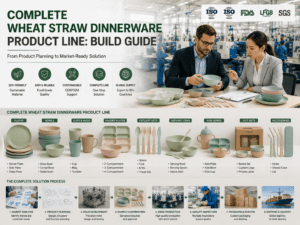
Complete Wheat Straw Dinnerware Product Line: Build Guide
Build a complete wheat straw dinnerware product line with plates, bowls, cups and cutlery. Learn assortment strategy, SKU planning and margin optimization. Get your line quote.
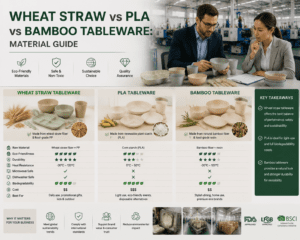
Wheat Straw vs PLA vs Bamboo Tableware: Material Guide
Compare wheat straw vs PLA vs bamboo tableware for B2B sourcing. Learn heat resistance, cost, and safety differences. Get material recommendations now.