
Compare Tableware Suppliers: B2B Factory Audit Guide
I have been on both sides of the factory audit table. Since 2008, as a manufacturer of wheat-straw composite and reusable tableware, I have hosted hundreds of buyer inspections — from junior sourcing agents ticking boxes on a form, to seasoned procurement directors who could spot a regrind contamination issue from 20 meters away.
Here is the uncomfortable truth: most B2B buyers do not know how to compare tableware suppliers in a way that predicts actual performance. They compare spreadsheets. They compare unit prices. They compare response times on WhatsApp. But none of those metrics tell you whether a supplier will deliver 20,000 identical, compliant, on-spec plates to your warehouse on time.
A proper supplier comparison is a structured investigation. It requires a pre-audit document review, an on-site walkthrough with the right factory audit questions, and a scoring framework that weights safety and consistency above price. This guide gives you that framework — built from the factory floor, not a procurement textbook.

Why Most Supplier Comparisons Fail
The typical B2B buyer evaluates three suppliers, compares three quotations, and picks the cheapest one that “seems professional.” This approach fails for a simple reason: a quotation is a marketing document, not a manufacturing contract. The supplier who quotes $0.05 less per unit may be using a lower PP-to-fiber ratio, skipping the annealing process, or sourcing unverified pigments — decisions that become your problem six months later when the plates start warping in customers’ microwaves.
For example, two quotations can show similar unit prices while covering different material specifications, test scopes, packaging and inspection requirements. Compare the approved sample, written specification, applicable test evidence and total landed cost before selecting a supplier.
If you are sourcing from our wheat straw dinnerware catalog, you will see exactly the level of documentation the industry expects from a professional manufacturer.
The difference between a good supplier and a cheap supplier is not visible on a quotation. It is visible in the audit.
The Pre-Audit Document Review
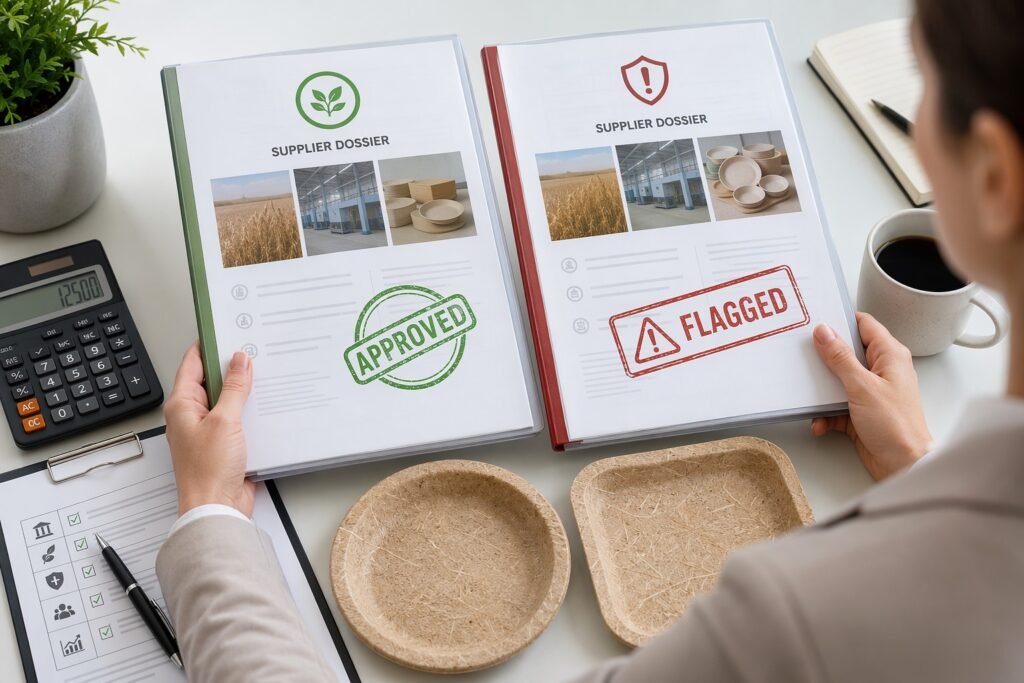
Before you book a flight or hire an inspector, there are six documents every supplier should provide within 48 hours of your request. If they cannot produce these, you do not have enough information to schedule an audit — and they have already failed the first test.
1. Business License and Export Registration This confirms the legal entity name, registered address, and business scope. Cross-reference the name on this document with the name on your Proforma Invoice. If they do not match, you are dealing with a trading company, not a manufacturer — which changes your entire risk profile.
2. ISO 9001:2015 Certification This is the baseline quality management standard. Verify the certificate number on the official ISO database or the issuing body’s portal. Many factories display expired or photoshopped certificates.
3. BSCI or SEDEX Audit Report Social compliance matters. European retailers in particular will not onboard a supplier without a valid BSCI audit. The report must be less than two years old and must show no “Zero Tolerance” violations.
4. Product-Specific Third-Party Test Reports A generic “plastic tableware” report is not sufficient. The report must list the exact material composition — for example, “Wheat Straw Fiber (35%) + Food-Grade Polypropylene (65%) Composite Plate” — and cover the specific color SKU you are ordering. Reports from SGS, TÜV, or Intertek carry the most weight with customs authorities and retail buyers.
5. Factory Audit Questionnaire (Self-Declared) Ask the supplier to complete a standardized questionnaire covering: number of injection molding machines, annual production capacity, number of QC staff, and a list of their five largest export customers. A supplier who refuses to share this information is hiding limited capacity.
6. Raw Material Certificates of Analysis (COA) For wheat straw composite, the supplier should provide a COA from their PP resin supplier and a sourcing declaration for the wheat straw fiber. This is how you verify the material ratio they claim in their quotation matches what actually goes into the mold.
If you are evaluating custom projects, our custom reusable plates product page shows the technical specifications we provide with every quotation — use it as a benchmark for what a professional supplier should offer.
15 Factory Audit Questions Every B2B Buyer Must Ask
When you are on-site, do not let the supplier control the narrative. They will want to show you the finished goods warehouse — the cleanest, quietest part of the factory. You need to see where the problems hide. These 15 factory audit questions are organized by production zone.
Raw Material Zone
- Question 1: “Show me the sealed PP resin bags with the batch number visible.” If the bags are open, unlabeled, or stored on a dirty floor, contamination risk is high.
- Question 2: “Where do you store the wheat straw fiber, and what is its moisture content right now?” Wheat straw fiber must be stored in a dry, temperature-controlled area. Moisture above 8% leads to surface defects.
- Question 3: “Show me the color masterbatch inventory. Is each batch labeled with the supplier name and date?” Unlabeled pigments are a heavy-metal risk.
Production Zone
- Question 4: “What is the current injection temperature on this machine, and what is the specification?” The answer must be within 5°C of the spec. Too hot = fiber charring. Too cold = incomplete mold fill.
- Question 5: “Show me the regrind storage area. What percentage of regrind goes back into food-contact products?” The correct answer for food-contact items is zero percent. Regrind introduces unknown contaminants.
- Question 6: “When was this mold last maintained, and what is its shot count?” Molds need polishing every 300,000-500,000 shots. Rough mold surfaces produce plates with sharp flash.
- Question 7: “Can you show me the annealing process?” Plates must be slowly cooled in a controlled cycle after molding to relieve internal stress. If the supplier says “we don’t anneal,” expect warping in microwaves.
Quality Control Zone
- Question 8: “Show me the Golden Sample for my order and the QC inspection records from the last production run.” If they cannot produce both within two minutes, their documentation system is broken.
- Question 9: “What is your AQL standard for major defects, and how many inspectors work per shift?” For tableware, major defects should be sampled at AQL 2.5 with at least two dedicated QC staff per shift.
- Question 10: “Do you have an in-house migration testing capability, or do you send everything to an external lab?” In-house capability (even basic) means they test more frequently.
Warehouse and Logistics Zone
- Question 11: “Show me the oldest stock of my product category. Pull the third carton from the bottom of that pallet.” This reveals whether warehouse storage conditions cause delayed defects like stress cracking.
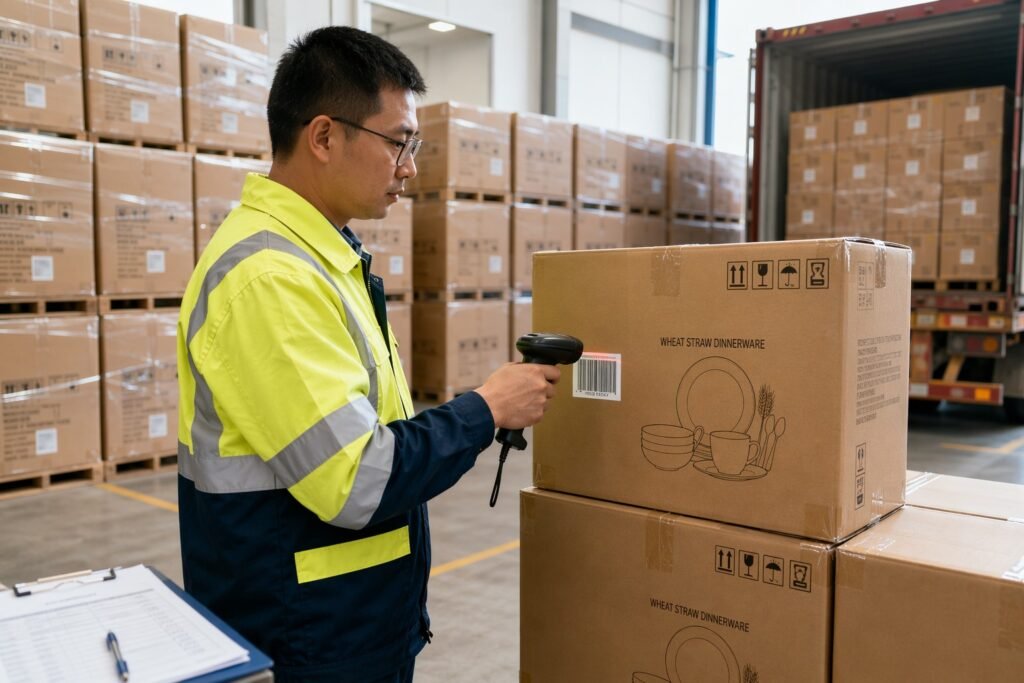
- Question 12: “What is your carton drop-test protocol, and when was the last test performed?” Export cartons must pass a 1.2-meter drop on six sides and four corners.
- Question 13: “Show me the barcode verification equipment.” If they do not own a GS1-compliant scanner, your barcodes may not scan at the destination warehouse.
Management and Ethics
- Question 14: “What happens if my independent inspector finds a batch failure?” The right answer: “We rework at our cost and submit for re-inspection.” The wrong answer: “That never happens here.”
- Question 15: “Can I speak to your QC manager alone for five minutes, without the sales team present?” If the sales team refuses or the QC manager looks uncomfortable during the conversation, there is a gap between what the factory claims and what actually happens on the floor.
How to Score and Weight Suppliers
Asking the right factory audit questions is step one. Scoring the answers objectively is step two. Here is the framework we recommend to our own OEM partners when they evaluate manufacturers.
| Evaluation Category | Weight | What to Score |
|---|---|---|
| Documentation completeness | 15% | Business license, ISO/BSCI certs, test reports — all current and verifiable |
| Material quality and traceability | 25% | PP resin source, fiber source, masterbatch labeling, regrind policy |
| Production capability | 20% | Machine count, mold maintenance records, annealing process, daily output capacity |
| Quality control systems | 20% | AQL standards, in-house testing, Golden Sample protocol, QC staff ratio |
| Logistics and packaging | 10% | Carton drop-test, barcode verification, loading plan capability |
| Management transparency | 10% | Willingness to share records, independent QC manager access, rework policy |
Apply a 1-5 scale to each category, multiply by the weight, and calculate a total score out of 5.0.
Our recommendation: Never shortlist a supplier scoring below 3.5. Never award a contract to the highest-scoring supplier without visiting the factory — or sending an independent inspector who follows this exact framework.
For a deeper look at the production quality benchmarks behind these categories, our wheat straw bowl manufacturer page details the specific QC checkpoints we maintain for every product line. You can use it as a reference standard when evaluating other facilities.
The 7 Red Flags That Eliminate a Supplier Immediately
Some problems cannot be fixed with better communication. These seven red flags should trigger an immediate removal from your shortlist — no second chances, no “let’s discuss.”
Unwillingness to share full test reports. If a supplier sends only the cover page of an SGS report and claims the rest is “confidential,” they are hiding something. Full reports are 8-25 pages. The cover page alone proves nothing.
Refusal to allow unaccompanied factory floor access. A supplier who insists on escorting you through a pre-planned route is hiding sections of the facility. Professional manufacturers are proud of their entire operation and welcome unscripted tours.
Inconsistent answers between staff members. Ask the QC manager and the production manager the same question: “What is the PP-to-fiber ratio?” If the answers differ by more than 5%, nobody actually controls the material formulation.
Evidence of regrind in food-contact production. If you see a grinder next to the injection machine with food-contact waste going in and the output feeding back to the hopper, leave immediately. This is a food safety violation regardless of what the salesperson tells you.
No Golden Sample on the QC bench. If the QC inspectors do not have a reference sample on their station to compare against production, they are inspecting from memory. This is not quality control — it is guesswork.
Off-season factory visit that feels “too quiet.” If you visit during what should be peak production season and fewer than 60% of the machines are running, the factory may be a trading front that subcontracts your order to a lower-quality facility after you leave.
Pressure to sign before you leave. A legitimate supplier wants you to make an informed decision. A supplier who pushes for a contract signature or deposit before you board your return flight is hiding something that deeper due diligence would uncover.
If you want to understand what a fully transparent supplier relationship looks like, read about Naike Dinner — we publish our certifications, material specifications, and factory capabilities openly because we believe the audit should confirm what the documents already prove.
Building a Long-Term Supplier Partnership
Finding a supplier that passes a rigorous audit is valuable. Building a long-term partnership with that supplier is transformational for your business.
A transactional buyer re-audits every order, negotiates every price increase, and treats the factory as an adversary. A partnership buyer invests in the relationship: they share 12-month demand forecasts, they visit for annual technical reviews rather than only for problem-solving, and they involve the factory’s engineering team in new product development.
The return on this investment is measurable. Our longest-standing OEM partners receive priority production scheduling during peak season, first access to new material formulations, and a dedicated engineering contact for custom mold development. They also receive better pricing — not because they negotiate harder, but because their predictable order volumes allow us to optimize raw material purchasing and production planning.
If you are at the early stage of evaluating suppliers, contact Naike Dinner to request our standard supplier qualification package. It includes our current ISO and BSCI certifications, a sample SGS test report for wheat straw dinnerware, and a factory floor plan with machine layout — the documents you need to begin your pre-audit review.
Scenario Analysis: Two Suppliers, One Scorecard
To make this framework concrete, here is how it played out in a real supplier comparison conducted by a North American distributor in early 2026.
The buyer evaluated two wheat straw plate manufacturers. Both quoted a 10-inch dinner plate. Both claimed ISO 9001 certification. Both promised 25-day lead times. On paper — and on price — they looked nearly identical.
| Category | Supplier X (Quoted $0.58) | Supplier Y (Quoted $0.71) |
|---|---|---|
| Documentation (15%) | Score 2: Business license only; ISO cert expired; no BSCI | Score 5: All six documents provided within 24 hours |
| Material traceability (25%) | Score 1: PP bags unlabeled, no fiber COA, regrind visible near machines | Score 4: Labeled resin batches, fiber moisture log, zero regrind policy |
| Production capability (20%) | Score 3: Machines running but no annealing process visible | Score 5: Annealing ovens in operation, mold logs current |
| Quality control (20%) | Score 1: No Golden Sample on QC bench, no AQL documentation | Score 4: Golden Sample present, AQL 2.5 standard, two inspectors per shift |
| Logistics (10%) | Score 3: Cartons looked standard, no drop-test records available | Score 4: Drop-test log maintained, barcode scanner on-site |
| Transparency (10%) | Score 1: Sales team refused unaccompanied access to QC area | Score 5: Full access, QC manager answered all questions directly |
| Weighted Total | 1.85 / 5.0 | 4.50 / 5.0 |
Supplier X was cheaper by 0.13perunit—a0.13perunit—a2,600 saving on a 20,000-unit order. But the audit revealed that Supplier X had no annealing process, unlabeled raw materials, and a sales team that blocked access to the QC department. The “saving” would have been consumed many times over by defect-related returns, Amazon listing penalties, and brand damage.
The buyer chose Supplier Y. The order arrived with a 1.2% defect rate and passed a third-party pre-shipment inspection on the first attempt. The total landed cost — including freight, duties, and inspection — was lower than Supplier X’s when defect and return costs were factored in.
The lesson: When you compare tableware suppliers, weight safety and consistency at 70% of your decision and price at 30%. Any other ratio is gambling.
B2B Buyer FAQ: Supplier Audits and Comparisons
How long should a factory audit take? A thorough audit of a wheat straw tableware factory takes 4-6 hours. You need time to inspect the raw material zone, observe production in progress, audit the QC station, review documentation, and walk the warehouse. If a supplier tries to compress your visit into a 90-minute conference room meeting followed by a quick factory walk, they are managing your perception rather than demonstrating their capability.
Can I audit a supplier remotely? Yes, and many buyers do for initial screening. Request a live video walkthrough using the 15 questions in this guide as your script. The supplier must show you real-time machine temperature displays, raw material labels, and QC logs — not pre-recorded footage. But reserve final approval for an in-person or third-party audit. A video cannot show you the regrind bin hidden behind the warehouse door.
What if two suppliers score identically? If two suppliers both score above 4.0, choose the one with better communication. After the audit, evaluate response quality during the follow-up phase. The supplier who sends a structured post-audit summary with answers to your follow-up questions within 24 hours is the one who will communicate clearly when problems arise during production.
Should I tell the supplier my scoring criteria before the audit? Yes. Share the six-category framework and the 15 questions in advance. A professional supplier will prepare documentation and ensure the right staff are available. A supplier who is alarmed by the transparency of your process is a supplier who relies on buyer confusion to close deals.
How often should I re-audit an approved supplier? Annually, at minimum. Material formulations, machine conditions, and staff change. An audit from 2023 is not valid for a 2026 order. Many of our OEM partners schedule a technical review visit every 12 months and request updated test reports every 6 months for high-volume SKUs.
If you are preparing for your first supplier audit, our sample approval process guide covers how to evaluate the physical product alongside the factory itself.
Conclusion
The ability to compare tableware suppliers effectively is not a sourcing skill — it is a competitive advantage. Every dollar you invest in a structured audit process returns ten dollars in avoided defects, prevented returns, and preserved brand reputation.
The 15 factory audit questions in this guide are not theoretical. They are the questions that separate professional manufacturers from order-takers, and they are the questions that protect your business from the most expensive mistake in importing: trusting a quotation instead of verifying a factory.
When you audit a supplier with the rigor described here, you move from being a buyer who hopes for quality to a buyer who can prove it.
Ready to Audit Your Next Supplier?
Start your evaluation with a supplier who meets every standard in this guide before you even ask.
Request Our Supplier Qualification Package
Browse the Premium 24-Piece Wheat Straw Dinnerware Set
CONTACT US
Shared Serving Pieces vs Individual Place Settings for Group Camping
A procurement framework for deciding which camping dinnerware components should be issued per person and which should remain shared across a group.
How to Prevent Rattle in a Nested Camping Dinnerware Set
A practical diagnostic for finding and controlling movement, impact and rubbing inside nested camping dinnerware sets without hiding problems behind unsupported claims.
How to Calculate Pack Volume for Camping Tableware
A practical procurement worksheet for measuring the complete camping tableware sales unit, calculating its external cube and separating real pack efficiency from unsupported freight claims.
Nesting vs Stacking: How the Two Designs Change Pack-Out
A buyer-focused geometry and pack-out comparison for choosing nested, stacked or hybrid camping dinnerware systems without confusing compact appearance with approved performance.

What Makes Camping Dinnerware Truly Stackable?
A procurement acceptance framework for reviewing stack rise, contact interfaces, separation, stability, mixed-component order, drainage and retained pack-out.

Deep Bowls vs Shallow Bowls for Outdoor Meal Sets
A procurement decision table for selecting deep and shallow camping bowl profiles by meal function, user access, stability, cleaning and packed-set architecture.