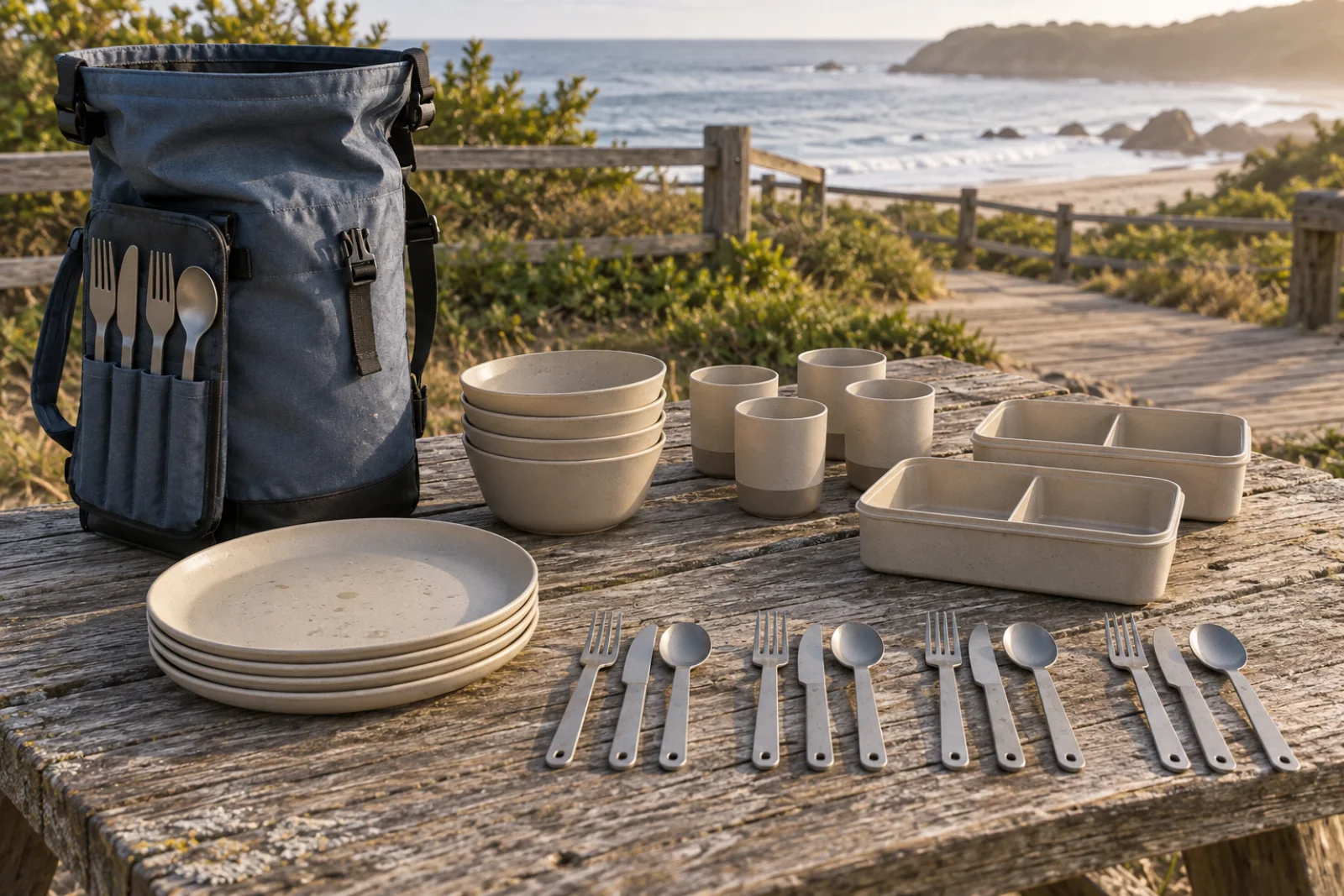
Description
PRODUCT PARAMETER
| Product concept | Roll-top modular camping dinnerware set |
|---|---|
| Reference users | Four users; final user count to be confirmed for the project |
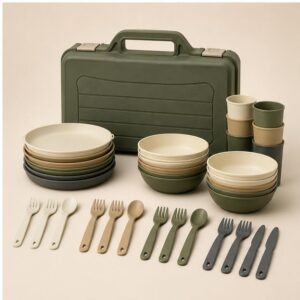
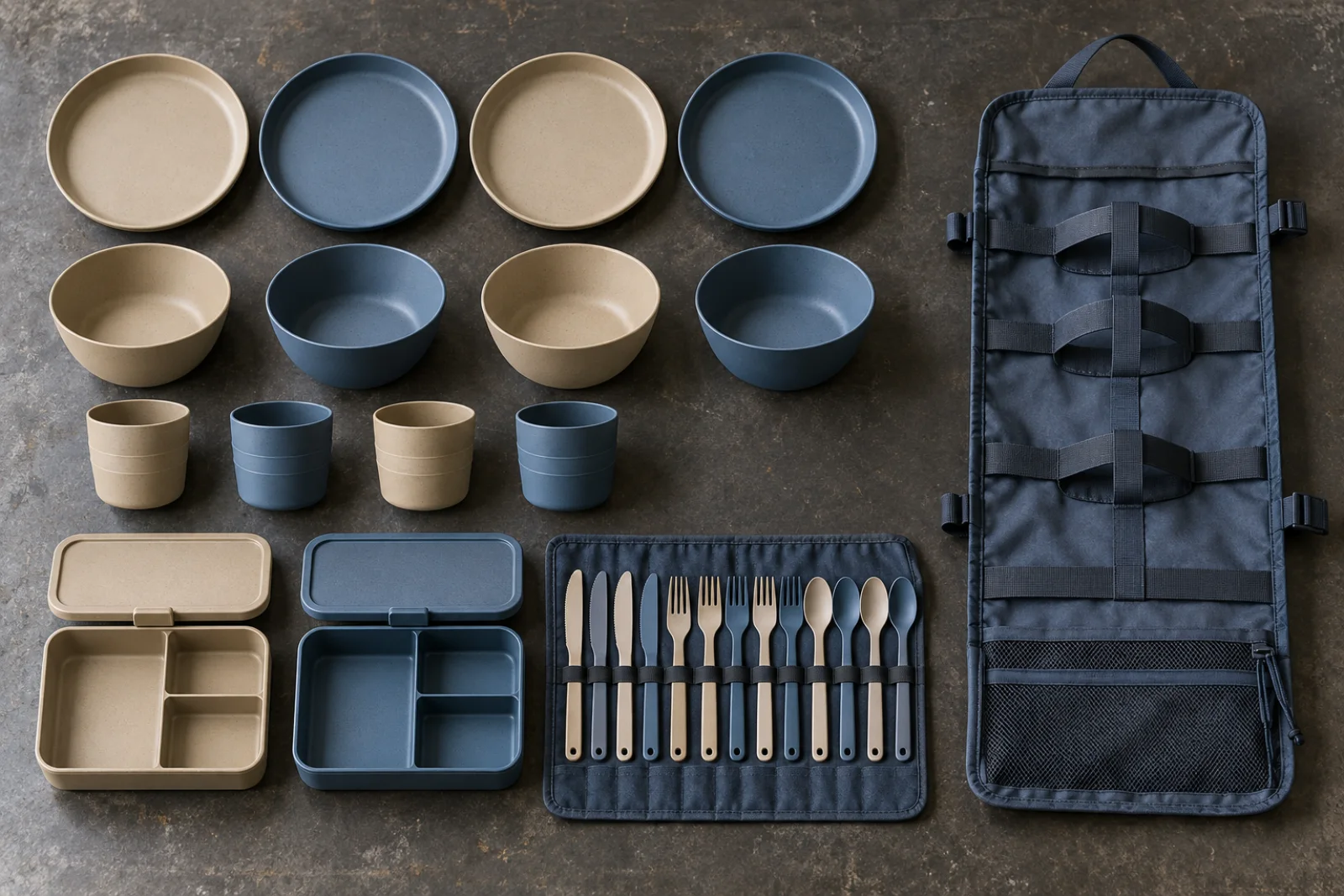
| Reference components | Shallow plates, deep bowls, low tumblers, divided food boxes, fork/knife/spoon groups, removable utensil sleeve and vertical carry bag |
| Material direction | PP-based tableware concept with separate textile carry components; exact formulations to be confirmed for the project |
| Color direction | Slate blue and warm sand reference palette; production colors to be confirmed for the project |
| Dimensions and capacity | To be confirmed for the project after component and nesting review |
| SKU | To be confirmed for the project |
| Logo and decoration | Artwork location and process subject to surface, material and project feasibility review |
| Packaging | Retail, transit and presentation format to be confirmed for the project |
| MOQ, price and lead time | To be confirmed for the project; no universal value is stated on this page |
| Applicable markets | Europe, North America, Australia and comparable B2B markets, subject to destination requirements |
REFERENCE CONFIGURATIONS
The modular camping dinnerware set is presented as a configurable system rather than a fixed catalog promise. Buyers can use the following reference configurations to describe a program, then confirm every quantity, interface and use condition through samples, drawings and written quotation.
| Configuration | Individual components | Shared and storage components | Buyer decision |
|---|---|---|---|
| Four-user meal set | Plate, bowl, cup and selected utensil group per user | Roll-top carrier and removable cutlery sleeve | Confirm meal type, component quantity and packed target |
| Four-user packed-lunch set | Selected eating and drinking pieces per user | Two divided food boxes plus vertical organization | Define box role and any closure-related claim before testing |
| Two-user compact variant | Reduced place-setting count | One or two food boxes and adjusted retention system | Confirm whether a new bag layout or tooling review is needed |
| Retail assortment variant | Channel-selected plate, bowl, cup and utensil combination | Presentation insert, carry bag and artwork package | Align visible count, replacement logic and packaging claim |
Build the set around a controlled component matrix
A buyer should define the set from the intended users and meals, not from an arbitrary headline piece count. The component matrix identifies how many plates, bowls, cups and utensil groups belong to each user, then adds only the food-storage and organization pieces with a documented task.
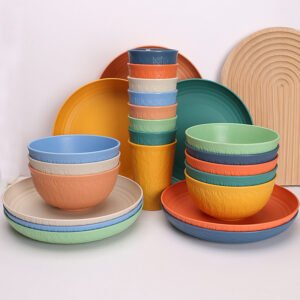
This approach supports different purchasing intentions without presenting the same product under a new color or background. A family retail program may emphasize complete place settings and shared food boxes, while an event, rental or vehicle-camping program may prioritize fast inventory checks, replacement components and a secure vertical carry arrangement.
Each quoted version should state the counting convention. Lids, utensils, straps, sleeves and the bag can be counted differently in commercial descriptions, so the matrix should show both physical part quantity and functional role. This enables buyers to compare proposals on an equivalent basis.
Vertical roll-top organization
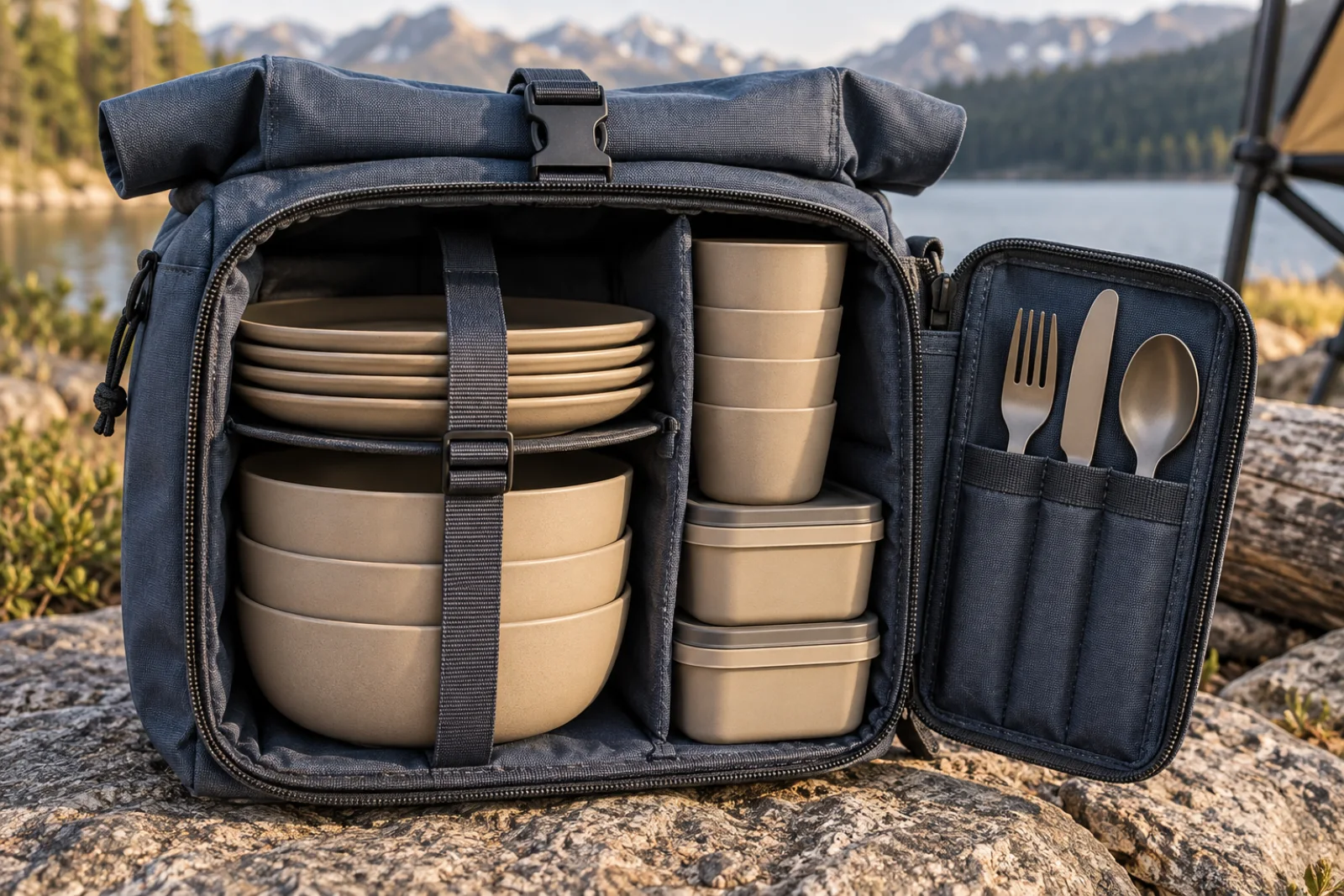
The proposed carrier uses height rather than a broad flat footprint. Plates and bowls form a restrained vertical stack, cups and food boxes occupy adjacent zones, and the removable sleeve separates utensil handles from primary food-contact surfaces. The roll-top opening provides adjustment potential when the final component height changes.
This is a design direction, not proof of fit. Stack height, rim contact, retention pressure, zipper or buckle position and repacking sequence must be checked with representative project samples. Compatibility to be confirmed by project sample and drawing.
Component combination and new-set development
Naike Dinner can review a buyer’s proposed combination against available product information and project requirements. The review begins by separating verified existing components from new shapes, modified interfaces, packaging work and any tooling proposal. No molding capability, production timing or compatibility is assumed until the relevant records and project inputs are checked.
For a new combination, the buyer should provide target users, meal pattern, component priorities, preferred colors, logo zones, retail channel, destination market, packing constraints and evidence needs. We then identify open decisions such as whether a cup nests inside a bowl, whether a divided box fits the vertical zone, or whether the utensil sleeve must be removable for cleaning.
A component may be attractive in isolation but unsuitable for the assembled set. Rim geometry can concentrate pressure, handles can consume pack space, lids can interfere with retention straps, and a taller cup can change the closing position. These interfaces should be resolved before artwork and packaging are frozen.
Customization options for B2B programs
| Customization area | Buyer input | Project control |
|---|---|---|
| Component combination | User count, required vessels, utensil group and food-box role | Return an approved component matrix with quantity and interface notes |
| Shape development | Reference drawing, intended foods, nesting goal and handling needs | Tooling feasibility, dimensions and timing to be confirmed for the project |
| Colors and surface | Palette, finish direction and channel presentation | Confirm material-compatible color process and approved sample |
| Logo and artwork | Vector file, placement, size, colors and durability expectation | Confirm process, surface, proof and evidence scope before production |
| Carry system | Transport mode, opening style, straps, internal zones and cleaning expectations | Approve bag drawing, materials, retention trial and packed sample |
| Retail packaging | Channel, presentation, language, claims and logistics target | Align artwork, component count, pack method and transit validation |
Outdoor application scenarios
This custom camping dinnerware set concept is aimed at organized group meals where the same assortment moves between storage, transport and an outdoor table. Potential project scenarios include vehicle camping, campground meals, family park picnics, caravan programs, terrace catering and outdoor retail bundles. Suitability depends on the approved configuration and use conditions.
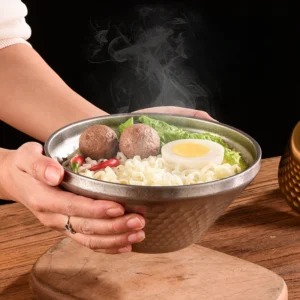
The set is dinnerware and food-storage equipment, not direct-flame cookware. No plate, bowl, cup or food box should be placed on a burner, stove, campfire or open flame unless product-specific verified evidence and instructions explicitly permit that use. The visual scene below represents table service only.

Material and compliance boundaries
The reference images suggest a PP-based reusable tableware direction and a separate textile carry system, but the exact resin, additives, colorants, food-contact scope and textile construction must be confirmed for the project. A broad material label does not demonstrate suitability for every food, temperature, contact time, cleaning method or destination market.
For U.S. projects, buyers can frame their evidence request using the FDA’s guidance on determining the regulatory status of food-contact material components and the FDA’s food types and conditions of use. For EU programs, Regulation (EC) No 1935/2004 provides the general food-contact framework, with material-specific requirements and evidence still needing project review.
Requested documents should identify the tested or assessed component, material identity, applicable condition and report scope. The product page does not claim a certificate, migration result, mechanical performance, dishwasher life or leak resistance. These claims require documented project-specific review.
B2B development controls
- Component freeze: Approve a revision-controlled list before final quotation and artwork.
- Interface review: Confirm nesting, lid fit, utensil sleeve and bag retention with representative samples and drawings.
- Claim boundary: Separate verified product facts from desired buyer claims and unresolved evidence.
- Pack trial: Check movement, rim contact, abrasion, closing force and repacking sequence.
- Market review: Align materials, labeling, instructions and evidence with intended destination and use.
- Change control: Require written approval for substitutions that affect appearance, fit, use or documentation.
Related live options can help buyers clarify the desired format. Compare the split-pouch family camping set for a round two-zone storage direction, the compact duo camping meal set for a smaller user count, and the six-person PP camping dinnerware set for a larger group brief. These are separate products or concepts; compatibility is not implied.
Approve the component matrix before the visual assortment
The development record for a modular camping dinnerware set should begin with a controlled component matrix. For each line, record the functional name, intended user, meal task, proposed quantity, material direction, color, interface, packed position and approval status. This document prevents a visually attractive sample from being accepted while a required cup, lid or utensil position remains undefined.
Use separate status fields for fixed requirement, preferred option and supplier proposal. A fixed requirement may be one complete place setting per user; a preference may be the slate-blue and sand palette; a supplier proposal may be the exact retention-strap routing. This distinction gives designers room to solve the pack without changing the buyer’s essential commercial promise.
Any alternative should be returned as a visible deviation, not hidden in a revised image. If a different bowl improves nesting, the proposal should explain the changed rim profile, stack height, user capacity and bag relationship. The buyer can then approve or reject the change with its consequences understood.
Packing-volume and retention review
Nominal component dimensions do not equal packed dimensions. The review should account for rim clearance, lid features, textile thickness, internal dividers and the free space needed for users to remove and replace pieces. The confirmed packed envelope should come from the representative assembled sample, not from adding catalog dimensions.
Test the vertical sequence in the way users are expected to pack it. Observe whether the lower bowls carry unintended pressure, whether the plates can tilt, whether cup rims contact hard surfaces, and whether the food-box lids remain unloaded. The cutlery sleeve should retain items without forcing sharp edges or handles against adjacent food-contact surfaces.
A roll-top closure provides adjustment but should not be used to hide uncontrolled variation. Define the acceptable closing position, buckle engagement and handle load path after the component stack is approved. If the set will be carried by shoulder strap, vehicle handle or shelf grip, state that use so the bag construction can be reviewed for the actual task.
Sample review plan for a complete set
Review the first sample as a complete system. Begin with a count against the approved matrix, then perform a dry assembly and photograph the agreed pack sequence. Check that every component can be identified, removed and returned without specialized knowledge, and record any point where users can pack an item in a damaging orientation.
Next, conduct a representative meal exercise using foods and beverages within the intended scope. The objective is not to create an unsupported performance claim; it is to verify that vessel roles, portions, utensil selection and shared-piece access make sense. Record decisions such as deleting an unused bowl, changing a cup position or adding a clearly justified serving function.
Finally, inspect the washed and dried components under the defined cleaning method. Look for trapped water in the packing sequence, difficult-to-reach areas, odor-retention concerns, textile contact with damp surfaces and loss of small items. Cleaning compatibility and durability claims require their own evidence, but this workflow can expose a poor configuration before a formal validation plan is approved.
Quotation and approval package
A useful written quotation for the modular camping dinnerware set should reference the same matrix revision as the sample and drawings. It should separate existing components, modified components, new tooling candidates, textile work, decoration and packaging, while leaving unverified fields clearly marked “To be confirmed for the project.”
The buyer should also request a list of assumptions. Examples include the intended food-contact conditions, color standard, artwork format, packing orientation, destination-market documentation and whether the bag is retail packaging or a reusable product component. An assumption becomes a controlled decision only when both sides approve it in writing.
Before order release, align the component matrix, approved sample, controlled drawings, artwork, test or evidence list, packaging specification and quotation. If one record shows four cups while another shows two, or if a bag drawing predates a bowl change, stop and reconcile the package. This control is more valuable than maximizing a piece count or adding unverified sales language.
Procurement FAQ
Is this roll-top modular camping dinnerware set a stocked SKU?
No stocked-SKU claim is made. It is a configuration concept based on outdoor tableware product directions and must be checked against current company records, component availability, samples and project requirements before quotation.
Can we change the number of plates, bowls, cups or boxes?
Yes, the buyer may propose another matrix. The resulting stack, bag zones, retention and packaging must then be reviewed. Compatibility to be confirmed by project sample and drawing.
Can Naike Dinner quote an MOQ or price from this page?
No universal MOQ or price is stated. Both depend on the confirmed component list, materials, decoration, packaging, tooling status, quantity and evidence requirements. They will be confirmed in a written project quotation.
Can the roll-top bag and utensil sleeve carry our logo?
Logo placement can be reviewed after artwork, surface, process, durability expectation and packaging context are provided. No printing or embroidery process is promised until feasibility is confirmed.
Are the divided food boxes leakproof?
No leakproof claim is made. The intended closure performance and verification method must be defined, and representative samples must be assessed under the agreed condition before any claim is approved.
Can we develop new molds for unique plates or bowls?
A tooling proposal can be evaluated from drawings, intended use, nesting interfaces and project requirements. Tooling feasibility, ownership, cost, timing and validation remain to be confirmed for the project.
What should we send for a useful quotation?
Send user count, component matrix, material direction, target colors, artwork, carry concept, packaging needs, market, use conditions, evidence list and expected order context. Mark fixed requirements separately from preferences.
Develop your modular outdoor set
Share the component list you want to combine, including plate, bowl, cup, lunch-box, cutlery and carry-system roles. Naike Dinner will review the request against verified product information and identify which dimensions, interfaces, samples, artwork, packaging and evidence must be confirmed before a written quotation.
Request a component and tooling review
For drawing-led projects or alternative group sizes, use the Naike Dinner inquiry form and state the intended market and application. Unknown specifications will remain “To be confirmed for the project” until supported by the approved project record.
RELATED SOURCING PATHS
Compare Products and Plan Your Project
Review related product formats, then compare material, set configuration, logo, packaging, testing scope and order quantity with our B2B team.