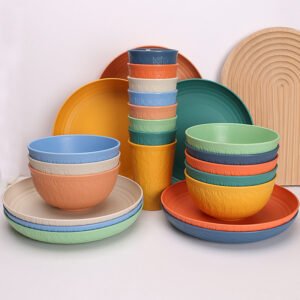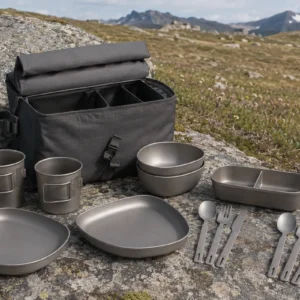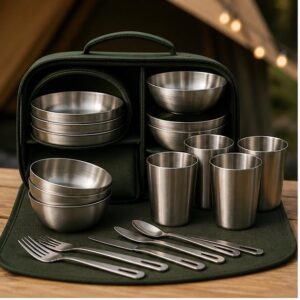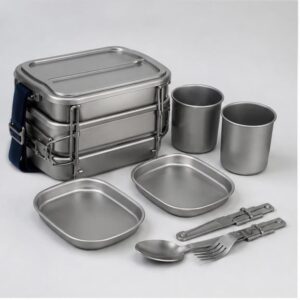
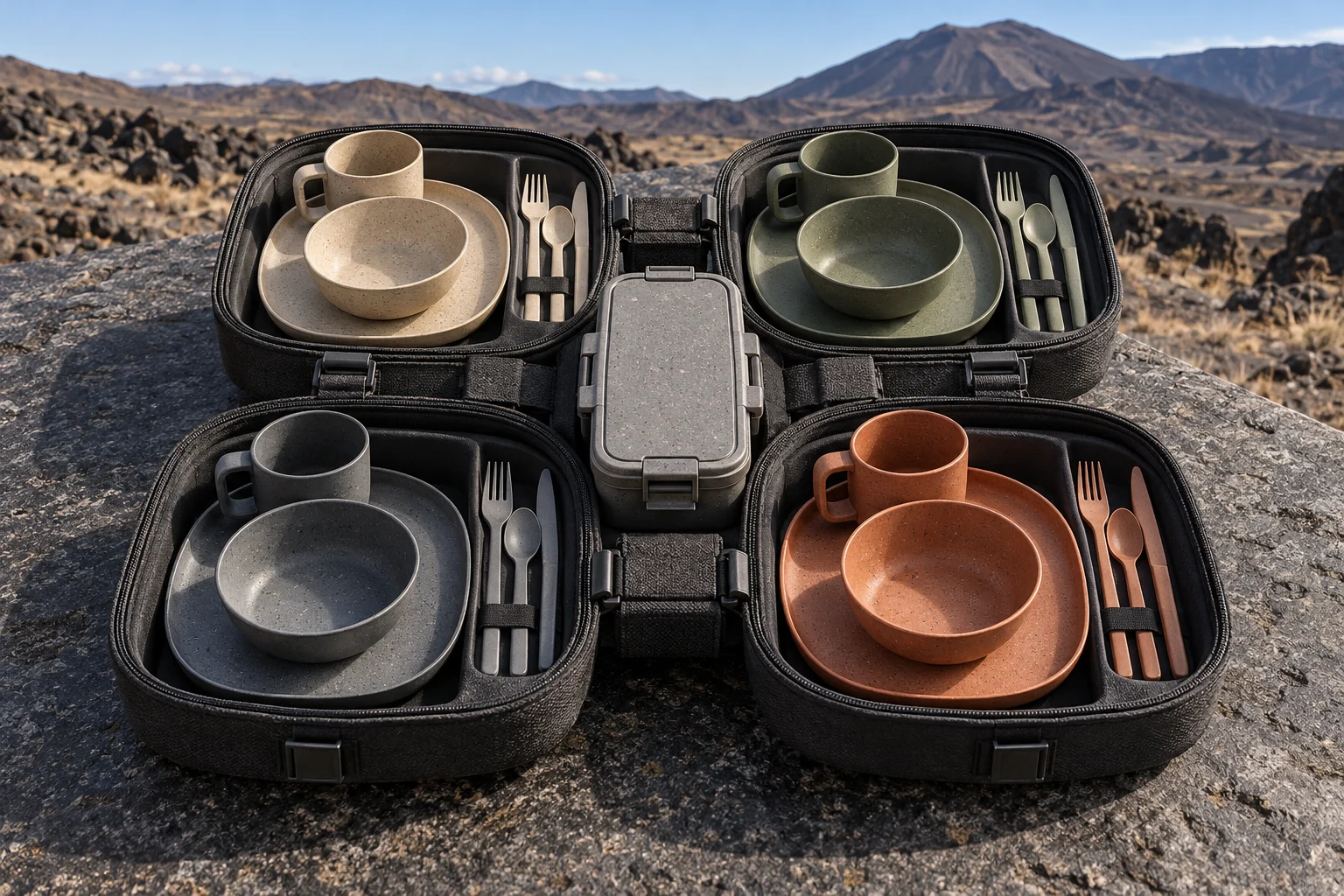
Description
CONCEPT CONFIGURATION · PROJECT REVIEW REQUIRED
This four-person camping dinnerware set concept divides service into four detachable personal pods. Each shallow pod groups a plate, bowl, cup and side cutlery channel, while a central lunch-box module occupies its own dock inside a low square textile harness. The proposal supports sourcing discussion only; it is not presented as a verified production SKU.
PRODUCT PARAMETER
| Product form | Four-person portable dinnerware set with four detachable personal serving pods |
|---|---|
| Reference component groups | Four plates, four bowls, four cups, four cutlery groups, four pod trays, central lunch-box module and square carry harness |
| Materials | To be confirmed for the project |
| Dimensions / packed envelope | To be confirmed for the project |
| Component compatibility | Compatibility to be confirmed by project sample and drawing. |
| Pod latch / dock construction | To be confirmed for the project |
| Decoration / color | To be confirmed for the project |
| Packaging / carton | To be confirmed for the project |
| MOQ / price / lead time | To be confirmed for the project |
| Compliance / evidence | Finished components, decoration, intended use and destination market require project-specific review |
REFERENCE CONFIGURATIONS
| Configuration | Illustrative arrangement | Decision to record |
|---|---|---|
| Four-pod service | One detachable pod allocated to each user around the central dock | Pod outline, component contacts and removal clearance |
| Two-user subset | Two pods removed while two remain secured in the harness | Case stability, restraint and access sequence |
| Distributed service | Each pod moves from the carry harness to a separate place setting | Grip points, edge safety and return orientation |
| Lunch-box option | Selected container assessed as an independent central module | Dock envelope, closure clearance and project inclusion |
These routes are review options rather than fixed specifications. Buyers should release counts, dimensions, nesting direction and packed orientation only against an approved BOM, drawings and physical sample.
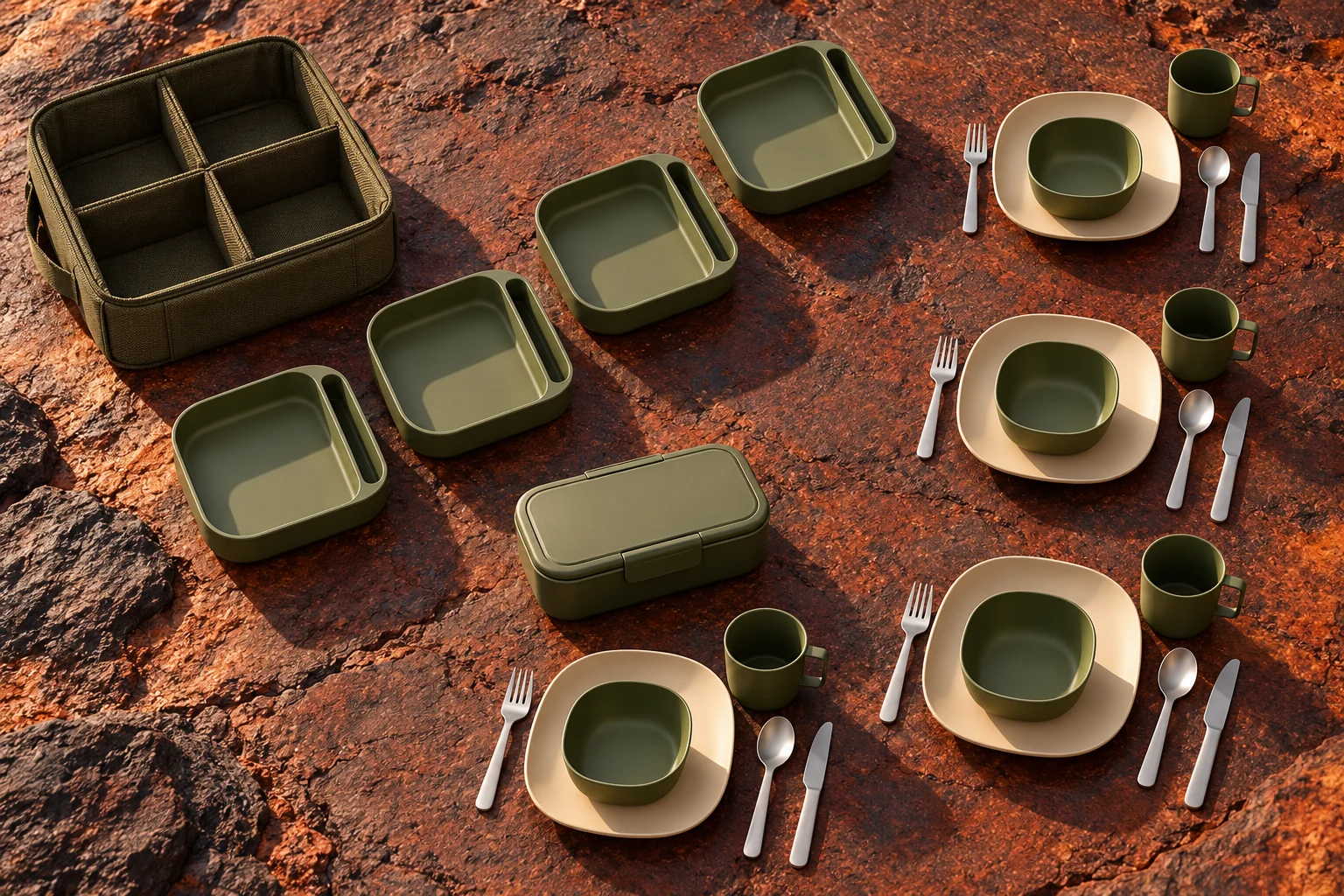
CLOVER-POD CAMPING DINNERWARE SET ARCHITECTURE
The defining change is a distributed personal-service layout. This camping dinnerware set does not depend on a vertical stack, ring deck, book-fold spine, pannier pair, accordion pocket, drum sleeve or wave channel. Four rounded-square pods instead locate around a central container dock, and each pod can leave the harness as a complete place-setting organizer.
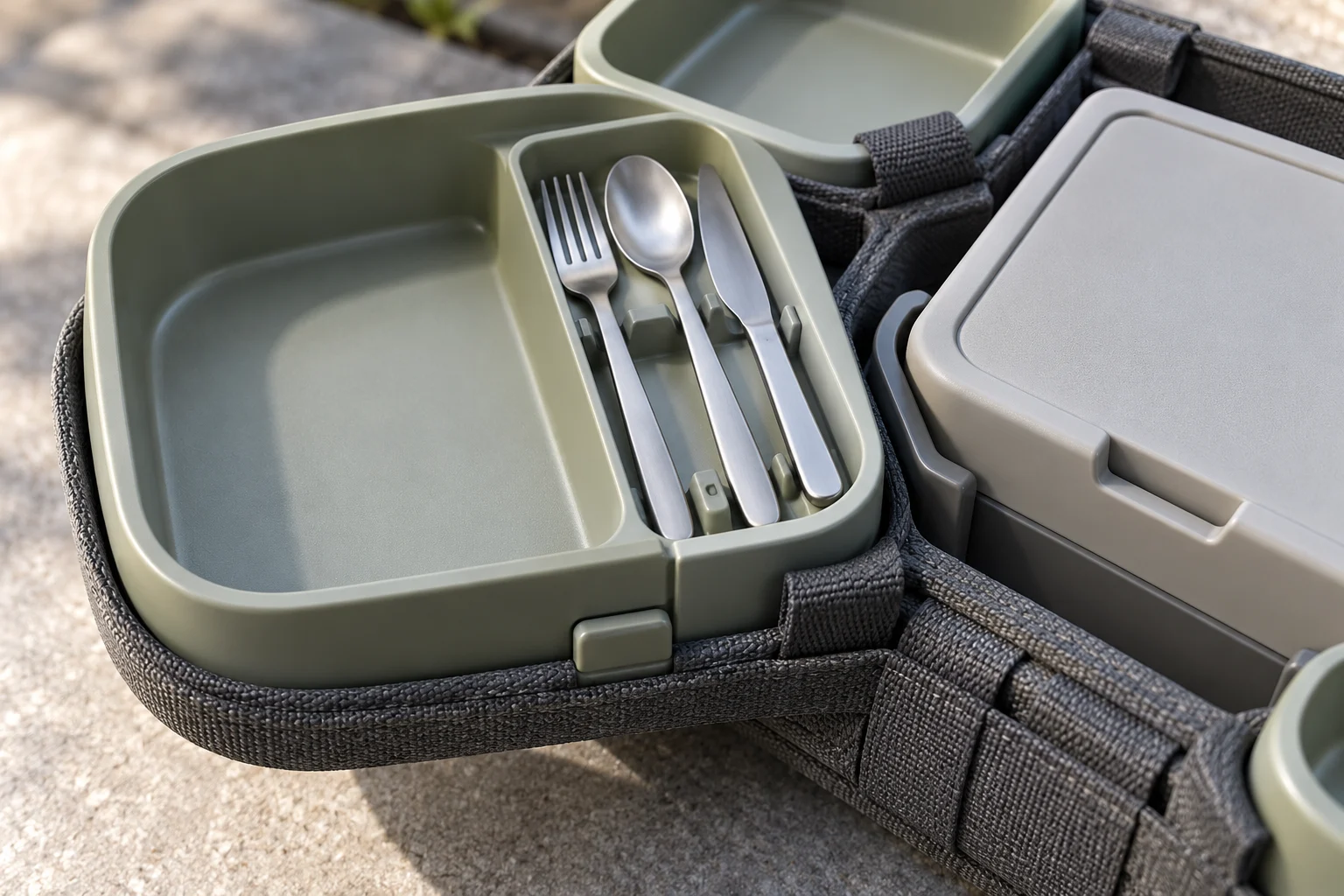
The arrangement creates a different approval path. A pod latch must release deliberately without creating a sharp catch point. Its side channel must separate utensils from bowls and cups without assuming an untested fit. The center dock must allow the selected lunch box to clear neighboring pod rims. Those results remain open until drawings, samples and a documented pack-out establish them.
WHAT TO SEND FOR A PROJECT REVIEW
- Controlled component BOM and required user count
- Plate, bowl, cup, cutlery and lunch-box drawings or physical samples
- Target closed-case envelope and preferred pod access order
- Cleaning, drying and food-use conditions by component
- Destination market, artwork locations and packaging channel
- Sample decisions, open compatibility questions and approval owners
DEVELOPMENT CONTROL
| Control point | Evidence to release | Risk if left open |
|---|---|---|
| Personal pod | Loaded layout drawing, contact map and handling sample | Components collide or become awkward to lift |
| Pod latch | Attachment detail, release direction and repeated pack observation | Pod disengages early or cannot be removed cleanly |
| Side cutlery channel | Approved utensil profiles, retention points and edge-clearance record | Wrong utensil fit or contact with food-use surfaces |
| Central lunch-box dock | Selected container drawing, closure sweep and removal trial | Lid, latch or rim interferes with adjacent pods |
| Harness and packaging | Closed-case sample, drop orientation plan and pack-out sheet | Pods rotate, rub or arrive in the wrong sequence |
Release one controlled revision at a time. Changes to any component profile can affect the pod, latch, harness and carton assumptions, so recheck the whole camping dinnerware set after a revision.
MATERIAL AND COMPLIANCE BOUNDARY
The visuals communicate layout only. They do not prove a resin family, bio-based content, food-contact status, dishwasher suitability, temperature resistance, migration result, durability or destination-market compliance. Material and color proposals must be tied to the final component list, decoration, use conditions and market before an evidence package is defined.
Ask the supplier to identify which evidence belongs to the exact finished article and which evidence describes only a raw material or color masterbatch. Do not transfer a statement from a plate to a lunch box, textile harness or metal utensil without a justified scope. Any claim on packaging or artwork needs its own approval record.

PACKING AND SAMPLE APPROVAL
Begin with one pod and its intended plate, bowl, cup and cutlery group. Record the component revisions, contact surfaces, lifting points and return sequence. Repeat that review for all four pods, because visual similarity does not establish interchangeable fit. Place the pods in the harness, add the selected lunch-box sample, and document clearances at every neighboring edge. Close the camping dinnerware set from the controlled sequence and note movement, scuffing, trapped handles or count errors. Repeat the trial with final packaging before quotation assumptions are frozen.
PROCUREMENT FAQ
Are the four personal pods identical?
The concept shows a common pod format, but interchangeability is not confirmed. Compatibility to be confirmed by project sample and drawing.
Does each pod include its own cutlery channel?
The proposed layout assigns one side channel to each user. Final utensil profiles and retention details are To be confirmed for the project.
Is the central lunch box included?
It is an optional project module. Inclusion, container geometry, closure and food-use requirements must be stated in the BOM.
Can the pod be used as a serving tray?
The concept supports that review route, but load, handling, edge and stability outcomes require an approved sample and intended-use assessment.
Which project inputs are needed before quotation?
Send the BOM, component drawings or samples, target packed envelope, destination market, decoration, packaging channel and decision owners. MOQ, price and lead time are To be confirmed for the project.
REVIEW THE CLOVER-POD PROJECT
Use the inquiry form to share the controlled BOM, pod priorities, component files, lunch-box scope, destination market and packaging brief. Naike Dinner can then evaluate the request against samples and drawings without treating this concept image as a production promise.
Start a camping dinnerware set review
Related buyer controls: BOM revision control · evidence-file review · pilot assembly planning
Primary context: FDA effective FCS notifications · European Commission food-contact materials · EU General Product Safety Regulation
Project-review page updated .
RELATED SOURCING PATHS
Compare Products and Plan Your Project
Review related product formats, then compare material, set configuration, logo, packaging, testing scope and order quantity with our B2B team.