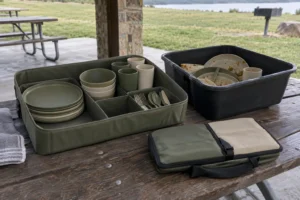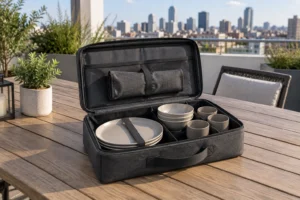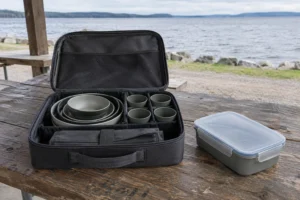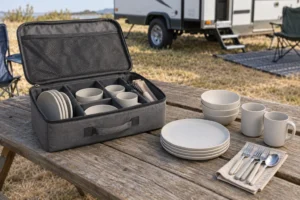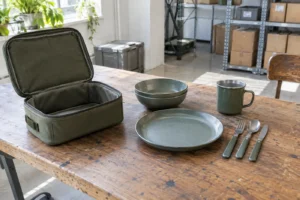
A camping dinnerware carry case opening should let users identify and remove the needed piece, but not spread so far that the lid, flaps or loose components consume the serving area. Approve it only after checking the loaded footprint, reach path, part sequence, closure clearance and return of used items on the actual table and sample revision.
This guide gives buyers an open-footprint and access review sheet for comparing top-lid, clamshell and partial-opening cases. The pictured arrangements are design concepts, not verified Naike Dinner products, fit tests or proof of durability. Record observations against revision-matched samples before releasing a bag, insert or dinnerware configuration.
Choose a camping dinnerware carry case opening from the table outward
A compact closed case can become inconvenient once its lid and components spread across a picnic table. Define the working envelope as the area occupied by the open case, displaced components and the hand path needed to remove a plate, bowl, cup or cutlery holder. The useful question is not merely whether everything fits inside; it is whether the set can be served and repacked without creating a second unpacking area.
Write down the tables the product is expected to meet: a narrow folding camp table, a campground picnic bench, an RV counter or a shared catering table. Do not assign one universal dimension from a lifestyle photograph. Instead, enter the buyer’s target surface depth and width in the review sheet, then test the real loaded case in at least the restrictive and normal use conditions.
The component-to-case fit checklist answers whether parts can be loaded and closed. This article adds the use-stage question: after the zipper opens, can the pieces be identified, reached and returned while the case remains stable? The pack-out instruction guide can then convert the approved access sequence into a repeatable packing step.
Compare three opening architectures
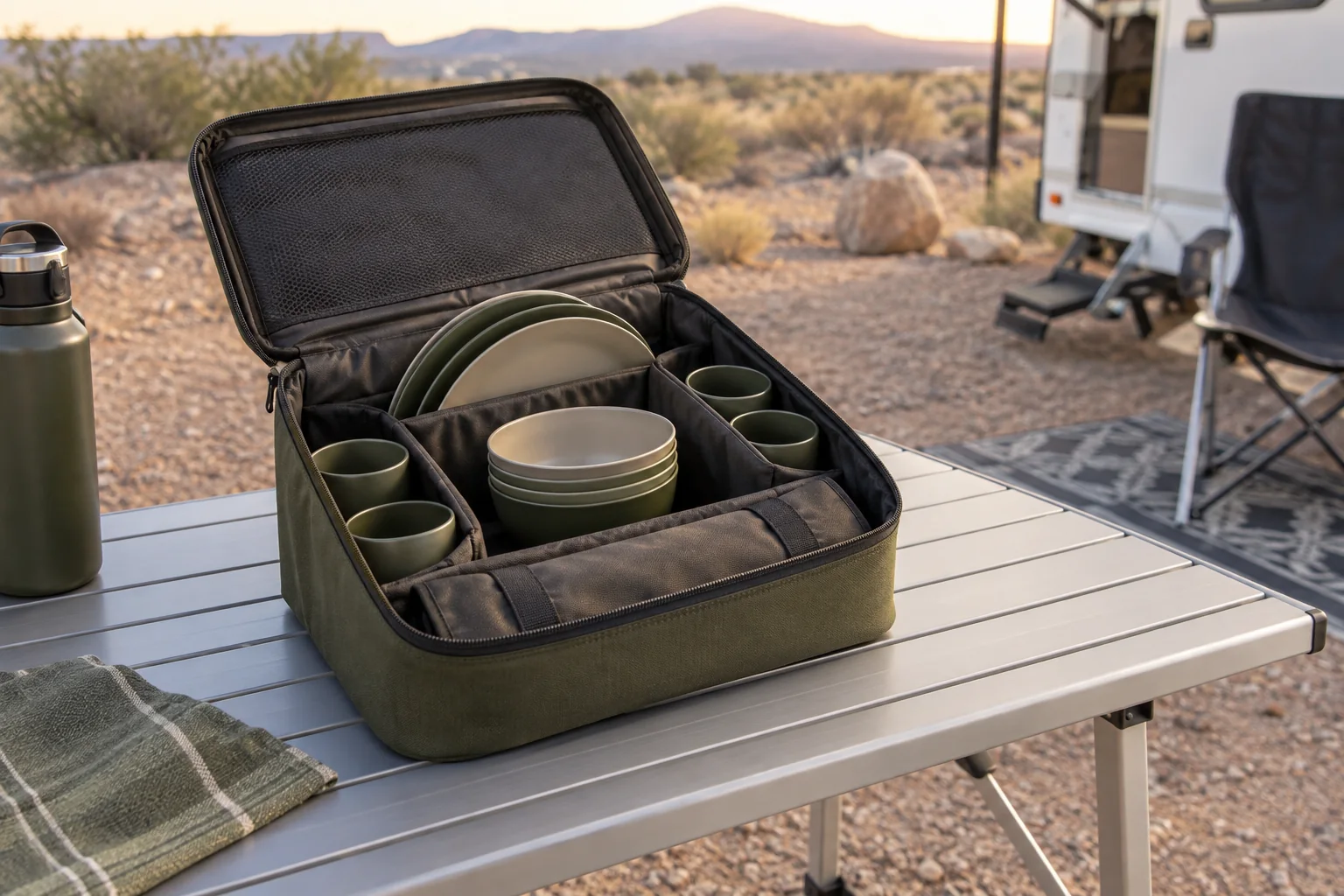
A top-lid opening uses a lid attached along one edge, often with a U-shaped zipper. It usually preserves more table area than a full clamshell because the lid stands or folds behind the case, but its walls can restrict access to pieces stored low in the base. Check whether the lid stays clear without needing a hand, wall or improvised support.
A clamshell opens into two panels. It can expose the component map clearly and may support separate retention zones, yet its working footprint can approach twice the closed length. Hinged cables, fabric gussets or zipper stops should prevent the panels from pulling against the seam, and both halves must remain stable when one side is unloaded first.
A partial-opening case exposes only the next-use items while the remaining stack stays contained. This can work for limited table space, but it depends heavily on packing order and part identification. If a bowl is under the plate stack or the cutlery pouch blocks cups, the theoretical space saving becomes repeated unloading.
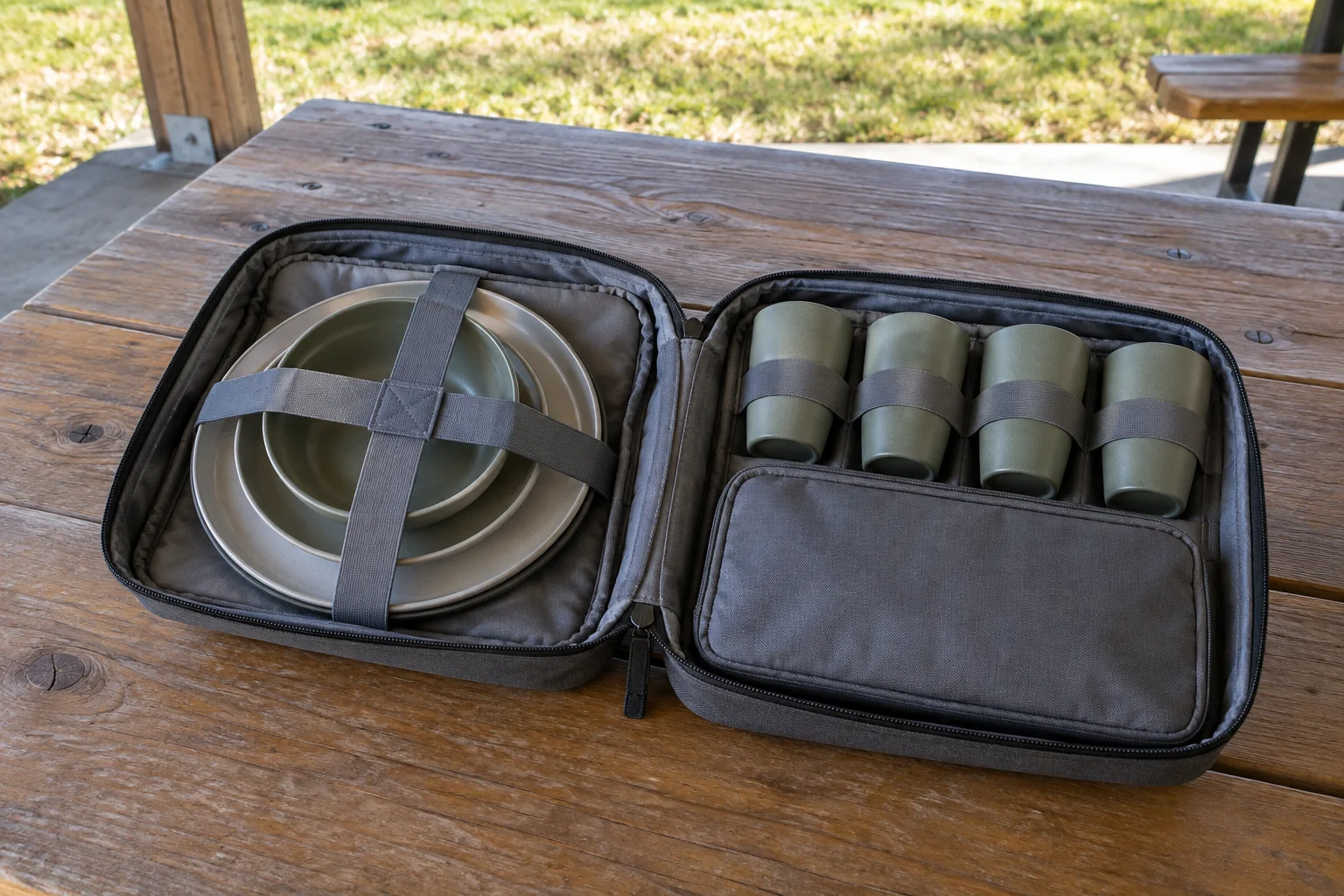
| Opening type | Potential advantage | Question to verify on a sample | Typical hold point |
|---|---|---|---|
| Top lid / U-zip | Compact footprint and direct view into one base compartment. | Does the lid remain open, and can the lowest part be lifted without scraping a wall or divider? | Lid falls forward, tall walls block grip, or zipper path is loaded by packed parts. |
| Full clamshell | Clear visual count and separate retention zones. | Does the open second panel fit the intended table and remain stable as parts are removed? | Open footprint is excessive or loose components fall when the case is carried vertically. |
| Partial / service flap | Accesses selected pieces while the rest remain contained. | Does the use sequence match the component order for every approved set configuration? | A frequently used item sits behind another part or the flap cannot close around a full load. |
| Removable tray or insert | Moves a complete serving module from case to table. | Can the loaded tray be lifted safely, cleaned and returned without changing component orientation? | Tray flexes, traps moisture, or adds height that interferes with closure. |
Use an open-footprint and access review sheet
Create one row for every action from placing the closed case on the table to returning the last used item. Observe rather than infer. Record the sample ID, case drawing revision, component list revision, table surface, opening direction and whether another object had to be moved. A pass on a warehouse bench is not automatically a pass on a narrow field table.
Measure two envelopes separately. The static envelope is the boundary of the fully open case and any fixed lid. The service envelope includes the temporary area needed to lift a plate stack, unfold a cutlery roll or place a removed insert. Buyers often record only the first number even though the second determines whether the table can still hold food and drink.
Then check sequence dependence. Remove items in the expected meal order, followed by a deliberately different order. If access works only when every user follows one hidden sequence, either provide a clear instruction or revise the configuration. Count visibility matters too: an empty sleeve, cup position or utensil loop should be identifiable without dismantling the entire set.
| Review field | Buyer observation to record | Release criterion to define |
|---|---|---|
| Closed placement | Orientation, handle position and table area before opening. | Case can be positioned without covering the intended dining area. |
| Opening motion | Zipper path, lid support, required clearance and any case movement. | Opening does not require excessive force or an unplanned support object. |
| First-piece access | Which item is reached first and which items must move. | Approved first-use items can be removed directly. |
| Deepest-piece access | Grip space, divider interference and contact with adjacent surfaces. | Part can be lifted without forcing, scratching or overturning the case. |
| Count visibility | Empty locations visible after removal. | Missing pieces can be identified before closure. |
| Used-item return | Location of wet, dirty or food-contact pieces after use. | Return flow is defined and does not silently contaminate clean items. |
| Final closure | Whether parts must be compressed, rotated or held down. | Zipper and lid close without forcing and with the written packing sequence. |
Run the sample review in a repeatable order
First inspect the empty case. Confirm the opening stops, lid restraint, divider attachment, removable liners and zipper endpoints. Second load the nominated component revision and take a photograph of the closed case, then the case immediately after opening. Third perform the planned service sequence while another reviewer records moved pieces and temporary table area.
Repeat the exercise after changing the component order and after removing the heaviest or tallest part first. This reveals whether stability depends on a balanced load. It also identifies walls or inserts that look tidy when full but collapse into the access path when partly empty.
Do not treat the visual review as a transport test. If the case and its retail or parcel pack require distribution validation, select a method for the real packaged-product route. The ISTA test-procedure overview explains that screening, general simulation and focused simulation procedures have different purposes; it does not certify any case shown here.
Likewise, the review does not prove food-contact compliance. Plates, bowls, cups and utensils need evidence matched to the finished material, color, decoration and intended conditions of use. The European Commission food-contact materials overview frames the EU regulatory context, and the FDA conditions-of-use guidance shows why food type, temperature and contact conditions matter. Neither source validates an illustrated case or its contents.
Recognize failure modes before artwork approval
A lid that falls onto the plates can create a two-hand task and transfer dirt from the table-facing fabric. A deep top-opening case can hide small cups or utensils below a plate stack. A clamshell can place its second panel in another diner’s space, while a removable tray can become an unplanned serving surface that has no defined cleaning instruction.
Zipper and hinge loads change as the case is packed. A bulging bowl rim or upright cup may press against the lid and make the zipper appear difficult even when nominal dimensions look adequate. Record the exact load state and do not solve closure by compressing food-contact pieces or allowing utensil edges to contact them.
Wet return is often overlooked. FDA outdoor food-handling guidance discusses keeping food protected and controlling perishable food temperatures; it does not make a fabric dinnerware case a cooler or hygienic return container. Buyers should separately define how used pieces are isolated, cleaned and dried before long-term storage.
Convert observations into a development decision
Send the supplier a revision-controlled component matrix, the intended pack order, target table scenarios, allowable open footprint and the actions that must be possible without moving other pieces. Ask the supplier to state which case, insert and component geometry already exists and which elements require new development. Compatibility must be confirmed by the project sample and drawing.
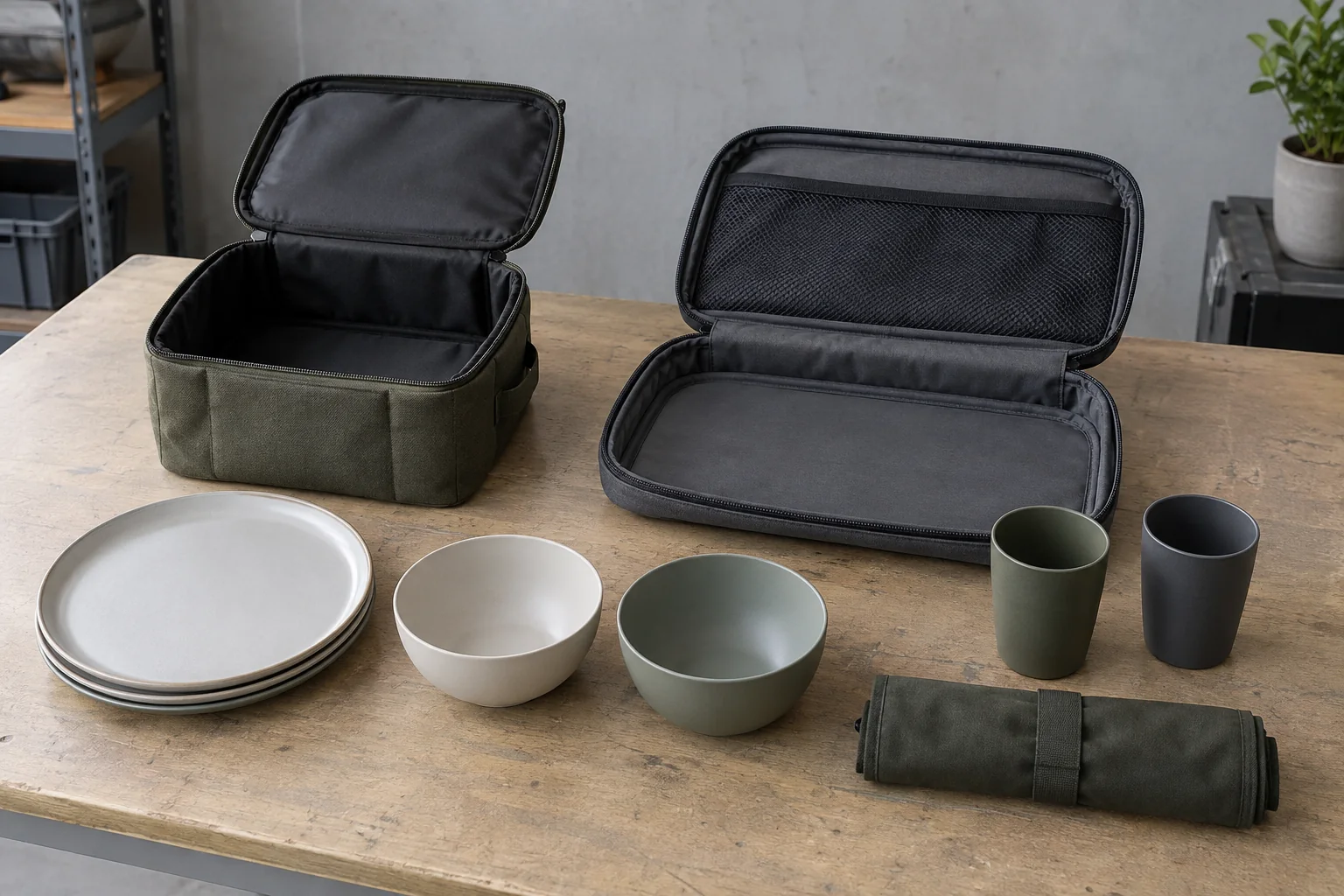
Request two sample configurations when the choice is not obvious: a compact top-opening case and a flatter clamshell or tray-based alternative. Review both with the same parts and table conditions. Do not compare a complete sample against a render of another option and call the result equivalent.
After selection, attach the completed review sheet to the case drawing, BOM and golden-sample record. If the component count, plate profile, cup height or cutlery holder changes, reopen the affected access rows. A case opening is an interface, so approval belongs to the complete revision combination, not the bag in isolation.
The final camping dinnerware carry case opening decision should therefore name the approved table scenario, case revision, component revision and access sequence together. Without those four references, a later assortment change can invalidate the observation while the old approval still appears current.
| Check | Question | Why It Matters |
|---|---|---|
| Use surface | Which real table or counter is the most restrictive approved scenario? | Prevents a spacious studio bench from hiding a field-use footprint problem. |
| Opening support | What keeps the lid or flap clear during service? | A falling lid changes access, cleanliness and two-hand use. |
| Component sequence | Can frequently used pieces be reached without moving others? | Turns a visually neat pack into a practical service layout. |
| Partial-load stability | Does the case remain stable as pieces are removed? | Exposes reliance on balanced weight or tightly packed walls. |
| Return flow | Where do damp or used pieces go? | Keeps the outward presentation from becoming an impractical return plan. |
| Revision control | Which case and component drawings were reviewed together? | Stops an obsolete access decision from following a changed part. |
Buyer FAQs
1. Is a clamshell opening always easier to use?
No. It gives broad visibility but can consume substantially more table area. Approve it only when the intended table accommodates both panels and the retained components remain secure as each side is unloaded.
2. How wide should a U-shaped opening be?
There is no universal width. The usable opening must clear the largest relevant part, the user’s grip and the removal angle after dividers and zipper curves are included. Verify the finished sample rather than relying on an external bag dimension.
3. Can a removable tray solve access problems?
It can simplify service when the tray is rigid enough, washable as required and easy to lift when loaded. It can also add height, weight and another part to count, so evaluate closure and cleaning at the same time.
4. Should the case stay on the table during the meal?
Only if that is the intended workflow and the open footprint leaves enough usable dining area. Some programs may prefer a case that dispenses components and is then removed; record that sequence explicitly.
5. Does easy opening prove the case is durable?
No. Access review observes use geometry and workflow. Seam, handle, zipper and transport durability require their own defined sampling and test plan for the finished case and load.
6. What information should accompany an RFQ?
Provide the component matrix, revision drawings, proposed pack order, restrictive table envelope, target channels and required access actions. Ask for written identification of existing versus development items and a sample-review plan.
Request a case-opening sample comparison
Send your component list, case or insert drawing, target table scenarios and proposed service sequence through the Naike Dinner inquiry page. Request a written comparison of opening options and identify which capabilities, materials and components are verified for the project before discussing samples.
For a controlled decision, ask for the same parts to be reviewed in two opening architectures. The approval record should capture open footprint, access sequence, partial-load stability, return flow, unresolved evidence and the owner of the next action; it should not invent MOQ, price, lead time or tooling capability.