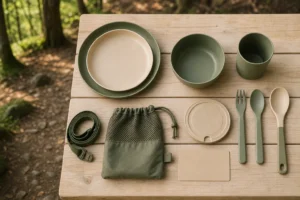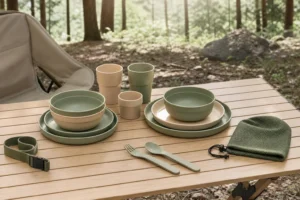
A camping mess kit should include only the pieces needed to serve, eat, drink, clean and carry meals in its intended scenario. A practical core is one eating vessel, one drinking vessel, suitable utensils and secure storage per user. Bowls, lids, serving tools, cleaning accessories and cookware are optional modules. Final contents should follow the camper, menu, trip style and verified product-use limits.
Camping Mess Kit Checklist: Start with Four Core Functions
A complete personal kit normally answers four questions. Where will the camper put the meal, what will the camper drink from, which tool will the camper eat with, and how will the pieces stay together between meals? A plate or bowl, cup, utensil and retention solution are therefore the most defensible core.
Everything else should solve a documented problem. A separate bowl helps when the menu includes cereal or soup. A lid helps with storage or splash control only when its fit and use are defined. A cleaning cloth is useful only when the pack can keep it hygienic and allow it to dry.
This camping mess kit checklist uses twelve component decisions, but it does not claim that every sellable kit needs twelve physical pieces. Several decisions may be satisfied by one multi-function product. Conversely, a family or hospitality set may repeat core pieces for every user and exceed twelve items without becoming excessive.
| Priority | Component decision | Default role | Include when |
|---|---|---|---|
| Core 1 | Primary eating vessel | Holds the main meal | Every complete mess kit |
| Core 2 | Drinking vessel | Holds an intended beverage | The offer promises a complete place setting |
| Core 3 | Eating utensil | Matches food format and user | Every personal kit unless clearly excluded |
| Core 4 | Retention or carry item | Keeps pieces organized | The products are sold as one portable kit |
| Menu module | Secondary bowl or plate | Separates liquid, dry or shared foods | The target menu needs two vessels |
| Menu module | Additional utensil | Cuts, scoops, serves or handles a second dish | A single utensil cannot perform the named meal tasks |
| Storage module | Functional lid | Covers a named container | Fit, closure and claims are validated |
| Group module | Serving utensil | Moves shared food hygienically | The set supports family or group meals |
| Cleaning module | Scraper, cloth or drying pouch | Supports field cleanup | The use instructions explain safe handling and drying |
| Identification module | Color or owner marker | Separates users’ pieces | Families, camps, rentals or group programs need control |
| Information module | Care and use guide | States use limits and cleaning steps | Every branded commercial set |
| Optional cooking module | Verified cookware | Receives a specified cooking heat source | Cookware is genuinely in scope and separately supported |
1. Choose the Primary Eating Vessel
The first component should cover the most common meal in the target trip. A flat plate handles grilled or assembled food, while a deep plate or bowl-plate covers rice dishes, pasta, stew and snacks with fewer spills. A deep bowl is efficient for liquid meals but can be less convenient for cutting.
Specify usable diameter, depth and nominal capacity rather than accepting a visual description such as “large.” Review rim grip, base stability and the ability to scrape food without chasing the vessel across a picnic table. For pack-oriented sets, evaluate how the base and rim interact with every nested piece.
A single versatile bowl-plate can be the right minimalist answer. A full family set may need both a plate and bowl per person. The decision belongs to the menu and user research, not to an assumption that more dishes always make a more complete kit.
2. Decide Whether a Separate Bowl Earns Its Space
A second vessel is justified when meals routinely combine dry and liquid foods, breakfast and drinks, or a main course and side. It can also act as a preparation or shared-serving piece in front-country use. The additional function should be described so the buyer can test it during sampling.
When the bowl nests with a plate, confirm removal and stacking after repeated washing and realistic load. Avoid a fit so tight that users need tools to separate damp pieces. If the bowl is meant to hold leftovers, state that function separately from any leakproof or temperature claim.
For reusable wheat-straw composite options, select the bowl by intended food contact and finished-product evidence. Naike Dinner’s wheat-straw bowl buying guide discusses size, shape and packaging decisions that can be applied to a camping range without implying cookware use.
3. Add a Drinking Vessel with a Clear Beverage Brief
A drinking vessel completes a place setting, but its function needs more precision than “camping cup.” State nominal fill, intended beverages, temperature conditions, contact time and whether a handle is required. The supplier should not translate a general camping theme into boiling-water, insulation or stove claims.
Handle-free tumblers nest efficiently and fit compact boxes. Handled mugs can be more comfortable but consume space and create interference points. If the cup includes a lid, define whether it only reduces splashes or is expected to resist leakage in a bag; those are different requirements.
For RV, caravan and family channels, stability may outrank minimum mass. A wide base and moderate capacity can be more useful than an oversized mug. For promotional sets, check that the proposed decoration area remains visible when the cup is nested or held.
4. Select Utensils from the Menu Backward
A spork can cover many soft meals and reduce piece count, but it does not automatically handle cutting, stirring in a deep pouch or serving shared food. A fork-and-spoon pair is familiar; adding a knife should follow the actual food and local product considerations. Long-handled utensils may suit meal pouches but can prevent compact pack-out.
Grip length, edge finish, stiffness and bowl depth matter more than novelty. Test the utensils with the target foods and with the intended users. Children’s kits require age-appropriate dimensions and separate safety review rather than simply shrinking an adult design.
Naike Dinner’s wheat-straw cutlery set guide provides a useful framework for travel and gift programs. Buyers should still verify the selected product, market and application instead of treating the guide as a certificate.
5. Use Storage to Make the Pieces a Kit
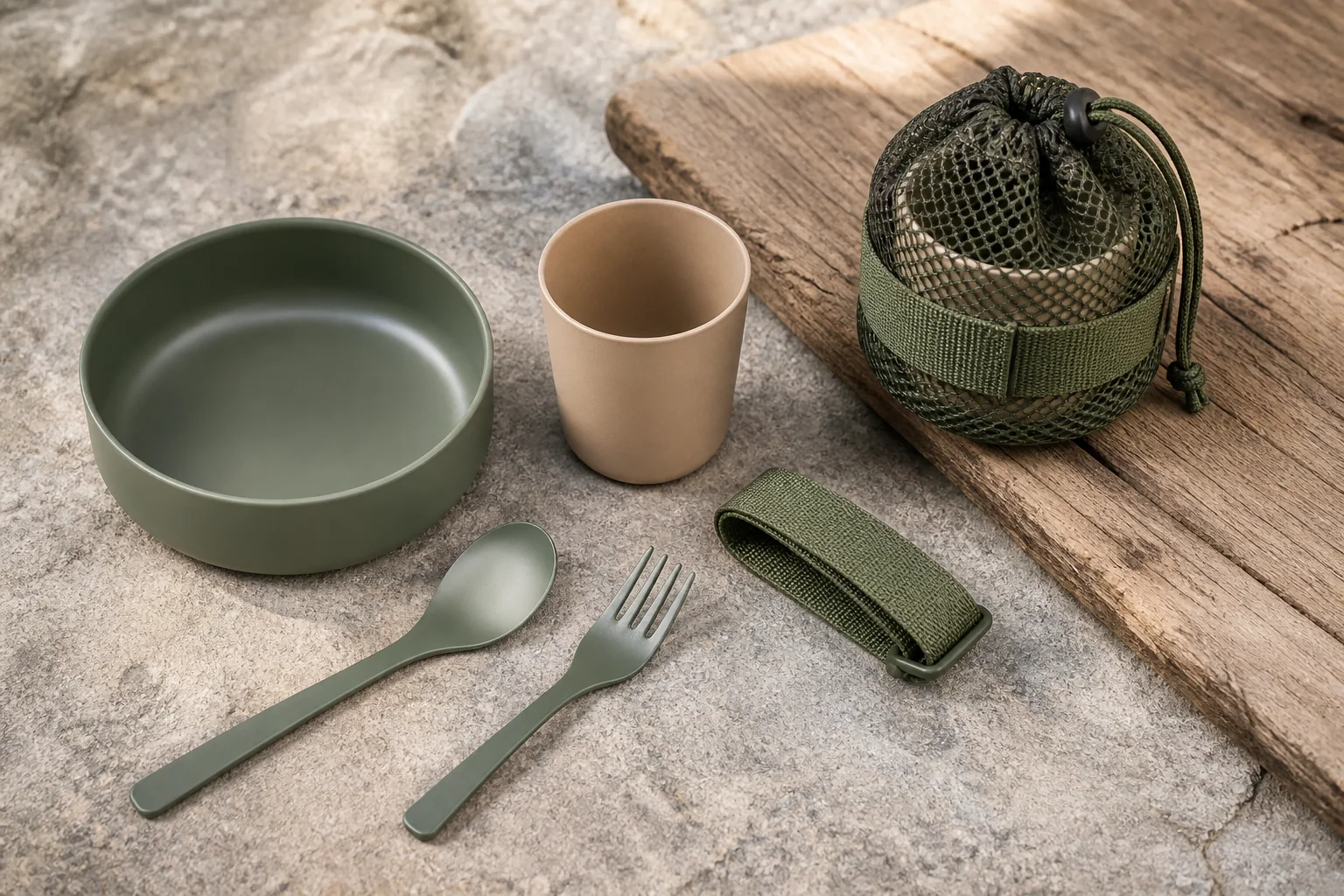
A retention system transforms separate dinnerware into a portable assortment. Options include a strap, lidded shell, drawstring pouch, mesh bag or fitted retail case. The selection should prevent loss and uncontrolled rattling while allowing reasonable cleaning and drying.
A sealed pouch can contain dirt during transport but may trap moisture after washing. A mesh pouch drains and ventilates but provides limited barrier protection. If one item doubles as the storage shell, make that relationship clear in the assembly instructions and confirm it does not create food-contact damage.
Specify packed length, width, height and complete mass. Ask for the nesting sequence in the instruction insert, especially when utensils must occupy a particular slot. Evaluate whether the average user can repack the set without forcing pieces or scratching decorated surfaces.
6. Include Lids Only When Their Function Is Testable
Lids can improve organization, cover leftovers or reduce splashes, but they also add material, tolerance and cleaning interfaces. A lid that rests on a bowl is not necessarily leak resistant. A friction fit that survives a tabletop tilt may still be unsuitable for transport inside a backpack.
Write the intended closure claim and test the complete assembly under a relevant protocol. Include the food type, fill level, orientation, duration and conditioning. If the project does not require liquid transport, a simple cover may be more honest and easier to maintain than an ambitious closure claim.
Check whether the lid remains flat after expected cleaning, whether seals can be removed, and whether replacement parts will be available. Any gasket or separate seal should appear in the component and material schedules, not disappear under the generic label “lid.”
7. Add Serving Pieces for Group Meals
A family or group kit may need one serving spoon, salad server or shared bowl even when every person has individual utensils. This reduces repeated contact with shared food and makes the set more operationally complete. The serving tools should be visibly distinct from personal utensils where possible.
The U.S. Centers for Disease Control and Prevention notes that norovirus can spread through contaminated food, surfaces and shared utensils, and its camp guidance emphasizes hand hygiene and treated water. That does not certify a product, but it supports the operational case for clean tools and controlled sharing. Review the CDC healthy camping guidance.
For youth camps, rentals and hospitality, countability is valuable. Color coding, marked storage positions and a printed inventory diagram help staff detect missing parts. The design should also avoid tiny removable pieces that are easily lost during a high-volume reset.
8. Treat Cleaning and Drying as Product Requirements
Cleaning accessories should be added with care. A scraper can reduce food residue before washing; a compact cloth may help wipe surfaces; a ventilated pouch can support drying. None of these replaces safe water, appropriate cleaning agents or local wastewater rules.
The National Park Service explains that visitors should plan for waste and follow location-specific disposal practices. Brands should therefore avoid printing one disposal instruction as globally universal. Link users to local rules and keep the kit guidance focused on containing scraps and preventing residue from being left at the site; see the NPS guidance on disposing of waste properly.
A cleaning accessory that remains wet beside food-contact items can become counterproductive. Test how the entire kit is packed after use, whether the pouch ventilates, and how users separate clean from dirty pieces. For rental programs, define a back-of-house wash, inspection and drying flow beyond the consumer instruction.
9. Add Identification for Families, Camps and Fleets
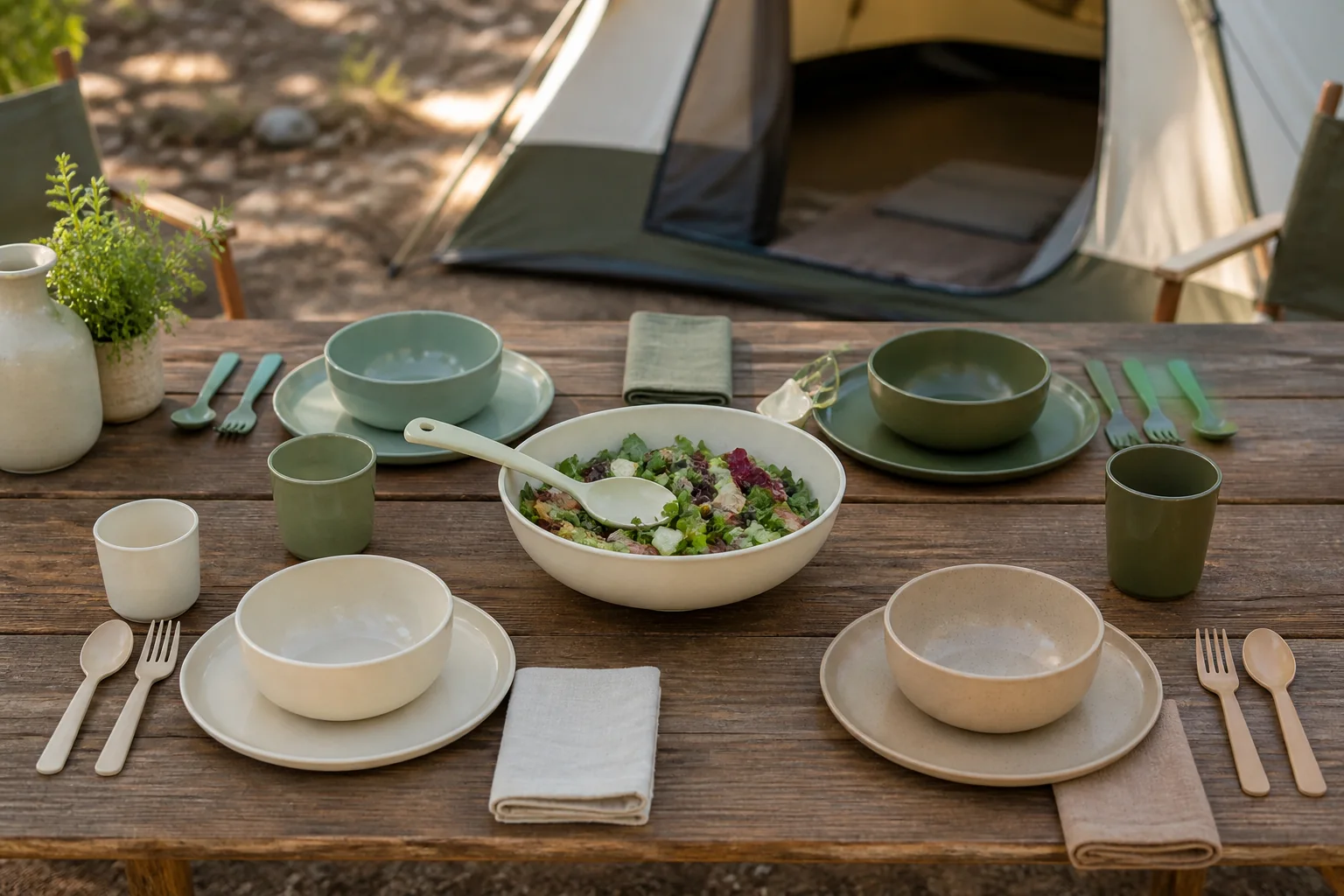
Color can assign a place setting to each user, simplify group counts and reduce accidental sharing. The palette should be locked to approved references and evaluated on the final material and surface. A digital color value alone does not predict the appearance of a fiber-filled molded product.
Owner marks, subtle icons or numbered storage positions may be useful when color variants are limited. Keep marks durable and readable without implying that decoration performance is identical across every process. Confirm printable area, artwork method and contact-zone boundaries before approving packaging.
For replacement sales, maintain a stable way to identify individual components. A lost cup should not require the customer or campsite operator to replace the entire set when the commercial program is designed for replenishment. Record component codes even if consumers see only the finished kit name.
10. Include a Care and Use Guide in Every Branded Set
The instruction insert should list the actual contents, assembly order, cleaning method, storage guidance and important limitations. It should distinguish dinnerware from any separately verified cookware. It should also avoid translating marketing adjectives into unsupported technical promises.
The U.S. National Park Service advises campers to keep food and food containers attended and to clean dishes and preparation areas, particularly where wildlife may be present. The exact operating rules vary by park and location, so the insert should direct users to applicable campsite requirements. The NPS Cooking in Camp page provides primary operational context.
Use instructions are also part of claim control. If a component is not intended for direct flame, campfire, stove burner or another heat source, say so where users can see it. A camping photograph must not override the written product boundary.
11. Separate Optional Cookware from Dinnerware
Cookware belongs in the set only when the product brief genuinely includes cooking and the exact vessel is designed for a named heat source. A plate or bowl does not become cookware because it appears beside a stove. Mixed-material assortments should identify the cookware pieces separately in listings, packaging and instructions.
Naike Dinner can discuss reusable wheat-straw composite dinnerware components for serving and eating scenarios. This article does not claim that Naike Dinner manufactures titanium or stainless-steel cookware, and it does not present wheat-straw composite tableware as open-flame equipment. Any cooking module requires separate supplier verification.
For buyers who need the category boundary first, the morning guide What Is a Camping Mess Kit? explains why the retail term can cover different architectures. This afternoon checklist continues from that definition by deciding which exact components earn a place.
12. Design Packaging Around the Real Pack-Out
Packaging is not a decorative afterthought. It must keep the nested pieces in order, protect surfaces, communicate included quantities and support channel handling. A product sleeve may suit a stable stack, while a box is more appropriate when accessories can shift or when retail presentation needs controlled faces.
Confirm the sellable pack before estimating cartons and logistics. The pouch, insert, barcode label and protective materials change dimensions and mass. Naike Dinner’s retail packaging guide explains box, sleeve, label and barcode choices relevant to camping dinnerware sets.
Packaging artwork should show the complete component list and state whether food, cookware or campsite props in the photography are excluded. That single control prevents a visually appealing scene from becoming an inaccurate contents promise.
Need a component schedule for your channel?
Send Naike Dinner the user count, target meals, trip style, sales market, preferred dinnerware material, branding and retail pack. We can organize the core and optional modules into a comparison-ready brief without inventing cookware or performance claims.
Request a component reviewScenario Configurations: What Changes by Camper?
| Scenario | Recommended core | Useful additions | Usually unnecessary unless proven |
|---|---|---|---|
| Solo light travel | One deep eating vessel, cup, versatile utensil, compact retention | Long spoon or cover when the meal format needs it | Multiple plates and group servers |
| Two-person car camping | Two place settings and organized carry pouch | Shared bowl, serving tool, color coding | Extreme weight-saving compromises |
| Family campsite | One identifiable setting per user | Shared servers, drying solution, inventory diagram | Identical unmarked pieces that are hard to count |
| RV or caravan | Stable, quiet-nesting place settings | Cabinet retention, splash-reducing lids | Backpacking-focused micro utensils |
| Glamping or rental fleet | Durable countable pieces and operating guide | Replacement codes, staff inventory map | Complex accessories with difficult cleaning interfaces |
| Promotional gift | Concise useful personal set | Controlled logo, attractive sleeve, message card | Filler components added only to raise piece count |
How to Turn the Checklist into a Supplier RFQ
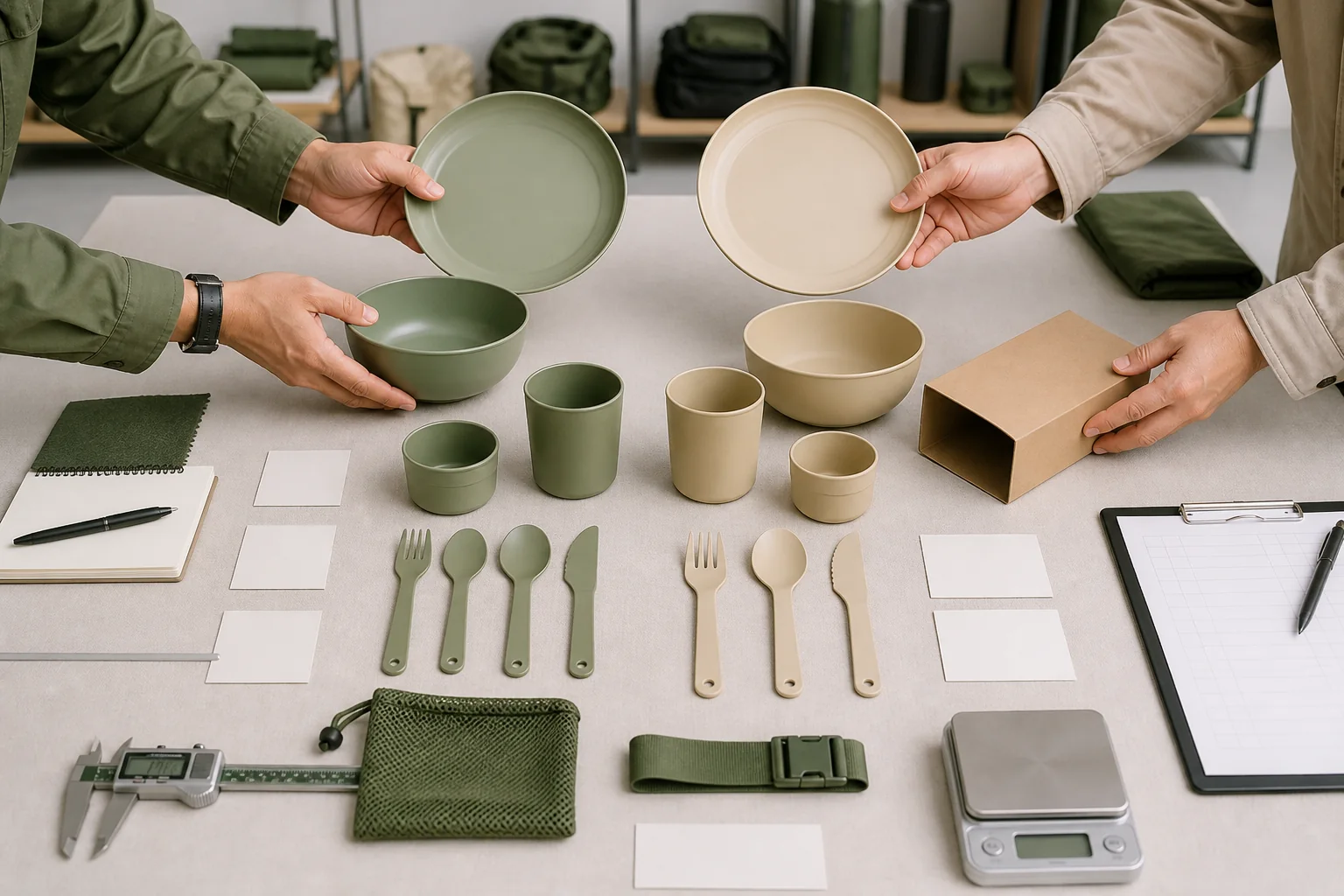
Give every component a line number, quantity, material, color, dimensions, nominal capacity, target mass and intended function. Add a drawing or reference image only after the written function is clear. This prevents two suppliers from pricing different interpretations of the same lifestyle picture.
Separate confirmed requirements from questions. For example, the buyer may require four place settings but ask the supplier to propose either a strap or pouch. When alternatives are allowed, require comparable packed dimensions, material identity and supporting evidence so the decision does not collapse into unit price alone.
State the destination market and evidence required for the exact products. Ask which documents already exist, which need new testing, and which claims the supplier will not support. Never accept another SKU’s report as proof without checking product identity and scope.
Finally, request a complete nested sample and at least one unpacked reference set. The controlled sample should match approved components, color, decoration and pack-out. Use the custom dinnerware sample-approval process to connect the sample to a production specification.
B2B Component Selection Checklist for Camping Mess Kits
| Check | Question | Why It Matters |
|---|---|---|
| User | Who uses the set, and how many place settings are promised? | Controls quantity, size and identification. |
| Menu | Which foods and drinks must the pieces handle? | Determines vessel shape, capacity and utensils. |
| Core | Does every user have an eating vessel, cup and suitable utensil? | Confirms the set performs its basic meal function. |
| Optional pieces | What problem does each added lid, bowl or accessory solve? | Prevents filler and uncontrolled complexity. |
| Cookware boundary | Are any pieces intended for direct heat, and what evidence supports them? | Prevents dinnerware from being misused as cookware. |
| Nesting | Can users pack and separate all pieces when dry and damp? | Validates real portability and repeat use. |
| Cleaning | How are clean, wet and dirty items separated and dried? | Connects product design to field hygiene. |
| Identity | Can users and staff identify individual settings and replacements? | Supports families, camps and fleets. |
| Evidence | Does documentation cover the exact SKU, material and use conditions? | Protects the buyer from generic claim transfer. |
| Packaging | Does the retail pack list every included piece and exclude props? | Aligns customer expectation with delivered contents. |
Follow-Up Questions Buyers Ask
1. Does every camping mess kit need a plate and a bowl?
No. A deep bowl-plate may cover both roles in a compact personal kit. Separate pieces are useful when the target menu combines liquid and dry foods or when a family expects a conventional place setting. Choose from the menu backward.
2. Should a camping mess kit include a cup?
Include a cup when the product promises a complete place setting or the user should not rely on another bottle or mug. Define capacity and intended beverage conditions. Do not imply insulation, boiling-water use or stove compatibility without product-specific evidence.
3. Is a spork enough for every camper?
No. A spork suits many meals but may not cut food, reach deep pouches or serve shared dishes well. Test the utensil with the named menu and user. A familiar fork-and-spoon pair may create better value than one compromised multi-tool.
4. Should cleaning accessories be counted as kit pieces?
They may be counted if they are genuinely included and useful, but the listing should not inflate value with token accessories. Explain the accessory’s function, storage and drying method. It does not replace safe water or local campsite waste practices.
5. When should cookware be included?
Only when cooking is part of the project scope and the exact vessel is designed and supported for the named heat source. Identify cookware separately from plates, bowls and cups. Never assume an outdoor theme makes every component flame safe.
6. How many pieces should a family camping kit contain?
Multiply the chosen personal core by the user count, then add only justified shared, cleaning and storage modules. A four-person set may have four plates, four bowls, four cups and twelve personal utensils, but another menu may need fewer pieces. Function is the decision rule.
7. What information should be sent before requesting a quote?
Send the user count, exact component schedule, dimensions or capacity targets, materials, colors, target market, artwork, packaging, evidence needs and sample plan. Mark optional alternatives clearly. This produces quotations that can be compared on the same scope.
Build the Set as a Modular Meal System
What should be included in a camping mess kit is ultimately a scenario question. Begin with an eating vessel, drinking vessel, suitable utensil and organized carry method for every intended user. Add bowls, lids, servers, cleaning tools, identification and cookware only when each addition solves a named problem and has a supportable use boundary.
Naike Dinner can help buyers evaluate reusable wheat-straw composite dinnerware pieces, coordinated colors, pack-out and private-label presentation for relevant serving and eating applications. We will not invent a universal component count, cookware capability, minimum order, certificate or test result. The correct next step is a written component schedule and controlled sample kit.
Convert your scenario into a controlled sample kit
Share the campers, menus, user count, target market, core components, optional modules, branding and packaging. Naike Dinner can organize a documented component schedule and sample-review matrix so your team can remove filler, compare like-for-like quotations and approve the complete pack-out.
Request a sample-kit reviewRequest a documented quotation