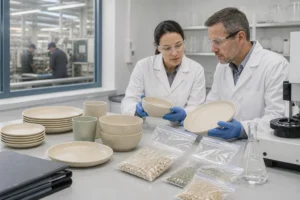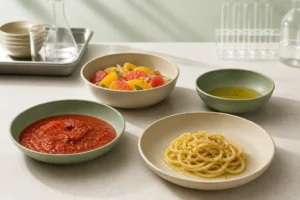
Yes, wheat straw composite tableware can be specified for acidic and oily foods, but the material name alone does not prove suitability. A buyer should match the finished SKU, formulation, food type, contact temperature, and contact time to the correct migration and performance evidence. Tomato sauce, citrus dressings, curry, and cooking oil create different verification conditions.
For an importer, retailer, foodservice distributor, or private-label brand, the useful question is not simply whether a plate “resists acid” or “handles grease.” The purchasing decision should identify the most demanding foreseeable meal, how hot it is when served, how long it remains in the product, whether reheating or repeated use is expected, and which market rules apply.
This factory-insider guide explains how to turn those use conditions into a test and sample brief. It does not claim that every wheat straw product has identical composition or performance, and it does not replace a laboratory assessment of the exact finished article you intend to buy.
Quick Decision Table for Acidic and Oily Foods
| Buyer scenario | Main contact challenge | Evidence to request | Practical sample check |
|---|---|---|---|
| Cold citrus salad | Acidic, aqueous food at low temperature | Market-specific migration scope covering the finished SKU and intended contact time | Inspect color, odor, surface feel, warpage and cleaning after realistic dwell time |
| Hot tomato sauce | Acidity combined with elevated temperature and staining pigments | Food simulant and test conditions justified for acidity, temperature and duration | Compare an exposed sample with an unused control after washing |
| Oily curry or pasta | Lipophilic contact, heat, pigment and repeated cleaning | Evidence appropriate to fatty-food contact and the actual formulation | Check retained odor, oily film, color change and dimensional stability |
| Retail meal-prep set | Longer storage, mixed foods and repeated use | Worst-case matrix covering all SKUs, colors, temperatures and reuse claims | Run a documented multi-cycle use-and-cleaning review |
| Restaurant service plate | Short contact but high frequency and aggressive washing | Food-contact documentation plus separate durability and dishwasher evidence | Evaluate stacking, rim wear, scratching and cleanability over defined cycles |
The table deliberately separates regulatory migration evidence from ordinary use checks. A sauce stain does not automatically mean unsafe migration, and a visually perfect plate does not automatically demonstrate compliance; buyers need both an evidence file and a product-performance review.
What “Suitable for Acidic and Oily Foods” Actually Means
Suitability is a defined-use statement, not a universal property. It links one finished product to specified foods, temperatures, contact durations, preparation methods, cleaning methods, and repetitions under the rules of a target market.
Wheat straw tableware is commonly a composite rather than compressed straw alone. The plant fiber, polymer matrix, pigments, additives, manufacturing controls, and final geometry can all influence what evidence is relevant, which is why buyers should first understand the wheat straw composite material behind the quoted SKU.
Acid resistance, oil resistance and food-contact compliance are different claims
“Acid resistance” may refer to appearance or physical integrity after contact with a sour food. “Oil resistance” may refer to whether the surface becomes greasy, discolored, softened, or difficult to clean, while food-contact compliance concerns whether substances transfer under defined conditions within applicable requirements.
A procurement file should not merge these ideas into one vague certificate request. Ask which requirement each document addresses, whether it covers the exact formulation and color, and whether the tested time and temperature represent your intended use.
Color retention is not a substitute for migration evidence
Tomato, turmeric, paprika, beetroot, and other foods can challenge a light-colored product visually. Staining is commercially important because it affects perceived cleanliness and customer satisfaction, but appearance alone cannot prove or disprove chemical migration.
Conversely, a product may look unchanged after a short kitchen trial even though the trial did not measure migration. Keep sensory and visual checks in the sample approval plan, then keep laboratory evidence as a separate gate.
Why Food Type, Time and Temperature Must Be Reviewed Together
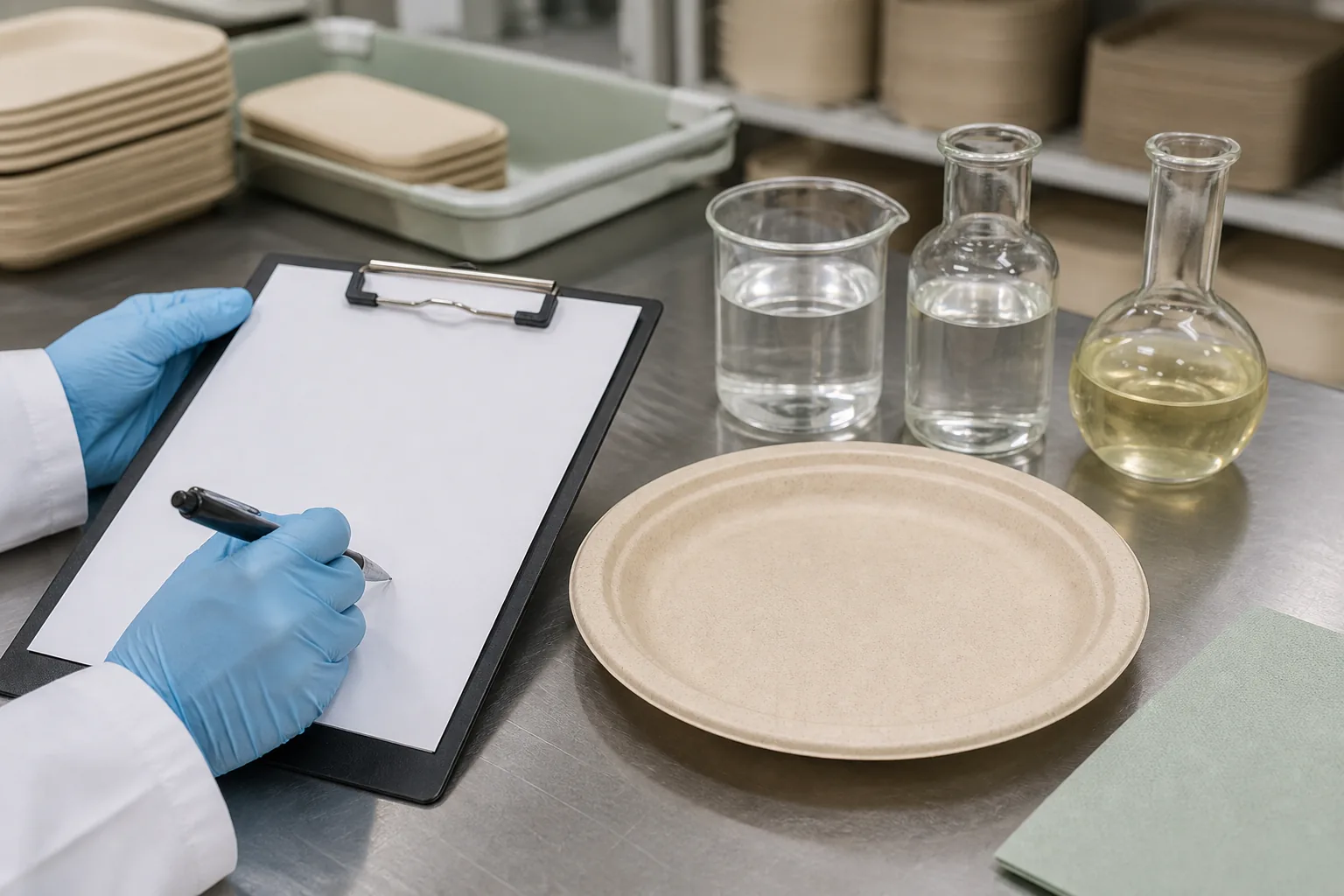
Food contact is an exposure scenario. The same bowl used for a cold lemon salad for twenty minutes and for hot tomato soup held for several hours does not represent the same condition, even though both foods are acidic.
The US Food and Drug Administration organizes food-contact evaluations around food types and conditions of use. Its official Food Types and Conditions of Use resource is a useful reminder that the identity of the food and the way the article is used belong in the same specification.
Temperature can change the severity of contact
Buyers sometimes provide a maximum service temperature without explaining whether the product is filled hot, reheated, stored, or merely rinsed at that temperature. A short fill event and a long hold can require different reasoning, and an isolated peak temperature should not be treated as the whole use case.
State the temperature at first contact, expected cooling profile, total contact duration, and whether the item is covered or stacked. If microwave or dishwasher use is also claimed, evaluate those functions separately through the established microwave and dishwasher use guidance rather than assuming one food-contact report proves every performance claim.
Repeated use adds change-control questions
Reusable tableware experiences cleaning, abrasion, drying, stacking, and sometimes reheating between food contacts. Those cycles can affect appearance and surface condition, so the buyer’s approval method should define how many cycles are relevant and what constitutes an unacceptable change.
This does not mean every routine kitchen trial becomes a regulatory migration test. It means the laboratory plan and the commercial durability plan should use the same intended-use description, preventing one team from testing a new plate while another approves claims based on an aged product.
How Official EU Evidence Frames Acidic and Fatty Foods
In the European Union, the general framework requires materials and articles intended to contact food to be manufactured so that, under normal or foreseeable conditions of use, they do not transfer constituents to food in quantities that could endanger health or cause unacceptable changes. Buyers can review the official European Commission food-contact materials legislation overview before defining the country-specific compliance file.
For plastic materials, EU rules use food simulants and standardized conditions to represent categories of food contact. Acidic aqueous foods and lipophilic or fatty foods are not automatically represented by the same simulant, so a report limited to one easy condition may not cover a buyer’s most demanding intended meal.
Food simulants are test tools, not ingredients
A food simulant is a controlled test medium selected to represent the extracting character of a food category. It allows laboratories to apply repeatable methods, but the selected simulant, time, temperature, surface-area relationship, repeated-use sequence, and analytical scope must still be appropriate to the product and intended use.
The EU Reference Laboratory provides technical material on testing conditions for kitchenware. Use such primary guidance with an accredited laboratory or compliance specialist; do not choose a convenient condition merely because it produces a short report.
Request the report scope, not just the cover page
A report title may mention a material family while the tested specimen differs in color, thickness, formulation, or intended use from the product being quoted. Ask for sample identification, photos or traceable codes, test dates, methods, simulants, conditions, limits, results, and the laboratory’s conclusion within its stated scope.
Then compare the report to the bill of materials and change-control record. If a pigment, additive, fiber source, polymer grade, or production process has changed, obtain a documented technical assessment of whether existing evidence remains representative.
How to Define the Worst Foreseeable Food-Contact Case
Worst foreseeable use should be demanding but realistic. It is not a dramatic scenario invented to make every product fail, and it is not the easiest meal selected to make every document appear acceptable.
Start with the product brief and list each channel: home meal, restaurant service, school catering, outdoor use, retail meal preparation, or promotional set. For each channel, identify the food family, maximum initial temperature, longest credible contact time, reuse pattern, cleaning method, and any printed consumer instruction.
Build a food matrix before requesting samples
A useful matrix might include cold citrus salad, hot tomato sauce, warm oily pasta, deeply colored curry, and a neutral control food. The matrix is not itself a legal testing protocol, but it helps the buyer, factory, and laboratory see which commercial risks and official test conditions must be addressed.
If one bowl will be marketed for soup, cereal, salad, and meal preparation, do not test only the least demanding cold application. Equally, if the product is explicitly limited to short cold-food service, do not silently extend a document to high-heat storage claims.
Identify which SKU is genuinely worst case
The largest contact surface, thinnest wall, deepest bowl, darkest pigment, or most complex formulation might be relevant, but there is no universal rule that one of these always represents every variant. Document the rationale for grouping sizes and colors, and ask the laboratory whether the proposed representative sample is scientifically defensible.
When the rationale is uncertain, treat variants separately. The cost of an additional justified assessment is usually lower than discovering after launch that the evidence cannot be connected to a retail SKU.
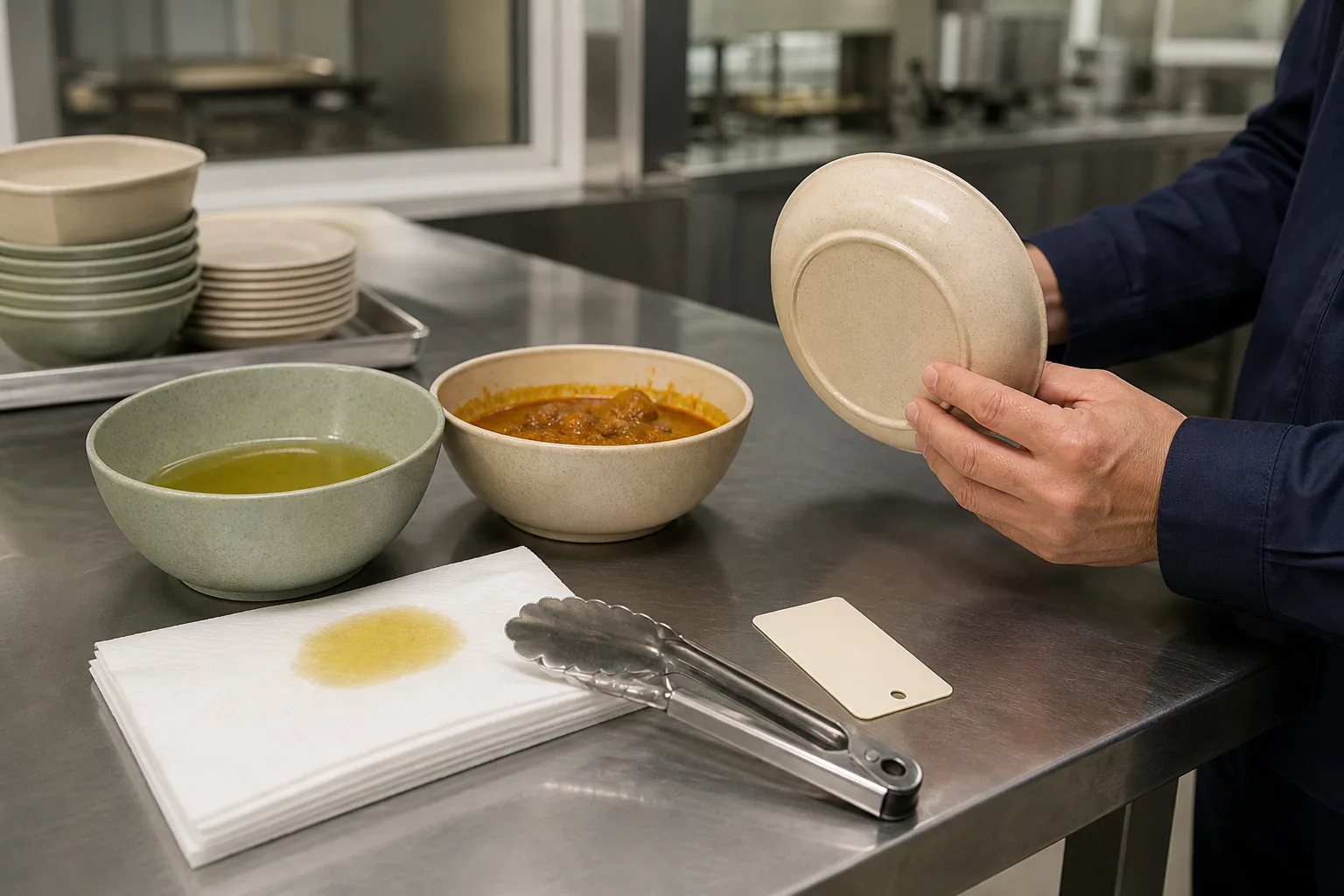
Factory Sample Checks Before Laboratory Testing
Factory checks help find obvious specification problems before costly external testing. They should use traceable samples and a written method, while making clear that an internal observation is not an accredited compliance result.
At minimum, photograph the unused control and exposed sample under consistent lighting. Record sample code, food or medium, fill temperature, exposure duration, room or storage condition, cleaning procedure, and inspection time so later teams can reproduce the review.
What to inspect after acidic food contact
Inspect the food-contact surface and rim for color shift, roughness, swelling, softening, cracks, loss of gloss or new odor. Review any decoration or printed area separately, especially when it can contact food or lips.
After washing according to the intended instruction, compare the sample with the control under the same light. A minor tomato tint may be a marketing concern even when structural integrity remains acceptable, so define appearance tolerances before tooling or packaging approval.
What to inspect after oily food contact
Check whether oil remains as a persistent film after the specified cleaning method, whether odor is retained, and whether pigments leave a visible mark. Also inspect the underside and stacking surfaces, because oil transfer during foodservice handling can affect packaging or neighboring units.
For repeated-use products, repeat the complete food-contact and cleaning cycle rather than exposing one fresh product each time. Record any progressive change without converting the observation into an unsupported safety conclusion.
Separate Migration, Sensory and Physical Performance Evidence
A robust procurement file has distinct evidence lanes. Migration work addresses transfer under defined test conditions, sensory review addresses odor or taste-related acceptability where relevant, and physical testing addresses deformation, cracking, staining, scratching, and cleaning performance.
Combining the lanes in one summary table is helpful, but combining the conclusions is risky. A physical pass cannot substitute for migration data, and a migration report may not tell a retailer whether turmeric staining will generate returns.
Migration evidence must connect to the finished article
Raw-material declarations and supplier specifications are important inputs, yet buyers normally need to know how the finished article is represented. Processing, color masterbatch, additives, recycled content decisions, and final contact geometry can affect the assessment.
Request a document map showing which evidence applies to the resin or compound and which applies to the finished plate, bowl, cup, or cutlery item. If the manufacturer relies on a family assessment, ask for the grouping rationale and change triggers.
Sensory and staining tolerances should be commercially explicit
Terms such as “no obvious stain” or “no odor” are hard to enforce across teams. Define the viewing light, control sample, cleaning method, waiting period, evaluation scale, and decision authority so the factory and buyer judge the same endpoint.
For light natural colors, consider a realistic acceptance range rather than assuming perfection after highly pigmented meals. Packaging instructions can explain prompt rinsing or approved cleaning methods, but instructions should never be used to hide a predictable mismatch between the product and its advertised application.
Documents B2B Buyers Should Request from a Supplier
Begin with a finished-product specification that identifies the SKU, dimensions, weight tolerance, material description, color, intended food types, temperature and time restrictions, cleaning method, and target markets. It should also state which claims are approved for packaging and which remain prohibited pending evidence.
Next, request traceable food-contact documentation suitable for your regulatory route. The file may include declarations, supporting test reports, material information, sample identity, and change-control commitments, but the exact combination should be decided with qualified market expertise.
Ask for a document-to-SKU matrix
A matrix prevents a certificate folder from becoming a substitute for product traceability. Each retail or foodservice SKU should point to the applicable formulation, color grouping, test report, declaration, label instruction, and approval status.
This approach also supports broader traceability planning. EU buyers can connect it with the controls described in the EU GPSR traceability guide, while keeping general product-safety duties distinct from food-contact migration requirements.
Define change notification before the purchase order
State which changes require buyer notification and technical review: fiber source, polymer grade, additive, pigment, mold, processing site, food-contact surface decoration, or packaging instruction. Agree on the approval evidence required before changed goods can ship.
Without change control, even a well-scoped initial report can become disconnected from later production. Build the notification clause into the quality agreement rather than relying on informal email memory.
B2B Buyer Checklist
| Check | Question | Why It Matters |
|---|---|---|
| Finished SKU | Does the evidence identify the exact plate, bowl, color and formulation? | Material-family documents may not represent the quoted article. |
| Food matrix | Are acidic, fatty, aqueous and pigmented foods described separately? | Different foods can require different test reasoning and performance checks. |
| Temperature | What is the initial temperature, hold profile and maximum foreseeable exposure? | A single temperature number does not define the use condition. |
| Contact time | Is the product for short service, storage, meal preparation or repeated use? | Duration is part of the exposure scenario. |
| Test scope | Do reports show simulants, conditions, methods, limits and sample identity? | A cover page alone cannot establish applicability. |
| Performance | Are stain, odor, oil-film, warpage and cleaning tolerances written? | Commercial acceptance needs measurable criteria beyond compliance. |
| Claims | Do packaging statements match verified restrictions and intended use? | Broad claims can exceed the supporting evidence. |
| Change control | Must the supplier notify you before formulation, pigment or process changes? | Evidence must remain connected to future production. |
Common Purchasing Mistakes with Acidic and Oily Food Claims
The first mistake is asking, “Is it food grade?” without describing the use. That question invites a generic answer; a professional inquiry specifies the finished SKU, target jurisdiction, food categories, time, temperature, cleaning and consumer claims.
The second mistake is accepting a report because the material name appears similar. Compare sample identity and formulation, then confirm whether the test conditions actually cover acidic and fatty food contact for the intended duration and temperature.
Do not use one kitchen trial as a compliance conclusion
A tomato-sauce trial is useful for observing staining, odor and deformation under that exact kitchen condition. It does not measure all relevant migrants, establish legal limits, or automatically represent long-term production.
Use the trial to improve the brief before accredited work, not to replace it. Preserve photos and records because they still help diagnose later differences between sample approval and production.
Do not let marketing wording outrun the evidence
Claims such as “safe for every food,” “acid proof,” or “oil proof” are broader than most realistic evidence packages. Prefer precise instructions describing the intended use and restrictions that were actually assessed.
If your sales channel needs a stronger statement, define the desired wording before testing. A laboratory or compliance adviser can then evaluate whether the evidence plan supports it, rather than trying to retrofit documentation after packaging has been printed.

Buyer FAQ: Acidic and Oily Foods
Can wheat straw plates hold tomato sauce?
They can be designed and specified for tomato-based foods, but approval should be based on the exact finished plate and intended conditions. Ask for applicable migration evidence and separately check staining, odor, deformation and cleaning after realistic hot or cold contact.
Does lemon juice damage wheat straw tableware?
The product name alone cannot answer this for every formulation. Define the concentration or real food, temperature and contact duration, then review appropriate evidence and compare the exposed sample with an unused control.
Is an oil-resistance test the same as a fatty-food migration test?
No. An internal oil-resistance check may evaluate visible film, staining, softening or cleanability, while migration testing follows defined regulatory methods and conditions. Keep both records and state which conclusion each supports.
Can one test report cover every color?
Not automatically. Pigments and masterbatches can differ, so the supplier and laboratory should document why a representative or worst-case color covers a group. If the grouping rationale is weak, assess colors separately.
Should buyers test real foods or food simulants?
Regulatory migration work commonly uses prescribed simulants and conditions, while real-food trials can help assess staining, odor and user experience. The correct combination depends on the market, material, article and intended use, so align the plan with an appropriate laboratory.
What should I send Naike Dinner for a useful review?
Send product references, target countries, food examples, initial and holding temperatures, maximum contact time, reuse and cleaning expectations, color list, packaging claims and requested delivery program. Naike Dinner can then discuss samples and the document plan without assuming unsupported results.
Turn Your Intended Use into a Verifiable Purchase Specification
Wheat straw tableware can be a practical choice for acidic and oily meals when the project is defined around the finished product and foreseeable use. The defensible answer comes from matching formulation, food type, time, temperature, repeated use and market requirements to traceable migration evidence and separate performance checks.
Do not buy a broad promise and hope the certificate folder fits later. Start with the meal and sales channel, approve a written evidence matrix, test representative samples, define stain and odor tolerances, and control any formulation or color change before shipment.
To review a plate, bowl or dinnerware program, browse the wheat straw dinnerware catalog, examine the sample approval process, and send a concise specification through Contact Naike Dinner. Request the exact samples, a documented quotation and a project-specific evidence review before approving packaging claims or mass production.