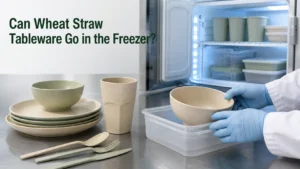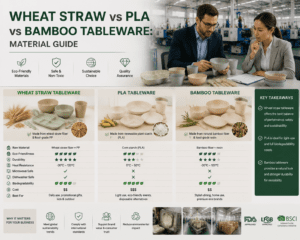
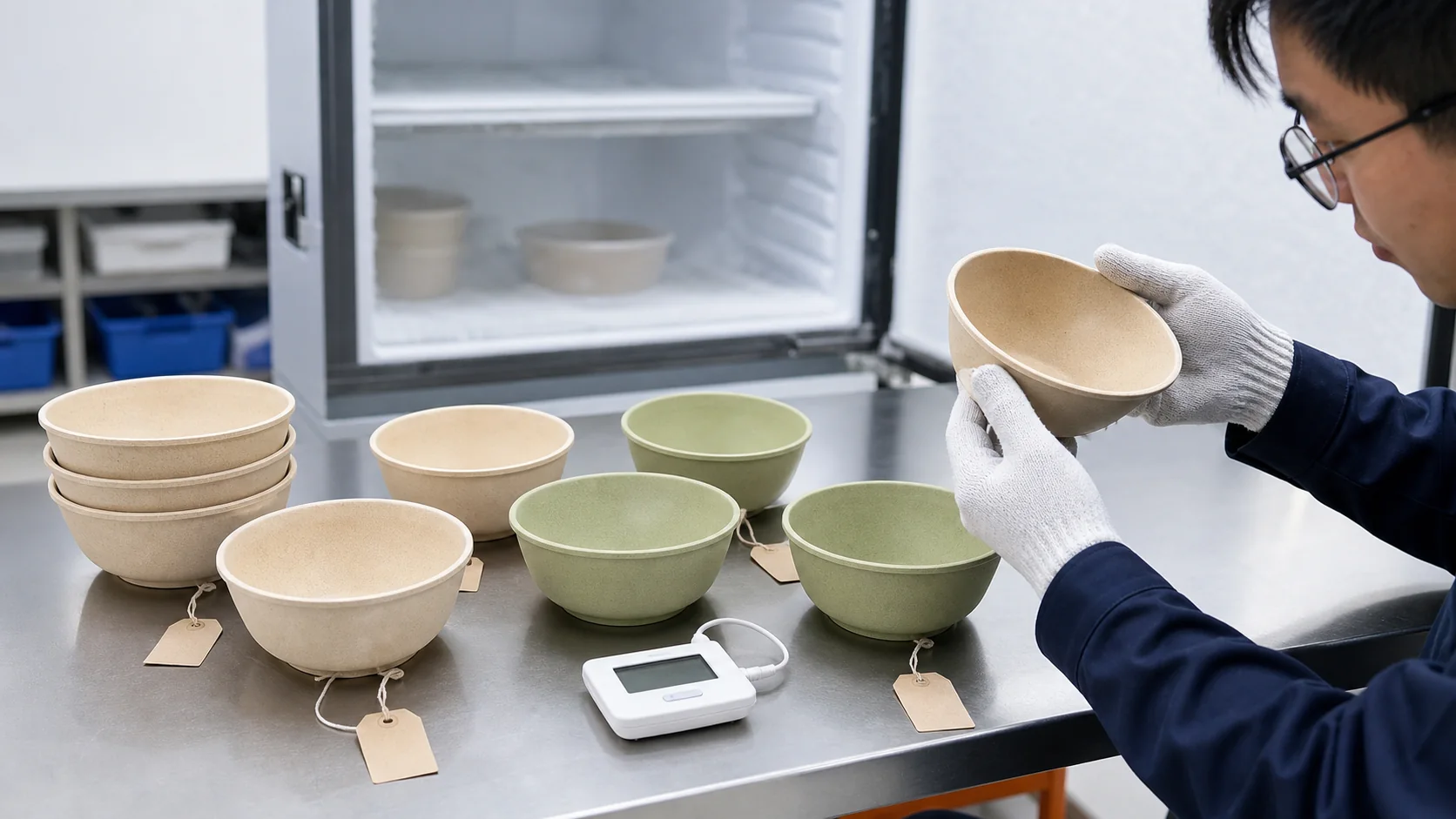
Can wheat straw tableware go in the freezer? It can only when the finished SKU—not merely the material name—has been specified and verified for frozen-food contact. Wheat straw products use different polymer ratios, wall thicknesses, pigments, and designs, so buyers should confirm intended temperature, storage time, food type, freeze-thaw performance, and documented food-contact compliance before approving a freezer-safe claim.
That distinction protects importers, private-label brands, retailers, meal-prep companies, and foodservice distributors from a common sourcing error. A supplier may use the same phrase “wheat straw tableware” for a rigid plate, a thin bowl, a cup, or a lidded container, yet those products can behave differently when food expands during freezing or when a cold article is flexed, dropped, stacked, or reheated.
This guide treats freezer use as a defined application rather than a marketing adjective. It explains what “freezer safe” should mean in a B2B specification, which evidence supports the claim, what physical checks belong in sample approval, and how to separate frozen storage from the more demanding freezer-to-microwave use case.
Can Wheat Straw Tableware Go in the Freezer? The Quick Decision Table
The fastest way to answer the question is to separate four levels of evidence. A material description can help a buyer understand the product, but only an SKU-level specification and relevant verification can support artwork, customer instructions, or a contractual freezer-use requirement.
| Buyer question | Acceptable evidence | What it does not prove | Decision |
|---|---|---|---|
| Is the article made with wheat straw composite? | Controlled bill of materials and raw-material specification | Low-temperature performance of the finished shape | Material identity only |
| Is the polymer portion suitable for the intended food-contact use? | Supplier declarations, applicable regulatory basis, and migration documentation | Resistance to cracking, warpage, impact, or food expansion | Chemical-compliance input |
| Does the finished SKU tolerate the defined frozen-storage cycle? | Documented conditioning and post-cycle inspection on representative samples | Automatic suitability for heating immediately after freezing | Physical-performance evidence |
| Can the retail pack say “freezer safe”? | Approved specification, evidence file, instructions, and market review | Unlimited temperature, time, food, load, or reuse conditions | Claim approval only within stated limits |
For ordinary food storage, the U.S. Food and Drug Administration advises that a freezer should be kept at 0°F (-18°C). That appliance temperature is a useful reference point for a buyer’s intended-use specification, but it is not by itself proof that a particular plate or bowl will perform correctly at that temperature.
The product file must connect the intended condition to the actual finished article. Buyers should therefore avoid approving a claim based solely on a resin data sheet, a generic competitor statement, or a report for a different design.
What Does “Freezer Safe Wheat Straw Tableware” Actually Mean?
Freezer safe wheat straw tableware should mean that the specified finished article is suitable for contact with the stated food types during the stated frozen-storage conditions, and that it remains fit for its intended function when used according to supplied instructions. The phrase should not mean indestructible, suitable for every industrial freezer, or safe to move directly into a microwave, oven, boiling-water process, or dishwasher.
A defensible product specification normally defines at least six boundaries: minimum intended temperature, maximum storage duration, food categories, fill level, stacking or load condition, and the permitted thawing or reheating method. If a lid is part of the saleable set, the specification must also address closure fit, venting, seal expectations, and whether the lid is made from the same formulation as the bowl.
The word “safe” also carries two different meanings. Food-contact compliance concerns whether constituents transfer into food within applicable limits under the relevant conditions, while functional safety concerns cracking, sharp edges, lid release, instability, leakage, or breakage during handling.
Both sides matter to a buyer. A migration document does not replace a freeze-thaw performance check, and a bowl that looks unchanged after freezing does not replace the food-contact compliance file.
Frozen Storage Is Not the Same as Freezer-to-Microwave Use
The FDA’s food-contact conditions distinguish frozen storage without thermal treatment from frozen or refrigerated ready-prepared foods intended to be reheated in the container. This is a useful procurement distinction because reheating adds a second temperature exposure and may create thermal gradients, steam pressure, hot fat contact, or localized deformation.
A buyer who needs only cold storage should write that narrow use into the request for quotation. A meal-prep brand that needs freezer-to-microwave performance should instead define the complete journey: fill temperature, freezing temperature and duration, thawing status, microwave power and time, venting method, food type, and number of intended reuse cycles.
Naike Dinner already explains the separate heating question in Can Wheat Straw Tableware Go in the Microwave and Dishwasher?. Do not combine the two claims unless the same SKU has been assessed for the combined sequence.
Why the Wheat Straw Material Name Cannot Answer the Freezer Question
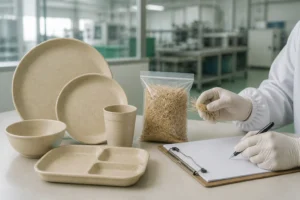
Commercial wheat straw tableware is usually a composite rather than a compressed bundle of straw. Cleaned, processed plant fiber is dispersed through a polymer matrix with pigments and other controlled processing inputs, so performance depends on the complete formulation and manufacturing process.
The fiber content can influence appearance, stiffness, moisture management, and processing behavior, while the polymer matrix contributes much of the finished article’s toughness and dimensional stability. Buyers can review the broader formulation logic in our wheat straw composite material guide.
Low temperature can reduce impact toughness in some polymers, but the practical outcome varies with polymer grade, filler loading, fiber treatment, coupling, pigment package, regrind policy, wall thickness, weld-line location, residual stress, and molding consistency. This is why a supplier should not extrapolate a freezer claim from a resin family name or from one successful sample in a different shape.
Design geometry is equally important. A broad plate may respond differently from a deep bowl, a thin compartment wall, a snap-fit lid, a cup handle, or a knife edge, even when all pieces share the same base compound.
The Food Can Create More Stress Than the Cold Air
Water-rich food expands as it freezes. If a bowl is filled to the rim, closed with a rigid lid, or packed with food in a shape that concentrates force, expansion can push against the walls or closure and produce deformation, stress whitening, leakage, or cracking.
The validation sample should therefore contain a representative food or an appropriate test load, not only an empty bowl placed in a freezer. The fill line, headspace, lid position, nesting arrangement, and stacking load should reflect foreseeable consumer or foodservice use.
Fatty, acidic, aqueous, and dry foods also present different contact profiles. A statement that a container passed with one benign load should not automatically cover every food type sold by a retailer.
What Regulatory Evidence Supports Frozen Food Contact?
In the United States, the FDA’s reference table for food-contact substances lists refrigerated storage and frozen storage as distinct conditions of use. The table also separately identifies frozen or refrigerated ready-prepared foods intended to be reheated in the container, reinforcing the need to state the actual application.
Buyers can consult the FDA’s official Food Types and Conditions of Use for Food Contact Substances. A supplier’s U.S. compliance rationale should identify the relevant substances, limitations, food types, and conditions rather than presenting the word “FDA” as if it were a universal product certificate.
In the European Union, Regulation (EC) No 1935/2004 establishes general safety and inertness principles for food-contact materials. The European Commission explains that food-contact materials should not release constituents at harmful levels or unacceptably change food composition, taste, or odor.
For plastic food-contact materials, Regulation (EU) No 10/2011 provides composition, migration, documentation, and testing rules. Its standardized overall-migration condition OM1—10 days at 20°C—covers food contact at frozen and refrigerated conditions, while the exact compliance evaluation still depends on article construction, intended food, applicable restrictions, and supporting documentation.
The European Commission’s food-contact legislation overview explains the EU framework, migration limits, standardized time and temperature conditions, and declaration-of-compliance system. The European Union Reference Laboratory’s kitchenware testing guidance helps laboratories and enforcement bodies select comparable test conditions.
Need a project-specific freezer-use evidence list?
Send the target market, SKU drawings, intended food, minimum temperature, storage time, fill level, lid design, and reheating instructions. Naike Dinner can use that information to prepare a documented quotation and sample-review plan without making unsupported universal claims.
Request a Specification ReviewHow Should a Factory Test Freezer Safe Wheat Straw Tableware?
A practical factory protocol should be written before samples enter the freezer. The protocol is not a substitute for accredited migration testing when such testing is required, but it creates repeatable evidence for physical performance and helps the buyer compare pre-production samples with later production lots.
Begin with representative samples from the intended material formula, color, cavity, mold version, and production settings. Record sample quantity, lot identification, dimensions, mass, surface appearance, lid fit, and any permitted cosmetic tolerance before conditioning.
Next, define the storage condition from the buyer’s real use rather than choosing a dramatic temperature for marketing. For a consumer-freezer application, the FDA’s 0°F (-18°C) reference can inform the protocol, while commercial blast freezing or lower-temperature logistics require a separate specification and should never be implied by a household-freezer result.
Fill selected samples with representative loads and maintain the required headspace. Include empty controls when useful, apply the planned lids, reproduce stacking or carton pressure, and record freezer temperature throughout the conditioning period.
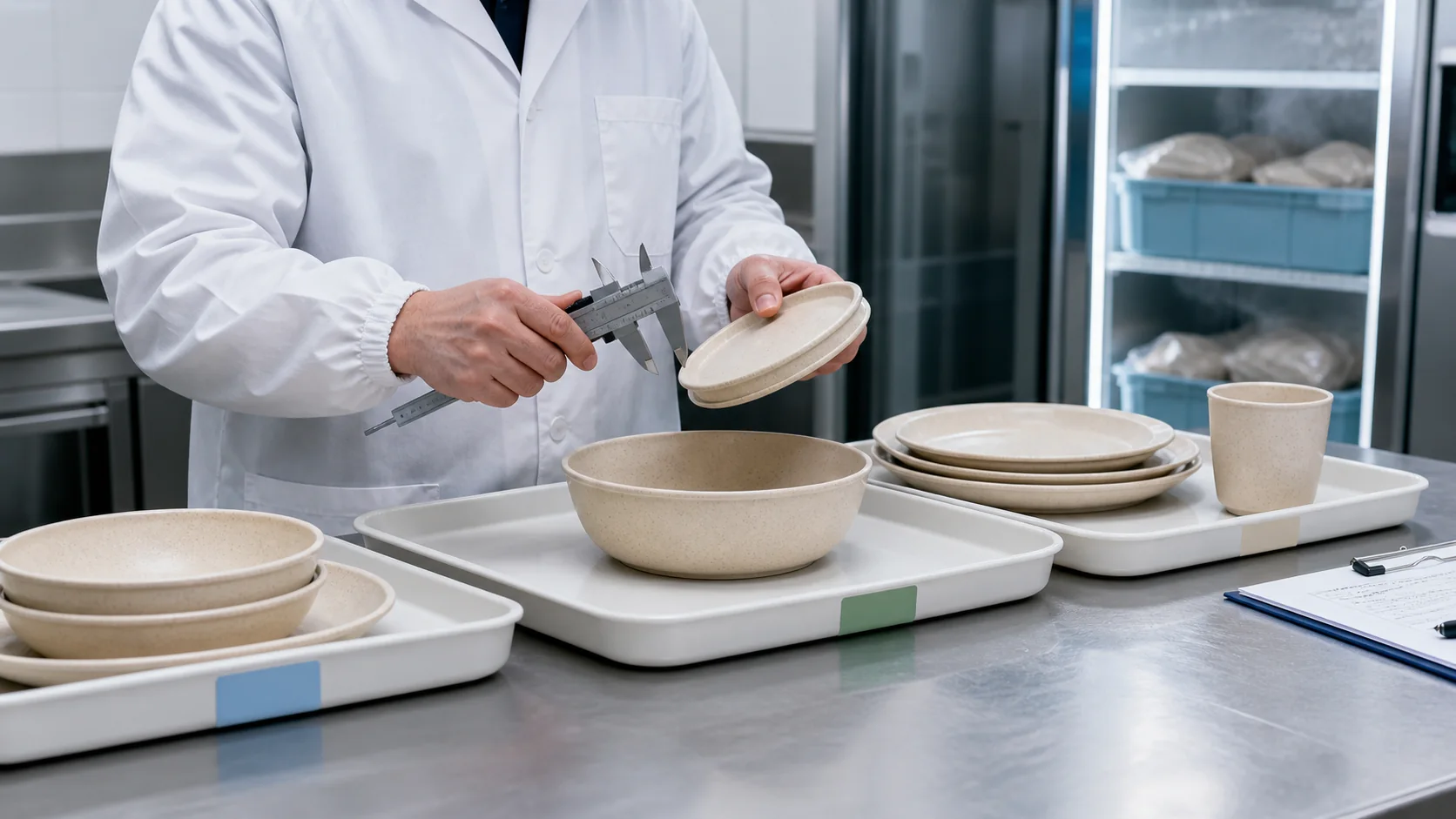
After frozen storage, inspect articles at the defined handling stage. Some projects require an immediate frozen-state inspection, while others require controlled thawing before opening, washing, or reuse; the sequence should match the consumer instruction.
Check for cracks, sharp edges, stress whitening, warpage, rocking, lid release, leakage, handle damage, odor change, surface change, and dimensional shift. If the article is reusable, repeat the cycle for the number of uses claimed or reasonably expected, and keep retained samples for comparison.
Write Acceptance Criteria Before Seeing the Result
A vague instruction such as “put it in a freezer and see if it is okay” invites subjective approval. The protocol should state which defects are unacceptable, which dimensions are critical, how lid fit is judged, how leakage is evaluated, and whether cosmetic color or gloss changes have a tolerance.
Acceptance criteria should also reflect product risk. A small color shift on an unprinted plate may be cosmetic, while a hairline crack, loose lid, unstable base, or sharp fracture surface is a functional failure.
For custom molds, validate high-stress features such as compartment corners, thin transitions, handles, locking tabs, and embossed areas. The sample approval process for custom wheat straw dinnerware explains how buyers can freeze critical specifications before mass production.
Freezer Storage vs Refrigeration vs Freezer-to-Reheat
These applications should appear as separate rows in a product specification and quotation. Combining them under one icon or one broad sentence can lead consumers to expose a product to conditions that were never reviewed.
| Use scenario | Primary stresses | Evidence focus | Instruction focus |
|---|---|---|---|
| Refrigerated storage | Long contact time, stacking, odor and staining | Food-contact scope, dimensions, lid fit, repeated handling | Maximum storage time and suitable foods |
| Frozen storage without heating | Low-temperature toughness, food expansion, frozen-state handling | Defined freezer cycle, crack/warpage/leak inspection, relevant migration basis | Fill line, headspace, thawing and handling limits |
| Freezer-to-microwave reheating | Thermal gradient, steam, hot fat, venting, deformation | Combined sequence on the exact SKU plus heating-use compliance | Microwave power, time, venting, thaw status and burn precautions |
| Commercial blast freezing | Faster cooling, lower process temperatures, industrial loading | Project-specific protocol and logistics simulation | Approved equipment and process window only |
A product may be acceptable in the first two scenarios and unsuitable for the third or fourth. The narrower truthful claim is usually more useful than a broad icon that creates avoidable warranty, compliance, and customer-service risk.
What Documents Should a B2B Buyer Request?
Start with the product specification, not the test report. The specification should identify the SKU, dimensions, weight tolerance, formulation code, color reference, food-contact surfaces, intended foods, temperature range, storage duration, use limitations, packaging, and revision date.
Next request the composition and regulatory file appropriate to the destination market. Depending on the project, this may include a declaration of compliance, substance declarations, migration reports, raw-material documents, GMP information, and a statement linking the evidence to the finished SKU and intended conditions.
Then request the physical freezer-use protocol and result. The report should identify sample lot, sample quantity, fill medium, temperature record, conditioning time, load and stacking arrangement, inspection timing, acceptance criteria, observed results, photographs, author, and approval date.
Finally, align consumer instructions and packaging artwork with the approved scope. A snowflake icon without a defined meaning can be interpreted too broadly, so pair symbols with clear words such as the minimum intended temperature, storage-only limitation, headspace instruction, and reheating prohibition where applicable.
How Do You Know the Report Belongs to Your Product?
Match the report’s sample description with the purchase specification. The SKU, color, material code, dimensions, manufacturer, photograph, production lot, and date should be consistent enough to show that the tested article represents the ordered product.
A report for a beige plate should not automatically approve a dark-pigmented bowl, a thinner promotional cup, or a new mold with snap features. If several SKUs are grouped, the technical file should explain the worst-case selection and why the result can cover the wider family.
B2B Buyer Checklist for Freezer Use
Use this checklist during supplier comparison, sample approval, and artwork review. A complete answer should be attached to the purchasing file rather than left in chat messages that cannot be traced to a product revision.
| Check | Question | Why It Matters |
|---|---|---|
| SKU identity | Does every document name the exact shape, size, color, material code, and revision? | Prevents evidence from an unrelated product being reused |
| Temperature | What is the minimum intended storage temperature? | Defines the boundary of the freezer claim |
| Duration | What maximum frozen-storage time was specified or represented? | Connects evidence to the intended consumer use |
| Food and fill | Which foods, fill levels, headspace, and lid conditions were evaluated? | Food expansion and contact type affect risk |
| Physical protocol | Were cracks, warpage, leakage, fit, sharp edges, and dimensions checked? | Migration compliance alone does not prove function |
| Food-contact file | Does the regulatory evidence cover the destination market and intended condition? | “FDA” or “EU compliant” must have a defined basis |
| Combined use | Is reheating included, excluded, or separately verified? | Frozen storage does not prove freezer-to-microwave use |
| Artwork | Do the icon, wording, instructions, and warnings match the approved evidence? | Prevents the consumer claim from exceeding the test scope |
| Change control | Will formula, pigment, regrind, mold, or supplier changes trigger review? | Preserves validity after mass production begins |
Common Procurement Mistakes to Avoid
The first mistake is treating all wheat straw products as one material. Two factories can use different polymer grades, fiber ratios, pigments, wall sections, and process settings while selling under the same category name.
The second mistake is requesting a single “freezer certificate.” Freezer suitability is normally supported by a combination of intended-use specifications, food-contact documentation, physical-performance evidence, instructions, and change control rather than one universal certificate.
The third mistake is testing empty samples only. Empty articles may look perfect while food expansion, lid pressure, stacking, or impact during frozen handling creates failures in real use.
The fourth mistake is approving a storage claim and later adding a microwave icon. A combined cold-to-hot sequence requires its own evidence, because the most severe stress can occur during reheating rather than during frozen storage.
The fifth mistake is ignoring production changes. A new pigment, higher regrind level, thinner wall, revised gate, alternate polymer supplier, or faster molding cycle can affect results, so the quality agreement should define which changes require re-approval.
When investigating odor, color difference, brittleness, or deformation, buyers can also use our guide to diagnosing wheat straw tableware quality issues. Freezer performance should be part of the same controlled quality system, not an isolated marketing test.

Buyer FAQs About Freezer Safe Wheat Straw Tableware
Can every wheat straw plate or bowl go in the freezer?
No. The category name does not establish freezer performance because formulations, wall thicknesses, designs, colors, and manufacturing controls vary. Verify the exact finished SKU against a written intended-use condition before making a claim or placing a bulk order.
What temperature should freezer safe wheat straw tableware tolerate?
The minimum temperature should come from the intended market and use case. For household food storage, the FDA identifies 0°F (-18°C) as the recommended freezer temperature, but a buyer should specify the required boundary and confirm it with the product supplier rather than assuming universal suitability.
Does an FDA food-contact report prove that a bowl is freezer safe?
Not by itself. Food-contact documentation addresses the regulatory basis and migration-related scope stated in the file, while freezer-safe functionality also requires evaluation of cracking, deformation, leakage, lid fit, sharp edges, stacking, and foreseeable handling.
Can frozen wheat straw tableware go directly into a microwave?
Only if the exact SKU and instructions cover the combined freezer-to-microwave sequence. Frozen storage without thermal treatment and reheating in the container are different conditions, so do not add a microwave instruction based on a cold-storage result.
How much headspace should be left when freezing food?
There is no universal headspace value for every food, bowl, and lid design. The brand should define a fill line based on representative food expansion and validate that condition, then communicate it clearly through instructions or packaging where consumers need it.
Should reusable tableware be tested through more than one freeze-thaw cycle?
Yes when repeated freezer use is intended or reasonably foreseeable. The protocol should reflect the claimed reuse pattern and check whether dimensions, fit, impact resistance, surface condition, or leakage deteriorate across cycles.
Can a supplier use one freezer test for an entire dinnerware set?
Only with a documented technical rationale. Different geometries can create different worst cases, so the file should identify representative or worst-case pieces and explain why their results cover other plates, bowls, cups, lids, or utensils.
Approve the Application, Not Just the Material Name
Can wheat straw tableware go in the freezer? The reliable answer is product-specific: yes when the exact SKU has a defined frozen-storage use, appropriate food-contact support, satisfactory freeze-thaw performance, accurate consumer instructions, and controlled production changes. Without those elements, “freezer safe” is an assumption rather than a procurement-ready claim.
For your next project, prepare a short use profile before requesting samples: destination market, product shape, food type, fill level, minimum temperature, storage duration, stacking load, lid requirement, reuse cycle, thawing method, and whether reheating is included. That profile gives the factory and laboratory a meaningful target and makes supplier quotations easier to compare.
Request a Freezer-Use Sample and Documented Quotation
Tell Naike Dinner how the product will be filled, frozen, handled, thawed, and reused. We will review the application against available designs or a custom project, identify the documents and sample checks required, and keep every proposed claim within the evidence available for the finished SKU.