
Wheat Straw Cutlery Set Wholesale: Travel & Gift Guide
Cutlery is the most underrated product in the wheat straw tableware category. Plates and bowls get the retail shelf space. Cups get the Instagram attention. But cutlery — the fork, the spoon, the knife — is what converts a tableware purchase into a complete dining experience. A consumer who buys a wheat straw dinner set and pairs it with generic plastic cutlery has an incomplete product. A brand that sells the matching cutlery set captures an additional SKU, an additional margin, and an additional reason for the customer to return.
In the wholesale market, wheat straw cutlery set wholesale is uniquely positioned across four distinct channels that conventional dinnerware cannot reach: travel and camping, office pantries, corporate gifting, and school lunch programs. A fork, spoon, and knife in a compact travel case is not a kitchen item — it is an everyday-carry product that sells in outdoor retailers, airport gift shops, and corporate wellness catalogs.
I have manufactured millions of wheat straw cutlery pieces at Naike Dinner, and I can tell you that the engineering of a fork is more demanding than the engineering of a plate. The tine geometry, the handle ergonomics, the hinge mechanism on a folding spork — these are precision injection-molding challenges that separate serious travel cutlery suppliers from factories that only make simple shapes. This guide covers the configurations, design specifications, packaging options, and channel strategies for building a profitable cutlery wholesale program.
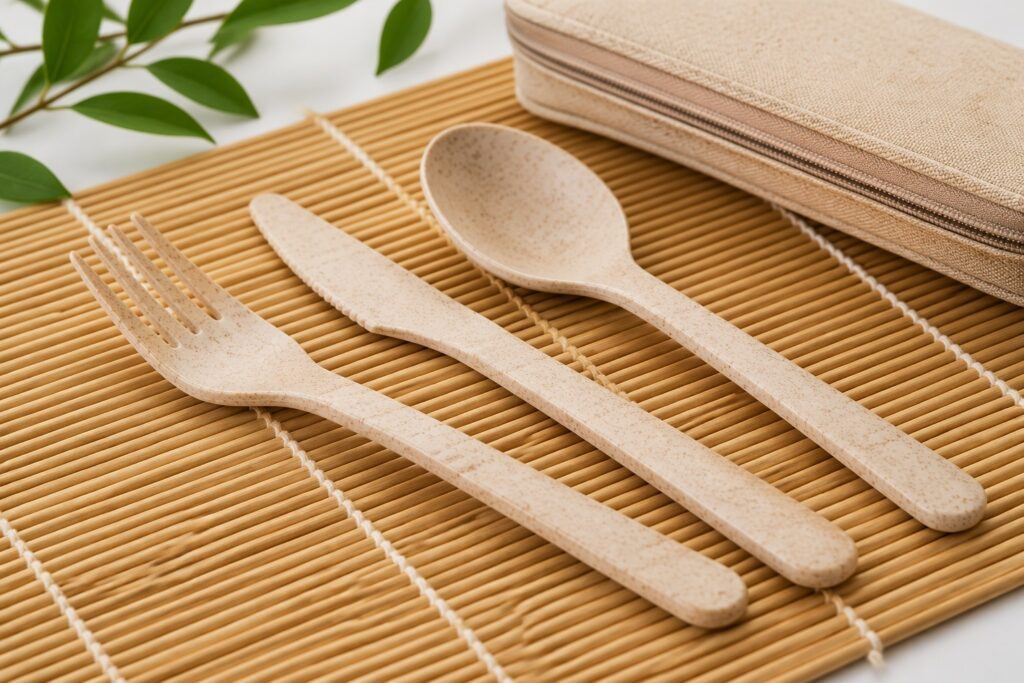
Cutlery Set Configurations That Sell
Unlike plates and bowls — where one shape covers most use cases — cutlery sets must be configured for specific end-use scenarios. A camping cutlery set and a corporate gift cutlery set have different piece counts, different packaging, and different price points.
| Set Configuration | Contents | Packaging | FOB Cost (approx.) | Best Channel |
|---|---|---|---|---|
| 2-Piece Basic | Fork + Spoon | PP polybag with header card | 0.45–0.70 | School lunch programs, budget travel |
| 3-Piece Standard | Fork + Spoon + Knife | Kraft paper sleeve or color box | 0.75–1.20 | Office pantries, everyday carry |
| 4-Piece Premium | Fork + Spoon + Knife + Teaspoon | Full-color retail box with window | 1.20–1.80 | Corporate gifts, retail chains |
| 5-Piece Deluxe | Fork + Spoon + Knife + Teaspoon + Chopsticks | Gift box with insert tray | 1.80–2.80 | Executive gifts, premium travel |
| Folding Compact | Folding Fork + Spoon + Knife in travel case | Zippered EVA case or tin box | 1.50–2.50 | Camping, hiking, outdoor retail |
| Kids 3-Piece | Child-size Fork + Spoon + Knife with rounded tips | Color box with character design | 0.80–1.30 | Children’s markets, school programs |
The margin opportunity in cutlery: a 3-piece standard set at 0.95 FOB , sold wholesale to acorporate office supplier at 3.50 per set, with an order of 5,000 units, generates 12,750 in gross margin on a 4,750 product investment — a 268% markup that reflects the value of curation, packaging, and channel-specific positioning rather than the commodity cost of the plastic.
For brands that already sell wheat straw dinnerware, adding the matching cutlery set to the product line typically increases the average order value by 22-30% according to our OEM partner data. Customers who buy the dinner set and see the matching cutlery option add it to their cart at a high conversion rate because the visual match is compelling. Browse our cutlery set category page for the complete range of matching configurations.
Design Specifications: What Makes a Quality Cutlery Piece
Cutlery is subject to forces that plates and bowls never experience. A fork tine must withstand prying. A knife edge must cut without being sharp enough to injure. A spoon bowl must scoop without flexing. The design specifications for wheat straw cutlery set wholesale are more exacting than for any other product in the eco-tableware category.
Fork tine geometry. The four tines must be identical in length, spacing, and thickness. A 0.2mm variation between tines creates a visible quality defect. The tine tips must be rounded to a 0.5mm radius — blunt enough to be safe for children, pointed enough to pierce food. The gap between tines must be at least 3mm to allow cleaning but no more than 4mm to prevent food from passing through without being held.
Knife edge design. Wheat straw composite cannot hold a sharp edge like steel. Serrated knife edges are molded into the product using a precision EDM-textured mold surface. The serration depth is typically 0.3mm-0.5mm with 8-12 serrations along the cutting edge. This design cuts through cooked vegetables, bread, and soft proteins but will not cut skin — a critical safety requirement for school and office use.
Spoon bowl depth and volume. A standard tablespoon bowl should hold 10-12ml. A teaspoon bowl should hold 4-5ml. The bowl wall thickness must be a minimum of 1.8mm to prevent flexing when scooping dense foods like ice cream or peanut butter. Our mold engineers use a “spoon-drop test” — dropping a loaded spoon from 30cm — to verify structural integrity.
Handle ergonomics. The handle must be long enough for an adult grip (minimum 90mm from bowl/tine base to handle end) and thick enough to resist bending (minimum 6mm diameter at the midpoint). The handle surface should have a subtle texture — typically EDM grain 21-24 — to provide grip without feeling rough against the lips or tongue.
Mold complexity and cost. A single cutlery piece requires a precision mold. A fork mold, with its four tines and complex parting line, costs 1,200−1,800 for a single-cavity P20 steel mold meeting ASTM D3641 standards for injection molding materials. A three-piece set requires three molds. For buyers developing custom cutlery designs, our sample approval guide covers the mold development and pre-production sampling process.

The Four Wholesale Channels for Cutlery
Understanding which channel you are selling into determines the product specification, packaging format, and price point. A travel cutlery supplier selling to an outdoor retailer needs a completely different product configuration than a supplier selling to a corporate HR department.
Camping and outdoor retail. This is the highest-volume channel for portable cutlery. The core product is a 3-piece or folding set in a compact travel case. Outdoor retailers — REI, Decathlon, Kathmandu, Anaconda — stock cutlery sets in the camping accessories aisle alongside mess kits, portable stoves, and water bottles. The packaging must communicate durability and portability. The travel case must be compact enough to fit in a backpack side pocket. The color palette skews toward earthy tones — olive green, charcoal grey, sand beige — that match outdoor gear aesthetics.
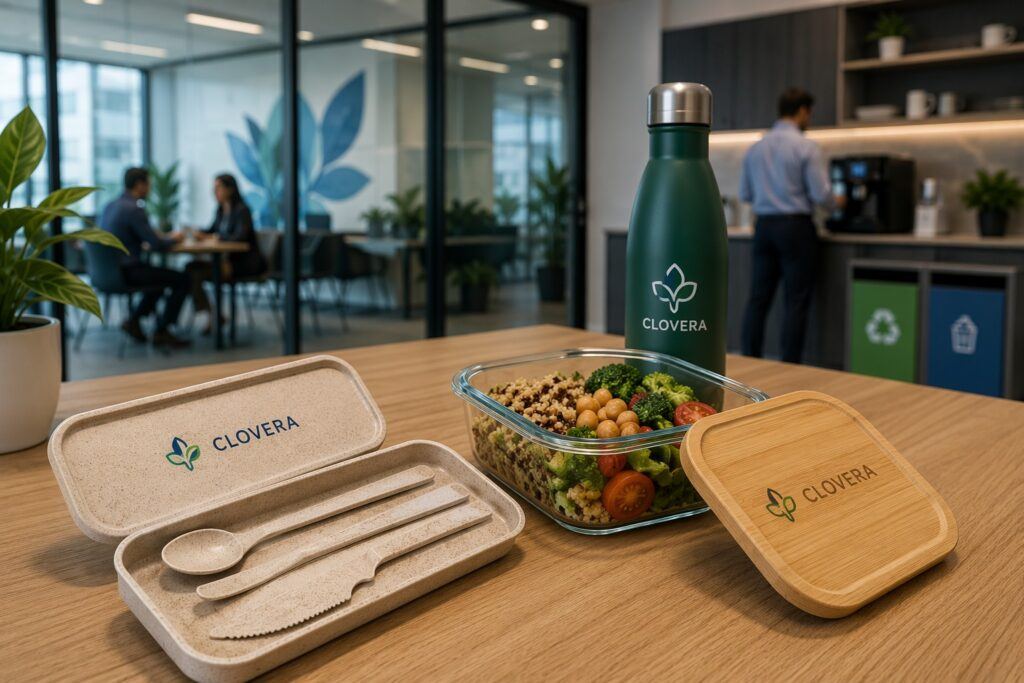
Office pantries and corporate wellness. Companies eliminating single-use plastic from their offices are installing reusable cutlery sets in break rooms. A typical order from a corporate office is 500-2,000 sets, branded with the company logo, stored in a central dispenser in the kitchen area. The cutlery must be dishwasher-safe at commercial temperatures (up to 85°C), stackable for storage, and labeled with the company’s sustainability messaging. This is a recurring-order channel — offices replace lost or damaged pieces every 12-18 months.
Corporate gifting and promotional products. Cutlery sets are increasingly popular as corporate gifts because they are functional, visible, and communicate sustainability. A branded fork-spoon-knife set in a gift box with the corporate logo and a “Thank You” card is a memorable alternative to a branded pen. The typical order size is 500-5,000 sets for employee appreciation or client holiday gifts. Our corporate gift program guide covers the full corporate gifting strategy.
School lunch programs and kids’ markets. Schools and daycare centers transitioning away from disposable plastic cutlery need child-sized, rounded-tip, brightly colored cutlery sets. The pieces are approximately 20% smaller than adult cutlery — typically 120mm total length versus 160mm for adult versions. Safety certification is critical: LFGB for EU schools, FDA for US schools, plus a heavy-metals screening on all color pigments. This channel has the most stringent compliance requirements but also the most predictable annual ordering cycles aligned with the academic calendar.
Packaging That Sells the Channel
The packaging for a wheat straw cutlery set wholesale order must match the channel. The same fork-spoon-knife set packed in a blister card for retail pegboard display and packed in a gift box for corporate distribution are two different products at two different price points.
Blister card with Euro slot. The standard for retail pegboard displays. A transparent plastic blister holds the cutlery against a printed cardboard card with a hanging slot. The card communicates the product features, sustainability claims, and barcode. FOB packaging cost: 0.08−0.15 per unit. Best for camping stores, supermarket housewares aisles, and discount retail.
Kraft paper sleeve with window. A recyclable paper sleeve wrapped around the cutlery set, with a die-cut window showing the product texture. The sleeve is printed with brand messaging and a barcode. FOB packaging cost: 0.10−0.18 per unit. Best for eco-focused retail, zero-waste stores, and brands marketing “plastic-free packaging.”
Zippered EVA travel case. A molded EVA case with a zipper closure, interior elastic straps to hold each piece, and a carabiner clip for attachment to a backpack. The case can be screen-printed with a logo. FOB packaging cost: 0.40−0.70 per unit. Best for camping sets, premium travel sets, and corporate outdoor event gifts.
Tin box with foam insert. A hinged metal tin with a molded foam or flocked insert that holds each cutlery piece in its own recess. Laser-engraved or printed logo on the lid. FOB packaging cost: 0.60−0.90 per unit. Best for executive gifts, milestone celebrations, and premium corporate programs.
Bulk dispenser box. A countertop dispenser box holding 50-100 loose cutlery sets for self-service in office pantries and cafeteria lines. The box is printed with the company logo and sustainability message. FOB packaging cost: 0.03−0.06 per unit (allocated across the contents). Best for corporate office programs and institutional food service.
For packaging that passes the ISTA 3A drop test for e-commerce and courier delivery, the retail packaging must be reinforced with internal structure — particularly for tin box and gift box formats where the metal or rigid board corners can puncture the outer shipping carton during transit.
Manufacturing Challenges Unique to Cutlery
Cutlery presents three manufacturing challenges that do not exist in plate, bowl, or cup production. Understanding these challenges helps B2B buyers distinguish between suppliers who genuinely specialize in cutlery and those who simply add cutlery to their catalog.
The parting line problem. In injection molding, the parting line is where the two mold halves meet. On a plate, the parting line runs along the rim — visible but functionally irrelevant. On a fork, the parting line must follow the contour of four individual tines, each 3mm wide, without creating flash (excess plastic) that leaves sharp edges. A factory that does not maintain its fork molds to a tolerance of 0.05mm at the parting line will produce forks with sharp flash between the tines — a safety hazard that will fail any QC inspection.
The cooling imbalance. A fork has a complex geometry: four thin tines connected to a wider handle via a narrow neck. The tines cool faster than the handle because they have less thermal mass. This differential cooling creates internal stress at the neck — the most common fracture point on low-quality wheat straw cutlery. Proper mold design addresses this with a generous radius at the neck transition (minimum R3.0mm) and a gate position that ensures the handle receives the hottest melt, compensating for its slower cooling rate.
The cutlery set weight tolerance. A three-piece cutlery set should have consistent weight across all pieces. A fork that weighs 18g and a spoon that weighs 22g feel unbalanced in the hand. Our QC specification for cutlery set weight tolerance is ±1.5g per piece and a maximum 3g difference between the heaviest and lightest piece in a set. This is tighter than the ±5g tolerance we apply to dinner plates, reflecting the fact that cutlery is held in the hand and weight inconsistency is immediately noticeable.
For buyers evaluating cutlery suppliers, request a measurement report for a sample set that includes: individual piece weight, fork tine gap measurement (all four gaps), spoon bowl volume (water displacement test), and knife serration count. A supplier who cannot provide these measurements does not have a systematic cutlery QC process. Our wheat straw cup manufacturer page demonstrates the level of specification detail we provide for every product category.
Sustainability Positioning for Cutlery Marketing
Cutlery offers the strongest sustainability narrative in the wheat straw product line because it directly replaces the most environmentally damaging category: single-use plastic cutlery. A single wheat straw fork used 500 times replaces 500 disposable plastic forks — a powerful visual and numerical story for marketing.
The disposable replacement calculator. For corporate and institutional buyers, quantify the environmental impact in terms they understand: “A set of 1,000 wheat straw cutlery sets, used daily in your office cafeteria, replaces approximately 250,000 single-use plastic forks, spoons, and knives per year. That is 1.2 metric tons of plastic waste eliminated annually from your facility’s waste stream.” This is the kind of specific, verifiable claim that corporate sustainability officers can include in their ESG reports — and it is the reason many corporate cutlery programs receive budget approval within weeks rather than months.
The “last plastic fork” marketing angle. For retail and e-commerce, the marketing narrative is personal: “This is the last fork you will ever need.” The durability claim — 500+ dishwasher cycles, 5+ years of daily use — supports a premium price point that generic “eco cutlery” cannot command. This narrative works particularly well for the travel and camping channel, where the message is reinforced by the product’s portability: “One fork. Every campsite. Every office lunch. Every trip.”
For wholesale customers developing their own brand positioning, our sustainability claims guide covers every claim your marketing can legally make — and every claim you should avoid.
- Piece count matched to channel. Camping = 3-piece or folding. Office = 3-piece standard. Corporate gift = 4-piece or 5-piece deluxe. Kids = 3-piece child-size. The set configuration determines the price point and the packaging format.
- Tine and edge safety verified. Fork tines have rounded 0.5mm tips. Knife edge is serrated, not sharp, and cannot cut skin under normal handling. Child-size cutlery has extra-rounded tips and thicker handles for small hands.
- Dishwasher durability tested. Cutlery must survive 300+ dishwasher cycles at 65°C for home use, and 500+ cycles for commercial/office use. Test reports should verify no surface degradation, no color fading, and no logo wear after the rated number of cycles.
- Packaging matched to sales channel and logistics. Retail pegboard requires Euro-slot blister cards. E-commerce requires packaging that passes the ISTA 3A drop test. Corporate programs require gift boxes that survive courier delivery to individual recipients. Bulk office programs require dispenser boxes that fit standard break-room counters.
- Travel case durability for portable sets. Zippered EVA cases must survive 1,000 open-close cycles without zipper failure. Tin boxes must not dent when dropped from 1 meter. Carabiner clips must hold 5kg without detaching.
- Barcode compliance. Each retail-packaged set must carry a unique EAN-13 or UPC barcode registered with GS1. Bulk dispenser boxes do not require individual barcodes. Corporate gift sets typically do not require barcodes unless they will be resold through retail channels.
- Matching design across the product line. If the cutlery is sold alongside wheat straw plates, bowls, and cups, the color, surface finish, and fiber texture must be visually consistent across all pieces. A customer who receives a sage green plate and a beige fork perceives a quality mismatch.
B2B Buyer FAQ: Cutlery Sourcing
Why is cutlery mold development more expensive than plate mold development? A fork mold requires a complex parting line that follows the contour of four individual tines. Each tine requires precision EDM machining to achieve the correct gap, radius, and thickness. The mold must also accommodate the transition from the tine area to the handle — a geometry change that creates uneven cooling and requires careful gate positioning. A fork mold typically costs 25-40% more than a plate mold of equivalent steel grade and cavity count.
Can I mix and match cutlery pieces from different sets? Yes. Many of our wholesale customers order a standard fork-spoon-knife set as their core SKU, and also order individual replacement spoons and forks in bulk for office pantry restocking programs. Individual pieces are typically priced at 30-40% of the set price per piece when ordered in quantities of 1,000+.
What is the MOQ for custom-colored cutlery? For custom Pantone-matched cutlery, the minimum order quantity is typically 3,000-5,000 sets per color. This covers the masterbatch production minimum, the mold purge and cleaning between color changes, and the per-SKU test report cost. For standard colors (natural beige, sage green, slate grey, navy blue), MOQ is 500-1,000 sets.
How do folding cutlery mechanisms work, and what is the failure rate? Folding cutlery uses a stainless steel hinge pin inserted through a molded channel in the handle. The handle folds over the functional end (fork tines, spoon bowl, knife blade) and locks into place with a friction detent. The hinge pin is the only metal component in the product. A properly manufactured folding mechanism should survive 5,000+ open-close cycles without loosening. Factory AQL inspection should sample folding mechanisms at AQL 1.0 for critical defects (hinge failure) and AQL 2.5 for major defects (loose detent, misalignment when folded).
Is wheat straw cutlery safe for hot food and liquids? Yes. Wheat straw composite with food-grade PP binder is safe for contact with food up to 120°C. The cutlery will not melt, warp, or leach chemicals when used with hot soup, coffee, or tea. However, like all polymer cutlery, it should not be left in a pot of boiling water or used as a cooking utensil — direct contact with a hot cooking surface above 160°C will cause deformation.
For brands building a complete wheat straw product line across multiple categories, our dinnerware catalog includes matching plates, bowls, and cups that coordinate visually with every cutlery color and finish.
Conclusion
Wheat straw cutlery set wholesale is a high-margin, multi-channel product category that complements any existing wheat straw dinnerware line and opens distribution channels — camping, corporate, institutional — that plates and bowls alone cannot access. The engineering requirements are more demanding than for any other wheat straw product, but the combination of compact size, high perceived value, and channel diversity makes cutlery one of the most profitable categories in the eco-tableware portfolio.
A travel cutlery supplier who masters the folding mechanism, the compact case packaging, and the outdoor retail channel requirements occupies a market position that generic tableware factories cannot easily replicate. The barrier to entry — precision mold engineering — is real. The reward — premium pricing, recurring orders, and channel exclusivity — is worth it.
Ready to Source Your Cutlery Line?
Request cutlery samples, a set configuration proposal, and a wholesale quotation for your target channel.
Request a Cutlery Quote & Sample Set
Browse the 12-Piece Wheat Straw Dinnerware & Cutlery Set
CONTACT US

Can Wheat Straw Tableware Go in the Freezer?
Can wheat straw tableware go in the freezer? This evidence-led B2B guide explains frozen-storage conditions, material variables, freeze-thaw testing, compliance documents and the questions buyers should ask before approving a freezer-safe claim.

EU GPSR Wheat Straw Tableware: A Traceability Guide
A factory-side guide to GPSR traceability, technical documentation, responsible-person information, online listings and corrective-action planning for EU wheat straw tableware programs.

Does Wheat Straw Tableware Contain Gluten?
A factory-insider guide for B2B buyers evaluating wheat straw material sources, gluten-related claims, testing scope, food-contact compliance and supplier controls.
Bulk Wheat Straw Dinnerware Order: 30 Supplier Questions
Ask these 30 bulk wheat straw dinnerware order questions before you sign. Avoid costly mistakes with our supplier checklist. Send your inquiry with confidence now.
Complete Wheat Straw Dinnerware Product Line: Build Guide
Build a complete wheat straw dinnerware product line with plates, bowls, cups and cutlery. Learn assortment strategy, SKU planning and margin optimization. Get your line quote.
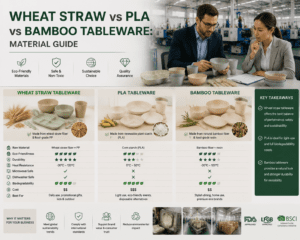
Wheat Straw vs PLA vs Bamboo Tableware: Material Guide
Compare wheat straw vs PLA vs bamboo tableware for B2B sourcing. Learn heat resistance, cost, and safety differences. Get material recommendations now.