
Custom Mold for Wheat Straw Dinnerware: Cost & Timeline Guide
Every brand owner eventually reaches the same inflection point. You have been selling stock wheat straw dinnerware designs — the standard 10-inch plate, the standard cereal bowl — and the margins are good but not great. Your competitors sell the same shapes in the same colors. The only differentiator is price, and the race to the bottom has begun.
The solution is investing in proprietary tooling — a custom mold that creates a product only your brand can sell. A proprietary shape — a plate with a unique rim profile, a bowl with your brand’s signature curve, a cup with an ergonomic handle that only your brand offers. A custom mold wheat straw dinnerware product cannot be compared price-for-price with a competitor’s generic product because it does not exist anywhere else in the market.
But custom mold development is also the single largest upfront investment in OEM tableware manufacturing — and the stage where B2B buyers lose the most money to poor planning, unclear specifications, and suppliers who quote a low mold fee but charge for every revision.
I have managed hundreds of custom mold projects at Naike Dinner, from simple single-cavity molds for startup brands to complex multi-cavity family molds for retail chains ordering 200,000 units per year. This guide explains the real OEM mold cost, the realistic timeline, and the five risks that can double your budget if you do not control them from day one.
The Four Stages of Custom Mold Development
A custom mold project is not a purchase — it is a process. Understanding the four stages and where the decisions happen is the difference between a mold delivered on budget in 30 days and a mold that costs twice the quote and arrives three months late.
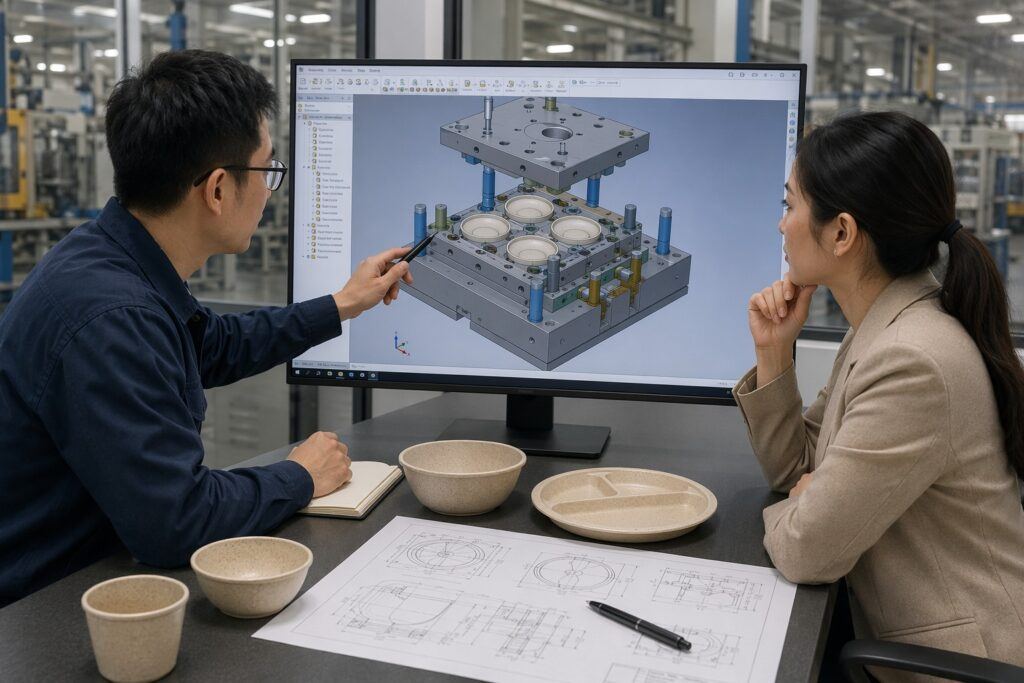
Stage 1: Design and 3D Modeling. Your concept becomes a technical drawing. The factory’s mold engineer creates a 3D CAD model showing the cavity geometry, the parting line, the gate location, the ejector pin positions, and the cooling channel layout. This stage typically takes 5-7 working days for a standard dinner plate or bowl. Complex shapes — divided kids plates, deep pasta bowls, cups with handles — may require 8-12 working days. You must review and approve the 3D model before any steel is cut.
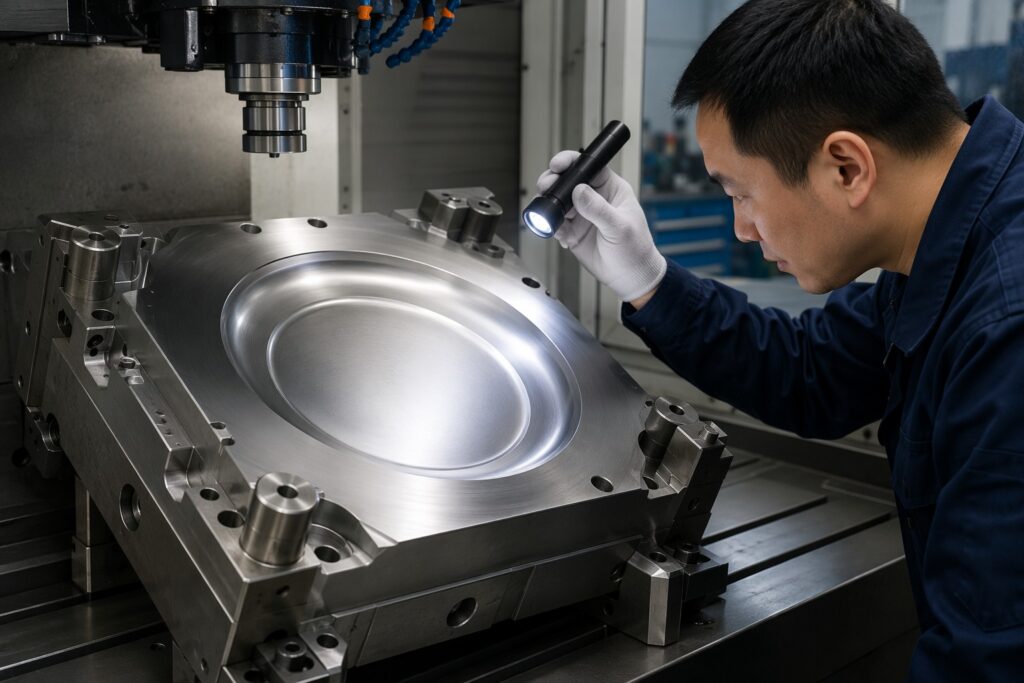
Stage 2: Mold Steel Cutting and Machining. The approved 3D model is loaded into a CNC machining center. The mold steel — typically P20 or 718H grade for wheat straw composite — is precision-cut to create the cavity. This stage takes 12-18 working days. The steel grade matters: P20 is suitable for production runs up to 300,000 shots; 718H is harder and rated for 500,000+ shots, but costs approximately 25-35% more. Always specify the steel grade in your mold contract — a supplier who quotes P20 but switches to lower-grade 45# steel saves $400 and costs you mold life.
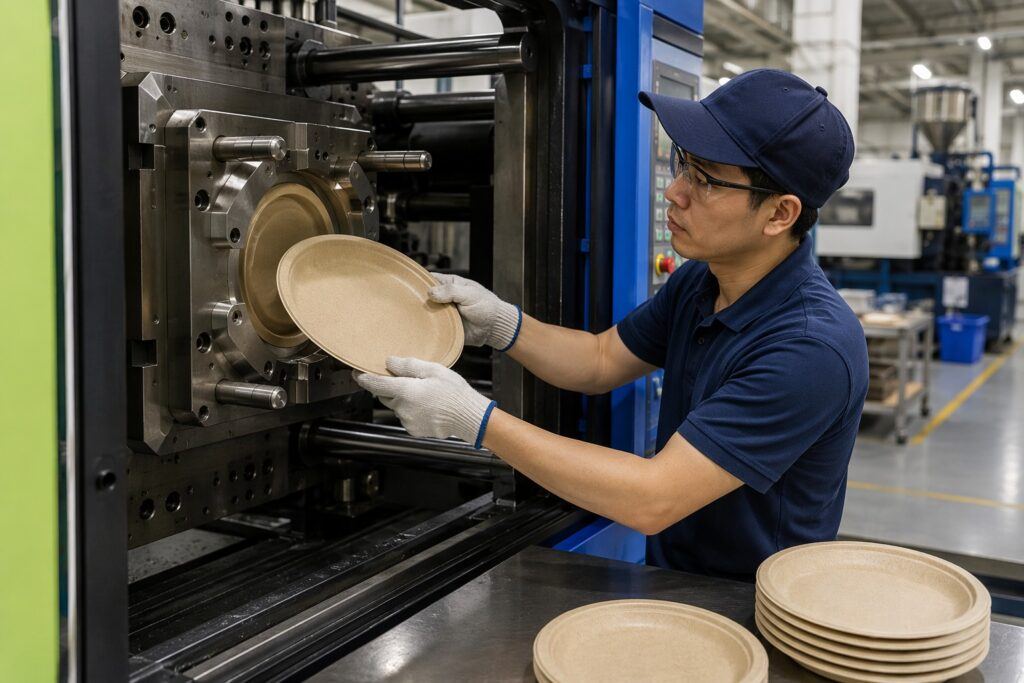
Stage 3: Mold Trial and First-Shot Sampling. The completed mold is installed on an injection molding machine. The factory runs a trial production — typically 50-200 pieces — to verify that the mold fills correctly, the wall thickness is uniform, the surface finish matches the specification, and the ejection system works without damaging the product. First-shot samples are sent to you for approval. This stage takes 3-5 working days.
Stage 4: Mold Adjustments and Final Approval. Based on your feedback on the first-shot samples, the factory makes adjustments — polishing the surface, modifying the gate, adjusting the cooling channels. One round of adjustments is standard and included in the mold quotation. Additional rounds of adjustment are typically charged separately. Once you approve the adjusted samples, the mold is locked for mass production.
OEM Mold Cost: The Real Numbers
The OEM mold cost for wheat straw dinnerware varies by four factors: product complexity, mold steel grade, number of cavities, and surface finish specification. Here are the real-world cost ranges from our tooling department.
| Product Type | Steel Grade | Cavities | Surface Finish | Mold Cost (USD) | Rated Life (Shots) |
|---|---|---|---|---|---|
| Simple round dinner plate (10″) | P20 | Single | Standard polish | 1,200–1,200–1,800 | 300,000 |
| Simple round dinner plate (10″) | P20 | Two-cavity | Standard polish | 2,000–2,000–2,800 | 300,000 |
| Simple round dinner plate (10″) | 718H | Two-cavity | Standard polish | 2,800–2,800–3,500 | 500,000+ |
| Cereal bowl (6″) | P20 | Single | Standard polish | 1,000–1,000–1,500 | 300,000 |
| Cup with handle | P20 | Single | Textured (EDM) | 1,800–1,800–2,500 | 250,000 |
| Kids divided plate (3 compartments) | P20 | Single | Textured (EDM) | 2,500–2,500–3,500 | 250,000 |
| Kids divided plate (3 compartments) | 718H | Single | Textured (EDM) | 3,500–3,500–4,500 | 500,000+ |
| Deep pasta bowl (8″) | P20 | Single | Standard polish | 1,400–1,400–2,000 | 300,000 |
What these prices include — and what they do not include — must be specified in your mold contract. At Naike Dinner, our standard mold quotation includes: 3D mold design, steel cutting and machining, one surface finish (polished or textured per specification), one mold trial with first-shot samples, and one round of adjustments. It does not include: additional rounds of adjustments, changes to the design after steel cutting has begun, or the cost of the sample courier.
A single-cavity mold for a dinner plate at 1,500maysoundexpensive.Butthatmoldwillproduce300,000plates.Themoldcostperunitis∗∗1,500maysou dexpe sive.Butthatmoldwillproduce300,000plates.Themoldcostperunitis∗∗0.005** — half a cent. The real cost of a custom mold is not the steel. It is the time, the revisions, and the risk.
The Custom Mold Timeline: 30 to 45 Working Days
Here is the realistic timeline for a custom mold wheat straw dinnerware project of standard complexity (single-cavity dinner plate). Add 5-10 working days for complex products (cups, divided plates, deep bowls).
3D mold design and approval: 5-7 working days. This includes your review and sign-off of the CAD model. Delays at this stage are almost always caused by the buyer — indecision about dimensions, changes to the rim profile, or internal brand approval processes that the factory cannot accelerate.
Mold steel cutting and machining: 12-18 working days. The factory cannot shorten this stage without compromising quality. A mold that is CNC-machined too quickly will have surface chatter marks that transfer to every plate in production.
Mold trial and first-shot sampling: 3-5 working days. The factory runs 50-200 test pieces. You receive physical samples by courier (add 3-5 days for international shipping).
Sample review and adjustment request: 2-3 working days. You inspect the samples and send feedback. The factory evaluates which adjustments are feasible within the existing mold structure and which require re-cutting.
Mold adjustments: 3-5 working days per round of adjustments. The factory modifies the mold and runs a second trial. If the first adjustment round resolves all issues, the mold is approved. If a second round is needed, add another 5-8 working days.
Final approval and production readiness: 1-2 working days.
Total realistic timeline: 30-35 working days with zero revisions beyond the first included round. 38-45 working days with one additional revision round. Plan for 45 working days and treat anything faster as a bonus.
The Five Risks That Double Your Mold Budget
Every mold project carries risk. The risks below are not hypothetical — they are the five most common causes of mold project cost overruns that I have observed across hundreds of OEM projects.
Design changes after steel cutting begins. This is the single most expensive mistake in custom mold development. Once the CNC machine has begun cutting the mold cavity, any change to the product design — a different rim width, a deeper bowl, a modified handle shape — requires either re-cutting the mold or starting over with new steel. The cost of a mid-production design change is typically 60-100% of the original mold fee. Always freeze the design before the machining phase begins.
Under-specifying the surface finish. A “polished” surface means different things to different people. Specify the exact SPI (Society of the Plastics Industry) finish grade. For wheat straw dinnerware, we recommend SPI A-2 (high polish, mirror finish) for glossy products and SPI C-1 (600 stone finish) for matte/satin products. A vague specification like “smooth surface” guarantees a mismatch between your expectation and the factory’s interpretation.
Choosing a single-cavity mold for high-volume production. A single-cavity mold produces one plate per machine cycle. For an order of 50,000 units at a 30-second cycle time, production takes approximately 17 days of continuous machine time. A two-cavity mold doubles the output. The additional mold cost is typically 60-70% more than a single cavity — not 100% more — because the mold base, cooling system, and design work are shared. For orders above 30,000 units, a two-cavity mold almost always pays for itself in reduced production time and lower per-unit manufacturing cost.
Not verifying the mold steel grade. Factory quotations often list the steel grade, but the buyer rarely verifies it. A mold made from 45# steel instead of P20 will develop surface pitting, wear at the parting line, and dimensional drift after 50,000-80,000 shots — one-third to one-quarter of P20’s rated life. If you cannot verify the steel grade yourself, your independent mold inspector can.
No mold ownership clause in the contract. You paid for the mold. But who owns it? Without a contractual clause specifying mold ownership, the factory may claim ownership because the mold is designed for their specific machine configuration. A standard ownership clause: “Mold remains the property of the Buyer. Upon written request, Supplier shall release the mold for transfer to an alternate facility within 30 days. Buyer is responsible for packing and shipping costs only. Supplier shall not charge a mold release fee.” Our sample approval guide covers the full contract specification framework for OEM projects.
How to Control Mold Project Risk Before You Invest
The most effective risk control for a custom mold wheat straw dinnerware project happens before a single dollar changes hands. Three practices separate professional mold projects from expensive learning experiences.
Request a Design for Manufacturability review. Before the mold enters the machining phase, ask the factory’s mold engineer to review the 3D model for manufacturability. Undercuts, impossible draft angles, and wall thickness variations that look fine in CAD may be impossible or cost-prohibitive to mold. A DFM review takes 1-2 working days and identifies these issues before steel is cut.
Require a mold trial report with measurements. After the first-shot sampling, the factory should provide a measurement report showing the actual dimensions of the trial samples against the CAD specifications. The report should verify: diameter, height, wall thickness at three points, weight, and warp measurement on a flatness gauge. A factory that cannot provide this report does not have a systematic quality process.
Visit the mold trial if possible, or hire an inspector. There is no substitute for seeing the first product come out of your mold. If you cannot attend the mold trial in person, hire a third-party inspector to attend on your behalf. The inspector should photograph the mold, photograph the first-shot samples, and verify the mold steel grade if possible. For a 3,000moldinvestment,a3,000moldinvestme t,a400 inspection is the cheapest insurance you will ever buy.
For brands developing multiple custom SKUs simultaneously, our custom dinnerware sets page shows how we coordinate multi-mold projects to keep timelines synchronized.
B2B Buyer Checklist: Before You Commission a Custom Mold
- Design is frozen. The 3D CAD model has been reviewed and approved. No further changes will be requested after machining begins.
- Steel grade is specified. The mold contract states P20, 718H, or another named grade — not “standard steel.”
- Surface finish is specified. The contract states an SPI finish grade and the expected visual appearance (“mirror gloss” or “satin matte”).
- Number of cavities is justified. Single-cavity for orders under 30,000 units; two-cavity or more for higher volumes. The ROI calculation accounts for reduced per-unit production cost.
- Mold ownership clause is in the contract. The clause specifies that the mold belongs to the buyer, the conditions for mold release, and that no release fee will be charged.
- The quotation includes one adjustment round. At least one round of mold adjustments after the first trial is included in the quoted mold fee.
- Mold trial attendance is planned. Either you or an independent inspector will be present for the first-shot trial, or will receive a measurement report with the trial samples.
- Mold maintenance is addressed. The contract specifies who is responsible for routine mold maintenance (cleaning, lubrication, ejector pin replacement) and whether maintenance costs are included in the unit price or charged separately.
For the full OEM project planning framework — including packaging, color matching, and freight coordination — browse our wheat straw dinnerware manufacturer catalog which includes the technical specifications we provide with every custom project quotation.
B2B Buyer FAQ: Custom Mold Projects
Can I use the same mold for different colors? Yes. The mold determines the shape. The color is determined by the masterbatch added to the raw material during injection. One mold can produce plates in any color — natural beige, sage green, terracotta, navy blue — without modification. However, each color requires its own SGS or LFGB test report for food contact compliance, because different pigments have different chemical profiles.
What happens if the mold wears out during my production run? A professionally manufactured P20 mold is rated for 300,000 shots and does not “wear out” during a single production run — even a 100,000-unit order. What can happen during a run is ejector pin wear, which causes minor surface marks on the product. Ejector pins are consumable parts that cost 5−5−15 each and can be replaced during production without removing the mold from the machine.
How do I know if my existing supplier’s molds are worn? Request a “Mold Condition Report” — a document that records the shot count, the last maintenance date, and close-up photographs of the cavity surface and parting line. A mold with rough parting lines, visible wear on the cavity surface, or a shot count exceeding 80% of the rated life should be scheduled for refurbishment before your next production run.
Is it cheaper to develop a mold in China compared to Europe or the US? For wheat straw dinnerware molds, Chinese tooling typically costs 40-60% less than equivalent European or North American tooling for the same steel grade and specification. However, the cost difference narrows when you factor in international communication, courier fees for samples, and the cost of mold trial attendance. The total project cost — not just the mold invoice — is what matters. For international tooling, the material standards we follow align with ASTM specifications.
If I only need 5,000 units, is a custom mold worth it? Probably not. At 5,000 units, the amortized mold cost per unit — even for a 1,200single−cavitymold—is1,200single−cavitymold—is0.24 per unit, which erodes most of your margin. For small-batch differentiation, consider customizing existing mold products with your brand logo, custom color, and custom packaging instead of investing in a new mold. Our stock wheat straw dinnerware set demonstrates how standard shapes can be transformed into a premium brand product through logo, color, and packaging alone.
Conclusion
A custom mold wheat straw dinnerware project is the most powerful competitive moat available to a tableware brand. A proprietary shape cannot be compared, cannot be undercut on price, and cannot be copied without the same mold investment. But a custom mold project is also the highest-risk procurement decision in OEM tableware manufacturing — and the difference between a mold delivered on budget and a mold that costs twice the estimate is almost always determined by decisions made before machining begins.
The OEM mold cost is not the invoice from the tooling shop. It is the invoice plus the cost of revisions, the cost of delays, and the lifetime production cost of a mold that produces 300,000 units or 80,000 units depending on the steel grade you specified. Control the specification, control the contract, and control the mold trial — and you control the outcome.
At Naike Dinner, we manage custom mold projects from 3D design through mass production with transparent pricing, documented steel grades, and contractual mold ownership. Every mold we build is designed to be an asset your brand owns, not a liability locked in our factory.
Ready to Discuss Your Custom Mold Project?
Tell us your product concept. We will provide a detailed mold quotation, a stage-by-stage timeline, and a mold contract that protects your ownership and your budget.
Request a Custom Mold Consultation & Quotation
Browse the Unbreakable 24-Piece Wheat Straw Dinnerware Set
Explore Our Custom Dinnerware Sets Capabilities
Read: Sample Approval Process for Custom Dinnerware Projects
Discuss Your Project
Tell us about your project.

Rental-Fleet Sets: How Many Spares Should Be Held?
Calculate rental camping dinnerware spare parts with buyer-entered loss, damage, deployment, review-cycle, buffer, stock and pack-multiple inputs.

Plan Replacement Pieces for a Portable Dinnerware Line
Plan replacement pieces for a portable dinnerware line with a service matrix that controls demand, compatibility, evidence, packaging and revision risk.
Which Camping Dinnerware Add-Ons Belong in the Base Set?
Use a buyer-side decision table to keep essential camping dinnerware functions in the base set and move optional, channel-specific or unverified add-ons into separate bundles.

Build Good–Better–Best Camping Set Tiers by Function
Build good, better and best camping dinnerware tiers from functional upgrades buyers can verify, rather than cosmetic changes or unsupported claims.

What Makes a Camping Tableware RFQ Quotable?
Use a complete camping tableware RFQ checklist covering controlled components, use conditions, decoration, packaging, commercial terms, evidence and approval fields.

Calculate Landed Cost Without Hiding Replacement Parts
Use a buyer-entered landed-cost model that keeps replacement parts, freight, duty, fees and channel costs visible instead of hiding them in the base set.