
BSCI, ISO, SGS for Tableware Factory: A Buyer's Guide
Every B2B buyer sourcing wheat straw tableware eventually encounters the same three acronyms: BSCI, ISO, SGS. They appear in supplier quotations, on factory walls, and in retail buyer onboarding checklists. And most importers — even experienced ones — cannot explain what each one actually covers, how to verify it, or which one matters most for their specific market.
I have watched buyers reject a fully compliant BSCI tableware factory because they confused BSCI with a product safety certification. I have seen importers accept an expired ISO certificate at face value because they did not know how to check the certificate number. And I have seen retail chains cancel purchase orders because the supplier’s SGS report — while genuine — did not cover the specific color SKU being shipped.
If you are sourcing from an ISO SGS supplier, or evaluating a factory’s certification package for the first time, this guide will give you the same understanding that our QC team uses every day. We will break down what BSCI, ISO, and SGS actually mean, how they differ, how to verify them independently, and how to use them in your supplier comparison process.
The Certification Alphabet: What Each One Actually Covers
Before we compare them side by side, let’s define each certification in plain language — not in the language of the standards bodies, but in the language of a B2B buyer who needs to make a decision.
A BSCI certification answers one question: “Does this factory treat its workers fairly?” It is a social compliance audit, not a product quality audit. BSCI — the Business Social Compliance Initiative, now managed by Amfori — evaluates working conditions, wages, working hours, health and safety, and freedom of association. It does not test your plates for heavy metals or verify your PP-to-fiber ratio. It tests whether the people making your plates work in safe, legal conditions.
An ISO 9001 certification answers a different question: “Does this factory have a functioning quality management system?” ISO 9001, published by the International Organization for Standardization, is the world’s most recognized quality management standard. It certifies that the factory has documented processes for design, production, inspection, and continuous improvement. It does not guarantee that every plate is perfect. It guarantees that the factory has a system for identifying and fixing problems when they occur.
An SGS test report answers yet another question: “Does this specific product meet this specific safety standard?” SGS is not a certification body in the same sense as ISO or BSCI. It is one of the world’s largest independent testing, inspection, and certification companies. An SGS report for wheat straw dinnerware typically tests for BPA, phthalates, heavy metals, and overall migration limits according to EU Regulation 10/2011 or FDA 21 CFR. The report applies to a specific product, a specific color, and a specific production batch — and it expires.
These three certifications serve three completely different purposes. You need all three for a complete supplier profile, and you need to understand the gaps that none of them cover.
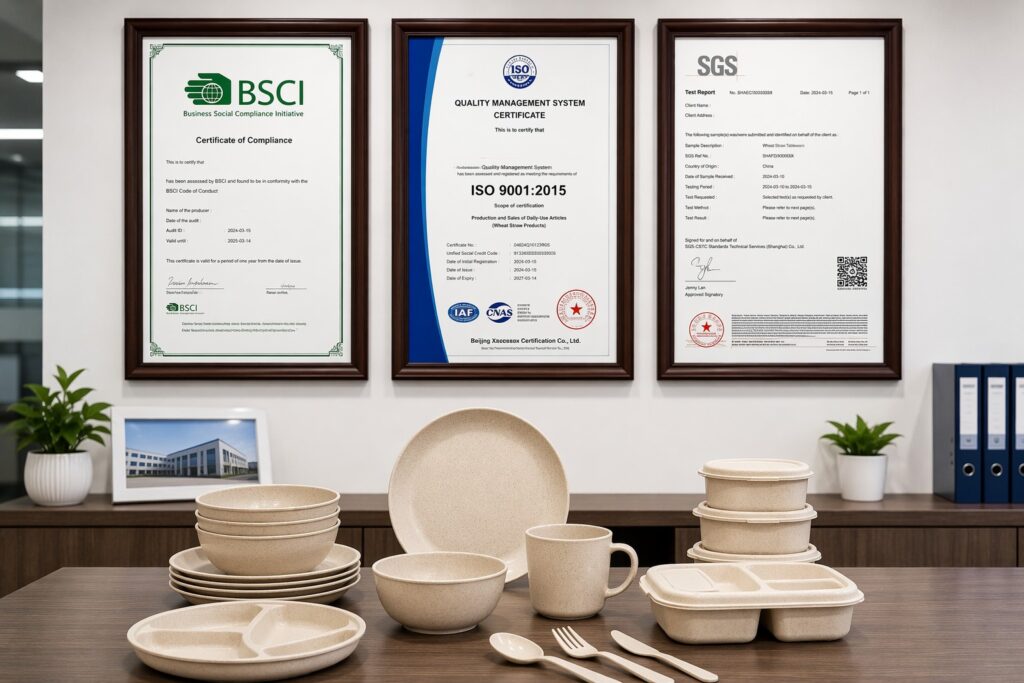
The Big Three: Detailed Breakdown
Amfori BSCI is a social compliance auditing framework based on ILO conventions and SA8000 principles. The audit evaluates 13 performance areas including fair remuneration, decent working hours, occupational health and safety, no child labor, no forced labor, and freedom of association. The audit is conducted by an independent, Amfori-approved auditing firm — not by the factory itself. The audit result is a report with a grade from A to E. Grade A or B is excellent. Grade C is acceptable. Grades D and E require corrective action. Most European retailers — including Aldi, Lidl, Carrefour, and Metro — require a valid BSCI audit report (Grade C or higher) before they will onboard a new supplier. The audit report is valid for two years, after which a re-audit is required. You can verify a BSCI audit report on the Amfori Sustainability Platform using the report reference number.
ISO 9001:2015 is the current version of the quality management system standard. It is based on seven quality management principles: customer focus, leadership, engagement of people, process approach, improvement, evidence-based decision making, and relationship management. The certification is issued by an accredited certification body — such as TÜV, Bureau Veritas, or SGS — after a successful on-site assessment. The certificate is valid for three years, with annual surveillance audits to confirm continued compliance. ISO 9001 does not test your product. It audits the factory’s quality management system: the documented procedures, the inspection records, the corrective action process, the management review meetings. A factory with ISO 9001 is not guaranteed to produce defect-free products. But a factory without ISO 9001 has no documented system for preventing or correcting defects — which means quality is dependent on individual worker diligence rather than institutional processes.
SGS, Intertek, Bureau Veritas, and TÜV are testing, inspection, and certification (TIC) companies — third-party laboratories that test products against specific standards. An SGS test report for a wheat straw plate will state: the product description, the material composition, the tested parameters (e.g., BPA, phthalates, heavy metals, overall migration), the test methods used, the results, and the pass/fail verdict. Critically, the report also states the sample description — if it says “plastic plate” rather than “wheat straw fiber (35%) + polypropylene (65%) composite plate, color: sage green,” the report is too generic to be useful. And it states the test date — reports older than 12 months are considered expired by most retail buyers. You can verify an SGS report by entering the report number on the SGS verification portal.
Certificate Comparison Matrix
| Dimension | BSCI (Amfori) | ISO 9001 | SGS Test Report |
|---|---|---|---|
| What it evaluates | Social compliance — workers’ rights and safety | Quality management system | Product safety — chemical and physical tests |
| Scope | Entire factory facility | Entire factory’s quality processes | Specific product, color, and batch |
| Issued by | Amfori-approved independent auditor | Accredited certification body (TÜV, BV, SGS) | ISO 17025-accredited laboratory |
| Validity period | 2 years | 3 years (with annual surveillance) | Typically 12 months for food contact |
| Retail buyer expectation | Required by EU retail chains | Expected by most professional buyers | Required for every shipped SKU |
| Verification method | Amfori Sustainability Platform | Certification body’s public database | Lab’s online verification portal |
| Common failure mode | Expired report; grade D/E | Certificate not matching factory name on invoice | Generic sample description; expired date |
If your supplier has all three — a valid BSCI report, a current ISO 9001 certificate, and per-SKU SGS test reports — you are looking at a professionally managed factory. If any one is missing, you have a gap in your compliance coverage.
For a practical demonstration of what a certified factory’s product line looks like, browse our wheat straw dinnerware catalog — every product is manufactured under our BSCI-audited, ISO 9001-certified facility with current SGS test reports.

How to Verify a Certificate in 60 Seconds
Suppliers know that most buyers never verify certificates. That is why expired, forged, and misattributed certificates are common in B2B sourcing. Here is a 60-second verification protocol that separates genuine documentation from decoration.
Find the certificate number. Every legitimate BSCI report, ISO certificate, and SGS test report has a unique reference number. If the supplier’s document does not have a visible, legible certificate number, treat it as unverified.
Go to the issuing body’s verification portal. For ISO certificates, search the certification body’s certificate database — for example, TÜV Rheinland’s Certipedia or Bureau Veritas’s certification check. For BSCI, log in to the Amfori Sustainability Platform. For SGS, use the public report verification page at sgs.com.
Enter the certificate number. If the number returns no result or returns a result for a different company at a different address, the certificate is invalid. This takes less than one minute and eliminates the most common form of certification fraud.
Check the validity dates. Even a genuine certificate is useless if it has expired. Verify that the issue date and expiry date are current.
Match the company name. The legal entity name on the certificate must match the legal entity name on the supplier’s business license and on your Proforma Invoice. A certificate issued to “ABC Manufacturing Co.” cannot be used by “XYZ Trading Ltd.” — even if they share the same factory building.
Most buyers skip these five steps because they seem confrontational. But professional suppliers expect verification. If a supplier reacts defensively to a certificate verification request, that reaction is itself a red flag. For more on evaluating supplier integrity during the audit process, see our factory audit questions guide.
Five Common Misconceptions About Factory Certifications
1. “ISO 9001 means the products are safe.” It does not. ISO 9001 is a management system standard. A factory can have perfect ISO 9001 documentation and still produce a plate that leaches heavy metals — if the raw material specification in their system allows uncertified pigments. Product safety is verified by SGS (or equivalent) test reports, not by ISO 9001.
2. “An SGS report from 2023 is still valid because the product hasn’t changed.” Retail buyers and customs authorities do not accept test reports older than 12 months as current, regardless of whether the product formulation has changed. The reason is practical, not legalistic: material batches, pigment sources, and machine conditions drift over time. A 2023 report documents the 2023 batch, not the 2026 batch.
3. “BSCI is a product safety certification.” BSCI audits social compliance: working hours, wages, safety equipment, fire exits. It has nothing to do with whether your plates are BPA-free. If a buyer asks for “product safety certification” and you send a BSCI report, you have sent the wrong document.
4. “All SGS reports are equivalent.” SGS offers hundreds of different testing services. An SGS “Inspection Certificate” — which confirms that a shipment was visually inspected — is not the same as an SGS “Chemical Test Report” — which confirms migration limits and heavy metal content. Always check which specific testing standard is referenced on the report.
5. “A supplier with no certifications can still be a good supplier.” This is technically true — a new factory or a small workshop may produce acceptable products without formal certifications. But it is a higher-risk sourcing decision. Without BSCI, you cannot supply European retail chains. Without ISO 9001, you have no evidence of a quality management system. Without SGS test reports, you cannot prove your products meet food contact safety standards. You are essentially self-certifying, which means you carry the entire liability.
The Certification Checklist Every B2B Buyer Needs
Before you finalize any supplier agreement, verify these seven items:
- BSCI audit report:Current (issued within 2 years), Grade A, B, or C. Verified on the Amfori Sustainability Platform with the report reference number.
- ISO 9001:2015 certificate:Current (issued within 3 years, with annual surveillance audits confirmed). Verified on the certification body’s public database with the certificate number.
- SGS chemical test report:Current (issued within 12 months). Covers the exact product SKU, color, and material composition you are ordering, not a generic sample.
- Company name match:The legal entity name on all three documents matches the name on the supplier’s business license and your Proforma Invoice.
- Raw material certification:A Certificate of Analysis (COA) from the PP resin supplier and a sourcing declaration for the wheat straw fiber. This is not a factory certification, but it is the document that proves the material the certifications attach to is what it claims to be.
- Additional market-specific certifications:If selling to the EU, verify LFGB or EU 10/2011 compliance. If selling to the US, verify FDA 21 CFR compliance. These are separate from BSCI/ISO/SGS and are covered in ourFDA food contact guide.
- Factory profile document:A single PDF that consolidates all certifications, test reports, factory photos, machine lists, and capacity data for retail buyer onboarding. Our OEM partners who maintain this document reduce their buyer onboarding time from 3 weeks to 3 days.
Why We Invest in Certification at Naike Dinner
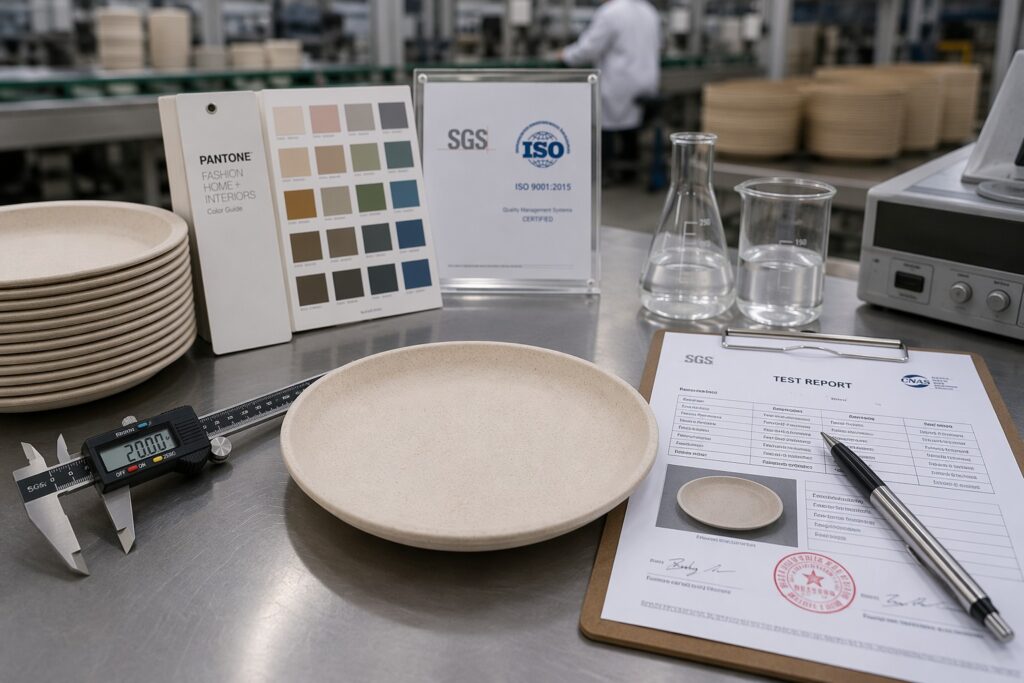
Transparency about certifications is not a marketing tactic for us. It is an operational requirement. Every European retail chain we supply requires a current BSCI audit. Every quality management decision we make is governed by our ISO 9001 procedures. Every product we ship to the EU, the US, or Australia is supported by a current, per-SKU SGS test report — or an equivalent report from TÜV or Intertek.
We maintain these certifications not because they are easy — a BSCI re-audit involves a multi-day on-site inspection by an independent auditor — but because they are the foundation of trust in B2B tableware sourcing. A buyer who receives a container of our 24-piece wheat straw dinnerware set does not need to trust our sales team’s promises. They can verify our BSCI report on the Amfori platform, our ISO certificate on Certipedia, and our SGS test report on the SGS portal — all within five minutes, from any device.
That is what ISO SGS supplier certification means in practice: not a wall decoration, but a publicly verifiable commitment.
If you are evaluating suppliers and want to compare our certification package against what you are seeing elsewhere, our custom reusable plates product page includes our current certification status and sample documentation for reference.
B2B Buyer FAQ: Certifications Decoded
Do I need BSCI if I only sell B2B and not to retail chains? Not legally. But increasingly, even B2B distributors and wholesalers require BSCI because their own customers — retail chains — require it upstream. Having BSCI now prepares you for distribution contracts that will require it later. In Germany specifically, the Supply Chain Due Diligence Act (Lieferkettensorgfaltspflichtengesetz) obligates large companies to ensure social compliance throughout their supply chain, which means BSCI certification flows downstream even to B2B-only suppliers.
Can a factory be ISO 9001 certified but have poor quality? Yes. ISO 9001 certifies that the factory has a documented quality system. It does not guarantee that the system is followed on every shift, or that the system’s specifications are demanding enough. This is why ISO 9001 should always be verified alongside product-specific SGS test reports and an on-site audit. A factory with ISO 9001 and a poor SGS test report has a working quality system whose standards are too low — which is a different problem from a factory with no quality system at all.
What if my supplier offers a cheaper, local test report instead of SGS? Local testing laboratories can be competent, but their reports carry less weight with international retail buyers and customs authorities. SGS, TÜV, Intertek, and Bureau Veritas are globally recognized and their reports are accepted without question across the EU, US, and Australia. A local lab report may require additional explanation and may not satisfy a retail buyer’s compliance checklist. The cost difference — typically 200−200−400 saved — is not worth the procurement friction it creates downstream.
How much does it cost to get SGS testing for a new product? For a standard wheat straw dinnerware SKU, a full suite of chemical tests — BPA, phthalates, heavy metals, overall migration, specific migration of melamine and formaldehyde — typically costs 500to500to1,200 per SKU, depending on the number of simulants tested and the laboratory’s location. At Naike Dinner, we absorb this cost for our catalog products and refresh reports annually. For custom-color OEM projects, we coordinate testing at the buyer’s expense and provide the certificate within 15 working days of sample approval.
My supplier’s BSCI report shows Grade D. Should I work with them? Grade D means the audit identified non-compliances that require corrective action. The factory is allowed to continue operating and must implement corrections within a specified time frame. You can work with a Grade D factory, but you should ask for the Corrective Action Plan, confirm the timeline for re-audit, and verify that the non-compliances do not include zero-tolerance issues like child labor, forced labor, or life-threatening safety hazards. If the supplier cannot produce the Corrective Action Plan or the timeline exceeds six months, consider alternative suppliers.
How do certification requirements differ between the EU and US markets? The EU market is more demanding across all three certification categories. BSCI is effectively mandatory for EU retail supply. ISO 9001 is expected by most professional European buyers. And LFGB or EU 10/2011 test reports — typically from SGS or TÜV — are required for customs clearance and retail onboarding. The US market is more flexible on social compliance — BSCI is recommended but fewer retailers require it — and FDA 21 CFR test reports are the standard for product safety. However, the gap is closing. Major US retailers including Walmart, Target, and Costco have strengthened their social compliance requirements in their supplier codes of conduct. If you are multi-market, build to the EU standard and you will satisfy both regions.
Who pays for re-certification when a certificate expires? At professionally managed factories like ours, annual certification renewal is part of the factory’s operating cost — not a charge passed to the buyer. If a supplier asks you to pay for their ISO 9001 renewal or BSCI re-audit, they are either in financial difficulty or treating certification as a per-client service rather than an institutional commitment. Either way, it is a red flag that warrants further investigation before placing a large order. For product-level SGS testing of new custom SKUs, it is standard industry practice for the buyer to cover the testing cost, with the understanding that the certificate belongs to the buyer and is portable if you change suppliers.
Conclusion
Conclusion
Certifications are not badges. They are evidence. When you are sourcing from a BSCI tableware factory or evaluating an ISO SGS supplier, you are not looking for framed documents on an office wall. You are looking for publicly verifiable records — current, specific, and independently audited — that prove the supplier’s claims about worker safety, quality management, and product safety are true.
The five-minute verification protocol in this guide — find the number, check the database, confirm the dates, match the names — is the most important five minutes you will spend in any supplier evaluation. It converts certification from a marketing claim into a verifiable fact.
A supplier who passes that verification welcomes it. A supplier who resists it is telling you something you need to know.
Ready to Verify Our Certifications?
Request our complete factory profile — including current BSCI audit, ISO 9001 certificate, and per-SKU SGS test reports — and verify everything yourself.
Request Naike Dinner’s Factory Certification Profile
Browse the Premium 24-Piece Wheat Straw Dinnerware Set
Explore Our Wheat Straw Plates Collection
Read: How to Compare Tableware Suppliers — The Factory Audit Guide
CONTACT US
Can Wheat Straw Tableware Go in the Freezer?
Can wheat straw tableware go in the freezer? This evidence-led B2B guide explains frozen-storage conditions, material variables, freeze-thaw testing, compliance documents and the questions buyers should ask before approving a freezer-safe claim.

EU GPSR Wheat Straw Tableware: A Traceability Guide
A factory-side guide to GPSR traceability, technical documentation, responsible-person information, online listings and corrective-action planning for EU wheat straw tableware programs.
Does Wheat Straw Tableware Contain Gluten?
A factory-insider guide for B2B buyers evaluating wheat straw material sources, gluten-related claims, testing scope, food-contact compliance and supplier controls.
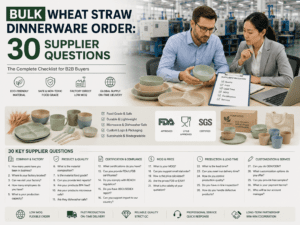
Bulk Wheat Straw Dinnerware Order: 30 Supplier Questions
Ask these 30 bulk wheat straw dinnerware order questions before you sign. Avoid costly mistakes with our supplier checklist. Send your inquiry with confidence now.
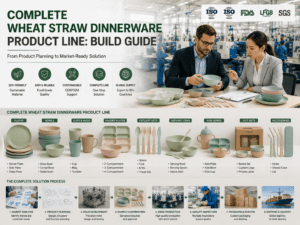
Complete Wheat Straw Dinnerware Product Line: Build Guide
Build a complete wheat straw dinnerware product line with plates, bowls, cups and cutlery. Learn assortment strategy, SKU planning and margin optimization. Get your line quote.
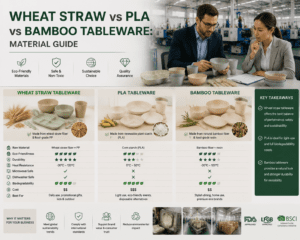
Wheat Straw vs PLA vs Bamboo Tableware: Material Guide
Compare wheat straw vs PLA vs bamboo tableware for B2B sourcing. Learn heat resistance, cost, and safety differences. Get material recommendations now.