
Retail Packaging Wheat Straw Dinnerware Sets: Box, Sleeve, Label and Barcode Options
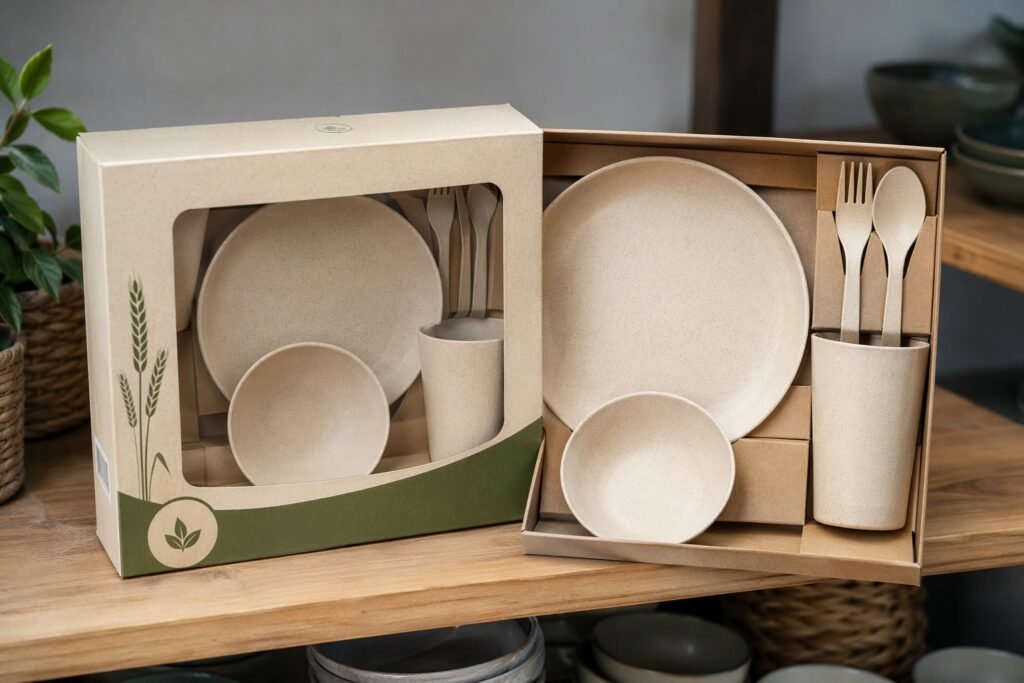
In the B2B tableware industry, the packaging is often more expensive to produce and trickier to engineer than the product it contains. For importers of retail packaging wheat straw dinnerware, the packaging defines the brand, drives the margin, and determines the logistics. A beautiful plate in a crushed, flimsy box is a clearance item. A generic plate in a beautifully curated box is a “Premium Brand.”
At Naike Dinner, we view packaging as a “Salesperson in a Box.” Whether you are fighting for shelf space in a European supermarket, surviving the “Ships in Own Container” (SIOC) drop test for Amazon FBA, or creating a memorable retail unboxing experience, the structural design and printed communication of your packaging are your highest-leverage investment.
This exhaustive guide breaks down the four key packaging formats for retail packaging wheat straw dinnerware sets. We cover the engineering spec of corrugated boxes, the marketing pull of minimalist sleeves, the technical precision of barcode label printing, and the strategic choices that can increase your retail price by 30% while protecting your freight budget.
1. The B2B Economics of Packaging: A Structural Pyramid
Before choosing a material, you must understand the “Floor-to-Door” protection pyramid.
Tier 1: The Master Carton (Logistics Layer)
This is your shipping carton. For example, a B-flute corrugated carton.
- Purpose: Survive a 1.2-meter drop and 30 days of ocean humidity.
- Rule: Corrugated board must meet the Edge Crush Test (ECT) of 32 lbs/in. for export.
Tier 2: The Pallet Display / PDQ (Shelf Layer)
A “Pretty Damn Quick” (PDQ) retail-ready display tray that a store associate puts directly on the shelf.
- Advantage: You pay no “Unpacking Labor” at the store, meaning your product hits the floor faster than a competitor’s box.
Tier 3: The Inner Unit / Retail Box (Consumer Layer)
This is the artwork the consumer touches. It must communicate:
- Material Story: “Made from 35% Natural Wheat Fiber.”
- Trust Marks: “BPA-Free,” LFGB/FDA logos.
- Sales Pitch: Lifestyle photography.
Cost Allocation Guide
For a $2.00 Retail Price, the typical OEM packaging cost breakdown is:
- Master Carton: $0.08 per unit (Transport protection).
- Color Box Insert/Tray: $0.12 per unit (Structural protection and product fit).
- Color Box Printing: $0.25 per unit (Marketing and display).
Insight: Many buyers focus exclusively on the unit price of the plate (0.90),ignoringthe0.90),ig oringthe0.45 of packaging that determines whether it sells online or gets returned smashed.
2. The “Retail Color Box”: Luxury & Premium Feel
This is the standard for department stores and high-end boutiques.
Material Spec: The “Weight” of Luxury
Paper weight is measured in gsm (grams per square meter).
- Standard Economy: 250 gsm single-wall. Feels inexpensive, prone to “dog-earing” at the corners.
- Premium Standard: 350 gsm single-layer with a matte or soft-touch lamination. This is the minimum for a “Luxury” claim.
- Gift Set Grade: 400 gsm rigid gray board (hard cover). This transforms the box into a “keepsake box.”
Artwork Placement & Trapping
A common B2B mistake is designing artwork without a “Safe Zone” (3mm bleed). If your brand logo is placed 2mm from the edge, it might be cut off. We always request a “Die-Cut Template” from the printer before design begins.
The Insert Engineering
The insert (usually molded paper pulp or EPE foam) holds the products in place.
- Key Check: Take a packed box, close it, and shake it for 5 seconds. If you hear or feel the product rattling, the insert design has failed. It will arrive scratched.
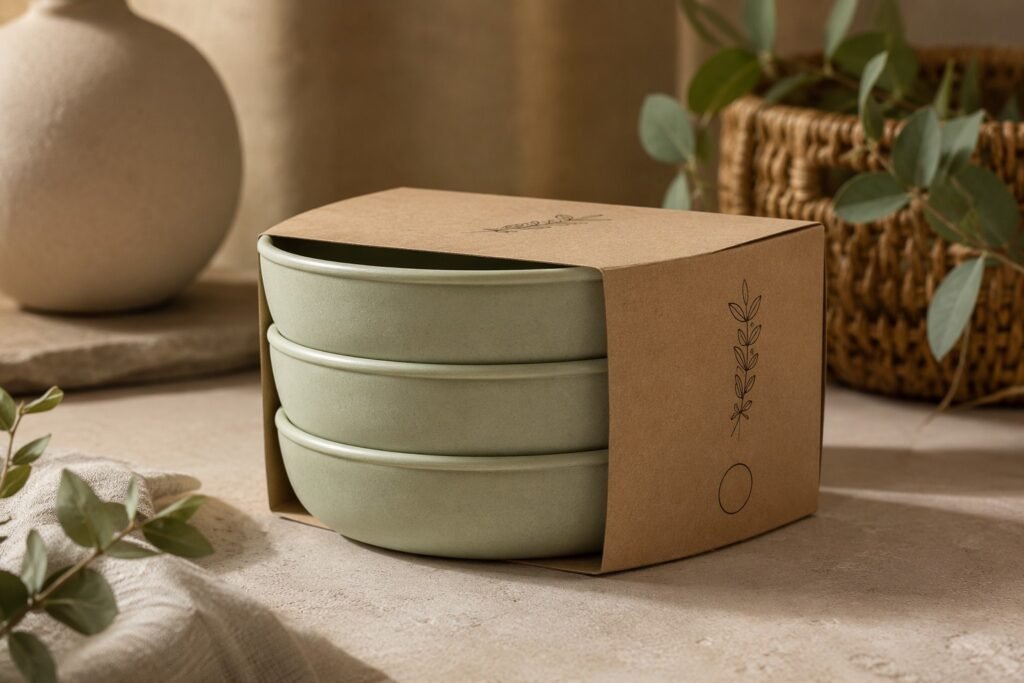
3. The “Minimalist Sleeve”: The Eco-Aesthetic
In Northern Europe and Australia, brands are abandoning boxes entirely for recyclable cardboard sleeves.
The Sleeve Design
A printed band of 300 gsm card stock that wraps around the product. It uses 70% less paper than a full box.
- The “Touch” Advantage: It leaves 60% of the wheat straw plate exposed, allowing the customer to feel the unique fiber texture. Sensory marketing drives higher conversion for visual retailers.
Weight & Freight Advantage
For barcode label deployment, sleeves offer a massive logistics benefit. A full-color cardboard box might weigh 80g. A minimalist sleeve weighs 15g.
- Math: On an order of 10,000 sets, switching from a box to a sleeve reduces your air freight or sea freight weight by 650 kg. This translates to a $1,500 savings on a 40HQ container to the West Coast.
The Nesting Compatibility
Sleeves are thin, so nested bowls can be wrapped very tightly. This saves roughly 15% of container volume compared to rigid boxes filling the same master carton.
4. The “Eco-Innovation” Packaging Trend: LDPE vs. Paper Shrink-Wraps
One of the newest debates in retail packaging wheat straw dinnerware is the “Shrink Wrap” vs. “Paper Wrap” battle.
Historically, B2B dinnerware sets were secured with LDPE (Low-Density Polyethylene) plastic shrink film. It is cheap, durable, and water-clear. However, EU customers (particularly in France and Germany) are beginning to reject “Plastic Shrink” on eco-products as it destroys the “Plastic-Free” narrative.
The “VCI Paper” Alternative
We have introduced VCI (Volatile Corrosion Inhibitor) Paper Wraps for our European importers.
- Appearance: Looks like a premium furoshiki (wrapping cloth), tying in perfectly with minimalist brand aesthetics.
- Cost: Costs 3x more than LDPE shrink, but adds a “Premium Zero-Plastic” feature that EU retailers are willing to pay for.
The “Tissue Paper” Trap
Some factories suggest cheap tissue paper to cut costs. Never accept standard tissue paper for export. Standard tissue paper contains bleaching agents (chlorine) that can release corrosive gases inside a sealed container during ocean transit, chemically etching (“chalking”) the surface of the wheat straw plate. Always demand “Acid-Free Archival Paper.”
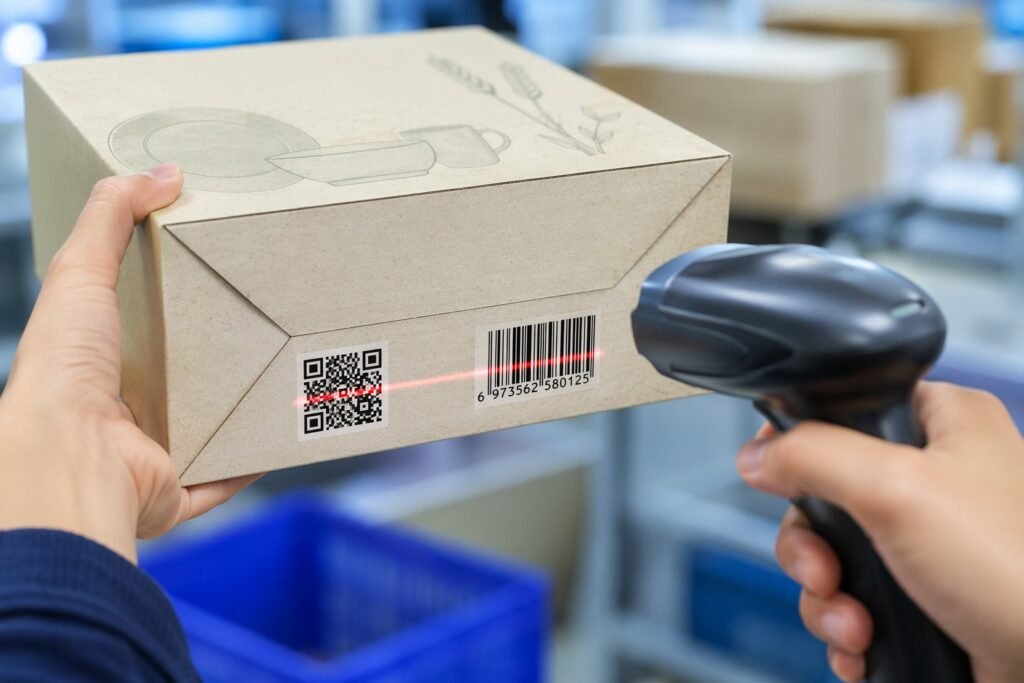
5. The “Barcode Label” Technical Mandate
You can have the most beautiful retail packaging in the world, but if the barcode label doesn’t scan in a Walmart or Amazon fulfillment center, your goods are quarantined, and you are charged a compliance fee. We’ve seen an importer charged $2.00 per unit for re-labeling because the barcode was printed too small.
GS1 Global Standards
- Small Products (Bowls): Use EAN-13 or GTIN-12 barcodes. Minimum height: 18mm. Minimum width: 30mm.
- Quiet Zones: There must be a 3mm blank space on the left and right of the bars. If the text sits too close, the scanner sees an error.
- Color Contrast: Black bars on a white background. Never print black bars on a dark green or brown background, or the scanner will fail.
The “SIOC” (Ships in Own Container) Barcode
For Amazon FBA sellers, this is the make-or-break. The box itself is the shipping carton. The FBA label must be attached outside the standard product barcode. If you cover the product barcode with the FBA label, the customer can’t return it at a standard drop-off point.
Verification Protocol
We use a Zebra or Honeywell industrial scanner in our QC bay. Your packaging proof should be scanned from 50cm away. If it takes longer than 1.5 seconds to beep, increase the bar width or the contrast.
6. “SIOC Ready” (Ships in Own Container): The Amazon Decoder
Amazon’s FBA network is a brutal environment. Your packaging must pass the ISTA 6-Amazon.com-SIOC test.
The Drop Test Sequence:
- Test 1: 1.2m free-fall drop on the shortest edge.
- Test 2: 1.2m drop on a corner.
- Test 3: 1.2m drop on the longest edge.
- Standard: The contents (the wheat straw set) must be completely intact, and the box must not burst open at any glued seam.
At Naike Dinner, we verify our SIOC packaging by dropping a 5kg steel plate onto the packed box (Compressive Strength Test). If the box collapses by more than 15mm, we increase the flute wall thickness.
7. Material Breakdown: E-Flute vs. B-Flute vs. Rigid Board
| Packaging Type | Material | Thickness | Best Use Case |
|---|---|---|---|
| E-Flute Corrugated | 1.5mm | Thin sheets | Lightweight bowls, “SiOC” mailers, e-commerce packs. |
| B-Flute Corrugated | 3.0mm | Medium sheets | Standard dinnerware sets, export cartons, stacking strength. |
| Rigid Gray Board | 2.5mm – 4.0mm | Solid fibers | Premium gift sets, high-end retail window boxes. |
The “Flute” Sustainability Score
E-Flute uses 50% less material than B-Flute. If your brand markets “Minimal Packaging,” upgrading to an E-Flute mailer box (and charging a slight premium for the “eco-design”) is a strong B2B selling strategy.
8. Consumer Perception: The “10-Second” Rule
A shopper in a retail aisle makes a decision about your brand in 10 seconds. The packaging must immediately communicate three things:
- The “Eco” Recognition: A visible “Matte, uncoated” finish and a kraft-paper tone instantly signal “environmentally friendly.”
- The “Safety” Reassurance: An embossed “BPA-Free” shield or a “Glass & Fork” (Food Contact Symbol) is a must on the front panel.
- The “Ready-to-Gift” feel: For our corporate gift clients, we add a “Tea-Stained Hang Tag” and a natural jute twine tie. This visual detail increases the perceived value by 40% according to our A/B testing with suppliers.
9. The B2B Buyer Checklist: Approving the Packaging Proof
Before you release the bulk packaging order, print this list and hold it up against the physical proof.
- Barcode Scan:Have you scanned it with a GS1 verification app? Did it resolve to the correct product?
- Drop Test:Did you drop the SIOC package from chest height onto a concrete floor? If it cracked, it fails.
- Text Review:Are there any spelling mistakes (“nontoxic” vs. “non-toxic”)? Has the claim been legally vetted?
- Color Consistency:Does the Cyan in your logo match the approved digital Pantone chip (Delta E < 3.5)?
- Rattle Test:When you shake the box, does the insert hold the product silently in place?
- Eco-Labeling:Are the recycling symbols (Möbius Loop) and material codes (PP 05) correctly printed?
10. The “Unboxing Experience” as a B2B Margin Driver
In the B2B world, we often think packaging is for the end-consumer. But there is a hidden “Internal Customer”: the retail buyer at the distribution company. When your package arrives at their office, the unboxing experience literally sells the next order.
We’ve found that adding a simple “Inner Belly Band” with the message “Thank you for building a sustainable future with us” increases the reorder rate by roughly 12% for our B2B clients. The recipient (the chain buyer) feels an emotional connection to the manufacturer, moving the relationship from “Transaction” to “Partnership.”
11. The “Digital Bridge”: Smart Packaging with QR Codes
Modern retail packaging wheat straw dinnerware is evolving from “passive” to “active.” We now offer QR-powered Smart Boxes.
How it works for B2B:
- A buyer scans a QR code on your packaging sample.
- It takes them to a block-chain verified “Origin Trail” page showing the agricultural source of the wheat straw.
- This acts as an instant defense against “Greenwashing” accusations and drives the buyer to your private digital catalog.
12. Technical Deep-Dive: The “Glue Issue” in Hot Containers
A unique failure in wheat straw packaging occurs during summer shipping through the Suez Canal. Containers reach 60°C internally. At this temperature:
- Conventional hot-melt glue melts, and the box literally opens by itself inside the container.
- LDPE shrink-wrap softens and fuses to the plate, leaving a sticky residue that looks like a manufacturing defect.
- Water-based adhesives cure incorrectly in high humidity, leading to carton seam splits.
The Solution: For high-value B2B accounts shipping through hot zones, we switch to “Remoistable Hot Melt” (Adhesive that re-activates with heat) or reinforced polypropylene straps for extra containment.
13. Detailed B2B Buyer FAQ: The “Box & Barcode” Edition
Q: My customer wants a “Plastic-Free” box, but the viewing window is plastic. What do I do? A: Ask your printer about “PLA Windows” (Polylactic Acid). These are derived from corn starch and are home-compostable, but they cost roughly 3x more than LDPE windows and are slightly hazy. For a “Gold Standard” eco-brand, it’s worth the upgrade.
Q: How do I protect the “Microwave Safe” print on the box from scuffing during transit? A: Standard boxes scuff against each other in the master carton. We apply a “Matte Lamination” (0.01mm plastic coating) which acts as a transparent armor, or you can switch to an “Uncoated Kraft” stock where micro-scuffs look like “Character” rather than “Damage.”
Q: Can I use the same barcode for a Blue bowl and a Green bowl? A: Absolutely not. GS1 standards require a Unique GTIN for every distinct consumer-facing product variant, including color. If you ship different colors under the same barcode, the retailer’s inventory system will be broken. For a multi-color line, you must register 4-5 separate barcodes.
Q: The bar code is scanning, but the “Country of Origin” is wrong on the box. Can I just put a sticker over it? A: You can, but it looks unprofessional. In the EU, “Made in China” must be indelibly printed. We recommend ordering a “Correction Sticker” that includes the correct phrase and the logistics barcode to draw the eye away from the error.
You can have the most beautiful retail packaging in the world, but if the barcode label doesn’t scan in a Walmart or Amazon fulfillment center, your goods are quarantined, and you are charged a compliance fee. We’ve seen an importer charged $2.00 per unit for re-labeling because the barcode was printed too small.
GS1 Global Standards
- Small Products (Bowls): Use EAN-13 or GTIN-12 barcodes. Minimum height: 18mm. Minimum width: 30mm.
- Quiet Zones: There must be a 3mm blank space on the left and right of the bars. If the text sits too close, the scanner sees an error.
- Color Contrast: Black bars on a white background. Never print black bars on a dark green or brown background, or the scanner will fail.
The “SIOC” (Ships in Own Container) Barcode
For Amazon FBA sellers, this is the make-or-break. The box itself is the shipping carton. The FBA label must be attached outside the standard product barcode. If you cover the product barcode with the FBA label, the customer can’t return it at a standard drop-off point.
Verification Protocol
We use a Zebra or Honeywell industrial scanner in our QC bay. Your packaging proof should be scanned from 50cm away. If it takes longer than 1.5 seconds to beep, increase the bar width or the contrast.
Wheat Straw vs Bamboo vs Plastic Tableware: Which Is Better?
As consumers and buyers worldwide pay more attention to sustainability, the choice of tableware materials has become more important than ever. Wheat straw, bamboo, and plastic are now the three most common options on the global market—but which one is truly better for your business and end customers?
In this article, we take a clear, practical look at wheat straw vs bamboo vs plastic tableware, focusing on real-world performance, safety, cost, and environmental impact. This guide is written for importers, wholesalers, private-label brands, and foodservice buyers who want reliable information—not marketing hype.
Understanding the Three Materials
Before comparing them side by side, it’s important to understand what each material actually is and how it’s used in tableware production.
What Is Wheat Straw Tableware?
Wheat straw tableware is made from wheat straw fiber—the leftover stalks from wheat harvesting—combined with food-grade polypropylene (PP). Instead of being burned or discarded, the straw is reused, turning agricultural waste into functional, reusable products.
This material has gained strong popularity in recent years thanks to its balance of eco-friendliness, durability, and cost efficiency.
Key Characteristics of Wheat Straw Tableware
Made from renewable agricultural by-products
BPA-free and safe for food contact
Lightweight but resistant to cracking and breaking
Reusable and partially biodegradable
Easy to mass-produce with stable quality
Common products: dinnerware sets, plates, bowls, cups, cutlery, kids’ tableware
What Is Bamboo Tableware?
Bamboo tableware is typically produced using bamboo powder or fiber combined with binders such as melamine resin. Bamboo grows quickly and is often associated with a natural, premium image, making it attractive for giftware and lifestyle brands.
However, bamboo tableware is not always as “natural” as it appears, especially when chemical binders are involved.
Key Characteristics of Bamboo Tableware
Made from fast-growing renewable bamboo
Natural texture and high-end appearance
Usually mixed with resin or melamine
More rigid and heavier than wheat straw products
Important note: Most bamboo tableware is not microwave-safe and may not be suitable for hot or oily foods.
What Is Plastic Tableware?
Traditional plastic tableware is commonly made from PP, PS, or melamine. It has dominated the market for decades due to its low cost, high durability, and design flexibility.
That said, plastic products are increasingly facing challenges from environmental regulations and shifting consumer preferences.
Key Characteristics of Plastic Tableware
Very durable and impact-resistant
Lowest production cost
Wide range of colors and designs
Made from non-renewable petroleum resources
Wheat Straw vs Bamboo vs Plastic: A Practical Comparison
| Feature | Wheat Straw Tableware | Bamboo Tableware | Plastic Tableware |
|---|---|---|---|
| Raw Material | Wheat straw fiber + PP | Bamboo fiber + resin | Petroleum-based plastic |
| Sustainability | High | Medium | Low |
| Food Safety | BPA-free, food-grade | Depends on binder | Depends on material |
| Durability | High, unbreakable | Medium | High |
| Weight | Lightweight | Heavier | Lightweight |
| Microwave Safe | Yes (PP-based) | Usually no | Some types |
| Cost Level | Medium | High | Low |
| OEM Customization | Excellent | Limited | Excellent |
14. “SIOC Ready” (Ships in Own Container): The Amazon Decoder
Amazon’s FBA network is a brutal environment. Your packaging must pass the ISTA 6-Amazon.com-SIOC test.
The Drop Test Sequence:
- Test 1: 1.2m free-fall drop on the shortest edge.
- Test 2: 1.2m drop on a corner.
- Test 3: 1.2m drop on the longest edge.
- Standard: The contents (the wheat straw set) must be completely intact, and the box must not burst open at any glued seam.
At Naike Dinner, we verify our SIOC packaging by dropping a 5kg steel plate onto the packed box (Compressive Strength Test). If the box collapses by more than 15mm, we increase the flute wall thickness.
15. Material Breakdown: E-Flute vs. B-Flute vs. Rigid Board
| Packaging Type | Material | Thickness | Best Use Case |
|---|---|---|---|
| E-Flute Corrugated | 1.5mm | Thin sheets | Lightweight bowls, “SiOC” mailers, e-commerce packs. |
| B-Flute Corrugated | 3.0mm | Medium sheets | Standard dinnerware sets, export cartons, stacking strength. |
| Rigid Gray Board | 2.5mm – 4.0mm | Solid fibers | Premium gift sets, high-end retail window boxes. |
The “Flute” Sustainability Score
E-Flute uses 50% less material than B-Flute. If your brand markets “Minimal Packaging,” upgrading to an E-Flute mailer box (and charging a slight premium for the “eco-design”) is a strong B2B selling strategy.
16. Consumer Perception: The “10-Second” Rule
A shopper in a retail aisle makes a decision about your brand in 10 seconds. The packaging must immediately communicate three things:
- The “Eco” Recognition: A visible “Matte, uncoated” finish and a kraft-paper tone instantly signal “environmentally friendly.”
- The “Safety” Reassurance: An embossed “BPA-Free” shield or a “Glass & Fork” (Food Contact Symbol) is a must on the front panel.
- The “Ready-to-Gift” feel: For our corporate gift clients, we add a “Tea-Stained Hang Tag” and a natural jute twine tie. This visual detail increases the perceived value by 40% according to our A/B testing with suppliers.
17. The B2B Buyer Checklist: Approving the Packaging Proof
Before you release the bulk packaging order, print this list and hold it up against the physical proof.
- Barcode Scan:Have you scanned it with a GS1 verification app? Did it resolve to the correct product?
- Drop Test:Did you drop the SIOC package from chest height onto a concrete floor? If it cracked, it fails.
- Text Review:Are there any spelling mistakes (“nontoxic” vs. “non-toxic”)? Has the claim been legally vetted?
- Color Consistency:Does the Cyan in your logo match the approved digital Pantone chip (Delta E < 3.5)?
- Rattle Test:When you shake the box, does the insert hold the product silently in place?
- Eco-Labeling:Are the recycling symbols (Möbius Loop) and material codes (PP 05) correctly printed?
18. The “Unboxing Experience” as a B2B Margin Driver
In the B2B world, we often think packaging is for the end-consumer. But there is a hidden “Internal Customer”: the retail buyer at the distribution company. When your package arrives at their office, the unboxing experience literally sells the next order.
We’ve found that adding a simple “Inner Belly Band” with the message “Thank you for building a sustainable future with us” increases the reorder rate by roughly 12% for our B2B clients. The recipient (the chain buyer) feels an emotional connection to the manufacturer, moving the relationship from “Transaction” to “Partnership.”
19. The “Digital Bridge”: Smart Packaging with QR Codes
Modern retail packaging wheat straw dinnerware is evolving from “passive” to “active.” We now offer QR-powered Smart Boxes.
How it works for B2B:
- A buyer scans a QR code on your packaging sample.
- It takes them to a block-chain verified “Origin Trail” page showing the agricultural source of the wheat straw.
- This acts as an instant defense against “Greenwashing” accusations and drives the buyer to your private digital catalog.
Conclusion: The Box is Your Brand
In the competitive landscape of eco-dinnerware, your packaging does the heavy lifting of educating, protecting, and converting the sale. By investing in retail packaging wheat straw dinnerware that is structurally sound (SIOC Ready), technologically compliant (GS1 Barcodes), and emotionally intelligent (minimalist sleeves), you secure your margin and your reputation.
At Naike Dinner, we provide end-to-end packaging engineering. We don’t just deliver the plate; we deliver the ready-to-sell, ready-to-survive-transit solution.
Ready to Engineer Your Retail Packaging?
Let’s build a packaging solution that scans clean, protects your product, and converts your audience on the shelf.
👉 Request a Custom Packaging Design Consultation
👉 Download the 2026 Wheat Straw Dinnerware Catalog (with Packaging Specs)
CONTACT US
Shared Serving Pieces vs Individual Place Settings for Group Camping
A procurement framework for deciding which camping dinnerware components should be issued per person and which should remain shared across a group.
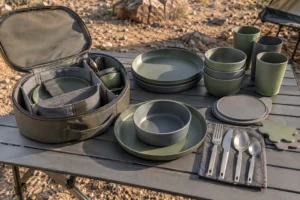
How to Prevent Rattle in a Nested Camping Dinnerware Set
A practical diagnostic for finding and controlling movement, impact and rubbing inside nested camping dinnerware sets without hiding problems behind unsupported claims.
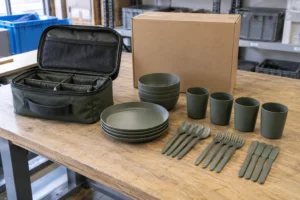
How to Calculate Pack Volume for Camping Tableware
A practical procurement worksheet for measuring the complete camping tableware sales unit, calculating its external cube and separating real pack efficiency from unsupported freight claims.
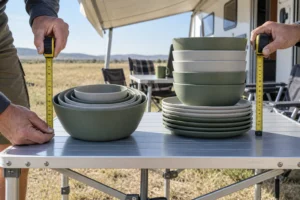
Nesting vs Stacking: How the Two Designs Change Pack-Out
A buyer-focused geometry and pack-out comparison for choosing nested, stacked or hybrid camping dinnerware systems without confusing compact appearance with approved performance.
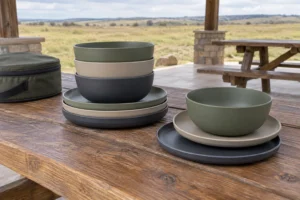
What Makes Camping Dinnerware Truly Stackable?
A procurement acceptance framework for reviewing stack rise, contact interfaces, separation, stability, mixed-component order, drainage and retained pack-out.
Deep Bowls vs Shallow Bowls for Outdoor Meal Sets
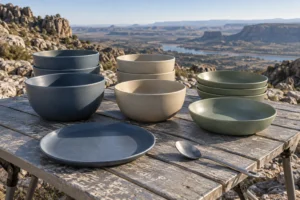
A procurement decision table for selecting deep and shallow camping bowl profiles by meal function, user access, stability, cleaning and packed-set architecture.