
Dishwasher & Microwave Claims for Wheat Straw Dinnerware: Testing Standards and Buyer Notes
If you are a brand owner or a category manager sourcing microwave safe wheat straw dinnerware, you have likely faced this nightmare: a customer sends back a photo of a warped, bubbled plate with the caption, “I thought this was microwave safe!”
Most B2B buyers assume that because the material is “composite” and the label says “Safe,” the product will withstand real-world use. As a factory insider who has tested thousands of units under extreme conditions, I can tell you that “Dishwasher Safe” and “Microwave Safe” are not generic promises. They are specific, conditional technical claims that must be verified by standardized laboratory protocols.
Many low-cost suppliers will claim their product is safe because they tested a 2mm-thick plate for 1 minute with 100ml of water. That isn’t a test—it’s a demonstration. A real test simulates the aggressive detergents, 70°C water pressure, and the “Hot Fat” spikes that occur when a consumer reheats lasagna.
In this guide, we provide the technical, factory-level evidence you need to verify dishwasher safe testing and microwave performance. We will break down the international standards (EN, ASTM), the material science behind heat deformation, and the engineering solutions we use at Naike Dinner to ensure our products survive 500+ cycles without leaving a food safety risk.
1. The Dishwasher & Microwave Claims for Wheat Straw Dinnerware: Why Plastic Warps
To understand why cheap wheat straw dinnerware fails on heat, you must understand the material’s Temperament.
Wheat straw composite is a mixture of natural fibers (lignin/cellulose) and a semi-crystalline polymer (PP). The critical measurement is the Heat Deflection Temperature (HDT) .
- Standard PP (Polypropylene): HDT of roughly 100°C at 0.46 MPa.
- High-Crystallinity PP: HDT of roughly 120°C.
- Wheat Straw Filled PP: This depends entirely on the fiber ratio.
The “Fiber-Nucleation” Effect
A 30% wheat straw fiber mix actually increases the HDT above pure PP because the fibers act as a rigid scaffold. However, this scaffolding is a double-edged sword. If the injection molding process introduces “Internal Stress” (frozen-in molecular orientation), that stress relaxes explosively when the plate reaches 95°C, causing catastrophic warping.
At our factory, we use “Annealing Ovens” during production. Post-injection, the plates are slowly cooled and heated in a controlled cycle to relax this stress before they ever reach the consumer. For more on how we manage material ratios, see our Composite Material Science Guide.
2. Microwave Safety: A Test Protocol, Not a Sticker
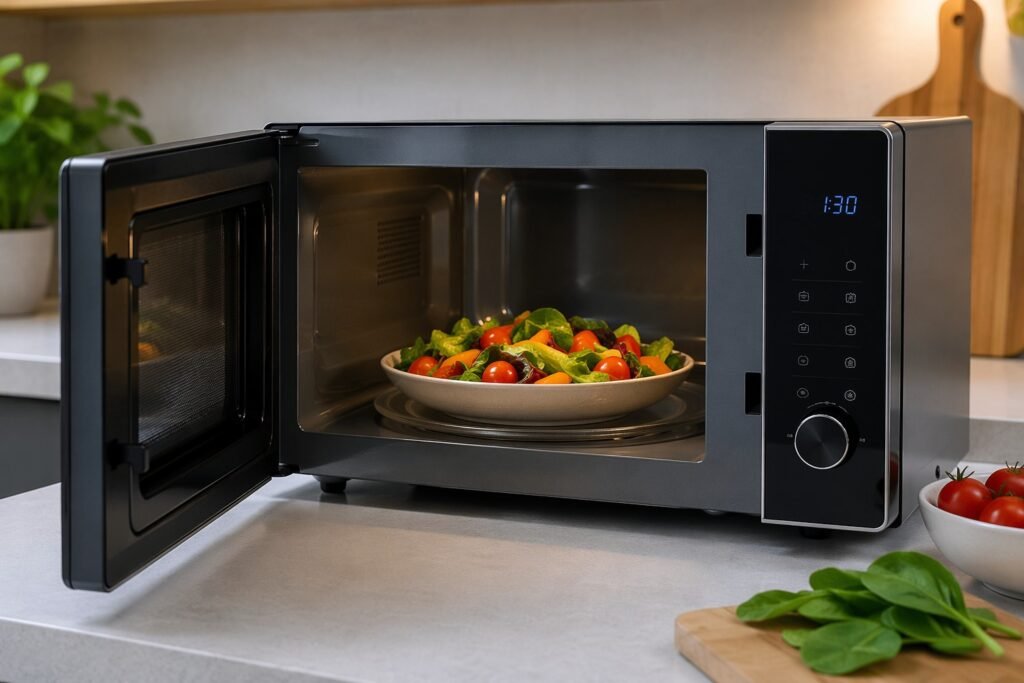
Here is the industrial protocol we use to verify microwave safe wheat straw dinnerware.
The “Dual-Stage” Microwave Test
We base our internal QC on an enhanced version of the EU standard for plastics (EN 15284:2007) , combined with the real-world “Food Factor.”
The Lean Test (Aqua Phase):
- Setup: Place the plate in the microwave with 200ml of water.
- Run: 5 minutes at 800W.
- Pass: The plate must be cool enough to handle immediately, with no deformation.
The Loaded Test (Fat Phase):
- Setup: Place high-fat content food (e.g., cheese or oil) on the plate because fat reaches 150°C+ locally in a microwave.
- Run: 3 minutes at 800W.
- Pass: No bubbling, blistering, or “burnt cereal” odor.
The “Residual Oil” Risk
This is where many products fail—both the safety test and the consumer experience. Cheap wheat straw products absorb fatty oils during microwaving. After washing, the plate retains a “Greasiness” and a rancid odor.
- Solution: We use a high-viscosity PP grade (Melt Flow Index around 10 g/10min) that forms a denser surface matrix, preventing oil penetration. Request your supplier’s MFI to gauge this.
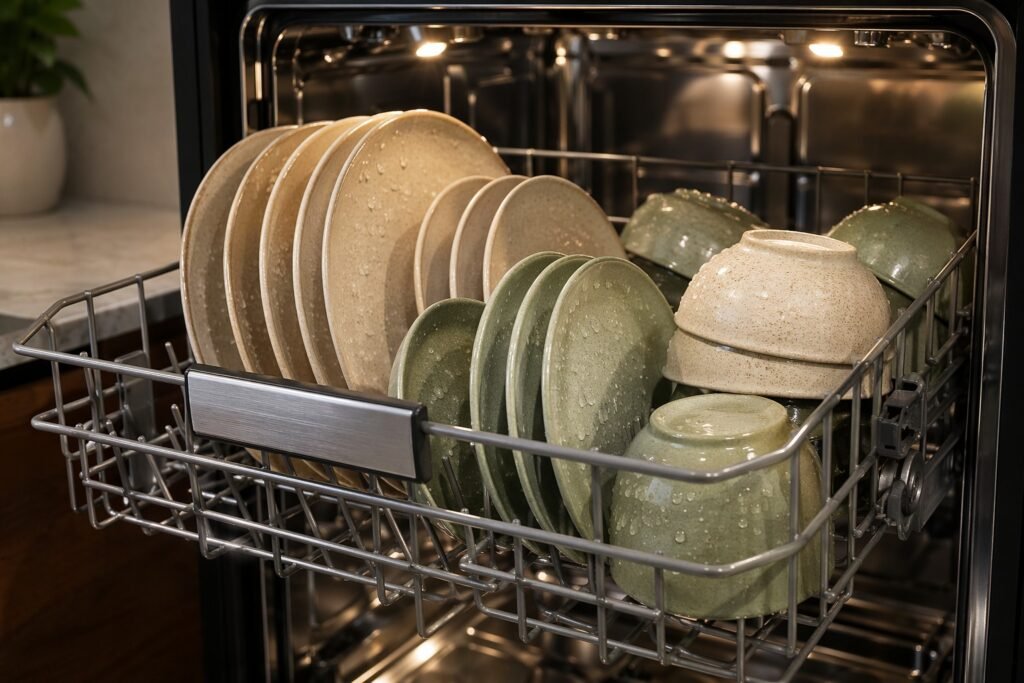
3. Dishwasher Safe Testing: The 500-Cycle Challenge
“Top Rack Dishwasher Safe” is the industry standard for dishwasher safe testing. But what happens on the lower rack, or in a commercial machine?
The EN 12875-1 Standard
This European standard specifies a method for assessing the resistance of ceramic and composite tableware to machine dishwashing.
- The Cycle: A full wash cycle with water at 65°C – 75°C, using an aggressive alkaline detergent.
- The Duration: 125 cycles (often extended to 500 cycles for “High Durability” B2B claims).
The “Gloss Fading” Curve
If you run a wheat straw plate through 500 cycles, you will see “Gloss Fading” (the surface becomes dull). This is not a safety hazard; it’s the natural micro-etching of the PP surface by hot alkaline water.
- Factory-Customer Communication: You should inform your retail partners that this is normal patination and not a material defect.
Commercial Dishwasher Challenge
For hospitality clients (cafes, restaurants), we test using a commercial “Hood-Washer” (85°C wash, chemical sanitizer).
- The Warning: Never claim a product is “Commercial Grade” unless it holds up here. Many home-grade products will melt into a twisted mess in 85°C water.
4. Safety in the Heat: The LFGB Hot Fill Migration
Heat resistance isn’t just about deformation; it’s about chemical safety. You can have a plate that looks perfect after microwaving but is leaching formaldehyde or heavy metals at toxic levels because the high temperature broke down the masterbatch binder.
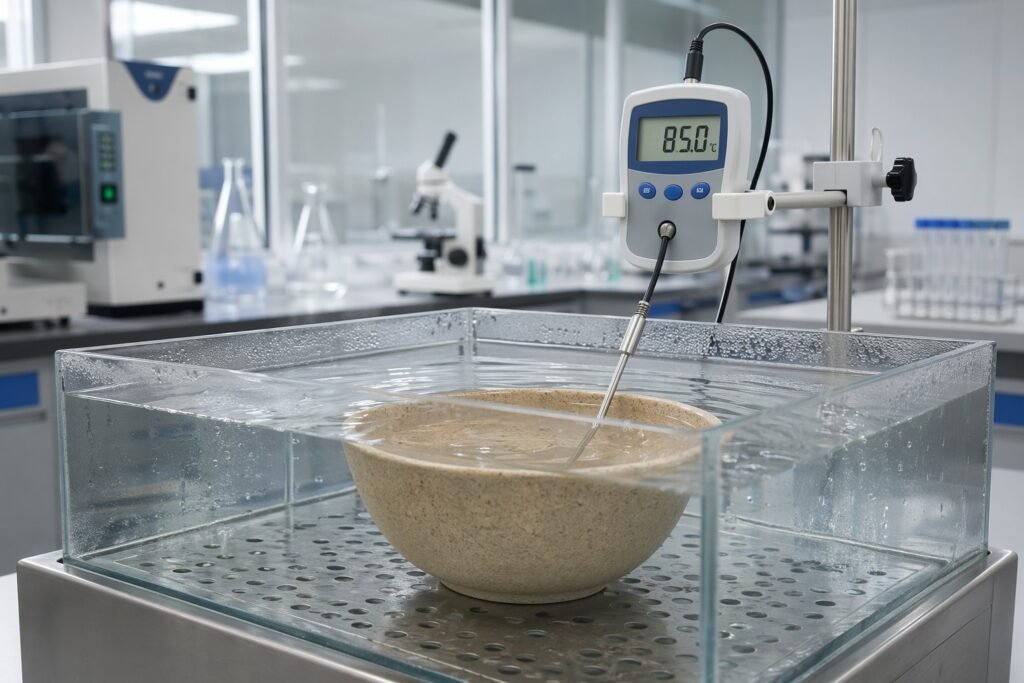
The Hot Migration Test Protocol
We always test the “Specific Migration Limit (SML)” under thermal stress.
- Temperature: 70°C for 2 hours (Simulates hot soup).
- Simulant: 3% Acetic Acid.
- Target: Melamine < 2.5 mg/kg, Formaldehyde < 15 mg/kg.
A product that passes at 40°C is not necessarily safe at 100°C. If your supplier’s LFGB Test Report was conducted at low temperature, it is worthless for a microwave product. You need a “Hot Fill” report.
5. B2B Buyer Checklist: Verifying Your Warranty Claims
Before you print “Microwave Safe” on your Custom Retail Packaging, verify these points.
- Test Frequency:Ask the factory for an internal “Batch Process Control” report, not just a one-time SGS report.
- Max Power:What does “Safe” mean? Our products are rated safe for 800W for 5 minutes (Home Microwave). If your market uses 1200W machines, request a specific Higher-Power validation.
- Stacking in Dishwasher:Items must not touch the heating element (Bottom Rack). Your packaging must clearly state “Top Rack Only.”
- Fat Attack:Have they specifically tested with fatty food simulants? Water-only microwave tests are nearly useless.
6. The Economics of “Heat-Warranty”: Why Ours Last
Why are some wheat straw products 50% cheaper? Often, they skip the “Stress Relief” process.
The “Skip Annealing” Trap
- Cost to Anneal: Adds $0.02 per unit (energy + time).
- Cost of Not Annealing: Adds a 5% Fail Rate that destroys your brand’s reputation.
- Risk: One viral video of a warped plate costs a brand $250,000 in lost retail trust.
Our advice to our OEM partners: Never optimize for “Factory Price.” Optimize for “Landed Quality.”
7. The “Emissivity” Secret: Why Fatty Food is Dangerous
An often-overlooked factor in dishwasher safe testing is how the heat gets into the plate.
- Soups and Gravy: A plate filled with soup at 100°C is heated only by gentle conduction. The wheat straw warms up slowly, and the fibers relax slowly. It’s usually fine.
- Fatty Pizza/Bacon: A slice with heavy melted cheese sitting directly on the plate can reach 170°C – 200°C where it touches. This is a very different heat transfer.
- Test Protocol: We simulate this by using a 1000W halogen bulb, held 10cm from the product, concentrated on the center. This “Spot Heating” test replicates the reality of a consumer reheating one corner of a frozen burrito or a dense pastry, hitting it with intense, localized energy while the rest of the plate is cool—creating massive thermal stress. Your testing must include this.
8. Technical Deep-Dive: The “Microwave Leakage” Myth
Some buyers ask: “Does the wheat straw absorb microwaves and get dangerously radioactive?”
No. A microwave oven operates at 2.45 GHz. At this frequency, polar polymers (like nylon) absorb the waves and get hot directly. Non-polar polymers (like PP) and dry organic fiber (like dry wheat straw) are Microwave-Transparent.
This means the microwave waves pass straight through the empty wheat straw bowl and heat the food. The bowl is heated only by the hot food. This is why wheat fiber is a superior microwave material to melamine or PLA.
9. The “Wear and Tear” on Corporate Claims
If you have a Custom Wheat Straw Tableware Contract for a corporate cafeteria, they want one thing: Indestructibility.
The worst enemy of a dishwasher is abrasive “High-Alkaline” detergents. We recommend your B2B clients use a “Balanced pH” liquid detergent. This prevents “Caustic Stress Corrosion Cracking” of the PP matrix. In our B2B care manuals, we explicitly state this to clients, turning a potential product failure into a “Client Care” moment.
10. Regulatory Alignment: EU, USA, and Asia
| Region | Microwave Standard | Dishwasher Standard |
|---|---|---|
| European Union | EN 15284:2007 | EN 12875-1:2005 |
| USA | FDA 21 CFR 175.300 | AHAM DW-1 |
| Japan | JIS S 2033 | JIS C 9807 |
If you are a global importer, your internal QC must be mapped to the strictest of these standards. Our Naike QC documents use the EU standard as the minimum, guaranteeing global compliance.
Conclusion: From “Claims” to “Certified”
Moving from a marketing claim of “microwave safe” to a fact requires a deep understanding of material stress and thermal migration. When you source wheat straw dinnerware for the global market, you are not just buying a product; you are buying the engineering and QC infrastructure behind it.
At Naike Dinner, we don’t just tell you the plate is safe. We give you the “Annealing Log” from the production line and the thermal migration test data to prove it.
11. Case Study: The B2B “Lunch Box” Recall of 2025
To put these standards into perspective, let’s look at a real-world failure that cost a distributor over $80,000 in 2025.
A German distributor imported 15,000 Wheat Straw “Meal-Prep” lunch boxes. The supplier provided a standard “Microwave Safe” test report conducted at 40°C water. The distributor, not reading the small print, assumed “Microwave Safe” meant safe for reheating Bolognese sauce (high fat, high acid).
When the end-customers reheated tomato-rich pasta at 800W for 3 minutes, the surface of the lunch boxes developed a “Cloudy Blistering” (micropits formed by rapid expansion of natural-fiber moisture). The boxes didn’t crack, but the rough surface became impossible to clean. The health department flagged them as a “Bacteria Trap.”
The Root Cause Analysis:
- The Tested Scenario: Water-based at 40°C.
- The Actual Scenario: Acidic-and-fatty at 120°C (localized hot spot).
- The result: The PP/Fiber ratio was too low for the binder to protect the fibers, leading to hydrolysis.
Lesson for B2B buyers:
Always ask: “What were the test parameters?” If the report simulates a “Lean Water Soup,” it doesn’t certify your product for “Rich Creamy Pasta.” This is why our contracts specify the exact food simulant and temperature range covered.
12. Technical Deep-Dive: The “Xenon Arc” Accelerated Ageing
One reason our microwave safe wheat straw dinnerware lasts longer is that we test for “Photo-Thermal Degradation.”
Natural plant fibers (lignin) are highly sensitive to UV light. When a plate is used near a sunny window, the UV rays break down the lignin, turning the surface into a chalky powder (chalking). This isn’t visible during normal QC.
- Naike Protocol: We use a Xenon Arc Chamber to “Sun-Storm” the samples. We expose them to intense UV at 60°C and 95% humidity for 500 hours.
- Pass standard: No chalking, no color fade greater than ΔE 4.
- Advice: If you are selling to customers in sunny climates (which are often the same as outdoor-dining cultures), this test is critical.
13. The “Hot-Juice” Chemical Migration Test
Building on Section 8 (the Emissivity of Fatty Food), I want to introduce the specific “Acidic-Hot-Fat” Triad that destroys low-grade dishwasher safe testing claims.
Acid (tomato), Fat (cheese), and Heat (microwave) form a “Super-Solvent” cocktail. This trio can extract BPA substitutes or leftover processing aids from the PP matrix faster than any lab simulation you’d find in a standard catalog. Why? Because the acid etches microscopic channels in the PP surface, the fat acts as a carrier into the food, and the heat provides the activation energy—each factor amplifying the others.
Therefore:
- If your product is for the “Kids’ Market” (spaghetti/pizza), your chemical migration tests must use 3% Acetic Acid and Fatty Simulant D2 at 90°C, not standard 40°C.
- If your product is for “Asian Soups” (high water, high salt, high heat), your tests must use the “Hot Fill” EU standard, 2 hours at 100°C with steam.
14. Operational Walkthrough: Our 3-Stage “Real-World” Test at Naike Dinner
At Naike Dinner, every SKU undergoes a three-stage process before we assign the “Microwave Safe” and “Dishwasher Safe” tags.
Stage 1: The “Maximum Abuse” Test
We take a random sample and intentionally put it on the bottom rack of a commercial dishwasher for 20 cycles, right next to the heating element (90°C water + 110°C metal contact). This is not “Approved Use”—it’s a stress test. If it survives this without deforming, it will easily survive a home top-rack.
Stage 2: The “Spot-Defrost” Test
We place a 500g frozen block of pizza directly on a cold plate and microwave on “High” for 10 minutes. The plate must go from -18°C to 120°C in 3 minutes. This extreme thermal shock eliminates any product with latent internal molding stress.
Stage 3: The “Steam-Pasteurization” Test
For the baby product market, we mimic the sterilization process. We place samples in a steam sterilizer (like a Philips Avent) for 10 cycles. The product must not warp, and the LFGB sensory test must show zero odor transfer.
These internal protocols are what separate “catalog sellers” from “technical manufacturers.” If your supplier can’t describe their thermal shock test, they haven’t done one.
17. When “Microwave Safe” Backfires: The Packaging Effect
A final note on consumer packaging: if your microwave safe wheat straw dinnerware is labeled “Safe for 5 minutes at 800W,” but your customer has a 1200W inverter microwave, that 5-minute recommendation becomes a 3-minute limit. High-power microwaves (“Inverter” or “Commercial” types) heat water so aggressively that the center of the plate can reach 140°C while the edges are still at 80°C.
- Solution: Instead of a one-size-fits-all label, consider a two-tier warning: “Safe for 800W for 5 minutes (home use). For inverter/commercial microwaves (>1200W), limit to 2 minutes per cycle.”
18. The “Dishwasher Darkening” Phenomenon Explained
A common after-sales complaint is: “My wheat straw bowls turned darker after a month in the dishwasher.”
The Cause: Lignin Oxidation
Wheat straw contains 15-20% lignin—a natural polymer that gives the fiber its strength. When exposed to the alkaline environment of dishwasher detergents + heat, this lignin undergoes a chemical change called “Alkaline Darkening.” It turns the surface a slightly darker, caramel-like shade, particularly on the bottom where water pools.
- Is it safe? Yes, the product remains structurally sound and food-safe, and the pigment change is purely cosmetic.
- How to handle: This is why we recommend our “Darker-Tone” palettes (Grey, Charcoal, Sage) for commercial dishwasher environments. A light beige plate will show the darkening.
15. Detailed B2B Buyer FAQ: The “Heat & Clean” Edition
Q: Can I claim my wheat straw dinnerware is “Oven Safe”? A: Absolutely not. Do not claim “Oven Safe.” Even high-temperature PP starts to flow (melt) dramatically at 160°C. Standard home ovens operate at 180°C – 220°C. Wheat straw composite is for “Microwave Reheating,” not “Oven Baking.”
Q: My client used a “Sanitize” cycle (80°C+), and the plates came out slightly warped. Why? A: The “Sanitize” cycle often involves a heated dry phase where the element reaches 120°C+, which exceeds the safe range for PP composite. Your instruction manual must warn against “Heated Dry” cycles for this reason.
Q: The supplier says “BPA-Free,” but there is a strange smell after microwaving. Is this safe? A: If there is a smell, it is not safe. Any detectable odor under heat means the material is degrading and releasing volatile organic compounds (VOCs), which can migrate into food. You need a fresh “Hot Migration” test from a certified lab immediately.
Q: Is wheat straw more scratch-resistant than plastic after dishwashing? A: Yes. The natural fibers provide a subtle, matte texture that hides micro-scratches much better than high-gloss melamine or generic PP. However, a powdered abrasive cleaner (Ajax/Comet) will destroy the surface.
16. The “Heavy-Duty” Commercial Claim: Schools & Hospitals
If you are bidding for a contract with a school district or hospital, your wheat straw dinnerware will face a beast: the “High-Temperature Flight-Type Dishwasher.” These machines push 85°C water and use “Caustic” detergents at extremely high pressure.
For these accounts, we do not use standard masterbatch. We use “Medical-Grade PP” (a higher melt-point polyolefin). This material costs 15% more but provides the necessary “Headroom” against thermal deformation.
The B2B Specification Sheet:
Ask your supplier for the “Vicat Softening Point” of their specific PP grade. For commercial accounts, you need a Vicat of > 150°C. Standard PP is around 130°C. This one data point tells you everything you need to know about the supplier’s material quality.
Ready to Verify Your Product’s Performance?
Stop trusting vague claims. Get the data that protects your brand. Contact us for a full technical specification and testing consultation.
👉 Request a Free Technical Consultation & Test Report
👉 Download the 2026 Wheat Straw Dinnerware Product Catalog
👉 Read: How to Verify ‘BPA-Free’ and ‘Non-Toxic’ Safety Claims
CONTACT US
Shared Serving Pieces vs Individual Place Settings for Group Camping
A procurement framework for deciding which camping dinnerware components should be issued per person and which should remain shared across a group.
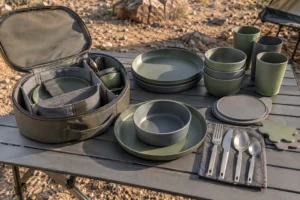
How to Prevent Rattle in a Nested Camping Dinnerware Set
A practical diagnostic for finding and controlling movement, impact and rubbing inside nested camping dinnerware sets without hiding problems behind unsupported claims.
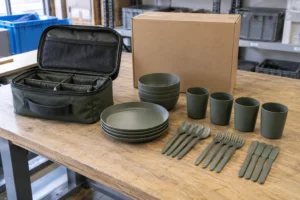
How to Calculate Pack Volume for Camping Tableware
A practical procurement worksheet for measuring the complete camping tableware sales unit, calculating its external cube and separating real pack efficiency from unsupported freight claims.
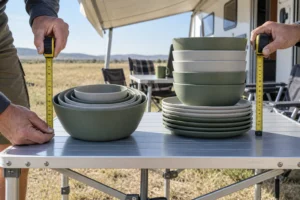
Nesting vs Stacking: How the Two Designs Change Pack-Out
A buyer-focused geometry and pack-out comparison for choosing nested, stacked or hybrid camping dinnerware systems without confusing compact appearance with approved performance.
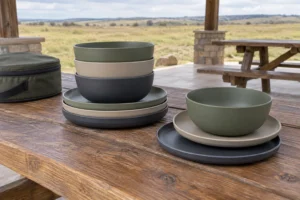
What Makes Camping Dinnerware Truly Stackable?
A procurement acceptance framework for reviewing stack rise, contact interfaces, separation, stability, mixed-component order, drainage and retained pack-out.
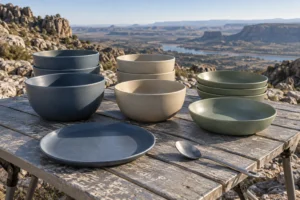
Deep Bowls vs Shallow Bowls for Outdoor Meal Sets
A procurement decision table for selecting deep and shallow camping bowl profiles by meal function, user access, stability, cleaning and packed-set architecture.