
BPA-Free, Non-Toxic and Food-Safe: How to Verify Wheat Straw Tableware Claims

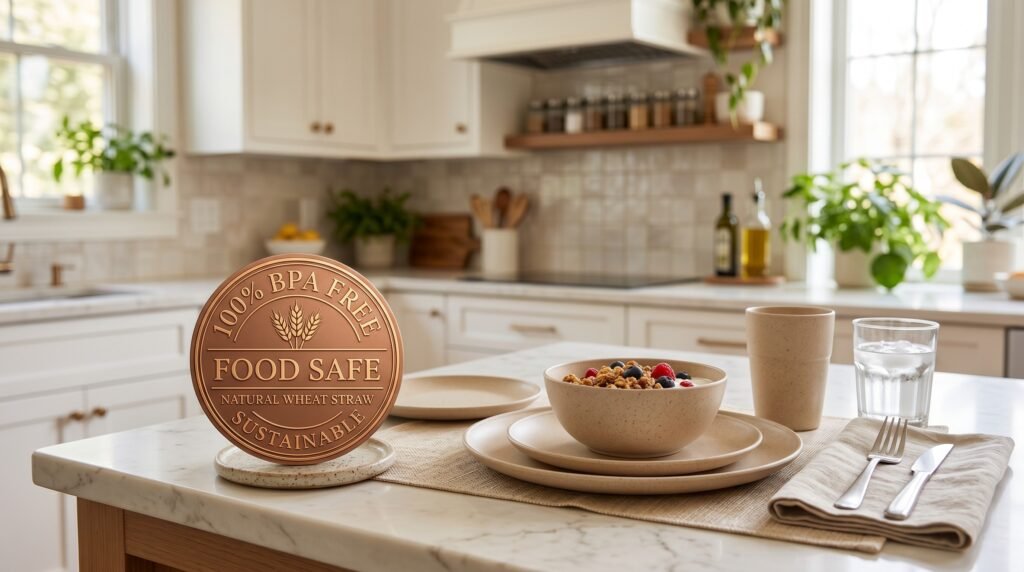
If you are a professional buyer in the home goods or hospitality sector, you’ve likely seen the words “BPA-Free,” “Non-Toxic,” and “Food-Safe” thousands of times. On platforms like Amazon or in bulk wholesale catalogs, these labels have become almost wallpaper—standard marketing noise that everyone includes because everyone else does.
But here is the “Factory Insider” truth: A sticker that says “BPA-Free” is not a safety certificate. In fact, in the world of high-volume manufacturing, Bisphenol A (BPA) is only one of over a hundred potential chemical contaminants that could be hiding in low-quality BPA-free tableware.
As a manufacturer who has spent years navigating the move from traditional plastics to bio-composites, I have seen the gap between “marketing safety” and “technical safety” widen. Buyers who don’t know how to verify these claims often end up with shipments flagged by customs, rejected by major retail chains like Walmart or IKEA, or worse—pulled from shelves due to a product recall.
In this exhaustive guide, we are going to look past the stickers. We will explore what “Non-Toxic” actually means in 2026, the critical difference between “Food-Safe” and “Food-Grade,” and precisely how to audit a supplier’s chemical test reports to ensure your brand is protected.
1. The “BPA-Free” Marketing Myth: Why It’s Only the Beginning
To understand why “BPA-Free” is an insufficient claim, we have to look at the chemistry of polymers. Bisphenol A was traditionally used as a building block for polycarbonate plastics. Since wheat straw composite material (which we explained in our previous material science guide) is typically made with Polypropylene (PP) as the binder, it is naturally BPA-free.
BPA is the Easy Part
Most modern PP resins produced by legitimate chemical giants like Sinopec or LyondellBasell are BPA-free by design. So, when a supplier brags about being “BPA-Free,” they are often just stating a baseline property of the raw material.
The Real Risks: The “BPA Replacements”
The real danger lies in the chemical additives used to make low-quality composites perform like high-end ones. Some factories use Bisphenol S (BPS) or Bisphenol F (BPF) as substitutes. While these allow them to legally claim “BPA-Free,” research suggests they carry similar endocrine-disrupting risks.
Insider Tip: When reviewing a test report, don’t just look for “BPA – ND” (Not Detected). Look for a “Full Bisphenol Screening” that covers BPS and BPF. If your supplier can’t provide this, they are likely using a standard resin without specialized food-contact purity.
2. Decoding “Non-Toxic”: The Chemical Hit-List for 2026
When a B2B buyer asks for non-toxic dinnerware testing, they need to be specific. In the EU and the US, “Non-Toxic” is not a legal term; it is a collection of specific chemical limits.
Here are the four “Big Groups” of toxins we monitor at the factory level. If your supplier’s test report doesn’t list these, your products are not verified as non-toxic.
A. Phthalates (Plasticizers)
Phthalates are used to make plastics more flexible. While wheat straw plates are rigid, phthalates can hide in the color masterbatch or the processing aids used during injection molding.
- The Standards: REACH (EU) and CPSIA (USA).
- The Risk: High-volume “stock” colorants from unverified sources often contain DEHP, DBP, or BBP to lower costs.
B. Heavy Metals (The Pigment Risk)
This is where most failures occur in BPA-free tableware. To get that vibrant “Sage Green” or “Pastel Pink” look, factories use pigments. Low-cost industrial pigments can contain Lead (Pb), Cadmium (Cd), Mercury (Hg), and Hexavalent Chromium (Cr VI).
- The Audit Step: Check the “Total Lead” and “Leachable Lead” sections of the report. For products sold to children, the limits are significantly tighter.
C. Primary Aromatic Amines (PAAs)
PAAs are substances that can migrate from certain dyes and adhesives. Many PAAs are known carcinogens.
- The Industry Shift: Since 2023, EU inspectors have increased their focus on PAAs in colored plastic housewares. If you are importing into Europe, you must have a PAA migration test.
D. Formaldehyde and Melamine
As we highlighted in our LFGB Testing for Wheat Straw Dinnerware guide, if the binder used is a melamine resin instead of PP, formaldehyde migration is a massive risk.
| Chemical Group | Why It Matters | Standard Test Reference |
|---|---|---|
| Bisphenols | Endocrine disruption | EPA 3550C / 8270D |
| Phthalates | Reproductive toxicity | EN 14372:2004 |
| Heavy Metals | Neurological damage | EPA 3052 / 6010D |
| PAAs | Carcinogenic risk | EU 10/2011 Appendix II |

3. Food-Grade vs. Food-Safe: The Technical Distinction
I often see buyers use these terms interchangeably. They are not the same, and misunderstanding the difference can lead to major compliance gaps.
What is “Food-Grade”?
“Food-Grade” refers to the raw material. It means the Polypropylene resin and the wheat straw fiber powder were manufactured in a facility that meets hygiene standards and the chemical components are “generally recognized as safe” (GRAS) for contact with food.
- Analogy: Buying high-quality organic flour.
What is “Food-Safe”?
“Food-Safe” refers to the finished product. Just because you start with food-grade resin doesn’t mean the final plate is food-safe. If the factory’s injection molding machines are dirty, if they use industrial-grade lubricants, or if the logo printing ink contains heavy metals, the product is no longer food-safe.
- Analogy: The organic flour was used to bake bread in a dirty kitchen.
The Verification Rule: For your BPA-free tableware brand, you need a “Declaration of Conformity” for the raw materials (Food-Grade) AND a third-party test report for the finished product (Food-Safe).
For a step-by-step look at how we manage this at Naike Dinner, refer to our Custom Wheat Straw Tableware development workflow.
4. The Science of Migration: How Safety is Measured
The most accurate way to verify food contact safety is through Migration Testing. This isn’t just about what is in the plate; it’s about what comes out of the plate and into the food.
Overall Migration (OM)
This measures the total amount of substances (both known and unknown) that leach from the plate into a food simulant.
- The Limit: 10 mg/dm² of surface area.
- The Simulants: We use 3% Acetic Acid (to simulate acidic food like orange juice), 10% Ethanol (to simulate alcohol/water), and Olive Oil or Isooctane (to simulate fatty foods).
Specific Migration (SM)
This targets specific regulated chemicals like Melamine or Formaldehyde. Even if the overall migration is low, if a specific carcinogen is leaking at 0.1 mg/kg, the product fails.
Repeated Use Testing (The 3-Cycle Rule)
Legitimate BPA-free tableware meant for reuse must be tested three times. The migration results from the third cycle are the ones used for compliance. Why? Because some materials become more unstable after repeated exposure to heat and acid. If your supplier’s report only shows one cycle, it is only valid for single-use disposables.
Check our FDA Food Contact Requirements guide for the specific extraction limits required by the US market.
5. How to Audit a Supplier’s Safety Claims: A 5-Step B2B Protocol
If you are currently evaluating a supplier for wheat straw products, do not ask, “Is it safe?” They will always say yes. Instead, follow this “Insider” audit protocol.
Step 1: Request the Full PDF Report (Not a Screenshot)
Opportunistic traders often send a screenshot of the first page of a report with a “PASS” stamp.
- What to look for: A real report from SGS, Intertek, or TÜV is 8–25 pages long. It must include the exact photo of the product you are buying.
Step 2: Check the “Applicant” Name
Does the name on the test report match the name of the company on your Proforma Invoice?
- The Trap: Often, trading companies send reports belonging to their “partner factories.” If the names don’t match, you have no legal chain of custody for that safety claim.
Step 3: Verify the Report Number
Go to the testing lab’s official website (e.g., SGS Check). Enter the report number and date. You would be shocked at how many “edited” reports exist in the supply chain.
Step 4: Align the Materials
Look at the “Sample Description” in the report.
- Bad: “Plastic plate.”
- Good: “Wheat straw fiber (35%) + Polypropylene (65%) composite plate in natural beige.” If the material ratios in the report don’t match the specs in your Wheat Straw Tableware Quotation, the report is technically invalid for your shipment.
Step 5: Ask about the Printing Ink
If you are ordering Private Label Wheat Straw Dinnerware, the logo printing is a major contamination point.
- The Requirement: Ask for a separate “Ink Safety Data Sheet” (SDS). Ensure the ink is specifically rated for food-contact items.
6. Reading a Chemical Test Report: What the Terms Mean
B2B buyers often get bogged down in the terminology. Here is a quick “cheat sheet” for reading an SGS or Intertek report.
- ND (Not Detected): The chemical was not found above the “Method Detection Limit.” This is what you want to see.
- MDL (Method Detection Limit): The lowest concentration the lab equipment can see. A lower MDL means a more sensitive test.
- Limit: The maximum amount allowed by law (e.g., LFGB or FDA).
- Simulant: The liquid used to represent food (Acetic Acid, Ethanol, etc.).
- Specific Migration Limit (SML): The legal cap on one specific chemical leaking into food.
The “Sample Description” Red Flag
If the test report says the sample was a “plaque” or a “granule,” it means the factory tested the raw material, not the finished plate. While useful, some migration issues are caused by the geometry of the product (e.g., sharp corners where stress causes polymer breakdown). Always push for testing on the finished product SKU.
7. The “Hidden” Risks: What the Big Labs Sometimes Miss
Even a perfect test report can miss certain risks if the buyer isn’t vigilant about the factory environment.
Recycled Content “Creep”
To lower costs, some factories mix “Regrind” (scrap plastic from the floor) back into the production line. While environmentally friendly in theory, regrind can introduce unknown contaminants from previous production runs.
- Naike Rule: For food-contact items, we use only 100% Virgin Food-Grade PP. Any regrind is used only for non-food items like crates or pallets.
Cross-Contamination
If a factory produces industrial parts and food-grade plates in the same room using the same centralized cooling water system, cross-contamination is possible.
- Verification: Look for a factory with a dedicated food-grade production zone or ISO 22000 certification.
8. B2B Buyer Verification Checklist: Your Safe-Sourcing Tool
Before you place your next bulk order for BPA-free tableware, go through this checklist with your supplier.
- Does the supplier have an ISO 9001 or BSCI factory audit?
- Can they provide a “Material Composition Declaration” listing the PP vs. Fiber ratio?
- Is the test report issued within the last 12 months? (Certificates don’t last forever).
- Does the report cover “Specific Migration of PAAs”? (Crucial for EU buyers).
- Has the sensory test (odor/taste) been performed for LFGB compliance?
- If custom colors are used, has the specific color been tested for heavy metals?
- Is the supplier willing to sign a “Safety & Compliance Agreement” as part of the contract?
If you need a professional template for this checklist, we’ve included one in our How to Import Wheat Straw Tableware from China guide.
Case Study: The High Cost of “Sticker-Only” Safety Verification
To illustrate why these technical details matter, let’s look at a real-world scenario from 2024 involving a European retail chain.
The retailer sourced 50,000 sets of “Eco-Friendly Wheat Straw Bowls” from a supplier who provided a simple “BPA-Free” test report. The shipment cleared customs, but a routine spot-check by a national consumer safety agency in Germany found that when the bowls were used with hot, acidic food (like tomato soup), the migration of Primary Aromatic Amines (PAAs) was 5x higher than the legal EU limit.
The Fallout:
- Immediate Product Recall: All sets had to be pulled from over 400 stores.
- Brand Damage: National news outlets reported on “Toxic Eco-Tableware.”
- Legal Fees and Fines: The retailer faced €120,000 in regulatory fines.
- Logistics Loss: The cost of disposing of 50,000 sets was born entirely by the retailer because the supplier’s contract only guaranteed “BPA-Free,” not “Full EU Compliance.”
This is why we emphasize the Full Compliance Package. A $0.05 higher unit price for verified safe materials is the cheapest insurance policy your brand will ever buy.
Technical Deep-Dive: Understanding Food Simulants and Migration Mechanics
How do laboratories actually test if your BPA-free tableware is safe? They don’t use real food—they use “simulants” that mimic the chemical behavior of different food groups. As a buyer, you must ensure the simulants used in the report match your target customer’s use case.
1. Simulant A: 10% Ethanol (Aqueous/Alcoholic Food)
Used to simulate milk, juices, and most non-acidic water-based foods. This is the “baseline” test.
2. Simulant B: 3% Acetic Acid (Acidic Food)
The most aggressive simulant. It mimics citrus fruits, vinegar, tomato sauce, and carbonated drinks. If a material has any instability, the acid will expose it. Critical for wheat straw products, as natural fibers can react with acids if not properly sealed in the PP matrix.
3. Simulant C: 20% Ethanol (High-Alcohol Food)
Used for items that will contact wine, spirits, or certain medicinal foods.
4. Simulant D2: Vegetable Oil or Substitute (Fatty Food)
Used for oils, butter, cheese, and fried foods. Fatty foods are highly effective at “pulling” chemical additives out of plastics. Many phthalate failures occur only in this simulant.
5. Simulant E: Poly(2,6-diphenyl-p-phenylene oxide) (Dry Food)
Used for grains, bread, and sugar. This is the least aggressive simulant.
| Customer Use Case | Required Simulants in Report |
|---|---|
| Baby/Toddler Sets | A, B, and D2 (Must cover everything) |
| Camping/Picnic Sets | A and B (General use) |
| Coffee/Tea Mugs | A and B (Heat + slight acidity) |
| Salad Bowls | B and D2 (Vinaigrette + oils) |
Global Regulatory Comparison: US vs. EU vs. Asia-Pacific
If you are a multi-market brand, you cannot rely on one report. Each region has a different “Toxicology Philosophy.”
United States (FDA 21 CFR 177.1520)
The FDA treats safety as a “List of Ingredients.” They specify which polymers and additives are allowed. Verification is done through “Extraction Tests” (measuring what dissolves out of the plastic). It is a chemistry-heavy approach but lacks the sensory testing of Europe.
European Union (Regulation 10/2011)
The EU focus is on “Migration Limits.” It is more performance-based. They don’t just care what is in the plate; they care exactly how much of it ends up in the human body. The addition of the LFGB Sensory Test makes the EU standard the most difficult to pass globally.
Japan (JFSL 370)
Japanese standards are unique, focusing heavily on the “Evaporation Residue.” They also have specific colorant requirements that are stricter than the FDA in some areas.
Australia & New Zealand (AS 2070)
Australia typically references either FDA or EU standards. However, recent changes in “Green Claims” laws mean that if you claim a product is “Non-Toxic” or “Safe,” you must have the specific lab evidence to back up that claim locally.
The “Greenwashing” of Safety: 3 Common Claims to Ignore
Don’t let marketing terms distract you from the BPA-free tableware data.
Claim 1: “100% Organic Safety” Reality: No injection-molded dinnerware is 100% organic. It is a composite. The safety comes from the high-purity polymer binder, not the “organic-ness” of the fiber.
Claim 2: “Chemically Inert” Reality: Only glass and high-grade stainless steel are truly inert. Every plastic and plant-fiber composite will have some degree of migration. The goal is not “zero migration”—it is “safe migration” (below the legal SML).
Claim 3: “Hospital Grade” Reality: This is a meaningless marketing term in the consumer tableware industry. There is no “Hospital Grade” standard for a lunch box. Stick to “Food-Grade” and “LFGB Compliant.”
Advanced Verification: The “Batch Integrity” Audit
A common question from B2B buyers is: “How do I know the bulk shipment is the same as the lab sample?”
This is where Batch Integrity comes in.
- Retained Samples: Ask your factory to provide “Shipment Samples” pulled from the middle of the production run. Compare the weight and surface finish to your original “Golden Sample.”
- Material Batch Number: Every shipment should come with a Certificate of Analysis (COA) from the PP resin supplier. This COA should show the batch number that matches the production dates of your order.
- Random Third-Party Sampling: If the order is over $50,000, consider hiring an inspector (like SGS or QIMA) to pull a random sample from the finished cartons and send it directly to a lab for a “Check Test” on the 3 core migration parameters.
Detailed B2B Buyer FAQ: Safety & Verification
Q: If my product is microwave-safe, does that mean it’s non-toxic under heat? A: Not necessarily. “Microwave-safe” often only refers to the fact that the plate won’t melt or warp. To verify non-toxicity, the migration tests in your report must be performed at 70°C for 2 hours (the standard for microwave contact) or 100°C for 15 minutes (for boiling water contact). If the test was done at 40°C, it is NOT verified for hot food.
Q: Are certain colors “riskier” than others? A: Yes. Red, Orange, and bright Yellow pigments often have higher heavy-metal risks (cadmium/lead). Darker colors like Black or Navy can hide recycled content more easily. Natural “Beige” or pastel “Sage Green” are typically the safest starting points for a new brand.
Q: Does LFGB certification expire? A: Technically, the test report is a snapshot of that batch. However, retailers typically expect reports to be refreshed every 12 months. If the material formula or the pigment supplier changes, the report must be remade immediately.
Q: My supplier provided a “CE” mark. Is that enough? A: No. The CE mark is for electronic safety or general consumer safety (toys). It has nothing to do with food contact. For tableware, you need the Glass and Fork symbol (EU food contact logo) and the supporting migration data.
Conclusion: Safety is a Brand Asset, Not a Cost
In the modern retail landscape, safety is no longer a “back-end” concern. It is a front-line brand asset. When you can tell your customers—and your retail partners—exactly how your BPA-free tableware was tested, which bisphenols were excluded, and how you verified the purity of your pigments, you aren’t just selling a plate. You are selling trust.
The cost of a comprehensive safety audit is negligible compared to the cost of a product recall. By moving from “Label-Based Sourcing” to “Evidence-Based Sourcing,” you protect your business from the “race to the bottom” that characterizes low-quality manufacturing.
Ready to Verify Your Supply Chain?
At Naike Dinner, we believe that transparency is the best marketing. We don’t just put “Food-Safe” on our boxes; we provide the laboratory data to prove it. Whether you are a retail chain auditor or a private label brand owner, we welcome your technical questions.
👉 Request a Sample Compliance Document Package
👉 Download the 2026 Wheat Straw Dinnerware Catalog
👉 Learn: Composite Tableware Chemical Testing — The Deep Science
CONTACT US
Shared Serving Pieces vs Individual Place Settings for Group Camping
A procurement framework for deciding which camping dinnerware components should be issued per person and which should remain shared across a group.
How to Prevent Rattle in a Nested Camping Dinnerware Set
A practical diagnostic for finding and controlling movement, impact and rubbing inside nested camping dinnerware sets without hiding problems behind unsupported claims.
How to Calculate Pack Volume for Camping Tableware
A practical procurement worksheet for measuring the complete camping tableware sales unit, calculating its external cube and separating real pack efficiency from unsupported freight claims.
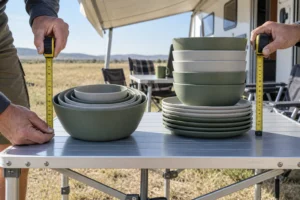
Nesting vs Stacking: How the Two Designs Change Pack-Out
A buyer-focused geometry and pack-out comparison for choosing nested, stacked or hybrid camping dinnerware systems without confusing compact appearance with approved performance.
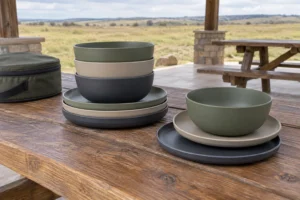
What Makes Camping Dinnerware Truly Stackable?
A procurement acceptance framework for reviewing stack rise, contact interfaces, separation, stability, mixed-component order, drainage and retained pack-out.

Deep Bowls vs Shallow Bowls for Outdoor Meal Sets
A procurement decision table for selecting deep and shallow camping bowl profiles by meal function, user access, stability, cleaning and packed-set architecture.
4 Responses