

Logo Printing for Wheat Straw Products: How to Customize Your Eco-Friendly Tableware
When it comes to customizing wheat straw products, one of the most popular options for private label brands is logo printing. Whether you’re creating eco-friendly tableware for retail or wholesale, having your brand’s logo on the products can significantly increase brand recognition and marketability.
In this article, we’ll explore different logo printing options for wheat straw products, from eco-friendly methods to design tips, and how to select the right technique for your brand.
Why Logo Printing for Wheat Straw Products
Logo printing offers several advantages for your business:
- Brand Identity: A well-designed logo builds trust and helps you stand out in a crowded market.
- Customization: It gives your products a unique look, setting you apart from competitors.
- Customer Loyalty: A recognizable logo enhances repeat purchases and strengthens customer relationships.
According to The Nielsen Company, 59% of consumers prefer to buy products from brands they recognize.
👉 Logo printing is not just an aesthetic choice; it’s a smart marketing strategy.
Popular Logo Printing for Wheat Straw Products
Here are the most common techniques for printing logos on wheat straw products:
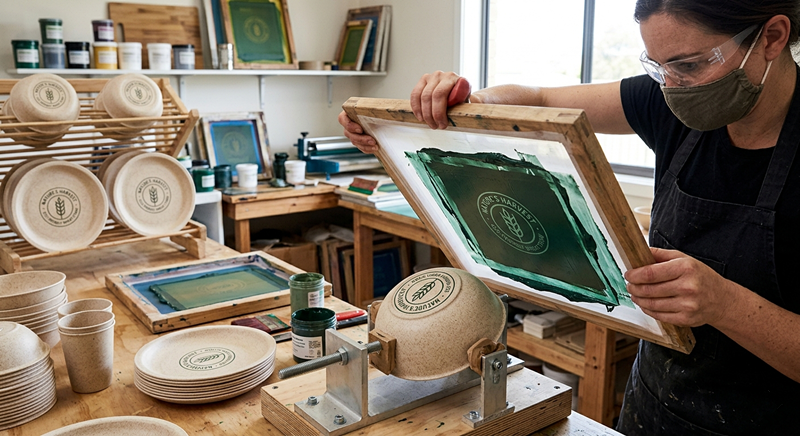
1. Silk Screen Printing
Silk screen printing is the most traditional and widely used method for printing logos on wheat straw products.
Benefits:
- Cost-effective: Best for large production runs.
- Durability: The print lasts long without fading.
- Vibrant colors: Ideal for multi-color logos.
👉 Tip: Works best on flat or slightly curved surfaces.
2. Laser Engraving
Laser engraving offers a high-end, precise method for adding logos to wheat straw items.
Benefits:
- Permanent: The engraving won’t fade or peel off.
- Premium Look: Gives a sophisticated, high-quality finish.
- Eco-friendly: Uses no chemicals or inks.
👉 Tip: Ideal for wooden or natural material finishes like wheat straw.
3. Pad Printing
Pad printing is another great option for logos, especially for irregular shapes or small batches.
Benefits:
- Versatile: Can print on uneven surfaces (e.g., curved or concave items).
- Fast Turnaround: Works well for small orders.
- Low Ink Consumption: Good for intricate designs.
👉 Tip: Suitable for cups, bowls, and small wheat straw products.
4. Heat Transfer Printing
Heat transfer printing is a digital printing technique that transfers a design from paper onto the product using heat and pressure.
Benefits:
- High Detail: Ideal for complex, full-color logos.
- Low Setup Costs: Perfect for smaller batches or custom designs.
- Quick Production: Short lead times for custom designs.
👉 Tip: Best for products that require vibrant and intricate designs.
Factors to Consider When Choosing the Right Printing Method
Choosing the best printing technique depends on several factors:
1. Quantity of Products
For large production runs, silk screen printing or pad printing are cost-effective. If you’re starting small, heat transfer printing may be your best bet.
2. Type of Product
Flat or slightly curved surfaces are best for silk screen printing. For uneven or irregular surfaces, pad printing or laser engraving work better.
3. Design Complexity
If your logo is simple and uses few colors, silk screen printing or laser engraving can offer excellent results. For complex, multi-color designs, heat transfer printing works well.
4. Budget
- Silk screen printing is affordable for large runs.
- Laser engraving is premium but higher in cost.
- Pad printing and heat transfer printing balance quality and cost.
How to Get Started with Custom Logo Printing for Wheat Straw Products
- Choose Your Supplier
Partner with a reliable manufacturer that offers customization services like logo printing. Ensure they have experience with wheat straw products and are capable of high-quality printing. - Prepare Your Design
Work with a designer to create a logo that fits your brand image. Make sure the logo is scalable and looks good on different product types. - Request Samples
Before placing a large order, always request samples with your logo printed to ensure quality and consistency. - Confirm Certifications
Ensure your supplier meets required standards like FDA (for U.S. markets) and LFGB (for European markets).
🔗 Recommended Internal Resources
To learn more about customizing your wheat straw products, check out:
- 👉 /wheat-straw-tableware-quality-certification
- 👉 /custom-wheat-straw-dinnerware-private-label
- 👉 /how-to-create-your-own-eco-friendly-tableware-brand
🌐 External Reference (Authority)
For more information on branding and product labeling standards, visit:
- U.S. Food and Drug Administration: Food Contact Materials
- European Commission: Food Safety Regulations
Final Thoughts
Customizing wheat straw products with your logo is a powerful way to differentiate your brand in the growing eco-friendly market. By choosing the right printing method, you can enhance your products’ appeal and build a stronger connection with consumers.
👉 Whether you’re just starting or scaling up, the right logo printing technique can help your eco-friendly wheat straw tableware brand succeed.
FAQ
1. Which is the best logo printing method for wheat straw?
It depends on the product type and quantity. Silk screen is great for large runs, while laser engraving offers a premium finish.
2. Can I print on any wheat straw product?
Yes, but some methods work better on specific shapes and surfaces.
3. How much does logo printing cost?
Costs vary based on the method, design complexity, and order volume. Request a quote from your supplier.
4. Do I need certifications for logo printing?
Ensure your supplier meets FDA and LFGB standards for food contact materials.
CONTACT US

What Should Be Included in a Camping Mess Kit?
A scenario-based B2B checklist for building camping mess kits around actual users, meals and channels, with twelve component decisions, evidence boundaries and sample-evaluation criteria.

What Is a Camping Mess Kit?
A definition-first B2B guide to camping mess kits: their functional layers, optional components, material and nesting decisions, use scenarios, food-safety boundaries and supplier briefing points.
How Should Buyers Test Wheat Straw Tableware Impact Resistance?
A step-by-step B2B procurement guide to impact-resistance testing for reusable wheat straw tableware, from intended-use risks and conditioning to drop sequences, packaging validation and lot acceptance.

Does Wheat Straw Tableware Release Microplastics?
An evidence-led B2B guide to microplastic-release questions for wheat straw composite tableware, including material scope, use simulation, contamination controls and claim limits.

How Should Buyers Set AQL Inspection for Wheat Straw Tableware?
A practical procurement guide to setting product-specific AQL inspection rules for wheat straw tableware, from lot definition and defect classes to random sampling and shipment release.
Does Wheat Straw Tableware Contain PFAS?
A practical B2B evidence guide to PFAS questions in wheat straw composite tableware, covering formulation review, supplier declarations, testing scope and claim limits.