Description
CONCEPT CONFIGURATION · PROJECT REVIEW REQUIRED
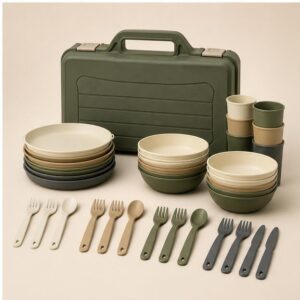
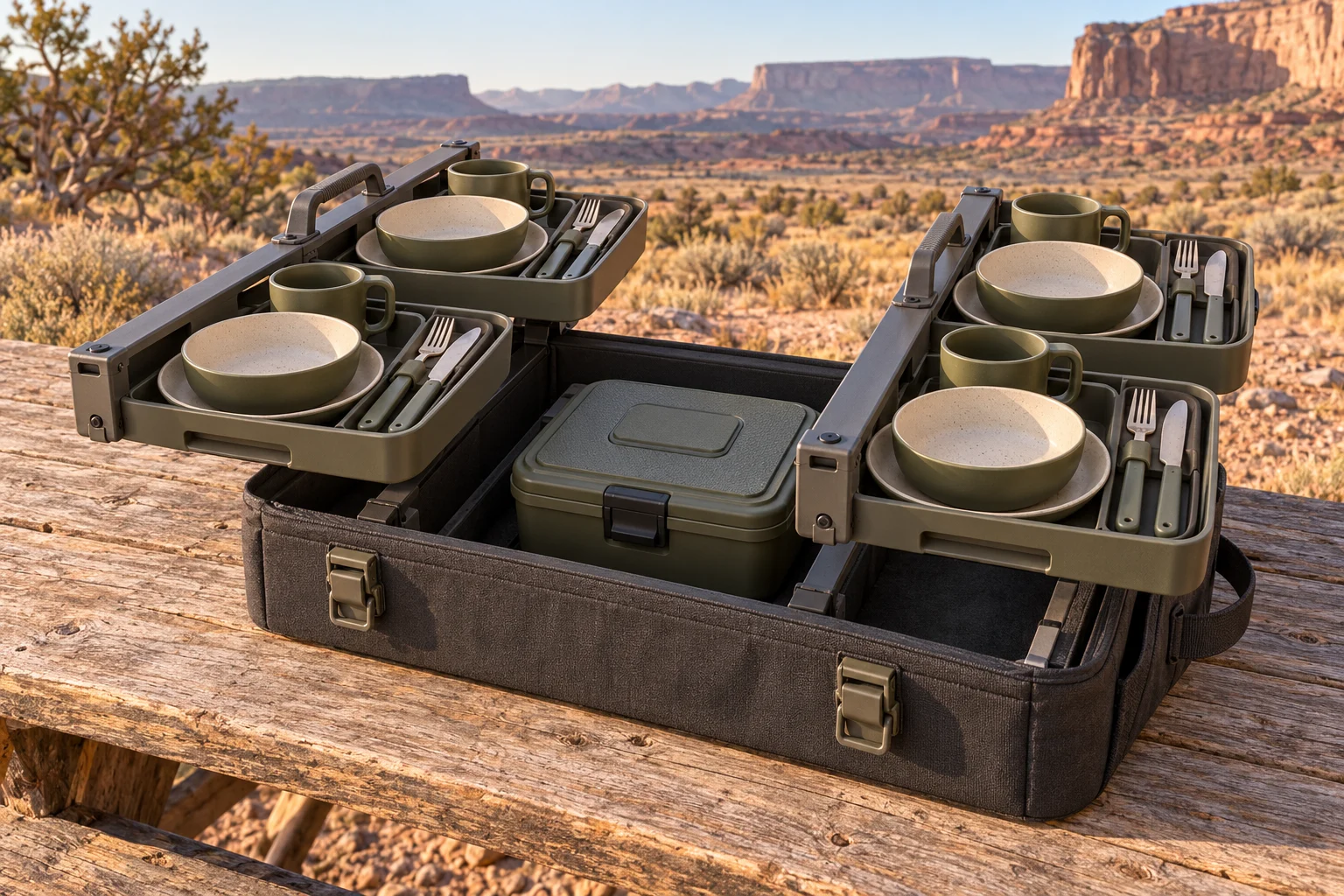
This four-person camping dinnerware set concept separates handling from the base case. Two rigid lift-out beams each carry two shallow personal caddies, while a lunch-box module stays in a protected center bay. Buyers can review two-user service modules without treating the illustration as a finished production SKU or verified performance claim.
PRODUCT PARAMETER
| Product form | Four-person portable dinnerware set with two removable two-user carrier beams |
|---|---|
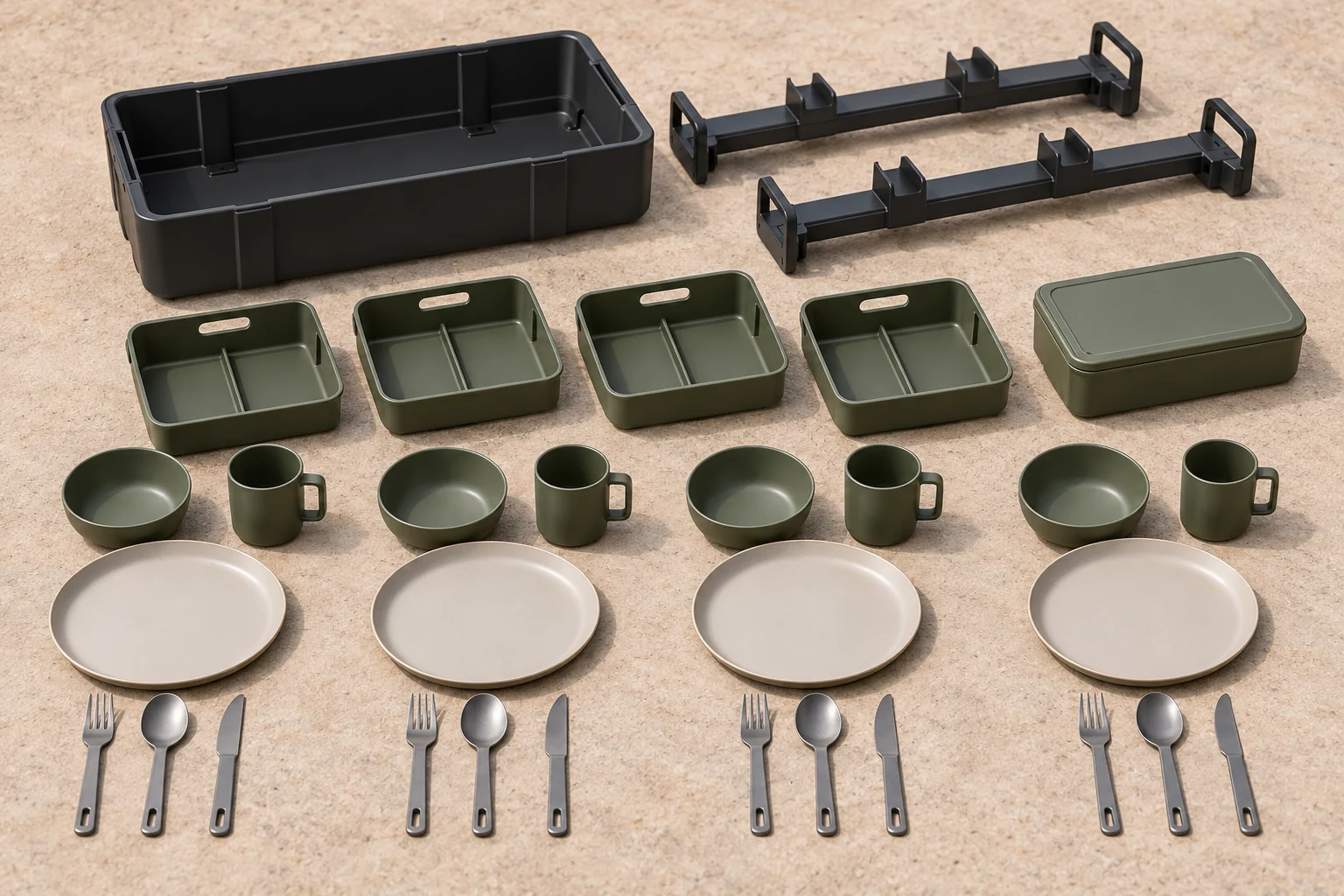
| Reference component groups | Four plates, four bowls, four cups, four cutlery groups, four personal caddies, two carrier beams, central lunch box and low rectangular base |
| Materials | To be confirmed for the project |
| Dimensions / packed envelope | To be confirmed for the project |
| Component compatibility | Compatibility to be confirmed by project sample and drawing. |
| Beam, socket and caddy interface | To be confirmed for the project |
| Decoration / color | To be confirmed for the project |
| Packaging / carton | To be confirmed for the project |
| MOQ / price / lead time | To be confirmed for the project |
| Compliance scope | Evidence depends on released components, decoration, intended use and destination market |
REFERENCE CONFIGURATIONS
| Configuration | Reference arrangement | Buyer approval point |
|---|---|---|
| Full four-user carry | Two loaded beams seat across the base above the central module | Load path, closed clearance and restraint |
| Two-user beam | One beam lifts out with two assigned personal caddies | Handle balance, caddy locks and serving stability |
| Separated caddies | Four caddies detach from the beams for individual place settings | Release action, edge safety and return position |
| Central container | A selected lunch box remains independent under the beam span | Lid sweep, vertical clearance and inclusion in BOM |
The configurations are decision routes, not declared specifications. Dimensions, weights, fit, beam strength and packed orientation must be confirmed from controlled drawings and an approved physical sample.
TWIN-BEAM CAMPING DINNERWARE SET ARCHITECTURE
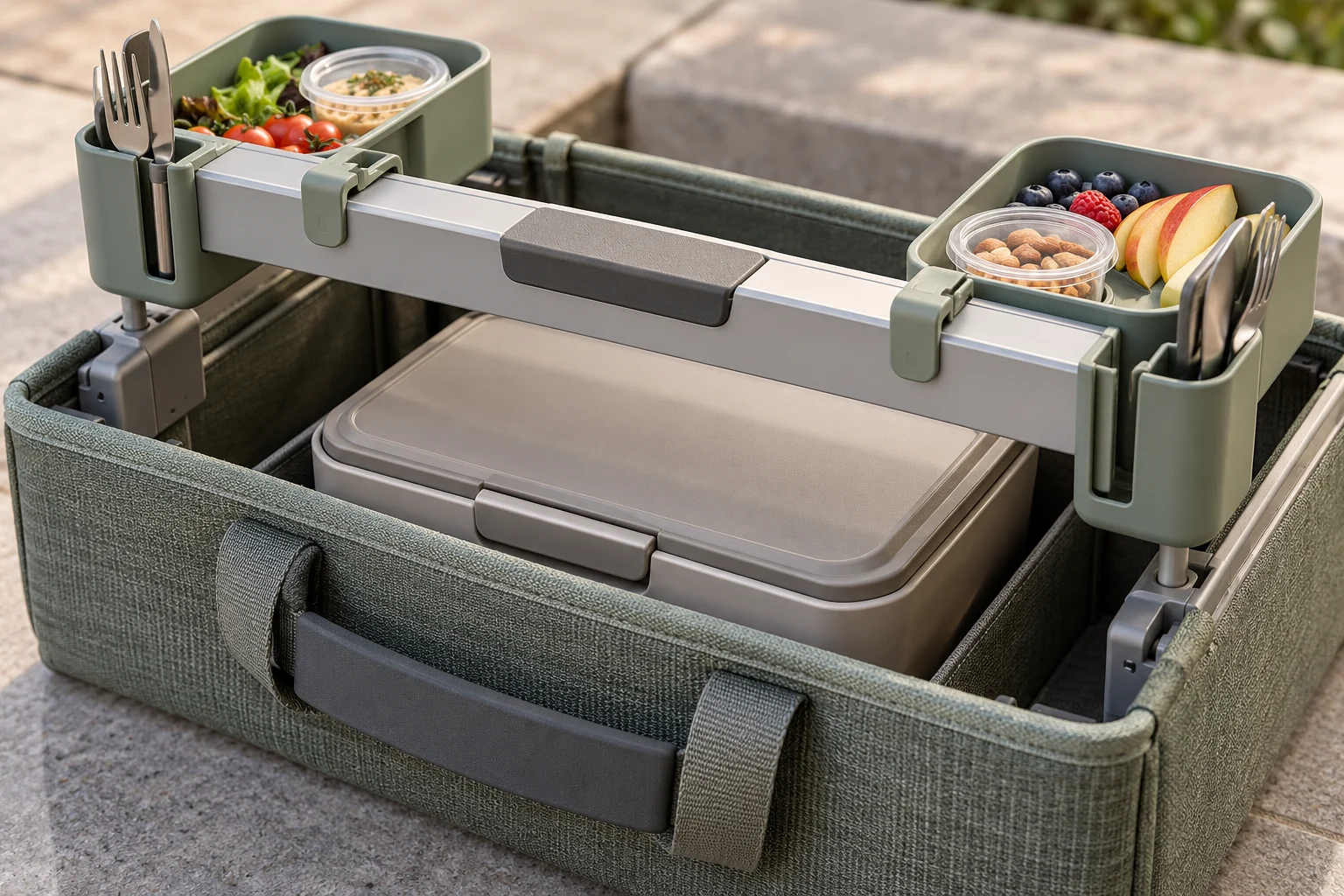
The distinguishing mechanism is a pair of load-carrying cross members. Unlike a vertical pull stack, ring deck, book-fold spine, four-pod field, pannier pair, accordion sleeve, drum shell or wave channel, this camping dinnerware set transfers two caddies at once through a removable beam. The base acts as a receiver rather than the only service surface.
That approach raises specific questions. Each end socket needs a defined seating depth and release direction. Both caddy connections must remain controlled when a user lifts the handle off-center. The span must also clear the central lunch-box lid without implying an untested payload. These points stay open until the selected components are drawn, sampled and observed in a documented carry trial.
WHAT TO SEND FOR A PROJECT REVIEW
- Controlled four-user BOM and the intended two-user grouping
- Plate, bowl, cup, utensil and lunch-box drawings or physical references
- Target packed envelope, case opening direction and lifting sequence
- Expected handling, cleaning, drying and food-use conditions
- Destination market, decoration files and packaging channel
- Named approval owners and unresolved compatibility questions
Send the controlled brief · Request a beam-layout assessment
DEVELOPMENT CONTROL
| Control point | Required evidence | Open-risk example |
|---|---|---|
| Beam span | Profile drawing, intended load distribution and handled sample | Excess deflection or unstable lift |
| End sockets | Insertion depth, retention feature and removal sequence | Beam rocks, binds or exits unintentionally |
| Caddy clips | Two-position interface drawing and repeated attachment record | One caddy rotates when the beam is carried |
| Cutlery channel | Released utensil profiles and protected-edge contact map | Utensils move into a food-use area |
| Central bay | Lunch-box sample, lid movement and vertical-clearance check | Beam or caddy blocks the container closure |
| Final pack-out | Loaded case, inner protection and carton instruction | Parts rub, swap positions or arrive incomplete |
A change to the cup handle, utensil profile or lunch-box height can alter more than one interface. Reopen affected approvals rather than assuming the original camping dinnerware set pack-out still applies.
MATERIAL AND COMPLIANCE BOUNDARY
The photographs explain a mechanical layout and do not establish material identity, renewable content, food-contact status, temperature limits, dishwasher suitability, migration behavior, load rating or market compliance. The finished BOM, use conditions, color and decoration determine which evidence should be requested.
For every document, record the supplier, article or raw material it covers, revision, test conditions and destination-market relevance. A statement for one bowl cannot automatically cover the beam, textile base, lunch box, coating or metal cutlery. Packaging claims also require their own substantiation and approval owner.

PACKING AND SAMPLE APPROVAL
First assemble one caddy around the released plate, bowl, cup and cutlery group. Mark contacts, retention points and the direction used to remove every item. Attach two approved caddies to one beam, lift it through the intended path and record balance, deflection and clip behavior. Repeat for the second beam rather than assuming identical results. Seat both beams in the base, add the selected lunch-box sample, close the case and inspect clearance, movement and scuffing. Run the complete camping dinnerware set check again with final inner packaging.
PROCUREMENT FAQ
Are the two carrier beams load rated?
No load rating is represented by this concept. Beam profile, material, connection and intended load are To be confirmed for the project.
Can one beam be supplied as a two-person subset?
That is a review option. Component counts, balance, packaging and commercial scope need their own BOM and approved sample.
Do all four caddies use the same clip?
The illustration uses a common interface, but interchangeability is not verified. Compatibility to be confirmed by project sample and drawing.
Is the lunch box part of the base?
It is shown as a separate module. Inclusion, dimensions, closure and food-use requirements must be defined for the project.
What is needed before a quotation review?
Provide the BOM, component files or samples, target case envelope, handling sequence, market, decoration and packaging brief. MOQ, price and lead time are To be confirmed for the project.
REVIEW THE TWIN-BEAM PROJECT
Share the controlled component list, beam priorities, caddy references, lunch-box scope and target market through the inquiry form. The request can then be assessed against drawings and samples without converting a visual concept into an unsupported manufacturing promise.
Start a camping dinnerware set review
Related buyer controls: BOM revision control · evidence-file review · pilot assembly planning
Primary context: FDA effective FCS notifications · European Commission food-contact materials · EU General Product Safety Regulation
Project-review page updated .
RELATED SOURCING PATHS
Compare Products and Plan Your Project
Review related product formats, then compare material, set configuration, logo, packaging, testing scope and order quantity with our B2B team.