Description
ROLL-UP FOUR-PERSON DEVELOPMENT CONCEPT
Roll-Map Four-Person Camping Dinnerware Set
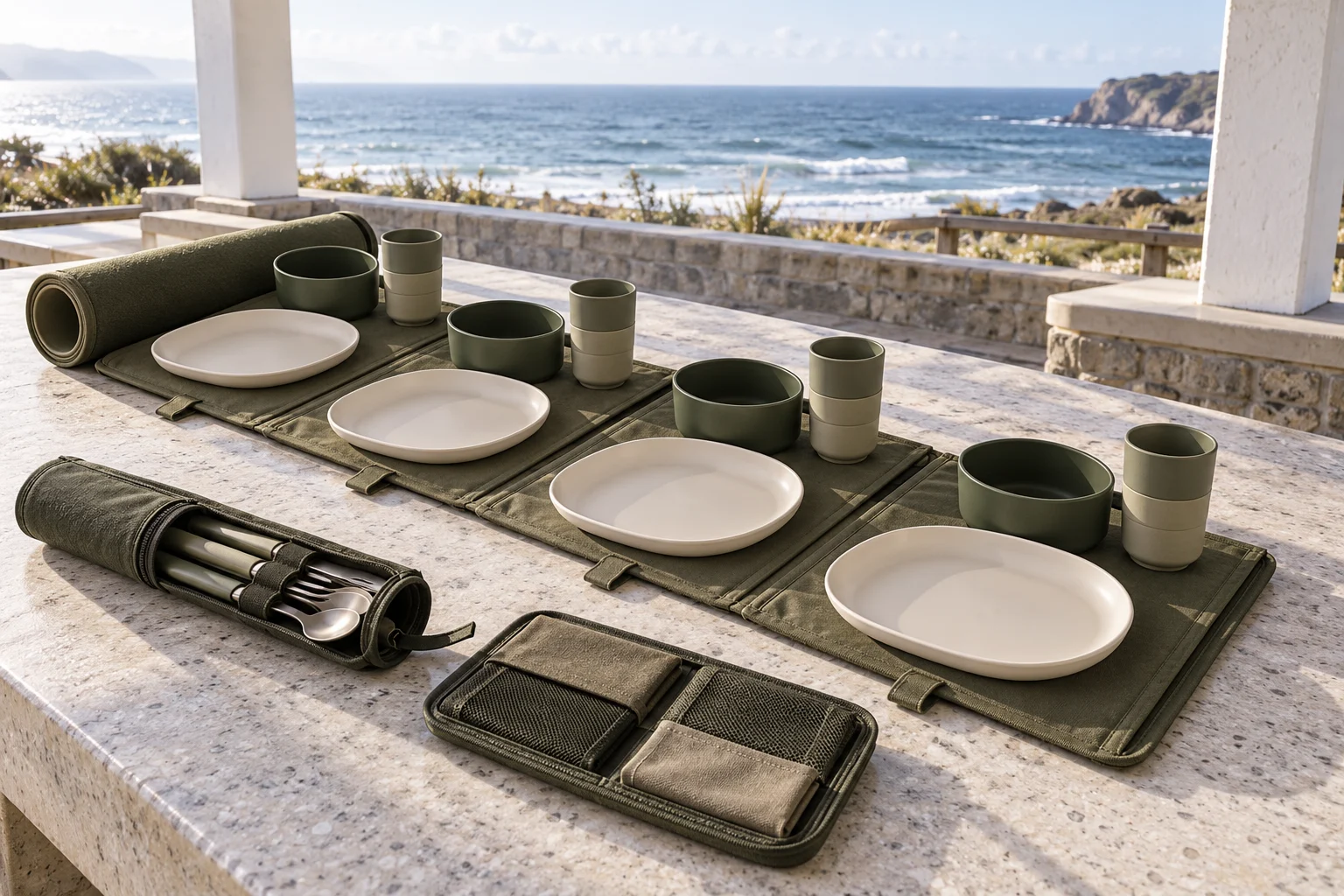
This camping dinnerware set uses a flexible roll-up organizer with four removable rigid place-setting tiles. Each tile carries an oval plate, D-shaped bowl and nesting tumbler; utensils sit in a separate zipper tube, while a flat divided lunch-box pouch detaches from the outer edge. The organizer rolls around a hollow core for carrying. It is a concept, not a verified production SKU.
- Four place-setting tiles separate user count from shared storage
- Tile sleeves, roll diameter, pouch attachment and loaded retention require drawing and sample review
- Materials, dimensions, MOQ, price, lead time and verified claims: To be confirmed for the project
Product review contents
Use this page to define a project brief: component matrix, organizer interfaces, closed roll envelope, cleaning route, intended market, evidence scope, logo positions and packaging. Visuals communicate an organization direction only.
PRODUCT PARAMETER
| Set format | Four removable place-setting tiles in one roll-up organizer |
|---|---|
| Reference components | Four oval plates, four D-shaped bowls, four nesting tumblers, four utensil groups, one zipper tube, one divided lunch-box pouch and one hollow roll core |
| Materials | To be confirmed for the project |
| Dimensions and weight | To be confirmed for the project |
| Color, finish and logo | To be confirmed for the project |
| Packaging, MOQ, price and lead time | To be confirmed for the project |
| Compatibility | Compatibility to be confirmed by project sample and drawing. |
REFERENCE CONFIGURATIONS

The camping dinnerware set configuration image separates the organizer, four tiles, component groups, zipper tube, pouch and roll core so buyers can create a controlled matrix. Counts, dimensions and compatibility remain project decisions.
| Configuration decision | Reference direction | Approval check |
|---|---|---|
| Place-setting tile | One removable rigid support per user | Sleeve retention, edge exposure, cleaning and replacement |
| Dinnerware profile | Oval plate, D-shaped bowl and nesting tumbler | Food-use conditions, stack clearance and tile fit |
| Utensil storage | Separate long zipper tube | Count control, edge protection and drying access |
| Shared container | Detachable flat divided pouch | Closure, leakage boundary, cleaning and attachment |
| Carry format | Organizer rolls around a hollow core | Loaded diameter, strap load and component movement |
Use removable tiles to control each place setting
The tile is the organizing interface, not proof that any plate, bowl or tumbler fits. Define the tile envelope, sleeve opening, retention direction, edge clearance and removal sequence. Review whether a user can remove one setting without releasing the other three. Compatibility to be confirmed by project sample and drawing.
Inspect the roll core, zipper tube and pouch attachment

The hollow core establishes the minimum roll radius, while the zipper tube and flat pouch add asymmetric load. Evaluate seam construction, strap routing, attachment release, utensil edge control, access for cleaning and drying, and whether the loaded roll remains balanced. Do not approve the closed envelope from an empty organizer.
Customization and project boundaries
Customization can include component mix, tile geometry, plate and bowl profiles, cup form, textile organizer, core structure, pouch division, color allocation, decoration and packaging. New geometry, mold, textile construction or attachment hardware requires written feasibility review. This page does not promise tooling, production capacity, MOQ, price or timing.

Review the camping dinnerware set in use
For mountain picnic, coastal outing and camping-retail programs, observe how the organizer transitions from carry roll to table runner. Check whether dishes contact the textile, whether wet parts can be isolated, how utensils are returned and how the pouch affects balance. The scene is a use concept, not proof of field performance or a customer order.
Prepare a useful project brief
For the camping dinnerware set, send the sales channel, user group, required components, closed roll envelope, carry method, food-use conditions, destination markets, cleaning expectations, logo route, packaging objective and target schedule. Distinguish required functions from preferred styling.
B2B development controls
- Approve a component and tile matrix before evaluating the loaded camping dinnerware set.
- Control tile sleeves, core diameter, zipper tube and pouch attachment by drawing revision.
- Measure the closed roll only with the released component configuration.
- Review removal order, count visibility, wet-part isolation, drying and repack sequence.
- Link color, decoration, packaging and evidence to finished components.
- Record open issues and reapproval triggers before written quotation.
Material and compliance boundary
For this camping dinnerware set, the visuals establish only a Roll-Map organization concept. They do not verify material identity, food-contact status, migration, textile suitability, impact, attachment strength, dishwasher suitability or destination-market compliance. Define evidence by finished component, food type, contact duration, use temperature, cleaning route, decoration and jurisdiction. Unknown values remain “To be confirmed for the project.”
For context, review the FDA food-contact substances framework, EU Framework Regulation and European Commission FCM overview. Connect this brief to the component-selection guide, case-fit checklist and pilot-assembly control.
Procurement FAQs
Is this camping dinnerware set a current SKU?
No. It is a development concept for discussing a roll-up organizer and component architecture. Final availability and specifications require written confirmation.
Can a different plate shape be used?
It can be evaluated, but the tile, sleeve, roll radius and closed envelope may change. Compatibility to be confirmed by project sample and drawing.
Does the textile organizer touch food-contact surfaces?
The project should define orientation and barriers, then verify the representative packed sample. The concept image does not establish a hygiene claim.
Can the lunch-box pouch carry liquids?
No leakage or liquid-carrying claim is made. Container and pouch performance must be specified and verified for the project.
Are materials or certifications confirmed?
No. Define finished-component materials, intended use, markets and evidence requirements in the brief.
What should the buyer send first?
Send the component matrix, tile and closed-roll envelope, carry priorities, food-use conditions, market, logo, packaging and evidence brief.
Build a practical Roll-Map camping dinnerware set
Send the component and organizer brief or request a drawing-and-sample review. Naike Dinner will identify open specifications, interface checks, evidence needs and inputs required for a written quotation.
RELATED SOURCING PATHS
Compare Products and Plan Your Project
Review related product formats, then compare material, set configuration, logo, packaging, testing scope and order quantity with our B2B team.