Description
Last updated:
CONFIGURABLE OUTDOOR DINNERWARE CONCEPT
A-Frame Modular Camping Dinnerware Set
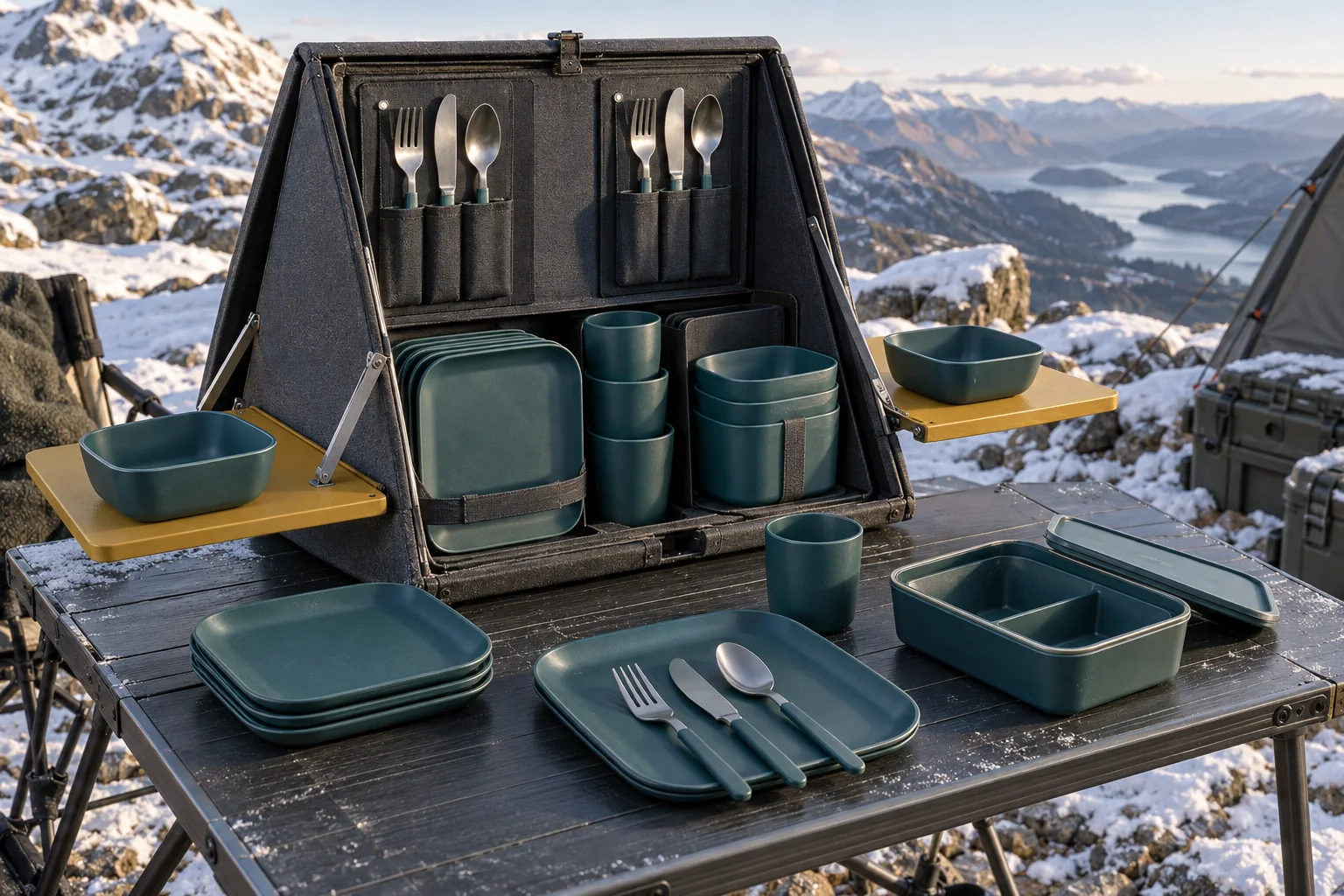
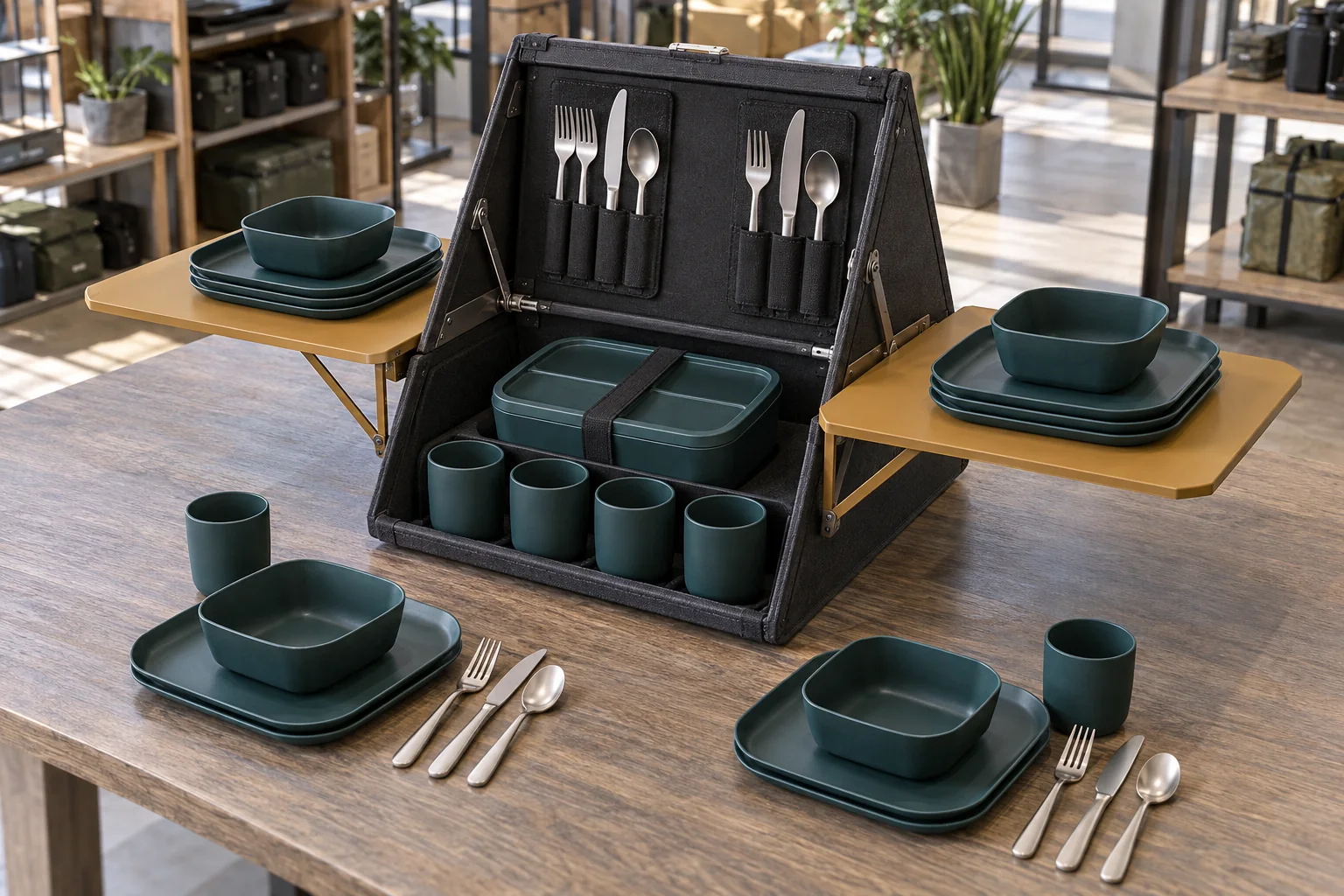
This modular camping dinnerware set uses a triangular-prism carry case that opens into a freestanding service station with fold-out shelves, organized tableware and a divided meal container. The concept is for buyer configuration review; it is not a verified production SKU.
- Clipped-corner plates, low bowls and handleless cups
- Divided lunch container and protected cutlery sleeves
- A-frame case with locking struts and fold-out service shelves
- Component count, materials, dimensions and interfaces are project decisions
MODULAR CAMPING DINNERWARE SET PARAMETERS
| Product concept | Portable A-frame camping dinnerware and serving station |
|---|---|
| Reference components | Carry case, fold-out shelves, plates, bowls, cups, divided lunch container and knife/fork/spoon sleeves |
| Material | To be confirmed for the project |
| Dimensions and weight | To be confirmed for the project |
| Color and finish | To be confirmed against approved samples |
| Logo and packaging | To be confirmed for the project |
| MOQ, price and lead time | To be confirmed for the project |
| Compatibility | Compatibility to be confirmed by project sample and drawing. |
REFERENCE CONFIGURATIONS FOR A MODULAR CAMPING DINNERWARE SET
| Configuration | Buyer decision | Evidence before approval |
|---|---|---|
| Compact pair set | Two place settings with one shared container | Pack envelope, removal order and service workflow |
| Four-person table set | Four plate/bowl/cup groups plus cutlery | Loaded case stability and shelf load review |
| Lunch-led set | Prioritize divided containers and compact tableware | Food-contact conditions and seal/interface sample |
| Retail assortment | Choose counts, colors and packaging by channel | Approved component matrix and written specification |
Reference images illustrate modular camping dinnerware set configuration logic only. Final component count, form, material, construction and claims require project samples and written approval.
A service case, not just a storage shell
In this modular camping dinnerware set, the triangular case is intended to stand as an A-frame after opening. Side panels become small service shelves while the central cavity keeps nested tableware visible. Buyers should evaluate stability with the selected component load, the opening angle, strut locks and the intended table surface.
The case must not be assumed to support any stated load until the hinge, shelf and structure have been reviewed through drawings and samples. Shelf depth, edge retention and closing clearance are controlled by the approved component matrix.
Component architecture for new set development
Within the modular camping dinnerware set, clipped-corner plates and bowls provide a clear design language distinct from round nesting sets. Handleless cups and a divided lunch container can be sized around the inner cavity, while cutlery sleeves separate utensils from food-contact surfaces during transport.
Buyers can request alternative counts, but every change affects nesting, center of mass, case closure and packaging. Compatibility to be confirmed by project sample and drawing.
Structure and docking details

The modular camping dinnerware set depends on the hinge, strut, shelf edge, divider and sleeve construction as development controls. Review pinch points, fastener retention, textile seams, cleanability and the way components remain separated. Hardware finish and corrosion expectations must be defined for the target environment and verified with appropriate evidence.

Application concept: a compact service station can keep the complete set visible during a rooftop or outdoor meal. The image is not a verified customer case or production SKU.
Customization and connected procurement choices
| Control | Options to review | Dependency |
|---|---|---|
| Set composition | Place-setting count, shared pieces, lunch-container priority | Case volume and carry mass |
| Geometry | Plate corners, bowl depth, cup profile and divider layout | Nesting, molding and cleaning access |
| Case architecture | Opening angle, shelf size, divider and sleeve layout | Stability, closure and packing sequence |
| Branding | Logo position, color system and packaging hierarchy | Material/process suitability and approved artwork |
| New tooling review | Revised component or case geometry | Drawings, tolerances, samples and written feasibility |
Modular camping dinnerware set development controls
- Freeze the component matrix before confirming the inner case layout.
- Review shelf and A-frame stability with representative loads and surfaces.
- Confirm nesting, rattle control, removal order and closure clearance on samples.
- Define logo, packaging and labeling only after material and process review.
- Separate dinnerware claims from any cookware or direct-heat claim.
Material and compliance boundary
For this modular camping dinnerware set, no material, certification, migration result, mechanical result or market claim is represented by the concept images. The buyer should define target markets, food types, temperatures, contact duration and cleaning conditions so the applicable evidence can be identified. The U.S. FDA food-contact overview and EU Regulation 1935/2004 illustrate why evidence must match the final material and intended conditions; neither source verifies this concept.
This is dinnerware and storage/service equipment. Do not infer direct-flame, burner, campfire, stove, oven or cookware suitability. Any required claim must be tied to the final construction and supported by project-specific evidence.
Related configuration references
Compare the A-frame organization with the rail-grid modular set and the arc-shell modular set. These references show different storage logic; they do not establish compatibility with this concept.
Outdoor food handling should also be reviewed separately using primary guidance such as the USDA FSIS camping food-safety guidance.
For a written review, contact Naike Dinner with the component matrix.
Modular camping dinnerware set procurement FAQs
Can the number of place settings change?
Yes as a development request, but the case, shelves, nesting and carry balance must be reviewed again. No count is final until written approval.
Can the lunch container be removed?
It can be considered as an alternative configuration. The freed volume and the retention of the remaining components must be checked on a revised sample.
Are the shelves load-rated?
No load rating is stated. Define the intended service load and acceptance method, then request drawings and samples for review.
Can buyers specify materials and colors?
They can submit preferences. Availability, suitability, evidence and color matching remain subject to project confirmation.
Does the concept include custom tooling?
New geometry may be evaluated, but capability, tooling route, cost and schedule are not assumed. Provide drawings, targets and required interfaces for a feasibility review.
What should accompany a quotation request?
Send the component matrix, target users and markets, meal/use conditions, material preference, pack envelope, logo and packaging brief, evidence expectations and sample-review plan.
Build the modular camping dinnerware set around your brief
Share the intended place-setting count, component drawings or references, case envelope, shelf use, target markets, food-contact conditions, logo and packaging requirements. Naike Dinner will review the request against verified capabilities and identify the drawings, samples and written confirmations needed before approval.
RELATED SOURCING PATHS
Compare Products and Plan Your Project
Review related product formats, then compare material, set configuration, logo, packaging, testing scope and order quantity with our B2B team.