Description
CONCEPT CONFIGURATION · PROJECT REVIEW REQUIRED
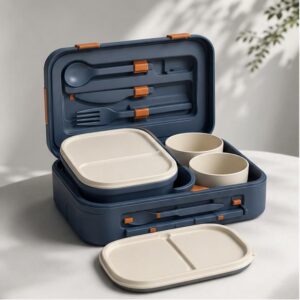
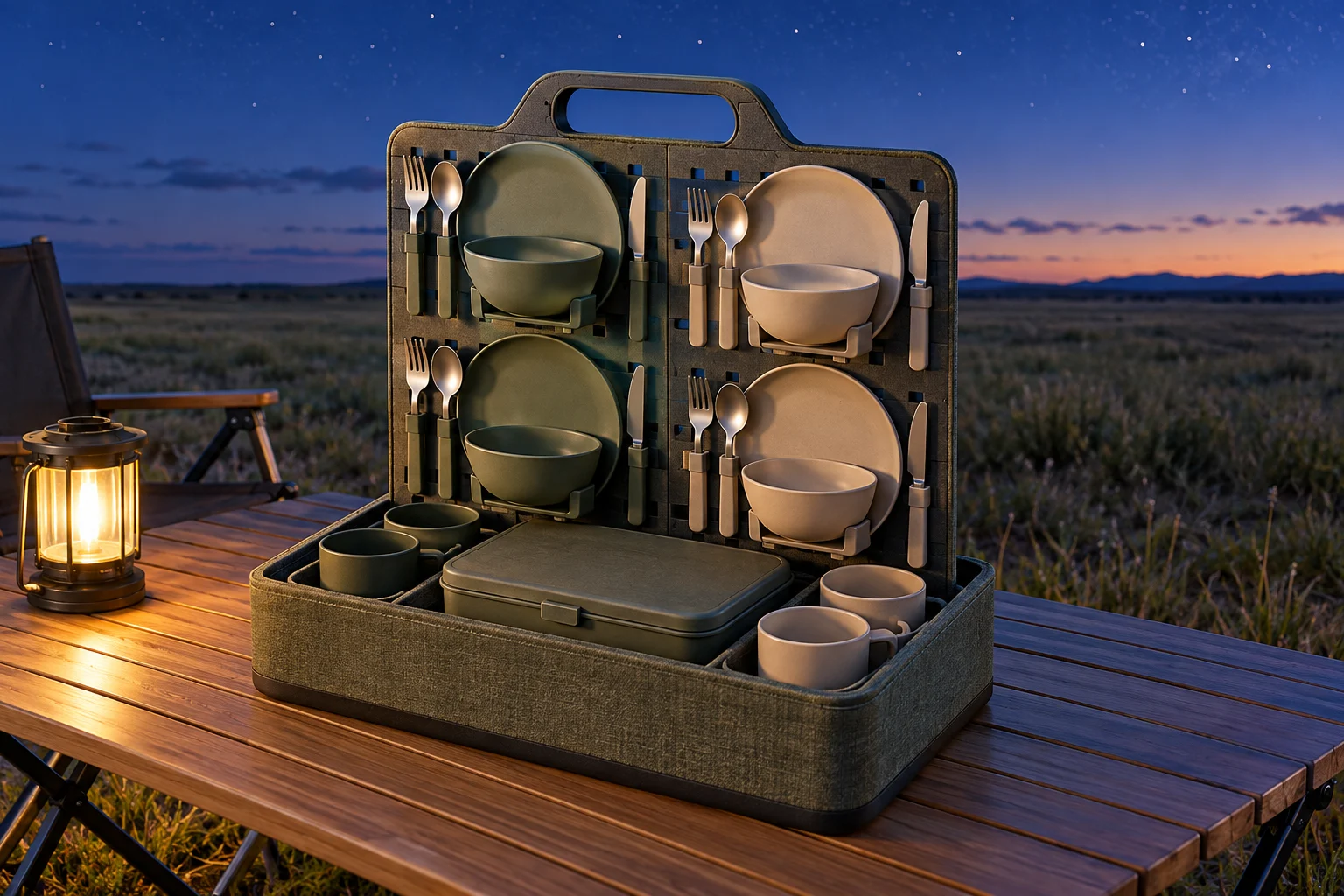
This four-person camping dinnerware set concept uses one removable perforated center panel to organize four personal place-setting carriers. The panel seats in a low tote base, provides an integrated carrying grip and leaves the corner cup wells and lower lunch-box bay independent. The visuals explain a development route; they do not represent a released SKU, confirmed material or tested performance.
PRODUCT PARAMETER
| Product form | Four-person portable dinnerware concept with a removable peg panel and low tote base |
|---|---|
| Reference component groups | Four plates, four bowls, four cups, four cutlery groups, four personal carriers, one perforated panel, one lunch-box module and one tote base |
| Materials | To be confirmed for the project |
| Dimensions / packed envelope | To be confirmed for the project |
| Component compatibility | Compatibility to be confirmed by project sample and drawing. |
| Panel, socket and carrier interface | To be confirmed for the project |
| Decoration / color | To be confirmed for the project |
| Packaging / carton | To be confirmed for the project |
| MOQ / price / lead time | To be confirmed for the project |
| Compliance scope | Defined by the released BOM, food-use conditions, decoration and destination market |
REFERENCE CONFIGURATIONS
| Configuration | Proposed arrangement | Buyer decision record |
|---|---|---|
| Complete tote | Panel seated in the base, four carriers secured, cups in corner wells and lunch box below | Packed clearance, restraint and lifting route |
| Panel service mode | Loaded center panel lifts vertically while the base remains on the table | Balance, grip comfort and socket release |
| Individual service | Each carrier detaches as one assigned place-setting group | Clip release, return position and edge access |
| Base-only access | Cups and the lunch-box module remain available after panel removal | Corner-well fit, lid sweep and base stability |
For a camping dinnerware set, these arrangements are sourcing options rather than specifications. Final counts, orientation, mass, interface geometry and packed volume require controlled drawings plus an approved physical sample.

PEG-PANEL CAMPING DINNERWARE SET ARCHITECTURE
The defining element is a flat removable organizer that serves as both divider and carry interface. Four carriers connect to two faces of the panel, while the tote base performs three different jobs: receiving the panel, locating four cups at the corners and protecting a separate lunch-box module below. Unlike a beam pair, folding spine, radial pod group, pull stack, drawer, ring deck or outer cage, the service groups travel on one planar support.
This architecture concentrates risk at the panel sockets and carrier clips. The panel must enter the base in a controlled direction, resist unintended movement and release without forcing a user to touch food-contact surfaces. Carrier depth must not cause interference across the two faces. The integrated grip also needs clearance from the upper place settings. None of those relationships should be assumed from the illustration.

WHAT TO SEND FOR A PROJECT REVIEW
- A controlled four-user BOM with each place-setting count
- Plate, bowl, cup, cutlery and lunch-box drawings or physical references
- Target tote envelope, panel lifting path and intended carry sequence
- Expected food use, cleaning, drying and storage conditions
- Destination market, color direction, decoration artwork and packaging channel
- Named approval owners plus the questions that remain unresolved
Send the controlled component brief · Request a peg-panel layout review
DEVELOPMENT CONTROL
| Control point | Evidence to request | Reason to hold approval |
|---|---|---|
| Panel body | Released profile, wall section, grip geometry and intended handling condition | Flex, sharp transitions or poor hand clearance |
| Base sockets | Insertion depth, anti-rotation feature and removal sequence | Panel rocks, binds or exits unevenly |
| Carrier clips | Interface drawing, assigned position map and repeated attachment record | Carrier rotates, swaps position or releases early |
| Two-face spacing | Loaded panel section and cross-face clearance check | Bowls, plates or utensils collide through the panel |
| Corner wells | Released cup profile and removal-access study | Cup binds or blocks the panel socket |
| Lower bay | Lunch-box sample, lid movement and packed-height record | Panel prevents closure or transfers pressure to the lid |
| Final pack-out | Approved inner protection, loaded tote photos and carton instruction | Parts rub, migrate or arrive in the wrong group |
A revision to a cup handle, bowl rim, utensil length or lunch-box height may affect several interfaces. Reopen the impacted checks rather than relying on a previous camping dinnerware set approval.
MATERIAL AND COMPLIANCE BOUNDARY
The camping dinnerware set images communicate arrangement only. They do not confirm material identity, renewable content, food-contact suitability, migration performance, temperature resistance, dishwasher use, carrying load, textile composition or market compliance. Evidence selection starts after the project BOM and intended conditions are released.
Match each declaration or test report to the exact component, supplier, material grade, color or decoration, revision and destination market. A record covering a bowl cannot automatically support the panel, tote textile, lunch box, metal cutlery or printed package. Claim wording also needs a named evidence owner and approval date.

PACKING AND SAMPLE APPROVAL
For this camping dinnerware set, begin with one released place setting. Confirm how its plate, bowl and cutlery sit inside the carrier, then mark all food-contact and restraint points. Fit that carrier to each assigned panel position and document clip engagement without assuming interchangeability. Load both faces, seat the panel in the tote and inspect grip clearance and balance. Add four approved cup samples to the corner wells and the selected lunch box to the lower bay. Close the complete pack with final inner protection, then record movement, rubbing, access and count reconciliation. Any changed component returns to the relevant checkpoint.
PROCUREMENT FAQ
Is the perforated panel a verified carrying structure?
No load or durability claim is made. Panel material, thickness, socket geometry and intended carrying condition are To be confirmed for the project.
Can buyers change the four carrier positions?
The hole field suggests layout flexibility, but a released position map is still required. Compatibility to be confirmed by project sample and drawing.
Are the cups fixed to the panel?
No. The concept places cups in four separate corner wells in the tote base. Cup size, handle form and removal clearance require project confirmation.
Is the lunch box included automatically?
It is a separate reference module in the lower bay. Inclusion, volume, closure and food-use scope must be defined in the approved BOM.
What information is needed for quotation review?
Send component files or samples, counts, target packed envelope, handling sequence, destination market, decoration and packaging brief. MOQ, price and lead time are To be confirmed for the project.
REVIEW THE PEG-PANEL PROJECT
Use the inquiry form to share the controlled component list, panel priorities, carrier references, lunch-box scope and target market. The proposal can then be assessed against drawings and samples without turning a visual concept into an unsupported production promise.
Start a camping dinnerware set review
Related buyer controls: BOM revision control · evidence-file review · pilot assembly planning
Primary context: FDA effective FCS notifications · European Commission food-contact materials · EU General Product Safety Regulation
Project-review page updated .
RELATED SOURCING PATHS
Compare Products and Plan Your Project
Review related product formats, then compare material, set configuration, logo, packaging, testing scope and order quantity with our B2B team.