
Description
CONCEPT CONFIGURATION · PROJECT REVIEW REQUIRED
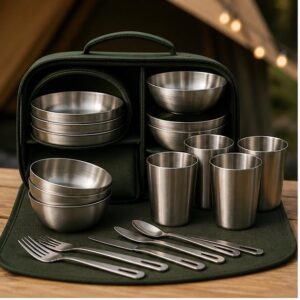
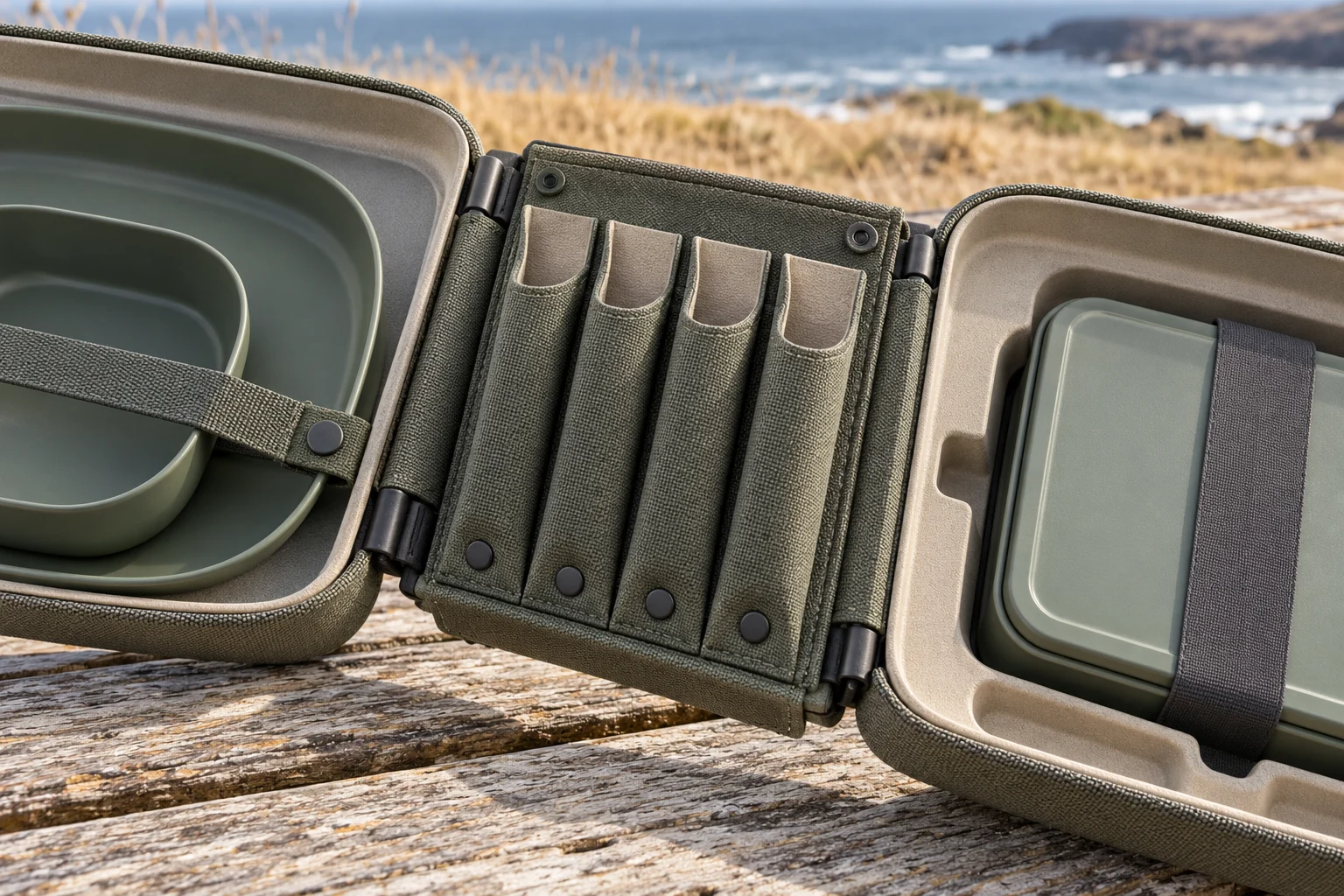
This four-person camping dinnerware set concept opens like a book. Two rigid shallow tray halves each organize two place settings, while a detachable center spine separates four cutlery groups and a compact lunch-box module uses its own docking zone. The architecture is offered for sourcing discussion only and is not represented as a verified production SKU.
PRODUCT PARAMETER
| Product form | Four-person portable dinnerware set with two hinged two-person tray halves |
|---|---|
| Reference component groups | Four plates, four bowls, four cups, four cutlery groups, removable center spine, lunch-box module and book-fold carry case |
| Materials | To be confirmed for the project |
| Dimensions / packed envelope | To be confirmed for the project |
| Component compatibility | Compatibility to be confirmed by project sample and drawing. |
| Hinge and spine construction | To be confirmed for the project |
| Decoration / color | To be confirmed for the project |
| Packaging / carton | To be confirmed for the project |
| MOQ / price / lead time | To be confirmed for the project |
| Compliance / evidence | Finished components, decoration, intended use and destination market require project-specific review |
REFERENCE CONFIGURATIONS
| Configuration | Illustrative arrangement | Decision to record |
|---|---|---|
| Book-fold four-person set | Two users per tray half with the cutlery spine between them | Tray geometry, fold direction and closed-case contact |
| Split service | One camping dinnerware set tray half opened while the second remains packed | Case stability, access order and component retention |
| Detached spine | Four cutlery sleeves removed as one service module | Attachment method, edge protection and return sequence |
| Lunch-box option | Compact container evaluated in a separate docking area | Envelope, removal clearance, closure and inclusion scope |
The table defines review routes rather than final specifications. Counts, dimensions, fit and packed orientation must be released against the selected BOM, drawings and approved sample.

BOOK-FOLD SPINE CAMPING DINNERWARE SET ARCHITECTURE
The substantive design difference is the folding service plane. The camping dinnerware set does not use a vertical stack, ring deck, pannier pair, accordion pocket, drum sleeve or wave channel. Instead, two shallow rigid panels pivot around a narrow removable spine. Each panel is assigned to two users, so the buyer can review a defined half-set without unloading every component.
This geometry creates its own questions. The hinge must close around the loaded trays without trapping a rim or handle. The spine must retain four cutlery groups while remaining removable for cleaning or service. The lunch-box zone needs a controlled envelope that does not force a food container against exposed utensil edges. None of those outcomes is assumed; each requires a drawing, sample and recorded pack-out trial.
WHAT TO SEND FOR A PROJECT REVIEW
- Controlled component BOM and user-count requirement
- Plate, bowl, cup, cutlery and lunch-box drawings or physical samples
- Target camping dinnerware set closed-case envelope and preferred opening direction
- Cleaning, drying and food-use conditions by component
- Destination market, artwork locations and packaging channel
- Sample decisions, open compatibility questions and approval owners
Send the component brief · Request a book-fold layout review
DEVELOPMENT CONTROL
| Control point | Evidence to release | Risk if left open |
|---|---|---|
| Tray half | Two-user layout drawing, contact map and loaded sample | Components shift, collide or block closing |
| Center hinge | Camping dinnerware set fold angle, clearance stack-up and repeated pack observation | Rims or sleeves enter the hinge path |
| Removable spine | Attachment detail, four sleeve profiles and removal sequence | Wrong utensil fit or ambiguous reassembly |
| Lunch-box dock | Container revision, orientation, clearance and closure check | Unverified compatibility or contact with cutlery |
| Carry case | Closed envelope, handle orientation and loaded pack-out record | Balance, protection and transport assumptions |
| Retail packaging | Final BOM, insert drawing, artwork release and carton sample | Count mismatch or obsolete presentation files |
MATERIAL AND COMPLIANCE BOUNDARY
This concept does not establish a material, certification, dishwasher, microwave, leakproof, insulation, load, durability or environmental claim. The finished plate, bowl, cup, cutlery, lunch-box, decoration and intended use must be evaluated for the destination market. The US FDA food-contact notification inventory, European Commission food-contact materials overview and EU General Product Safety Regulation can frame buyer questions but do not verify an unspecified set.
Useful internal controls include the finished-component evidence index, linked BOM revision register and blind repack observation process.

PACKING AND SAMPLE APPROVAL
First approve each camping dinnerware set tray half as a two-user unit. Record the component revision, pocket assignment, surface contacts and the path used to remove and return every piece. Then attach the center spine, load all four cutlery groups and confirm that no utensil edge enters the hinge or food-contact area. Add the selected lunch-box sample, close the case from the released sequence and document any interference, movement, scuff or count error. Repeat the camping dinnerware set trial with the final packaging configuration before quotation assumptions are frozen.
PROCUREMENT FAQ
Can either tray half be supplied as a two-person set?
That option can be evaluated, but component identifiers, case construction, packaging and commercial scope must be defined separately.
Is the center spine permanently attached?
The image shows a removable concept. The production attachment method is To be confirmed for the project.
Will existing cutlery fit the four sleeves?
Compatibility to be confirmed by project sample and drawing.
Is the lunch-box module leakproof?
No leakproof claim is made. Container closure, intended orientation and use conditions require project-specific validation.
Does the folded case protect food-contact surfaces?
Camping dinnerware set protection depends on the final contact map, retention features and transport packaging. Approve those conditions with the released sample.
REQUEST A BOOK-FOLD SPINE CAMPING DINNERWARE SET REVIEW
Send the BOM, component drawings or samples, target packed envelope, two-user tray priorities, cutlery profiles, lunch-box scope, destination market, artwork and packaging brief. Naike can return the open project questions required before sample or quotation review.
Reviewed . This page records a sourcing concept; commercial values, component choices and capabilities remain subject to project confirmation.
RELATED SOURCING PATHS
Compare Products and Plan Your Project
Review related product formats, then compare material, set configuration, logo, packaging, testing scope and order quantity with our B2B team.