
Description
MODULAR OUTDOOR DINNERWARE CONCEPT
Tension-Frame Four-Person Camping Dinnerware Set
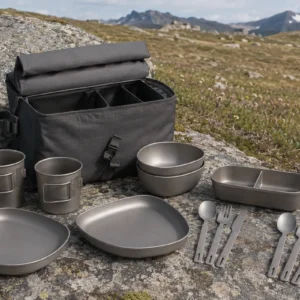
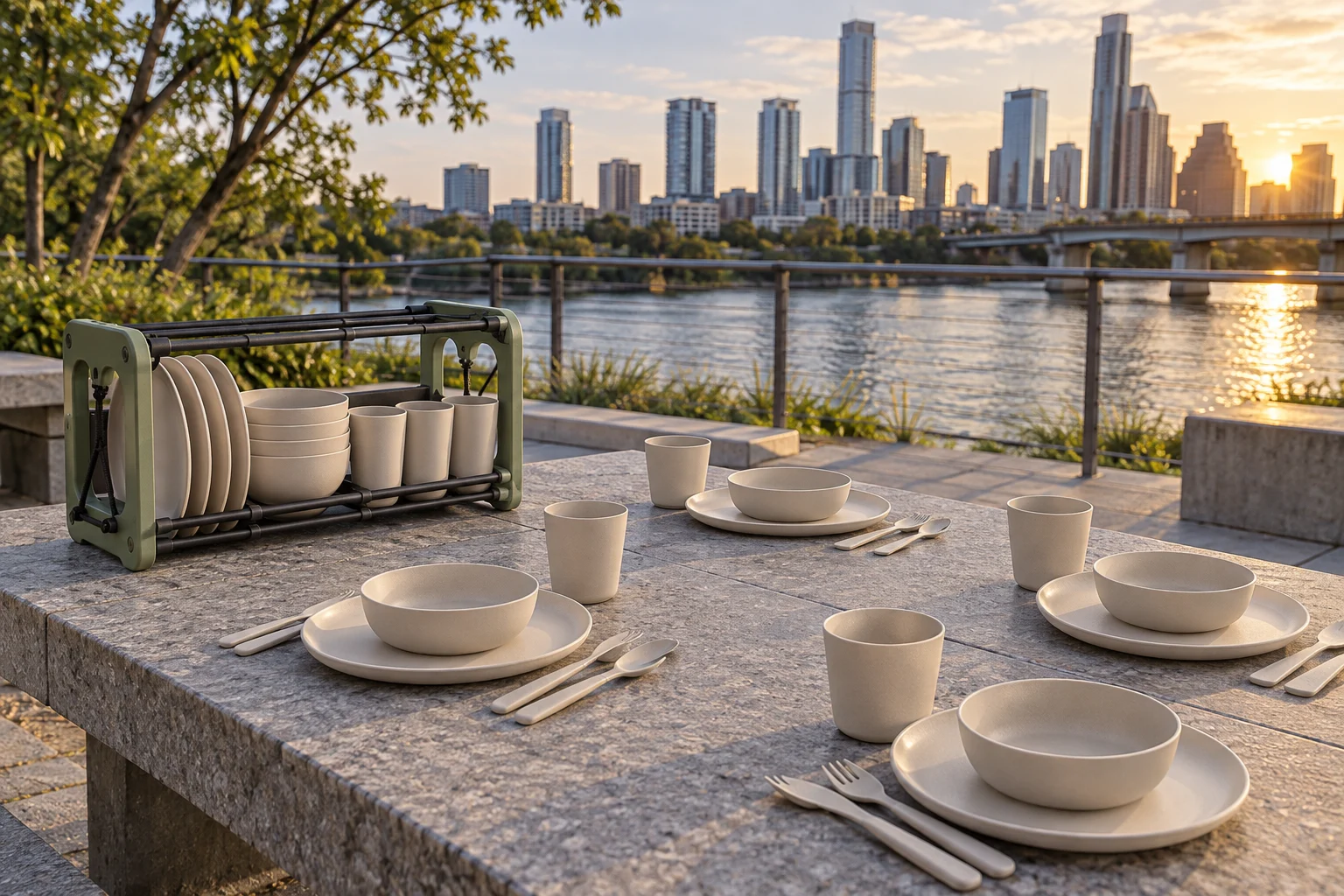
This tension frame camping dinnerware set organizes plates and bowls between two separate rigid end frames linked by removable parallel carrier rods. Detachable cup positions remain outside the central stack, while a lower cradle can receive a lunch container and a rolled utensil pouch. The open frame supports visible component access without presenting the concept as a finished production SKU.
Project boundary: rod count and locking method, materials, dimensions, capacities, colors, food-contact evidence, MOQ, price, tooling, production capacity and lead time are To be confirmed for the project.
PRODUCT PARAMETER
| Product form | Four-person outdoor dinnerware concept with two rigid end frames, configurable parallel carrier rods and a lower cradle |
|---|---|
| Reference components | Plates, bowls, cups, forks, spoons, knives, lunch container, utensil pouch, cup positions and tension-frame carrier |
| Material | To be confirmed for the project |
| Dimensions / weight / capacity | To be confirmed for the project |
| Rod count / locking method | To be confirmed for the project |
| Color / logo / packaging | To be confirmed for the project |
| MOQ / price / lead time | To be confirmed for the project |
| Compatibility | Compatibility to be confirmed by project sample and drawing. |
REFERENCE CONFIGURATIONS
The illustrated tension frame camping dinnerware set is a procurement starting point. Buyers can compare a four-person plate, bowl and cup layout; a reduced tension frame camping dinnerware set without the lunch container; or a carrier that uses different rod positions for alternate component envelopes. The exact BOM, rod array, locking collars, cup positions, utensil pouch, lower cradle and pack sequence must be frozen before quotation.

Tension frame camping dinnerware set architecture
The defining architecture of the tension frame camping dinnerware set is a pair of load-bearing end frames connected by removable parallel rods rather than a closed case, hinged bay, drawer, textile roll or vertical-slot board. The project review must decide how plates and bowls are supported, where the rods contact components, how locking collars are retained, whether cup positions detach, how the lower cradle carries a lunch container, and how loose utensils remain separated from food-contact surfaces.
Reference images explore both three-rod and four-position layouts. They show a design study, not two guaranteed variants. The final rod count, spacing and load path are To be confirmed for the project.

Freeze the frame and component envelope
Send the target user count, required BOM, plate and bowl stack envelope, cup positions, lunch-container and utensil requirements, material preferences, intended foods and temperatures, cleaning conditions, target markets, logo locations and packaging route. Naike Dinner can identify existing-component options and open development items. A drawing, physical sample and risk review must precede any compatibility, load or performance statement.
DEVELOPMENT CONTROL
| Gate | Buyer decision | Required record |
|---|---|---|
| Component envelope | Which plates, bowls, cups, utensils and container must fit? | Approved BOM and component envelope table |
| End frames | Required outline, handle path, feet and contact protection | Interface drawing and prototype observation |
| Rod array | Rod count, positions, locking method and removal sequence | Rod map, tolerance notes and retention review |
| External cup positions | How many positions and what access / retention method? | Cup envelope and packed-contact map |
| Lower cradle | Lunch container, utensil pouch or alternate module? | Cradle drawing, access review and closure plan |
| Cleaning | Which parts detach and where can soil or water collect? | Cleaning boundary and component instruction plan |
| Packaging | Fully assembled, partly disassembled or flat-packed carrier? | Approved pack-out, protection and assembly instruction |
| Release | Which drawing, sample, artwork and packaging revisions control? | Linked revision and approval record |
MATERIAL AND COMPLIANCE BOUNDARY
No concept image, surface color or product name proves polymer identity, fiber content, recycled content, biodegradability, BPA status, dishwasher suitability, microwave use or food-contact compliance. The finished component, colorant, decoration, adhesive, textile, intended food, contact time, temperature, cleaning condition and target market define the evidence scope. Dinnerware claims must not be expanded into cookware claims. Evidence and test scope are To be confirmed for the project.
The FDA food-contact notification inventory, EU Regulation (EC) No 1935/2004 and EU Regulation (EU) No 10/2011 are primary starting points. Applicability depends on the finished tension frame camping dinnerware set and target market.
CUSTOMIZATION, PACKAGING AND PROJECT EVIDENCE
Frame color, dinnerware mix, cup positions, utensil pouch, lunch-container option, logo location, labels, retail pack, e-commerce mailer and master carton can be reviewed as project variables. They are not automatically available together. For adjacent decisions, use the portable flatware reference product, retail insert design guide and camping set replacement-part inspection checklist. Development route, tooling, load review, assembly instruction, packaging validation and artwork release are To be confirmed for the project.
COMPONENT DESIGN DIFFERENCE
This product concept is not a recolor, crop, mirror or background variation of earlier portable sets. Its distinguishing system feature is a tension-frame carrier: two separated rigid end frames are joined by removable parallel rods that support the central dinnerware stack, while cup positions sit outside that stack and a lower cradle holds a separate meal-container or utensil module. The support path, access sequence, assembly interfaces and component zones differ materially from hinge-chain, drawer, roll, cassette, layer, corner, radial, A-frame and vertical-slot layouts.
PROCUREMENT FAQ
Is the Tension-Frame set an existing production SKU?
No. It is a configuration concept for project evaluation. Existing-component fit, tooling and the development route are To be confirmed for the project.
Why do the concept views show different rod arrays?
They illustrate an open design question. The approved rod count, position, diameter, locking method and contact protection must be frozen in the project drawing.
Can existing plates, bowls or cups be installed?
Possibly, but dimensions and load paths cannot be assumed. Compatibility to be confirmed by project sample and drawing.
Is the carrier proven for transport loads?
No load, drop, fatigue or retention claim is made. The buyer must approve the use case, specification, sample and validation method.
Can the frame be disassembled for packaging?
That is a project option, not a confirmed feature. Assembly sequence, loose-part control, instructions and packaging protection require review.
Can Naike Dinner quote from the images alone?
No. A usable quotation needs the BOM, target dimensions, materials, markets, intended use, customization, packaging route and evidence requirements.
Request a Tension-Frame project review
Send your component matrix, user count, stack envelope, frame and rod assumptions, target markets, use conditions, logo and packaging requirements. Unknown fields will remain To be confirmed for the project.
RELATED SOURCING PATHS
Compare Products and Plan Your Project
Review related product formats, then compare material, set configuration, logo, packaging, testing scope and order quantity with our B2B team.