
Description
MODULAR OUTDOOR TABLEWARE DEVELOPMENT CONCEPT
Cross-Layer Four-Person Camping Dinnerware Set
The Cross-Layer camping dinnerware set is a buyer-development concept with four shallow personal-setting trays overlapping in two perpendicular levels around a square central module. A broad compression strap and flat canvas sleeve organize the low square pack. Geometry, materials, dimensions and performance require drawings, samples and written project approval.
Four trays, two perpendicular levels
Each rectangular tray organizes one place setting and becomes a personal table zone after unpacking. In the carry state, two trays form a lower left-right level and two form an upper front-back level. Their overlap is controlled around the central lunch-box or accessory module rather than by radial wedges or L-shaped corner caddies.
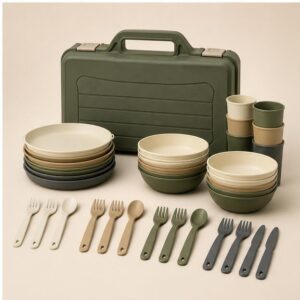
All visuals are concept images. They do not represent a verified production SKU, factory sample, customer order or performance result.
PRODUCT PARAMETER
| Product type | Modular four-person camping dinnerware set development concept |
|---|---|
| Reference components | Four trays, four plates, four bowls, four cups, four knife-fork-spoon groups, square central module, compression strap and canvas sleeve; final BOM to be confirmed |
| Material / finish | To be confirmed for the project after intended use, cleaning and target-market review |
| Dimensions / packed mass | To be confirmed for the project from approved drawings and packed configuration |
| Color / decoration | Artwork, color tolerance, decoration process and evidence scope require sample approval |
| Compatibility | Compatibility to be confirmed by project sample and drawing. |
| MOQ / price / lead time | To be confirmed for the project |
| Packaging | To be confirmed after channel, protection, instructions and transit-risk review |
REFERENCE CONFIGURATIONS
The reference arrangement is an RFQ discussion tool, not a fixed catalogue specification. The buyer should define component counts, dimensional envelopes, food and drink uses, target markets, replacement logic, branding and pack-out route.
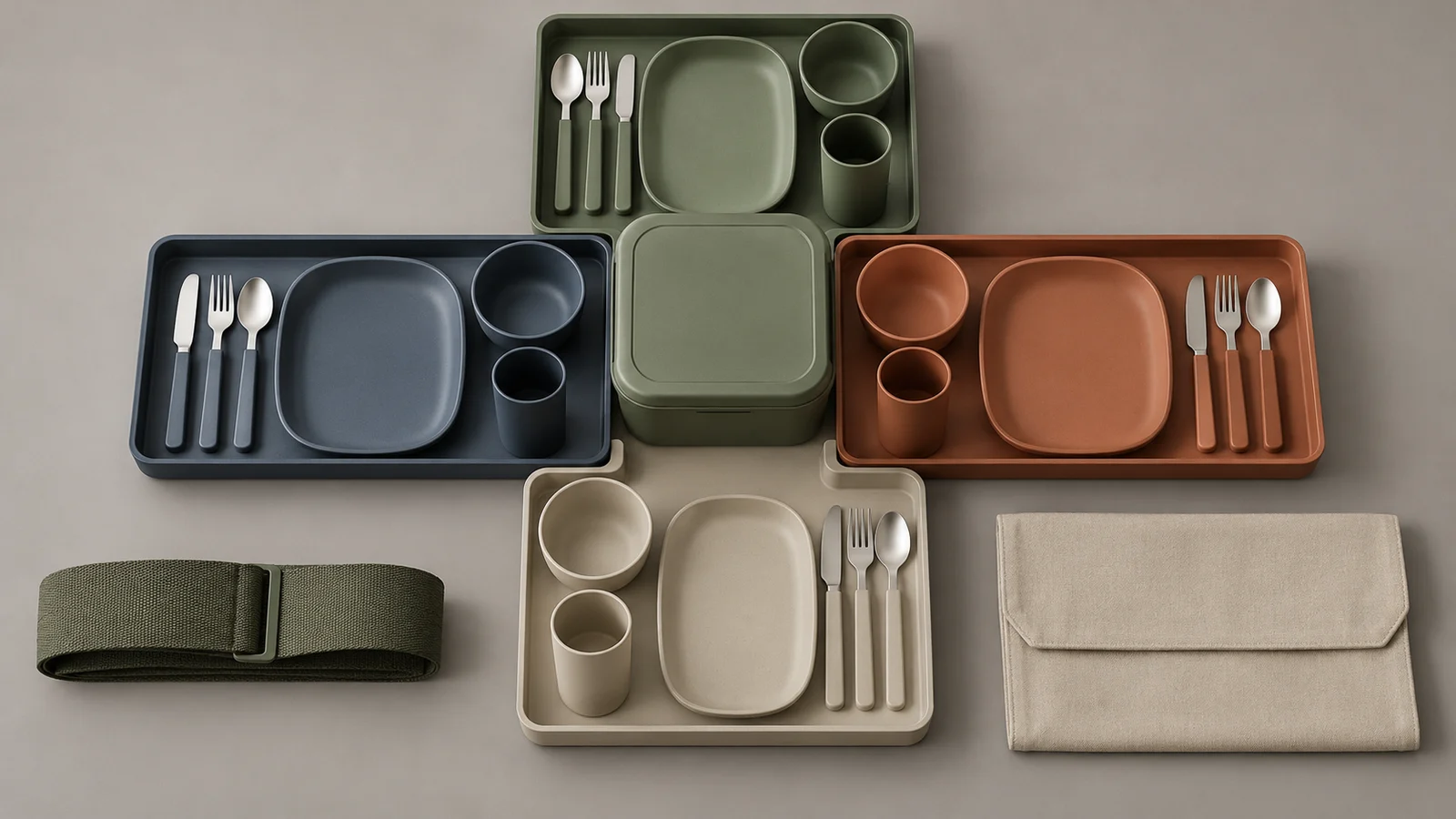
| Route | Reference grouping | Buyer decisions |
|---|---|---|
| Essential set | Four trays with plates, bowls, cups and cutlery | Counts, dimensions, use conditions and tray layout. |
| Food-container route | Essential set plus square central lunch-box module | Lid fit, sealing expectation, cleaning and food-contact scope. |
| Service-tray route | Each tray remains a personal place-setting zone | Edge height, drainage, carrying use and utensil retention. |
| Retail/channel route | Compressed stack, sleeve, protective insert and outer pack | Barcode, labels, transit method and disposal information. |
Orthogonal tray interfaces
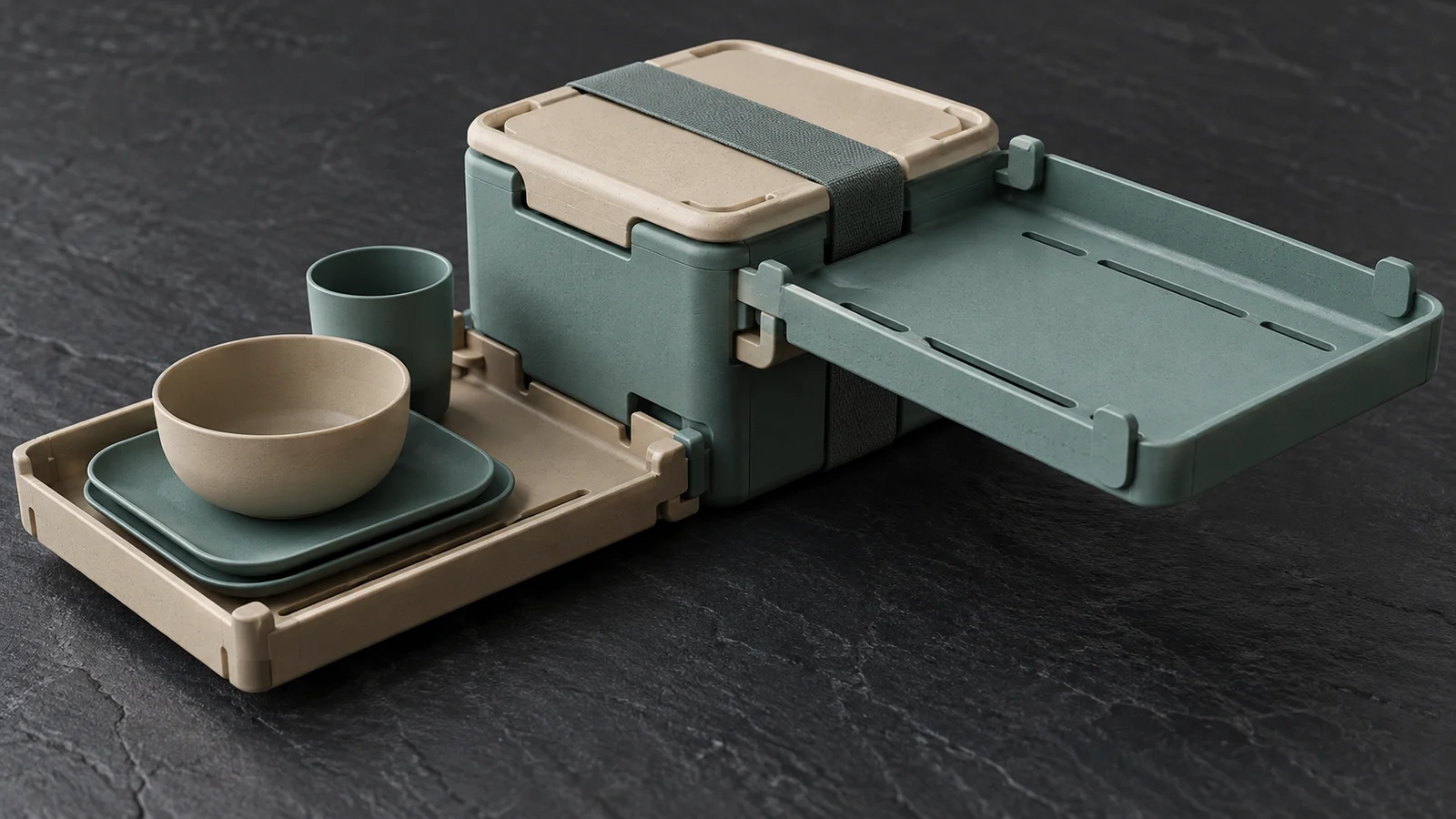
The defining difference is the cross-layer pack sequence. The trays are flat rectangular modules, not L-shaped corner caddies. Two lower trays support two upper trays at right angles. Rounded ledges and stop features must control the overlap without forcing the center. The strap compresses the stack vertically; the sleeve supports carrying and surface protection.
Structure questions
- Do tray ledges seat without distorting the square center?
- Can the upper trays be removed without dislodging the lower pair?
- Are rims, handles and cutlery separated from hard stop features?
- Does the strap remain clear of food-contact surfaces?
- Can one tray be replaced while retaining controlled interface tolerances?
Procurement brief to send
Provide the target BOM, component drawings or samples, food-use conditions, target markets, annual demand estimate, artwork, packaging channel and required evidence. Use the BOM revision guide, fit sampling plan and carry-case inspection guide to structure approvals.
Development control
Freeze tray outlines, overlap ledges, center-module envelope and strap path before representative fit review. A change to plate rim, tray wall, cup height, divider thickness or closure route can alter the complete pack even when the selling name is unchanged.
| Gate | Evidence | Decision |
|---|---|---|
| Brief | BOM, use conditions, dimensional envelope and channel | Approve feasibility review. |
| Drawing | Tray levels, ledges, gaps, center clearances and artwork zones | Authorize prototype or revise. |
| Sample | Traceable trays, components, stack sequence, balance and access | Accept, rework or hold. |
| Evidence | Material/food-contact scope, cleaning and packaging checks | Close market-specific gaps. |
| Golden sample | Signed BOM, drawings, color, pack-out and comparator sample | Freeze the approved state. |
Evidence limits for food-use selection
The concept visuals do not establish any material, certification or performance claim. Selection depends on food type, temperature, contact duration, cleaning and target market. Primary references include the US FDA conditions-of-use framework, the European Commission food-contact materials overview and the ISTA procedure directory for distribution planning.
No biodegradable, compostable, recycled-content, microwave, dishwasher, freezer, sealing, drop-resistance or load-capacity claim is made. Evidence remains To be confirmed for the project.
Customization and tooling review
Color families, surface finish, logo location, textile sleeve, strap hardware and retail packaging can be reviewed against buyer artwork and target requirements. New ledges, stops or tray geometry may require feasibility, tooling and intellectual-property review. Compatibility to be confirmed by project sample and drawing.
Packaging and outdoor application
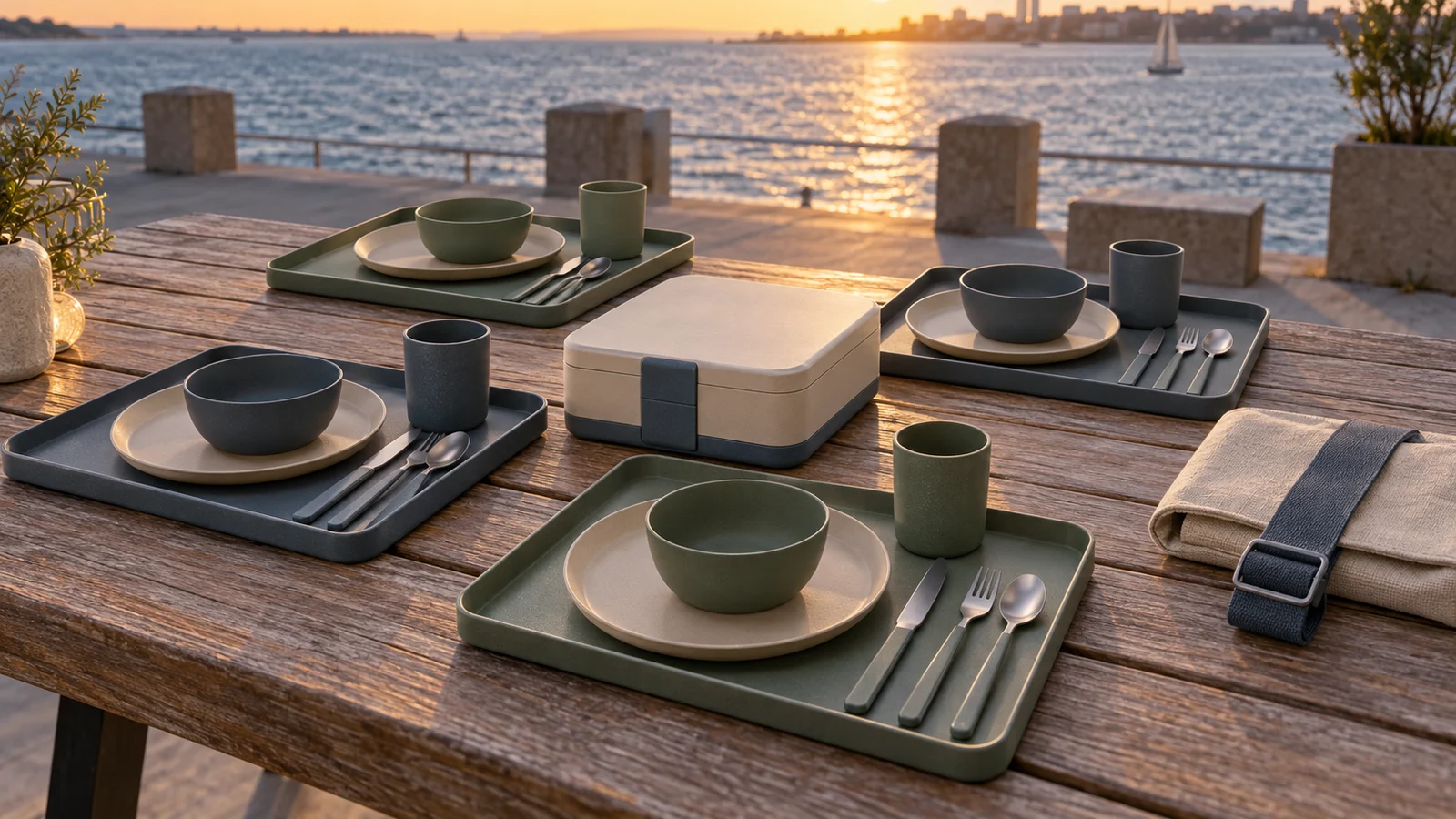
The compressed stack is not automatically the full transit package. Review surface separators, strap pressure, sleeve seams, instruction placement, labels and outer-carton controls for the selected channel. Record total packed mass, center of gravity and the tray removal sequence for each approved configuration.
Quality review points
- Lower/upper tray overlap and removal order
- Central-module clearances and lid access
- Plate, bowl and cup retention within each tray
- Strap path, sleeve fit and loaded balance
- Drainage gaps, cleanability and edge finish
- Decoration, component count and packaging traceability
Procurement FAQ
Is Cross-Layer an existing production SKU?
No. It is a buyer-development concept, not a factory sample or customer order.
Can one tray be supplied as a replacement?
That route can be evaluated, but interface tolerances, identification and replacement compatibility need controlled definitions.
Can existing dinnerware be loaded into the trays?
Possibly. Compatibility to be confirmed by project sample and drawing.
What materials and colors are available?
To be confirmed for the project after use conditions, target market, evidence and artwork are defined.
What are MOQ, price and delivery time?
To be confirmed for the project after configuration, material, decoration, packaging and development scope are known.
Does the reference set contain cookware?
No. The reference scope is dinnerware and an optional food-container module. Cookware requires separate heat and performance evidence.
Send your Cross-Layer brief
Share the target BOM, component drawings or samples, use conditions, markets, artwork, packaging route and approval evidence.
Last reviewed October 10, 2026 at 16:21:03 CST. Concept images do not represent a verified production SKU, factory, test or customer order.
RELATED SOURCING PATHS
Compare Products and Plan Your Project
Review related product formats, then compare material, set configuration, logo, packaging, testing scope and order quantity with our B2B team.