
Wheat Straw Tableware Quality Inspection Checklist for Buyers
When sourcing eco-friendly products, many buyers focus on price and design—but overlook a critical factor: quality consistency.
Understanding the common quality issues in wheat straw tableware can help importers, wholesalers, and brand owners avoid costly mistakes and ensure long-term customer satisfaction.
Common Quality Issues in Wheat Straw Tableware (Quick Overview)
Here are the most frequent problems buyers encounter:
- Cracking or brittleness
- Uneven surface finish
- Odor issues
- Poor heat resistance
- Color inconsistency
- Low durability
- Non-compliance with certifications
👉 Let’s break them down one by one.
1. Cracking and Brittleness
Low-quality wheat straw tableware may crack easily under pressure.
Causes:
- Poor material ratio (too much filler, low PP content)
- Weak molding process
👉 This is one of the most common quality issues in wheat straw tableware affecting durability.
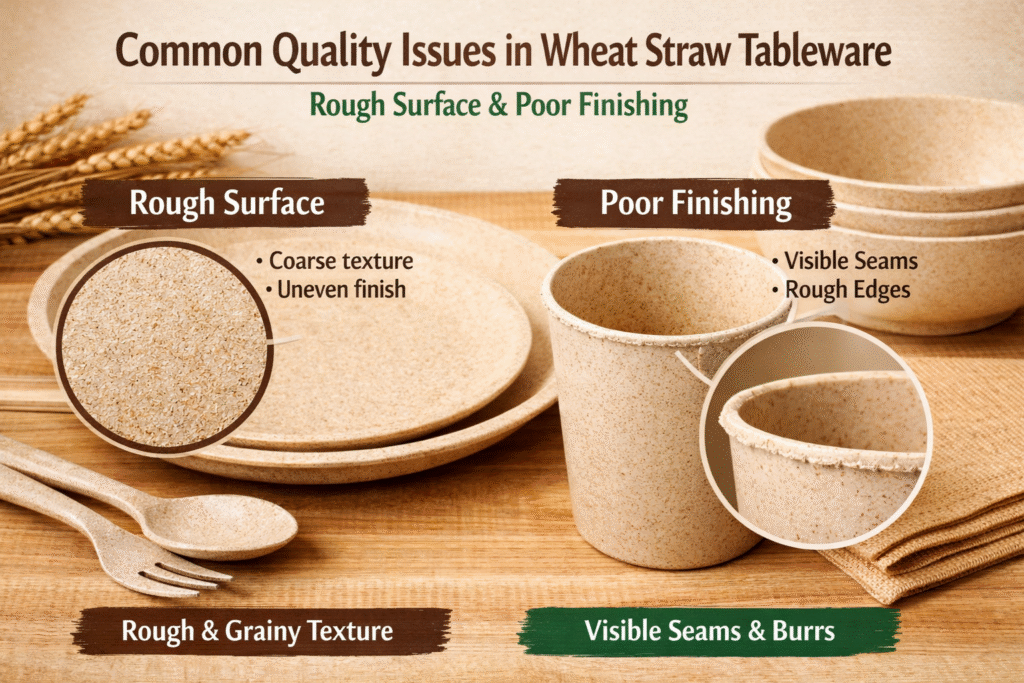
2. Uneven Surface and Rough Edges
Some products feel rough or look unfinished.
Causes:
- Low-quality molds
- Inadequate polishing
👉 This impacts both user experience and brand perception.
3. Odor Problems
Inferior products may have a noticeable plastic or chemical smell.
Causes:
- Low-grade materials
- Poor production control
👉 High-quality wheat straw tableware should be odor-free.
4. Poor Heat Resistance
Some products deform when exposed to heat.
Causes:
- Incorrect material composition
- Low heat tolerance
👉 Always verify temperature resistance range before bulk purchasing.
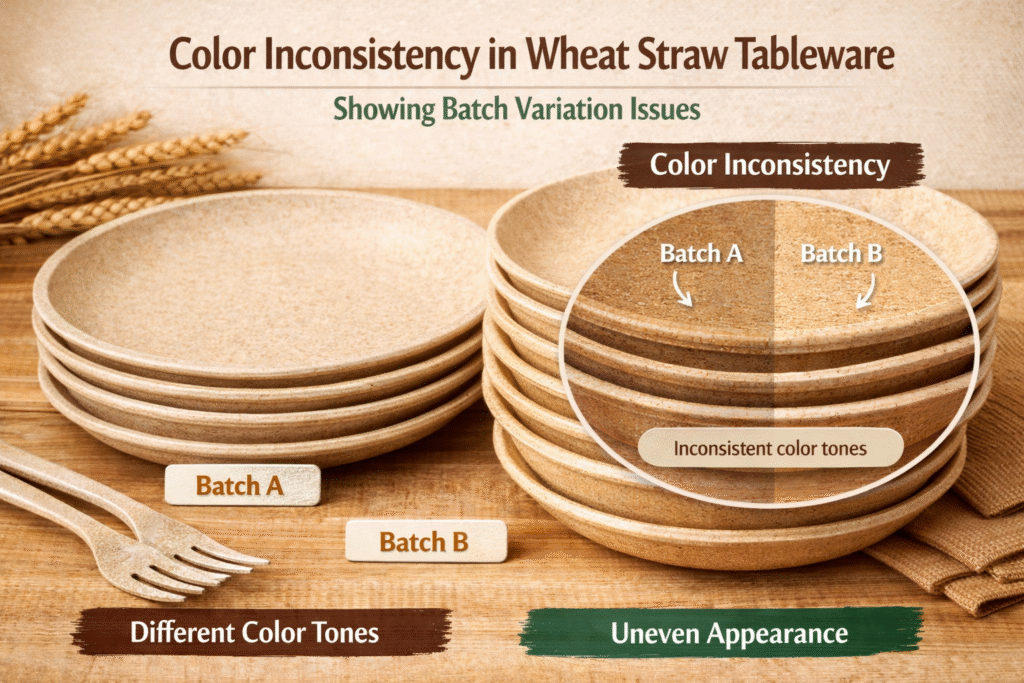
5. Color Inconsistency
Color variation between batches is a common issue.
Causes:
- Unstable raw materials
- Poor color mixing process
👉 This can affect brand consistency for OEM orders.
6. Low Durability and Easy Deformation
Products may warp or lose shape over time.
Causes:
- Thin structure design
- Weak material strength
👉 This is a major concern for long-term use.
7. Lack of Certification Compliance
Some suppliers cannot provide valid certifications.
Risks:
- Customs clearance issues
- Legal problems
- Loss of buyer trust
👉 Always check FDA and LFGB certification before ordering.
How to Avoid These Quality Issues
✔ Choose a Reliable Manufacturer
- Experienced factory
- Stable production system
✔ Request Samples Before Bulk Orders
- Test durability
- Check finishing quality
✔ Verify Certifications
- FDA / LFGB
- Third-party testing reports
🔗 Recommended Solution for Buyers
Looking for high-quality wheat straw tableware?
We provide:
- Strict quality control
- FDA & LFGB certified products
- OEM & ODM customization
- Stable bulk production
👉 Contact us today for samples and quotations.
Final Thoughts
Understanding the common quality issues in wheat straw tableware is essential for making smart sourcing decisions.
👉 By choosing the right supplier and verifying product quality, you can avoid risks and build a strong, reliable product line.
FAQ
1. What is the most common issue?
Cracking and low durability are the most common.
2. How to check product quality?
Request samples and test performance.
3. Are all products certified?
No, always verify certifications.
Discuss Your Project
Tell us about your project.

Rental-Fleet Sets: How Many Spares Should Be Held?
Calculate rental camping dinnerware spare parts with buyer-entered loss, damage, deployment, review-cycle, buffer, stock and pack-multiple inputs.

Plan Replacement Pieces for a Portable Dinnerware Line
Plan replacement pieces for a portable dinnerware line with a service matrix that controls demand, compatibility, evidence, packaging and revision risk.
Which Camping Dinnerware Add-Ons Belong in the Base Set?
Use a buyer-side decision table to keep essential camping dinnerware functions in the base set and move optional, channel-specific or unverified add-ons into separate bundles.

Build Good–Better–Best Camping Set Tiers by Function
Build good, better and best camping dinnerware tiers from functional upgrades buyers can verify, rather than cosmetic changes or unsupported claims.

What Makes a Camping Tableware RFQ Quotable?
Use a complete camping tableware RFQ checklist covering controlled components, use conditions, decoration, packaging, commercial terms, evidence and approval fields.

Calculate Landed Cost Without Hiding Replacement Parts
Use a buyer-entered landed-cost model that keeps replacement parts, freight, duty, fees and channel costs visible instead of hiding them in the base set.
What to Record Before Approving a Production Lot
This page is focused on incoming and pre-shipment inspection rather than general troubleshooting. Build the checklist from the approved SKU, destination, intended use and purchase specification.