Description
FOUR-LUNCHBOX CARRY-CRATE DEVELOPMENT REVIEW
B2B DOCK, CARRY AND DISTRIBUTE CONCEPT
Four-Lunchbox Carry-Crate Camping Dinnerware Set
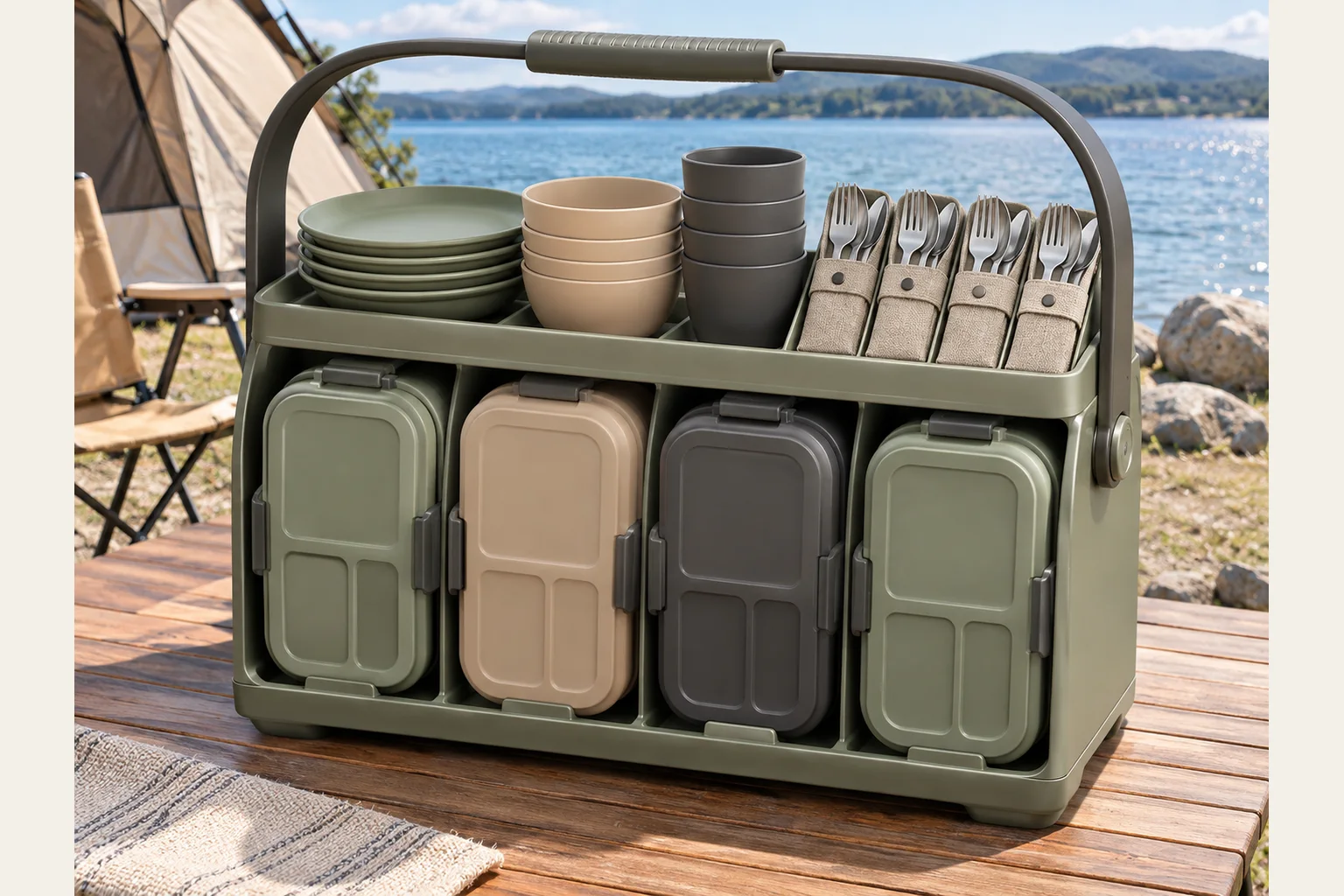
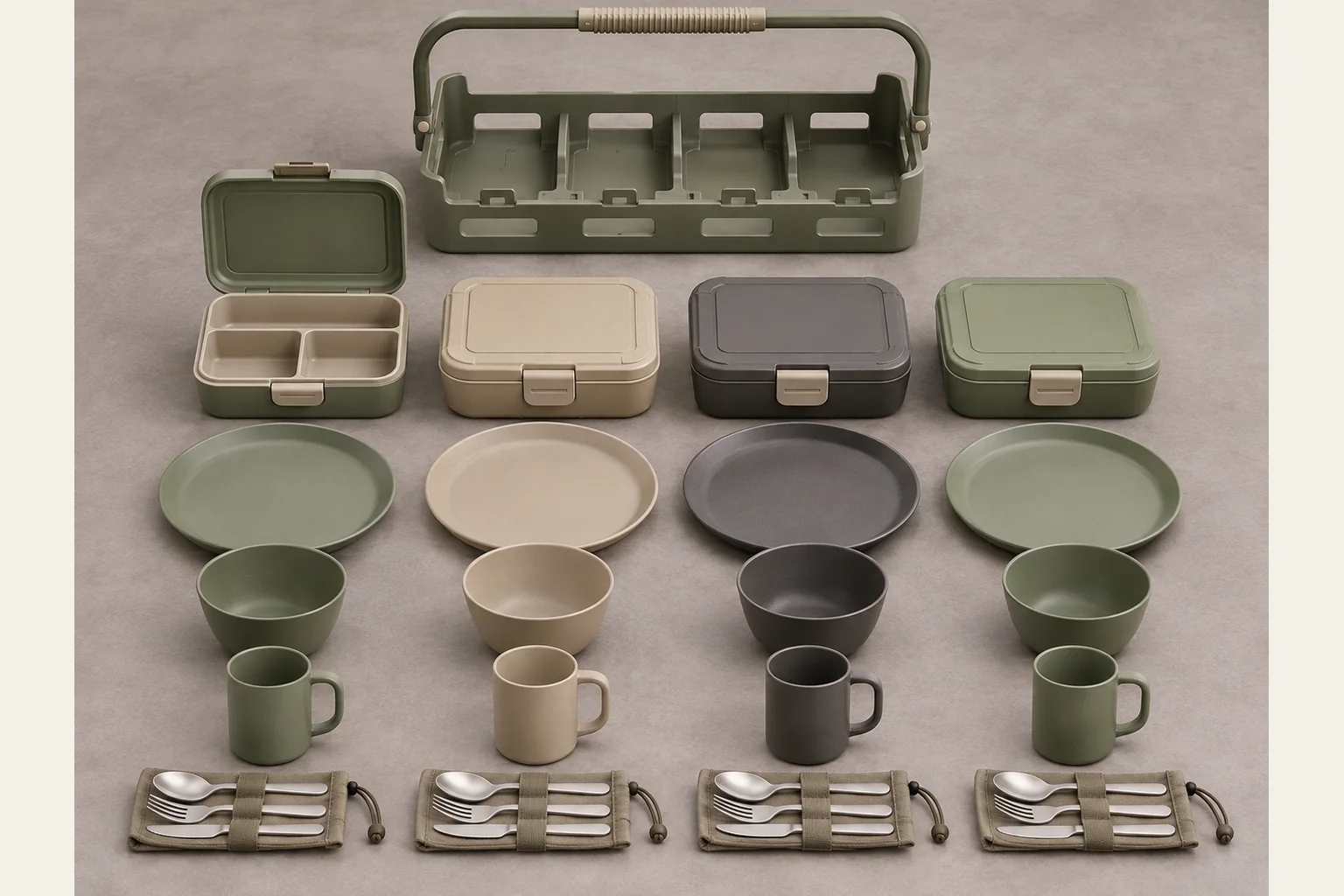
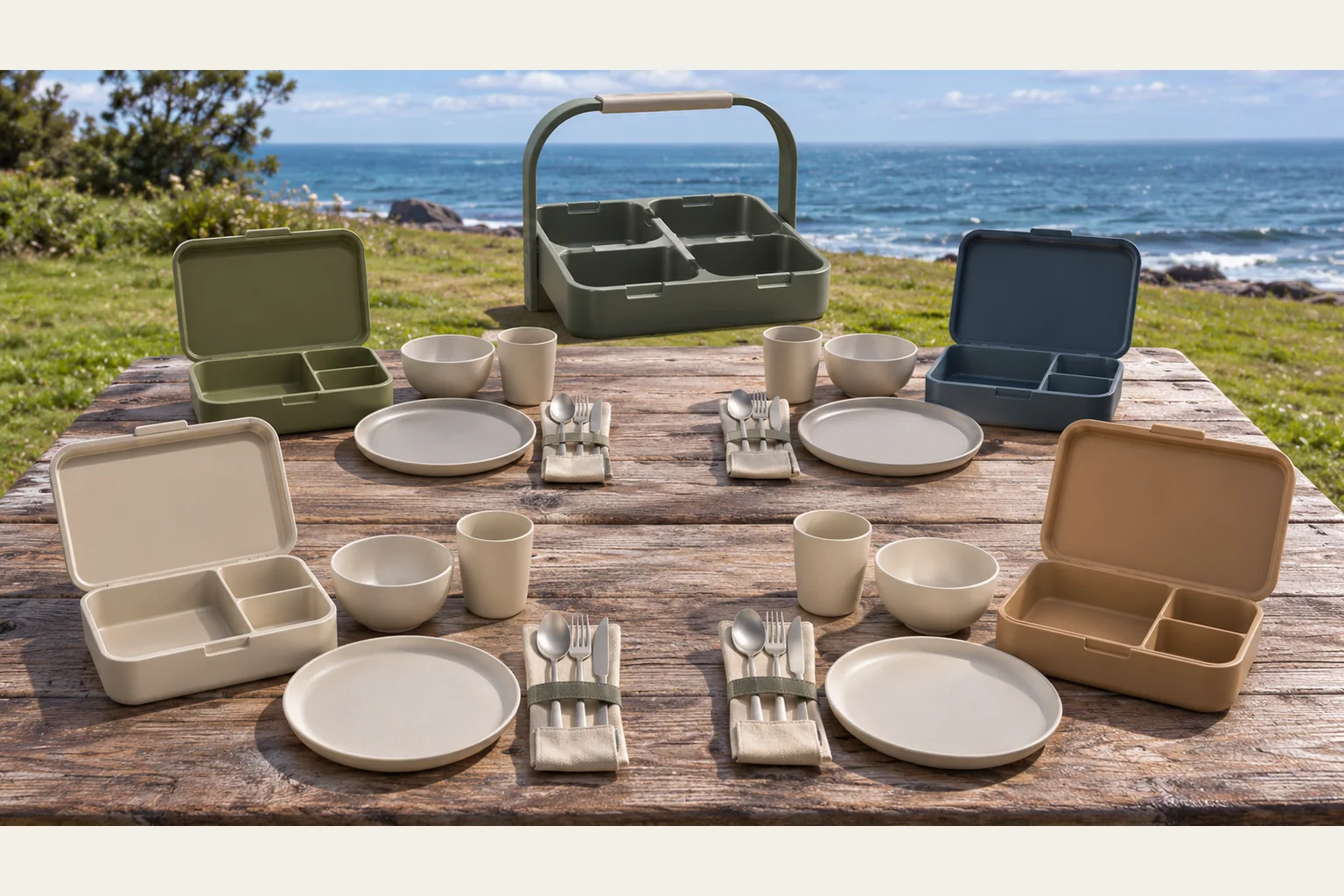
This carry-crate camping dinnerware set organizes four removable divided lunch boxes in separate docking lanes beneath a shared place-setting tray. The boxes distribute directly to four users while plates, bowls, cups and cutlery remain visible for count control. Final dimensions, materials, fit, closures, loads, food-contact evidence, MOQ and lead time require project confirmation.
- Concept users
- Four people
- Core architecture
- Open carry frame with four removable lunch-box docks
- Reference configuration
- 4 plates, 4 bowls, 4 cups, 4 cutlery bundles and 4 divided lunch boxes
- Project dimensions
- To be confirmed for the project
- Materials
- To be confirmed for the project
- Compatibility
- Compatibility to be confirmed by project sample and drawing.
PRODUCT PARAMETER
Carry-Crate Camping Dinnerware Set Specification Record
The values below separate the illustrated reference configuration from fields that require buyer-approved drawings, samples and evidence. No price information is displayed.
| Field | Current project value | Approval evidence required |
|---|---|---|
| Product architecture | Open carry frame, four vertical docking lanes and shared top tray; concept only | Released frame, dock, tray, handle and component drawings |
| User / component count | Four conceptual place settings and four divided lunch boxes | Signed component BOM with codes, quantities and substitution rules |
| Overall crate dimensions | To be confirmed for the project | Drawing with loaded/unloaded envelope, units and tolerances |
| Lunch-box outer dimensions | To be confirmed for the project | Box and lid drawing with compartment and latch geometry |
| Plate, bowl, cup and utensil dimensions | To be confirmed for the project | Individual drawings and top-tray fit review |
| Docking clearance and retention | Compatibility to be confirmed by project sample and drawing. | Matched box/crate drawings, tolerance stack and sample fit record |
| Handle, frame, tray and dinnerware materials | To be confirmed for the project | Component-level material, colorant, coating and destination evidence |
| Lunch-box seal or leak claim | No claim | Released closure design and buyer-approved method if required |
| Loaded carry and drop limits | To be confirmed for the project | Buyer-approved conditions, limits and results on released samples |
| Color, logo and packaging | To be confirmed for the project | Artwork, color standard, marking and pack-out approval |
| MOQ and lead time | To be confirmed for the project | Project quotation after design and evidence scope review |
REFERENCE CONFIGURATIONS
Configure the Carry-Crate by User and Packing Function
This architecture is centered on four independently removable lunch boxes, not the under-seat organizer used by the folding-stool carrier set, the wall-like access of the hanging organizer, or the drying function of the fold-out rack set. Compare the wider camping dinnerware program before freezing the BOM.
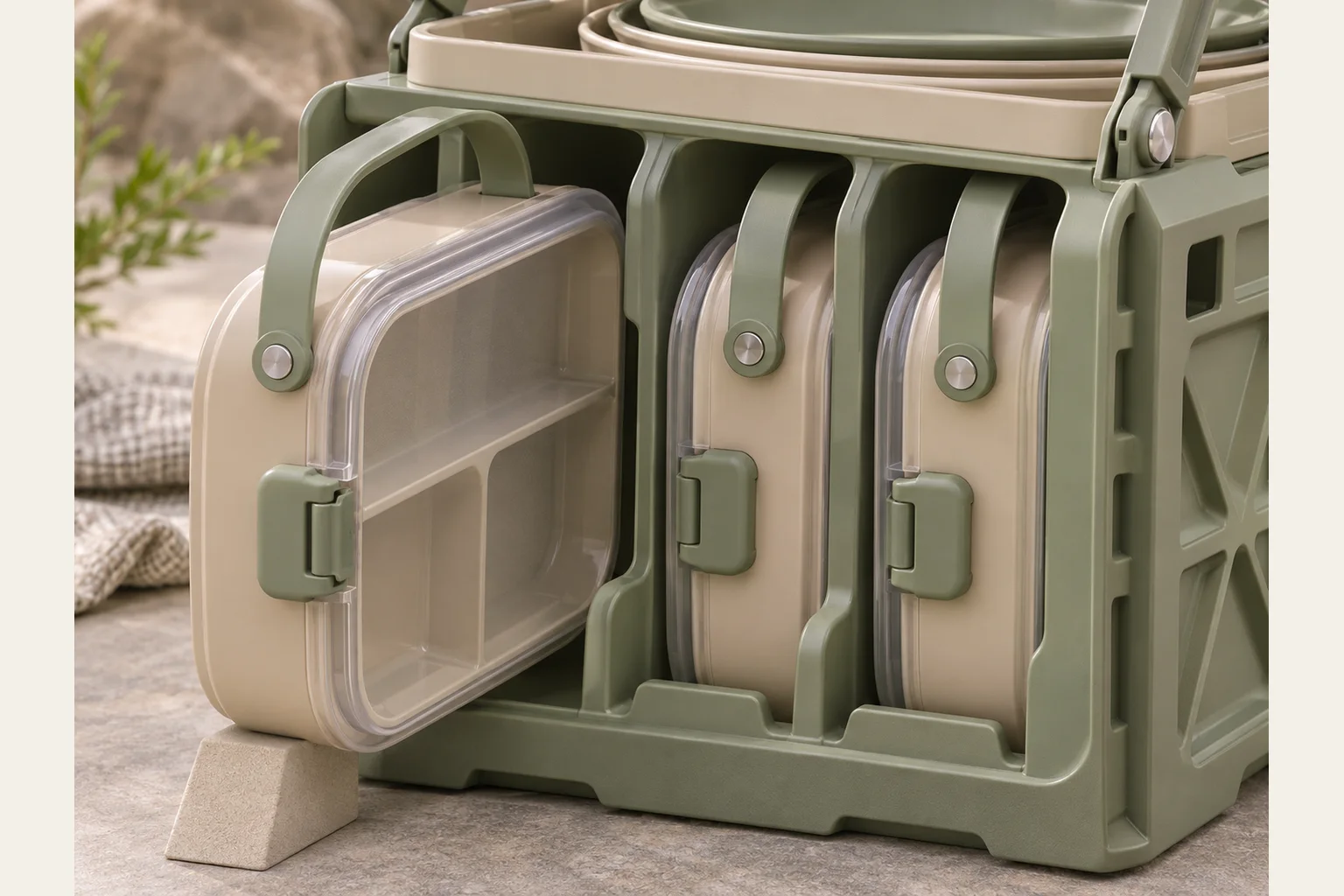
Four docking lanes
Each lane receives one lunch box. Divider thickness, entry clearance, retention and missing-box visibility require tolerance review.
Shared top tray
Plates, bowls, cups and utensil bundles remain grouped above the boxes. Tray stiffness, edge clearance and count visibility remain project controlled.
Removable lunch boxes
Each user receives one divided box. Lid, hinge, latch, compartment and intended-use requirements need separate approval.
Carry frame and handle
The open frame keeps modules visible. Handle geometry, balance, loaded deflection, pinch zones and retention require a released sample.
DEVELOPMENT CONTROL
Release the Carry-Crate Architecture in Four Steps
- 01
Freeze the component bill
Assign codes and revisions to crate, handle, pivot, top tray, dock dividers, four lunch boxes, lids, latches and every dinnerware component.
- 02
Control the envelopes
Approve overall, lunch-box, docking-lane, top-tray and carton dimensions with tolerances and matched revisions.
- 03
Review distribution and return
Check removal, place-setting distribution, used-item return, balance and visibility on a complete matched sample.
- 04
Release one evidence package
Connect exact materials, intended use, food-contact scope, carry limits, cleaning, artwork, packaging and inspection fields to the same revision.
MATERIAL AND COMPLIANCE BOUNDARY
Approve Carrier and Food-Contact Components Separately
The crate and handle require their own structural material, colorant, pivot, retention, loaded-carry, edge, cleaning and warning review. Plates, bowls, cups, utensils and lunch boxes require exact component-level material, colorant, intended-food, temperature, contact-duration and use-condition evidence.
For a United States project, applicable plastic food-contact use conditions should be reviewed against 21 CFR 177.1520 where relevant. An EU destination brief should be checked against Regulation (EC) No 1935/2004. The GS1 General Specifications may inform identification fields if the buyer selects that system. No food-safety certification, leakproof, airtight, dishwasher, microwave, freezer, impact, drop or service-life performance is claimed.
PROCUREMENT FAQ
Questions About the Carry-Crate Camping Dinnerware Set
Are the illustrated dimensions final?
No. Crate, lunch-box, tray, component and carton dimensions are To be confirmed for the project.
Will every lunch box fit the dock securely?
Compatibility to be confirmed by project sample and drawing. Lane clearance, divider stiffness, box tolerances and retention require matched-revision approval.
Are the lunch boxes leakproof or airtight?
No such claim is made. A closure claim would require a released lid/latch design, defined conditions and buyer-approved evidence.
Can buyers customize colors, logo and packaging?
These are project variables. Color system, artwork method, marking position, pack-out, MOQ and lead time are To be confirmed for the project.
Is the pictured product a standard SKU?
No. It is an AI-generated development concept. Tooling route, construction, dimensions, materials, capability and performance remain unverified.
Is this cookware?
No. It is dinnerware, flatware, lunch boxes and a carrier. No stove, flame, boiling or direct-heat claim is made.
CONTROL BOX FIT, COMPONENT COUNT AND CARRY BOUNDARIES BEFORE QUOTATION
Request a Four-Lunchbox Carry-Crate Set Review
Send the user count, component bill, target crate and box envelopes, intended food-contact conditions, closure expectations, carry boundaries, colors, artwork, packaging and destination evidence scope. Naike Dinner will separate approved project inputs from fields that remain To be confirmed for the project.
RELATED SOURCING PATHS
Compare Products and Plan Your Project
Review related product formats, then compare material, set configuration, logo, packaging, testing scope and order quantity with our B2B team.