Description
TWIN-SLIDE RAIL DECK CAMPING DINNERWARE SET REVIEW
B2B OPPOSED SLIDE-TRAY DEVELOPMENT CONCEPT
Twin-Slide Rail Deck Camping Dinnerware Set
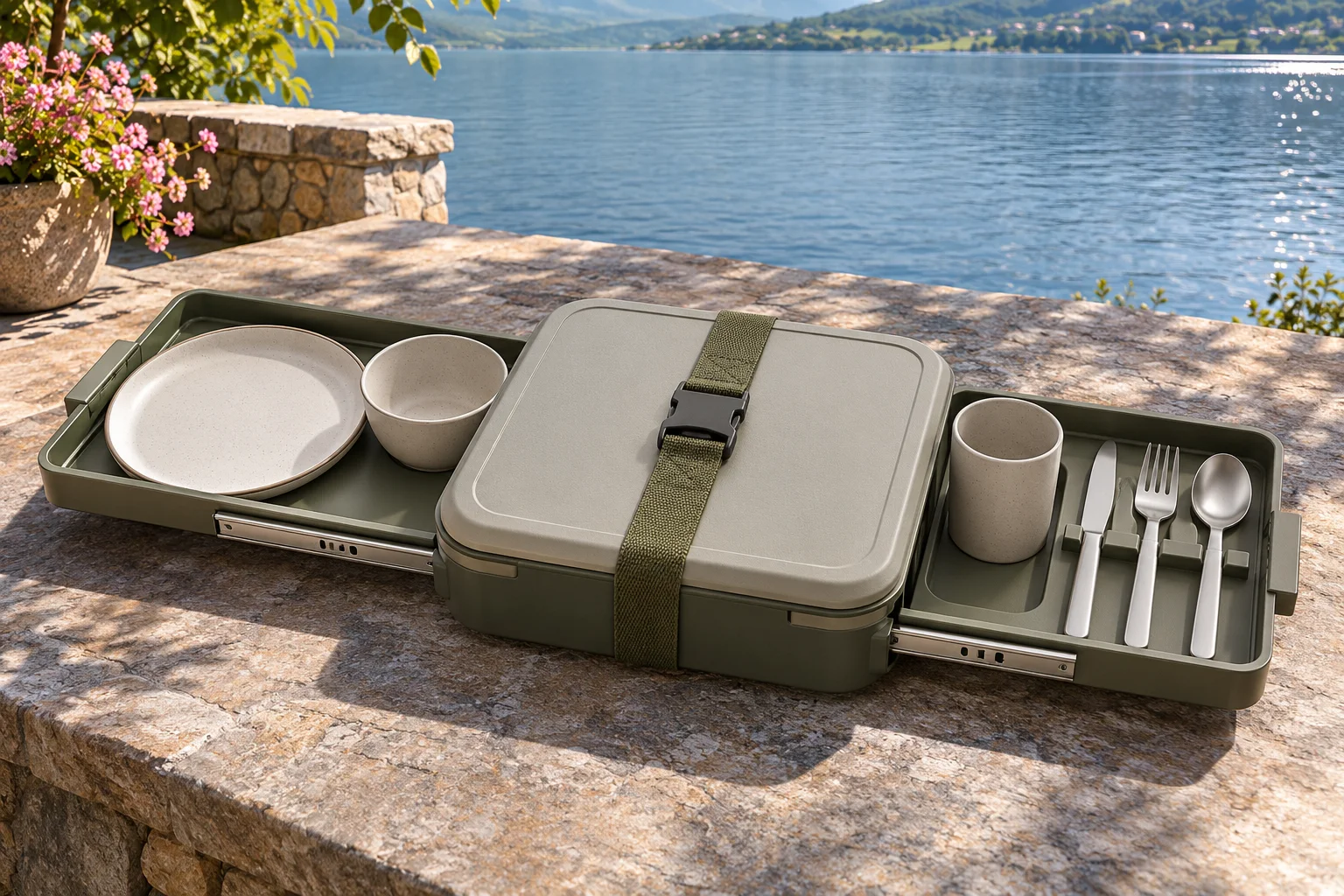
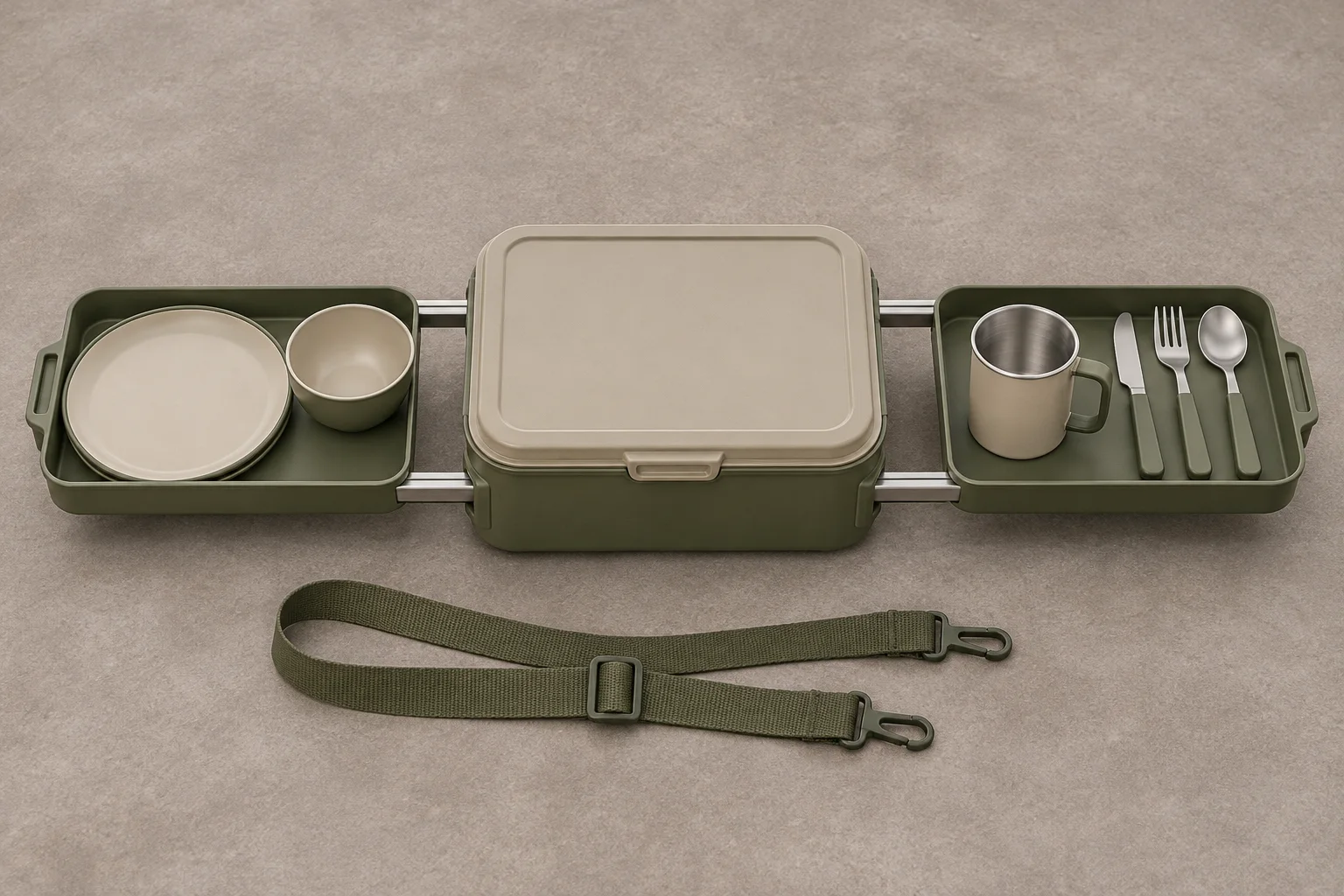
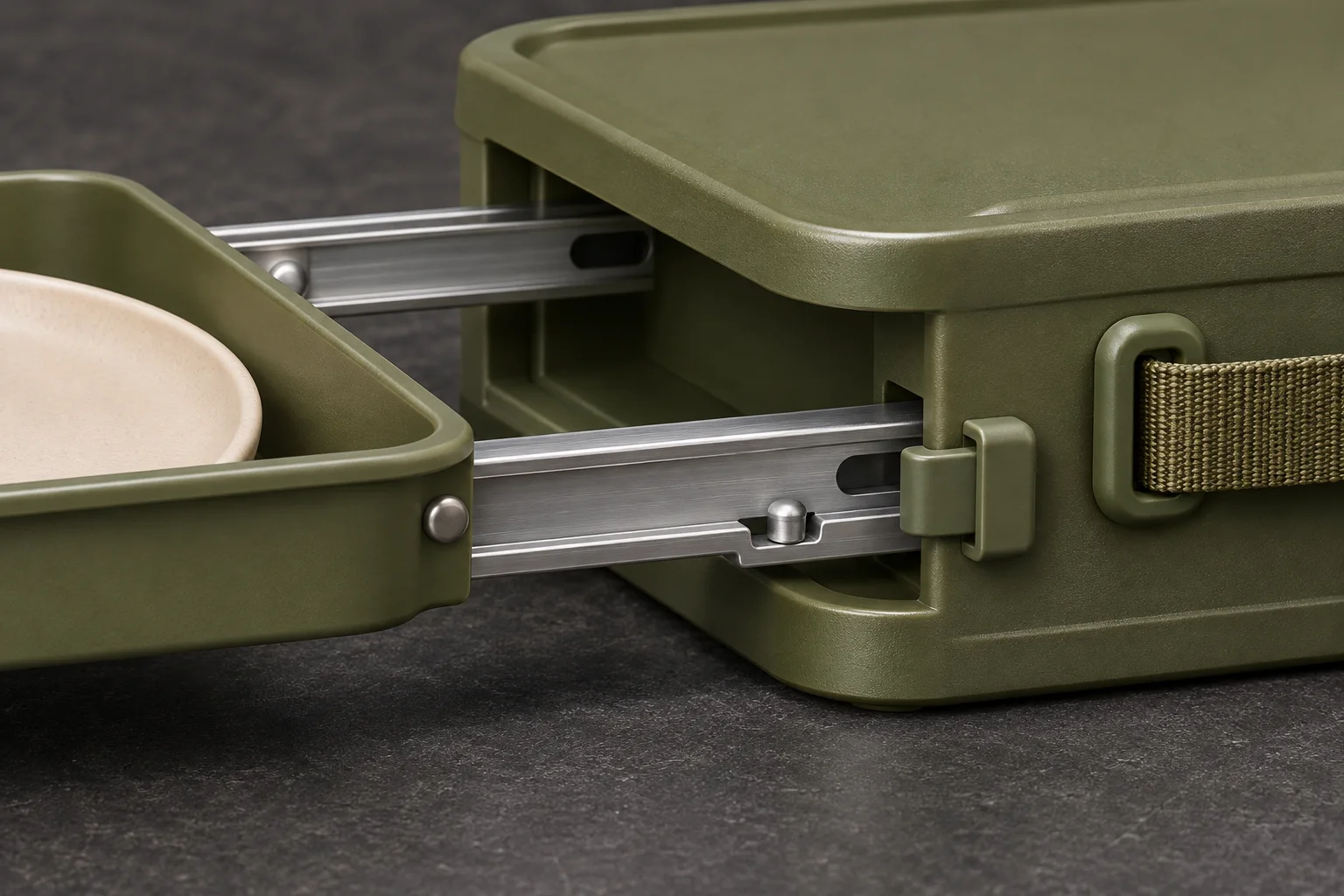
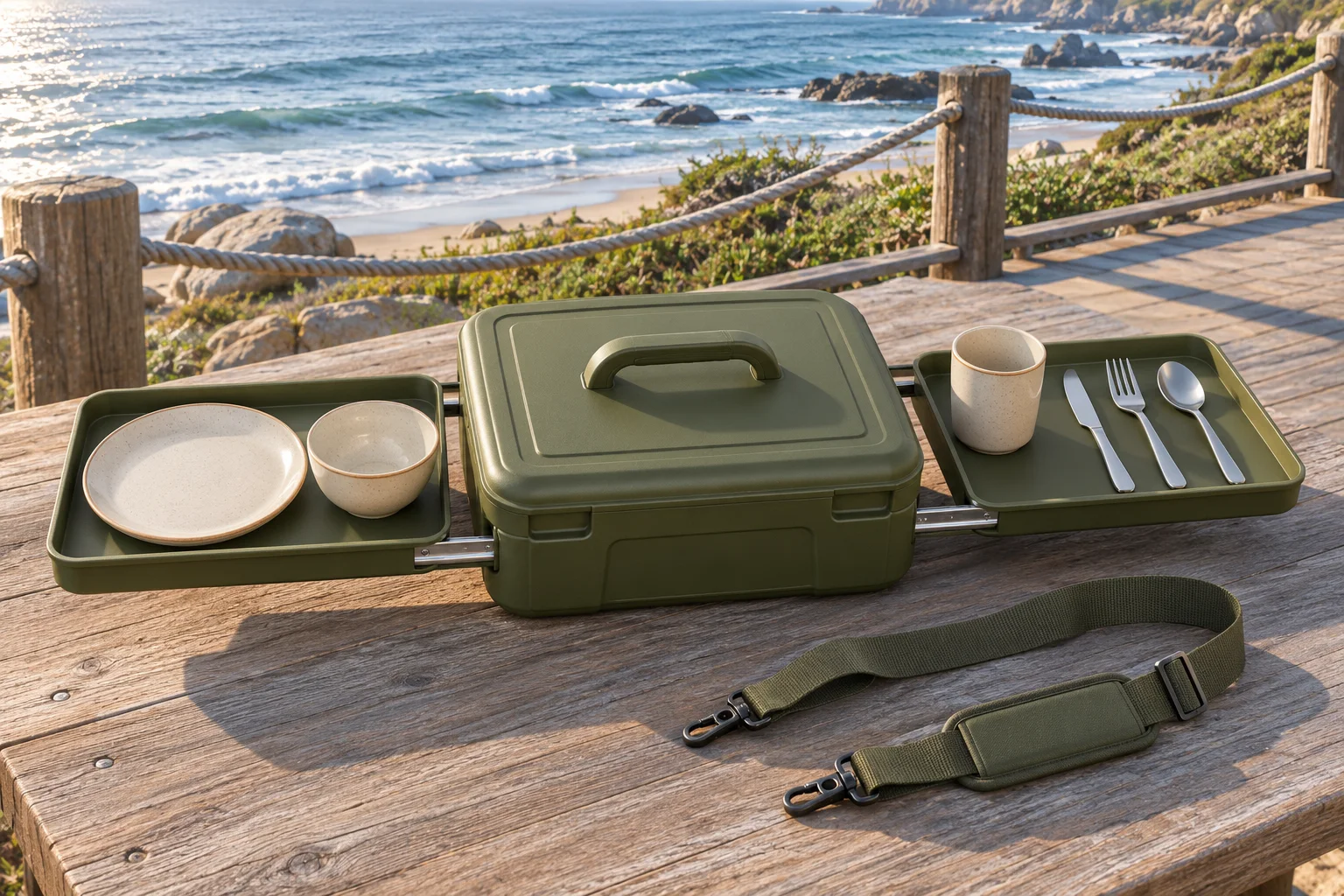
This twin slide rail deck dinnerware set concept places one shallow component tray on each side of a central lidded lunch-box base. Both trays travel horizontally on parallel rails and close against the central body for carrying. It is a development direction, not an existing SKU.
- Reference user
- One person, To be confirmed for the project
- Architecture
- Central lunch-box base with two opposed rigid sliding trays
- Reference content
- Plate, bowl, cup, knife, fork, spoon and lunch box
- Dimensions
- To be confirmed for the project
- Materials
- To be confirmed for the project
- Compatibility
- Compatibility to be confirmed by project sample and drawing.
PRODUCT PARAMETER
Twin Slide Rail Deck Dinnerware Set Specification Record
| Set architecture | One central lidded base plus two opposed sliding component trays |
|---|---|
| Left tray reference | Plate and bowl; final retention To be confirmed for the project |
| Right tray reference | Cup, knife, fork and spoon; final retention To be confirmed for the project |
| Rail system | Parallel guides, positive stop and removable/end-catch concept; To be confirmed for the project |
| Carry system | Detachable strap and closed-tray retention; To be confirmed for the project |
| Dimensions / mass | To be confirmed for the project |
| Materials / colors | To be confirmed for the project |
| Logo / packaging / MOQ / lead time | To be confirmed for the project |
| Compatibility | Compatibility to be confirmed by project sample and drawing. |
REFERENCE CONFIGURATIONS
Slide Two Component Decks From One Central Lunch-Box Base
The three-part linear architecture differs materially from the hinged bridge case, dovetail spine and roll-up service mat. Compare the broader camping dinnerware program before freezing the BOM.
Central lidded base
The lunch-box body carries both rail interfaces and the strap anchors. Capacity, closure and food-contact scope remain project inputs.
Plate-and-bowl deck
One shallow rigid tray travels outward without folding. Rim clearance, nesting and release force require drawings and samples.
Cup-and-cutlery deck
The opposite tray separates a cup and three utensils. Slot geometry and rattle control require a component bill.
Closed carry state
Both trays retract against the center and need positive closed retention. The envelope and balance remain open design controls.
DEVELOPMENT CONTROL
Release the Twin-Slide Rail Deck in Six Controlled Steps
Use the twin slide rail deck dinnerware set release record to connect each buyer input to evidence before sampling, tooling discussion or quotation.
| Gate | Buyer input | Evidence before release |
|---|---|---|
| 1. Component freeze | Exact plate, bowl, cup, knife, fork, spoon and lunch-box drawings | Controlled BOM and physical component set |
| 2. Tray allocation | Left/right placement, nesting, access and cleaning needs | Scaled tray layout and clearance review |
| 3. Rail envelope | Open travel, closed envelope, support surface and load cases | Section drawing with tolerance stack |
| 4. Stop and retention | Open stop, closed catch, removal/service rule and misuse cases | Prototype observation; acceptance criteria agreed before any claim |
| 5. Carry integration | Strap points, balance, packed mass and carton orientation | Packed sample plus drawing review |
| 6. Project release | Materials, compliance plan, artwork and packaging | Approved sample, specification and quotation inputs |
BUYER INPUTS
What Should a Buyer Send Before a Meaningful Quotation?
A twin slide rail deck dinnerware set quotation needs component, use, mechanical and commercial inputs that can be checked against drawings and project samples.
Component file
Provide counts, drawings, rim profiles, target nesting and whether components are existing references or new development.
Use and cleaning
State food types, serving temperatures, cleaning method, frequency, field conditions and prohibited claims.
Mechanical brief
Define open/closed envelope, support surfaces, expected packed mass, rail travel, removal rule and acceptance priorities.
Commercial brief
Provide destination, colors, logo files, packaging, forecast and desired sampling sequence. MOQ and lead time remain project-confirmed.
MATERIAL AND COMPLIANCE BOUNDARY
Separate Food-Contact Components From Rail and Strap Hardware
Do not assign one material claim to the entire assembly. The plate, bowl, cup, utensils and lunch-box contact food; trays, rails, stops, catches and strap hardware may have different functions and evidence needs. Final resin grades, additives, colorants, metal parts, supplier declarations, migration/testing scope and destination rules are To be confirmed for the project.
Reference sources may include 21 CFR 177.1520, EU Regulation 1935/2004 and buyer-selected identification rules in the GS1 General Specifications. Applicability and compliance must be established for the actual formulation, component, use and destination.
PROCUREMENT FAQ
Questions About the Twin Slide Rail Deck Dinnerware Set
Are the slide rails proven for a stated cycle count?
No. Rail life and stop retention require project-specific drawings, samples, conditioning and agreed acceptance criteria.
Can the trays be removed for cleaning?
That is a project decision. A removable end catch may help serviceability but changes retention, loose-part and misuse risks.
Does the central base already fit a specific lunch box?
No compatibility is claimed. Compatibility to be confirmed by project sample and drawing.
Can the carrier be quoted from these images?
Only as a concept discussion. A meaningful quotation needs the component bill, dimensions, material scope, rail design, packaging and destination.
Is it suitable for hot food, dishwashers or microwaves?
No universal suitability is asserted. Intended use, temperatures, cleaning and appliance compatibility require verified materials and samples.
Can colors, logos and packaging be customized?
They can be evaluated after artwork, surface, color tolerance, packaging and volume inputs are provided. Capability and process remain project-confirmed.
CONTROL THE CENTRAL BASE, BOTH SLIDE DECKS, RAILS, STOPS AND CLOSED CARRY ENVELOPE BEFORE QUOTATION
Request a Twin-Slide Rail Deck Set Review
Send the component bill, tray allocation, target open and closed envelopes, support and load conditions, intended use, colors, logo and packaging.
RELATED SOURCING PATHS
Compare Products and Plan Your Project
Review related product formats, then compare material, set configuration, logo, packaging, testing scope and order quantity with our B2B team.