Description
PORTABLE SET DEVELOPMENT CONCEPT
Accordion-Pocket Four-Person Camping Dinnerware Set
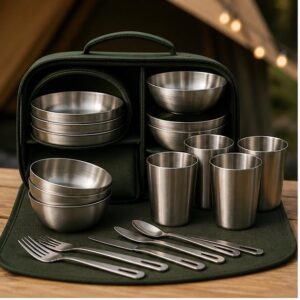
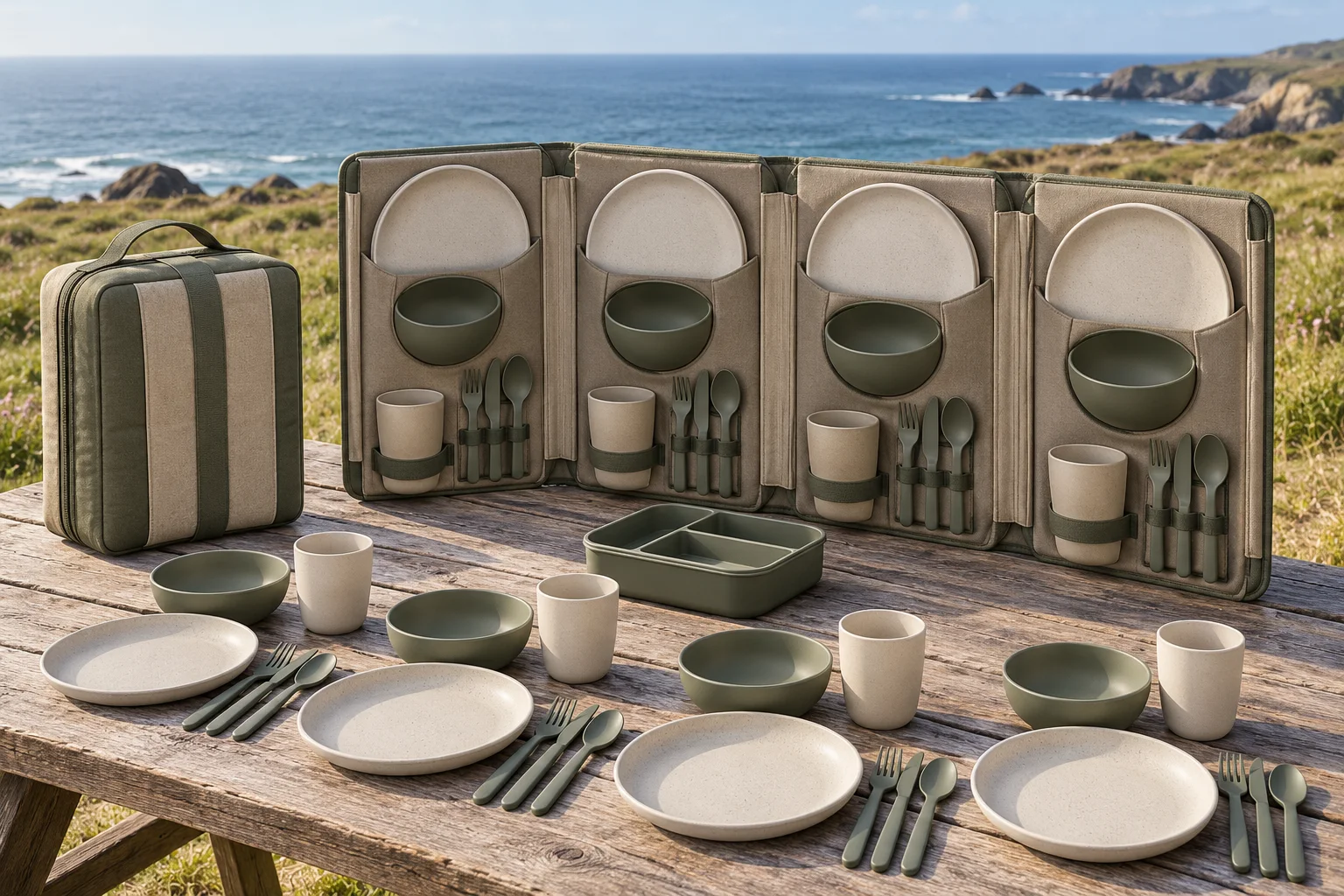
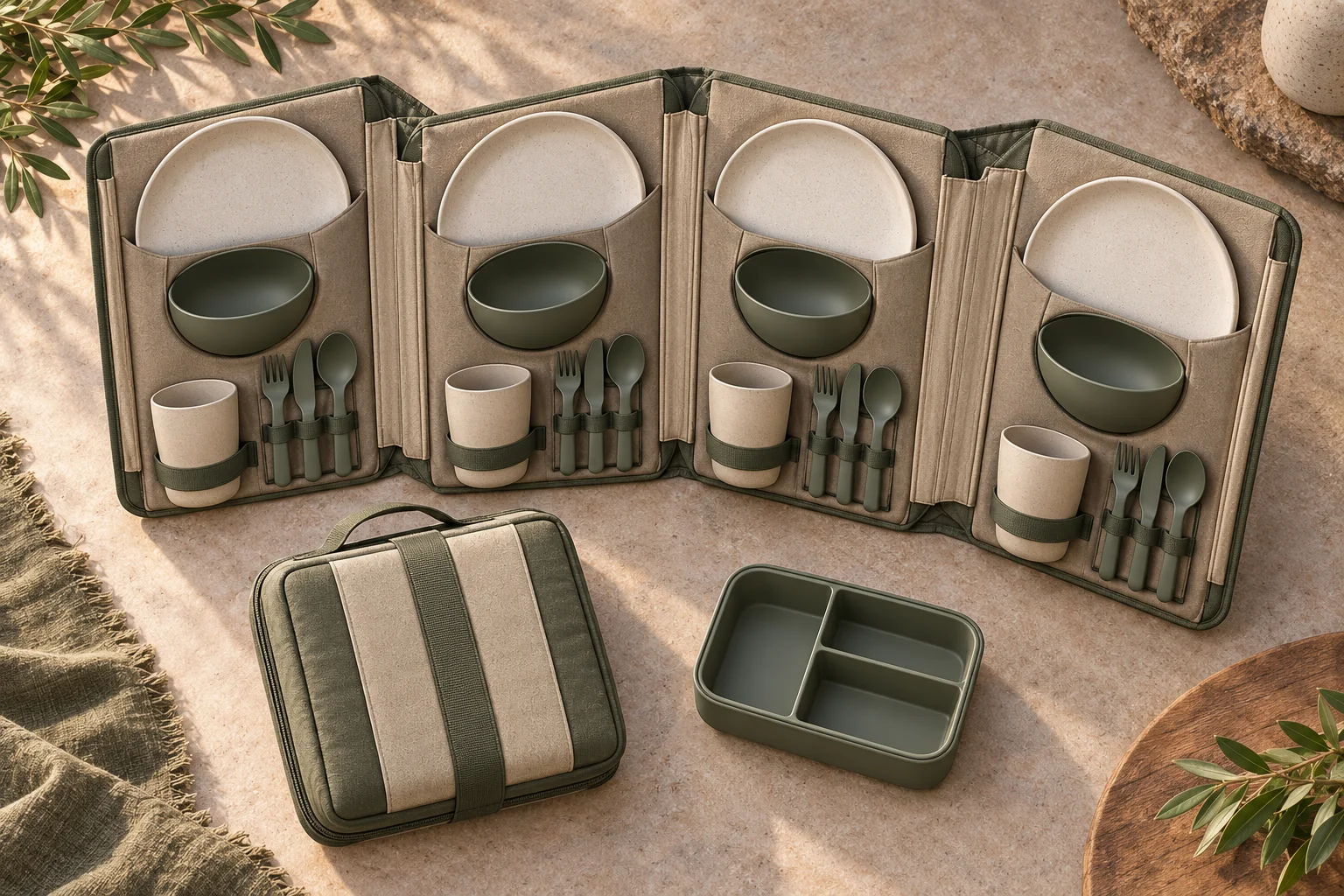
This camping dinnerware set concept uses four connected padded panels that fold into a compact carry case. Each panel holds one place setting in separate plate, bowl, cup and cutlery pockets, while a divided lunch box travels as a shared module. The images are concept visuals, not a verified production SKU.
- Four place-setting panels fold in a zigzag instead of stacking in a rigid rack
- Flexible gussets separate panels while keeping each user's components together
- Plate, bowl, cup, cutlery, lunch-box, case and packaging combinations can be evaluated
- Compatibility to be confirmed by project sample and drawing.
PRODUCT PARAMETER
The camping dinnerware set remains a concept until every project parameter below is confirmed against the approved brief and sample.
| Product concept | Four-person portable camping dinnerware set with connected accordion-fold pocket panels |
|---|---|
| Reference components | Four plates, four bowls, four handleless cups, four fork/spoon/knife sets, one divided lunch box, four padded panels and carry case |
| Material | To be confirmed for the project |
| Dimensions and weight | To be confirmed for the project |
| Color / finish / logo | To be confirmed against approved project samples and artwork |
| MOQ / price / lead time | To be confirmed for the project |
| Compatibility | Compatibility to be confirmed by project sample and drawing. |
| Packaging | To be confirmed for the project |
REFERENCE CONFIGURATIONS
Define the camping dinnerware set by component revision, user count and folded case envelope before pocket geometry is reviewed.
| Configuration | Reference combination | Review focus |
|---|---|---|
| Four place settings | Four panels, each with plate, bowl, cup and knife/fork/spoon set | Pocket fit, count visibility, access and repack sequence |
| Lunch module | Four panels plus one shared divided lunch box | Envelope, lid protection, closure and separation from utensils |
| Channel pack | Folded case, lunch module, instructions, protective pack and carton | Compression, scuff contact, carton cube and unpacking |
These are development references, not fixed commercial specifications. Final counts, materials, finishes, pocket construction, packaging and compliance scope depend on the approved brief.
ACCORDION-POCKET CAMPING DINNERWARE SET ARCHITECTURE
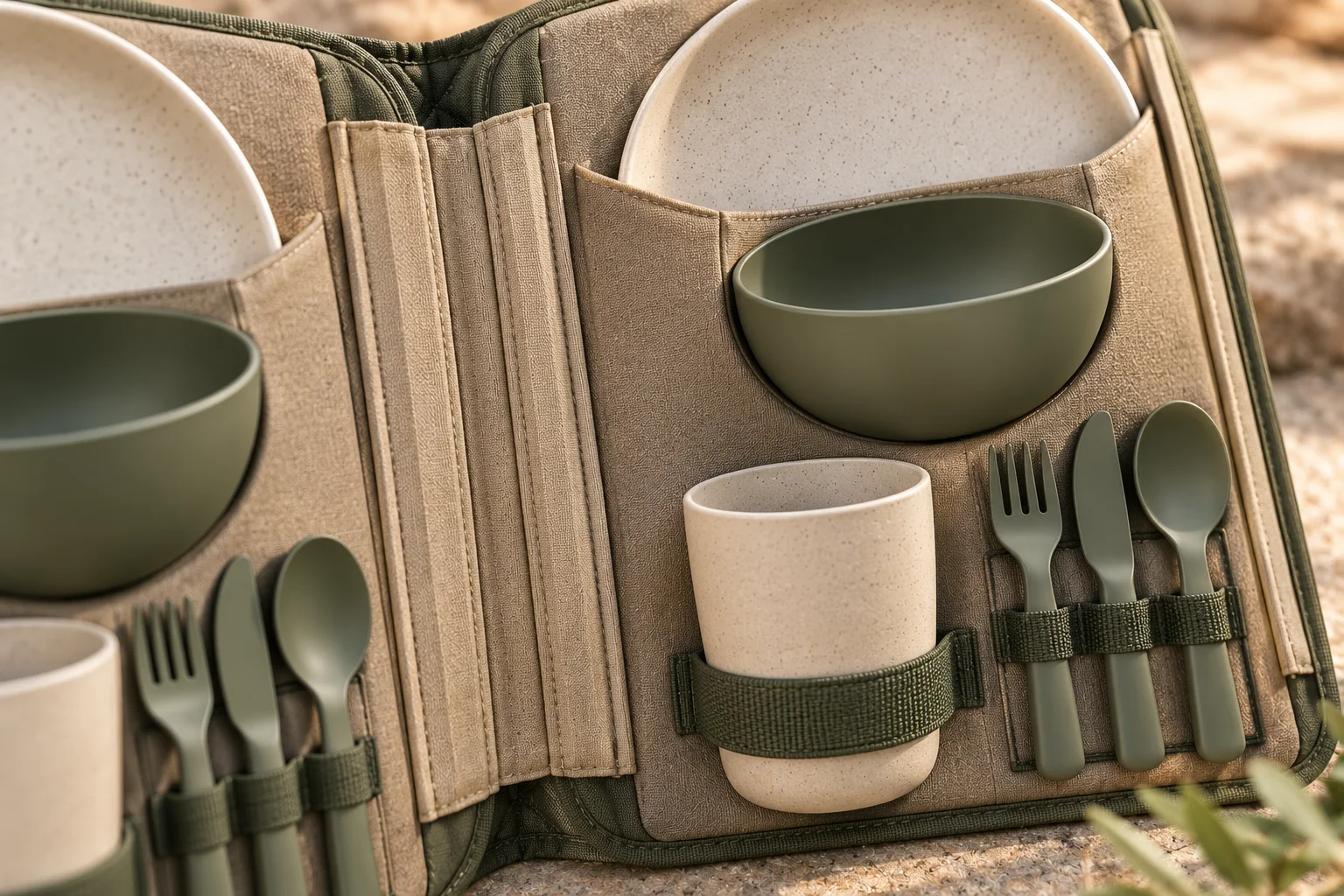
In this camping dinnerware set, each padded panel creates one visible place-setting bay. Flexible gussets allow the connected panels to open in a shallow zigzag and fold face-to-face for carrying. Separate sewn locations for the plate, bowl, cup and cutlery can make counts easier to inspect, but retention depends on the actual component geometry, pocket depth, strap tension, seam construction and loaded movement.
The panel system differs from recent rigid frames, slide-out decks, radial pods, wedge lanes and suspended slings: user-grouped components remain on four flexible connected leaves. This is a development concept, not a claim that the case is washable, waterproof, drop-proof or suitable for direct food contact.
WHAT TO SEND FOR A PROJECT REVIEW
| Buyer input | Why it matters |
|---|---|
| Controlled component BOM and target user count | Defines panel count and pocket allocation |
| Drawings or physical samples | Supports pocket opening, strap location and folded-clearance review |
| Target folded case envelope and carry method | Controls gusset width, panel thickness, closure and handle position |
| Food-use, cleaning and target-market conditions | Sets material and evidence questions without blanket claims |
| Logo, color, channel packaging and destination | Defines artwork, sample, packaging and quotation scope |
DEVELOPMENT CONTROL
A camping dinnerware set with four connected pocket panels needs one controlled drawing package for dinnerware, pockets, gussets, closure, lunch module and pack-out.
- Freeze the component revision and four-person count.
- Measure plate, bowl, cup, cutlery and lunch-box envelopes.
- Draw pocket openings, retention straps, gusset folds, seam allowances and closure stack-up.
- Review insertion, removal, panel folding and case closure with a project sample.
- Approve color, logo position, packaging and instructions against the same revision.
- Record any component substitution through a change-impact review before release.
No tooling, sewing process, molding method, production capacity or manufacturing capability is asserted here. Any custom case, component or mold requires project evaluation.
MATERIAL AND COMPLIANCE BOUNDARY
For this pocket-panel concept, the buyer should map every finished component to its exact color, surface, decoration, food type, temperature, contact time and cleaning method before deciding which material evidence applies. The US FDA food-contact notification inventory, the European Commission food-contact materials overview, and Regulation (EC) No 1935/2004 are primary starting points, not certificates for this concept.
The fabric case, pocket lining, thread, printed areas, adhesives, lunch box and dinnerware components may have different evidence needs. Dishwasher, microwave, leakproof, heat-resistant, biodegradable, compostable or cookware claims are not assumed. Dinnerware is not cookware unless a specific finished product and evidence scope supports that use.
CAMPING DINNERWARE SET PACKING AND SAMPLE APPROVAL

Approve the camping dinnerware set as an empty case, fully loaded panels, folded case and repack sequence. Observe whether pockets release components, bowls contact plate faces, cup straps loosen, utensils reach food-contact surfaces, gussets bunch at the folds, or the closure compresses the stack. Create a numbered pack-out instruction only after the configuration is stable.
For sourcing control, see the case-fit checklist, the pilot assembly guide, and the camping set cost breakdown. Keep service spares and replacement pieces visible after the configuration is defined.
PROCUREMENT FAQ
Are the pocket dimensions fixed?
No. Pocket depth, opening, strap position, gusset width and panel thickness are To be confirmed for the project from the approved component and case drawings.
Can existing dinnerware be used?
Existing components may be evaluated for the camping dinnerware set, but fit cannot be assumed. Compatibility to be confirmed by project sample and drawing.
Is the fabric case suitable for food contact?
No blanket claim is made. The intended contact route, material, finish, cleaning method and target-market evidence must be reviewed for the project.
Can the divided lunch box be replaced by four individual containers?
That configuration can be evaluated, subject to panel allocation, folded envelope, closure, retention, cleaning and packaging review.
What are the MOQ, price and delivery time?
To be confirmed for the project after the BOM, materials, case construction, decoration, packaging and development scope are reviewed.
REQUEST AN ACCORDION-POCKET SET REVIEW
Send the component BOM, drawings or samples, target folded envelope, intended use, target market, decoration and packaging brief. Naike will review the project inputs and identify which specifications, evidence and compatibility checks remain open.
Contact Naike Dinner · Send drawings and BOM · Discuss case and packaging scope
Reviewed . Concept page; specifications remain project-specific.
RELATED SOURCING PATHS
Compare Products and Plan Your Project
Review related product formats, then compare material, set configuration, logo, packaging, testing scope and order quantity with our B2B team.