Description
MODULAR OUTDOOR DINNERWARE CONCEPT
Hinge-Chain Four-Person Camping Dinnerware Set
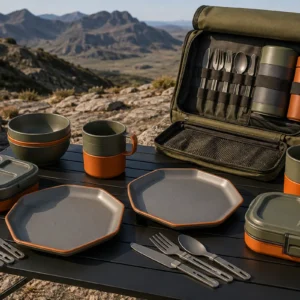
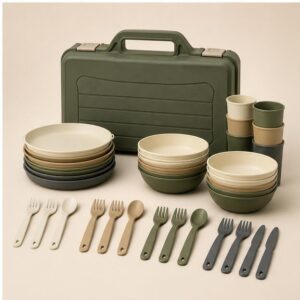
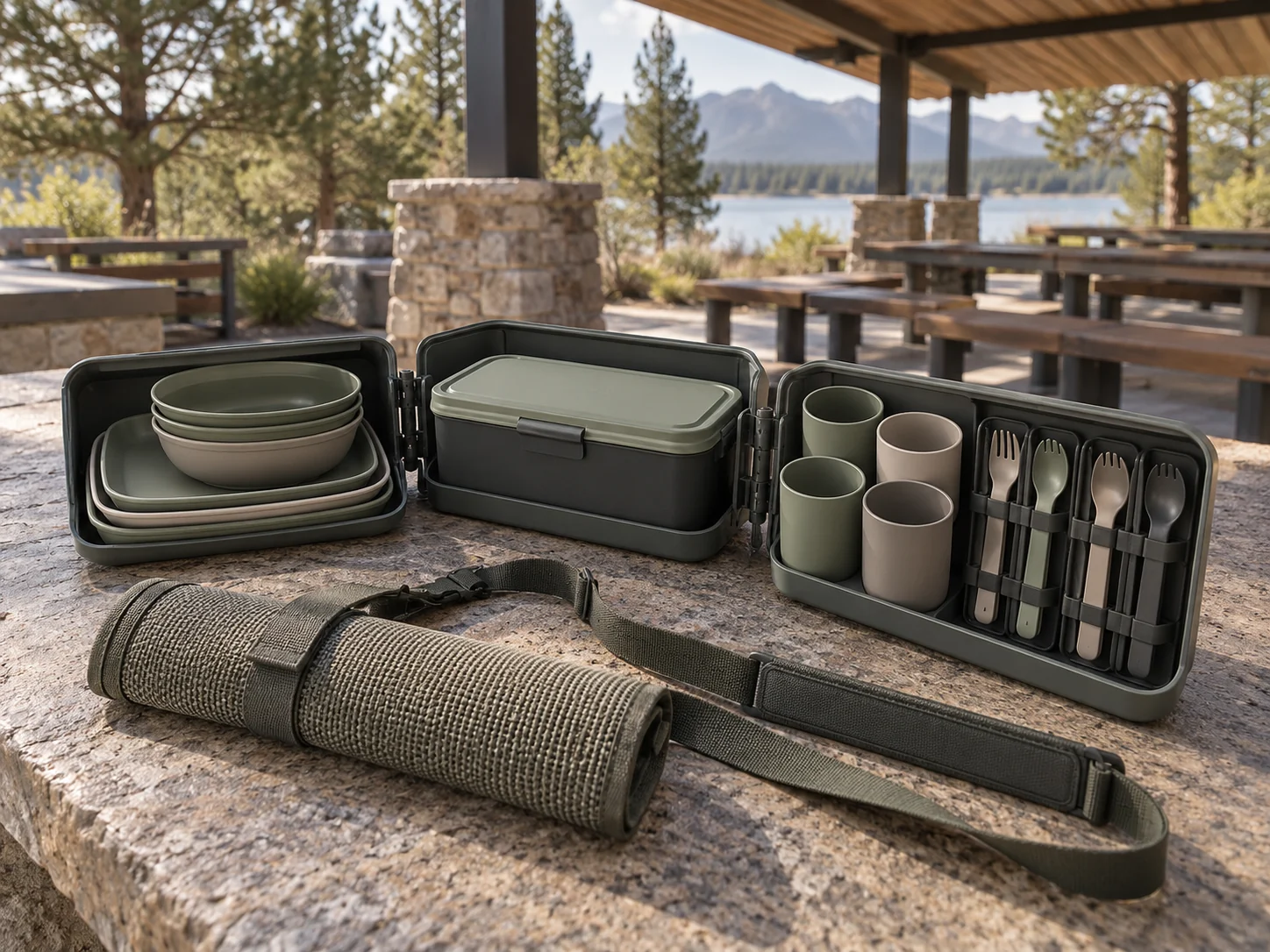
This camping dinnerware set organizes a four-person configuration across three rigid shallow bays joined in a visible hinge chain. One bay holds nested plates and bowls, the center bay receives a lidded lunch container, and the third separates cups from place-setting utensils. A removable wrap sleeve supports compact carrying review without presenting the concept as a finished production SKU.
Project boundary: all materials, dimensions, capacities, colors, food-contact evidence, MOQ, price, tooling, production capacity and lead time are To be confirmed for the project.
PRODUCT PARAMETER
| Product form | Four-person modular outdoor dinnerware concept with three linked rigid shallow bays and removable wrap sleeve |
|---|---|
| Reference components | Plates, bowls, cups, forks, spoons, knives, lidded lunch container, three linked organizer bays and wrap sleeve |
| Material | To be confirmed for the project |
| Dimensions / weight / capacity | To be confirmed for the project |
| Color / logo / packaging | To be confirmed for the project |
| MOQ / price / lead time | To be confirmed for the project |
| Compatibility | Compatibility to be confirmed by project sample and drawing. |
REFERENCE CONFIGURATIONS
The illustrated camping dinnerware set is a procurement starting point, not a fixed catalog specification. Buyers can compare a complete four-person layout, a reduced camping dinnerware set without a lunch container, or a meal-prep layout that changes the central bay. Component count, utensil type, bay envelope, hinge clearance, wrap construction and packing sequence must be frozen before quotation.
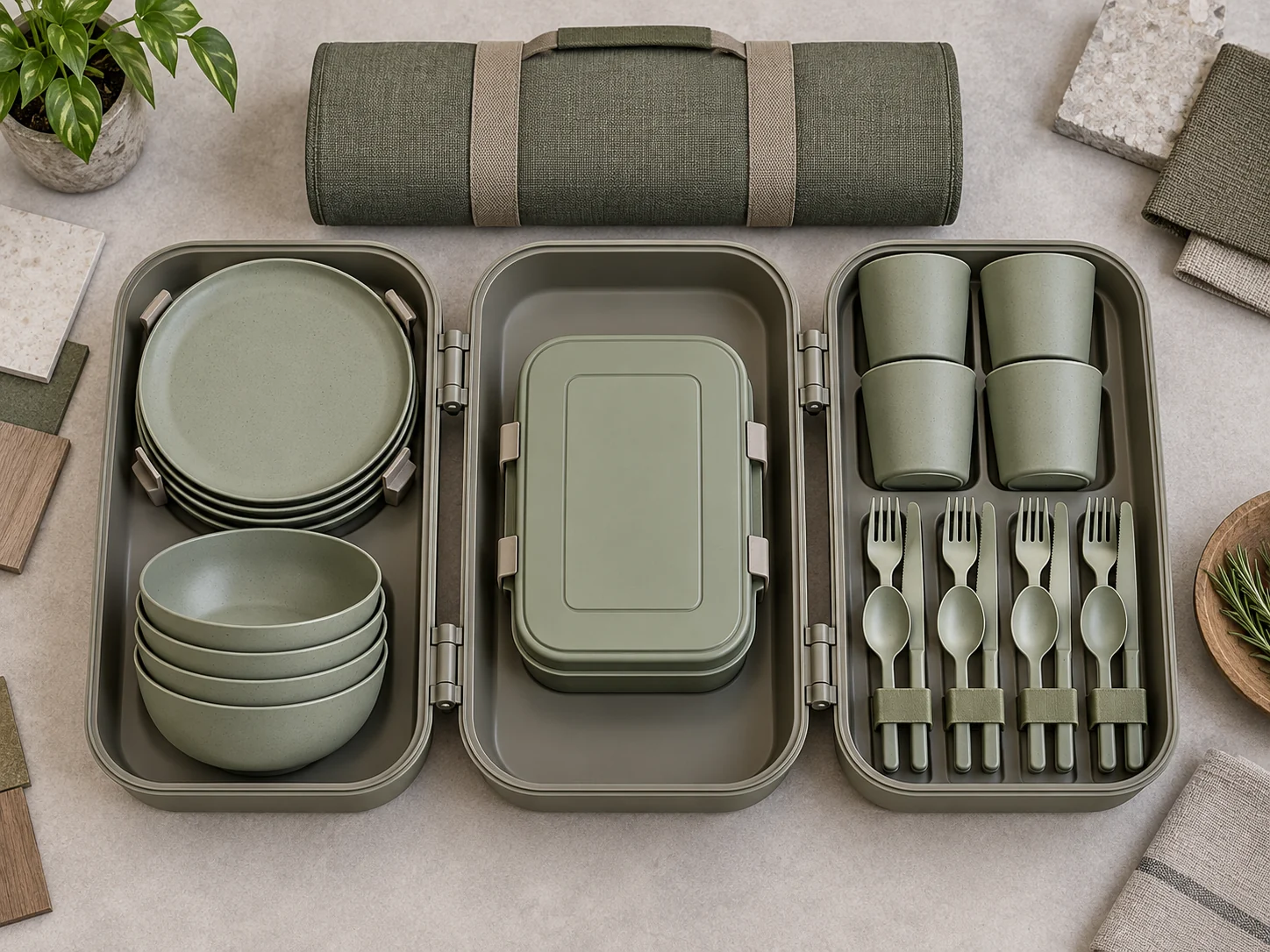
Camping dinnerware set architecture
The linked bays are intended to open as an offset chain so users can reach each component group without removing a deep stack from one case. The design review must address hinge travel, stop geometry, finger clearance, stability on uneven tables, utensil clip retention, cup access, lunch-container clearance and the closed pack envelope. These interfaces are development questions, not proven performance claims.
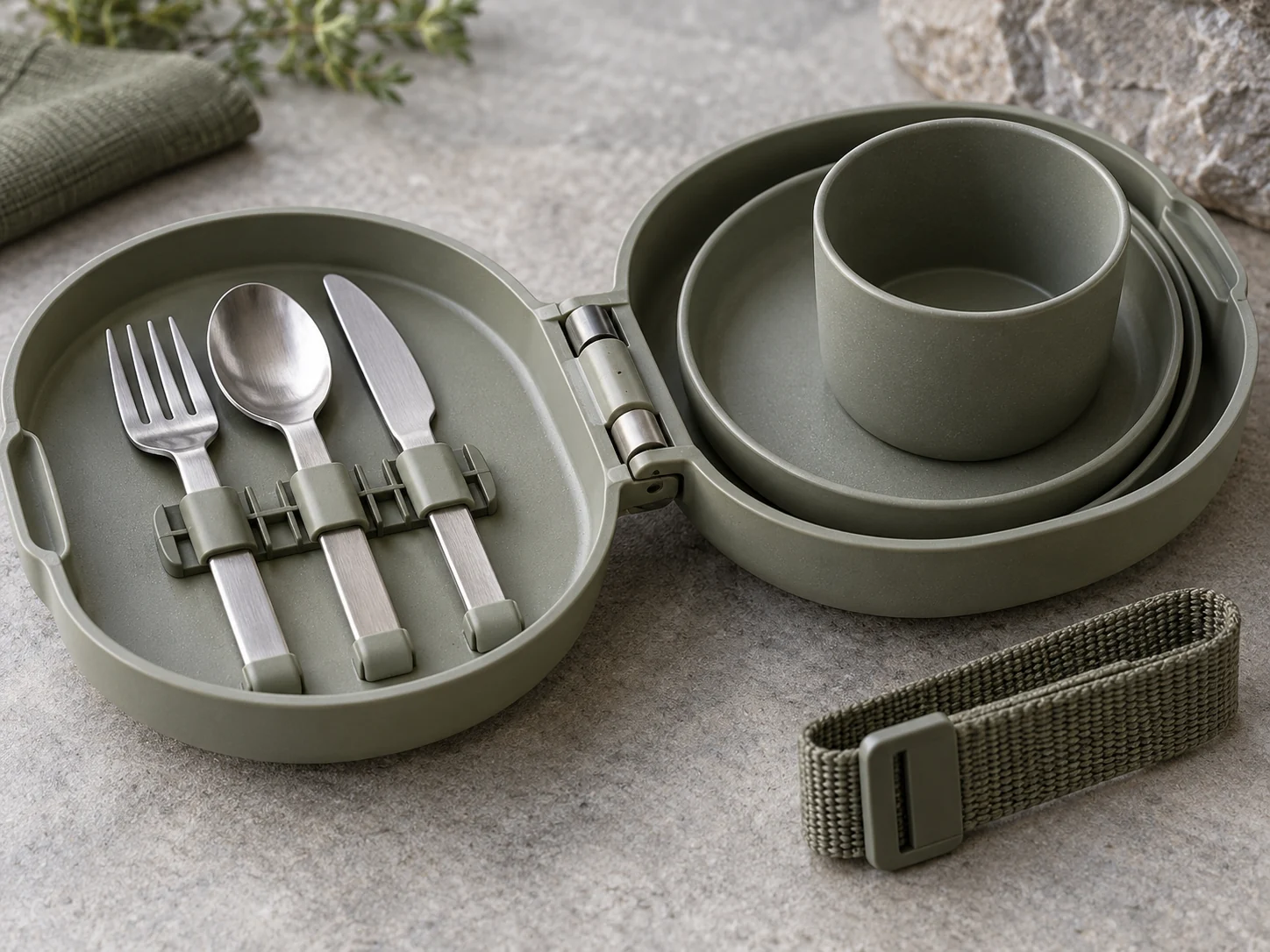
Freeze the three-bay project brief
Define the camping dinnerware set before quotation. Send the user count, required BOM, target component envelopes, material preferences, intended foods and temperatures, cleaning conditions, target markets, logo locations, packaging route and required evidence. Naike Dinner can identify existing-component options and open development items. A drawing, physical sample and risk review must precede any compatibility or performance statement.
DEVELOPMENT CONTROL
| Gate | Buyer decision | Required record |
|---|---|---|
| Bay architecture | Which components occupy each linked bay? | Approved BOM, bay map and pack-out drawing |
| Hinge interface | Required opening angle, stop, clearance and closed alignment | Interface drawing, tolerance notes and sample observations |
| Retention | How are cups, utensils and the lunch container retained? | Retention concept, access review and packed-contact map |
| Wrap sleeve | How does the sleeve close, carry and protect the linked bays? | Textile or case specification and closure review |
| Cleaning | Which components detach and which surfaces can trap soil or water? | Cleaning boundary and component instruction plan |
| Release | Which drawing, sample, artwork and packaging revisions are approved? | Linked revision and approval record |
MATERIAL AND COMPLIANCE BOUNDARY
No concept image, color or product name proves polymer identity, fiber content, recycled content, biodegradability, BPA status, dishwasher suitability, microwave use or food-contact compliance. The finished component, colorant, decoration, adhesive, textile, intended food, time, temperature, cleaning condition and target market define the evidence scope. Dinnerware claims must not be expanded into cookware claims. Evidence and test scope are To be confirmed for the project. The FDA food-contact substance notification inventory and the European Commission food-contact materials overview are primary regulatory starting points; the applicable route depends on the finished camping dinnerware set.
WRAP, BRANDING AND CHANNEL PACK
Logo position, bay color, wrap textile, utensil mix, lunch-container option, retail pack, e-commerce mailer, labels and outer carton can be reviewed as project variables. They are not automatically available in every combination. For adjacent decisions, use the portable flatware reference product, retail insert design guide and retail-box versus mailer matrix. The ISTA 3 Series overview can frame the distribution-hazard conversation; only the project-approved protocol determines what is actually verified. Tooling, hinge development, textile construction, packaging development and artwork release are To be confirmed for the project.
COMPONENT DESIGN DIFFERENCE
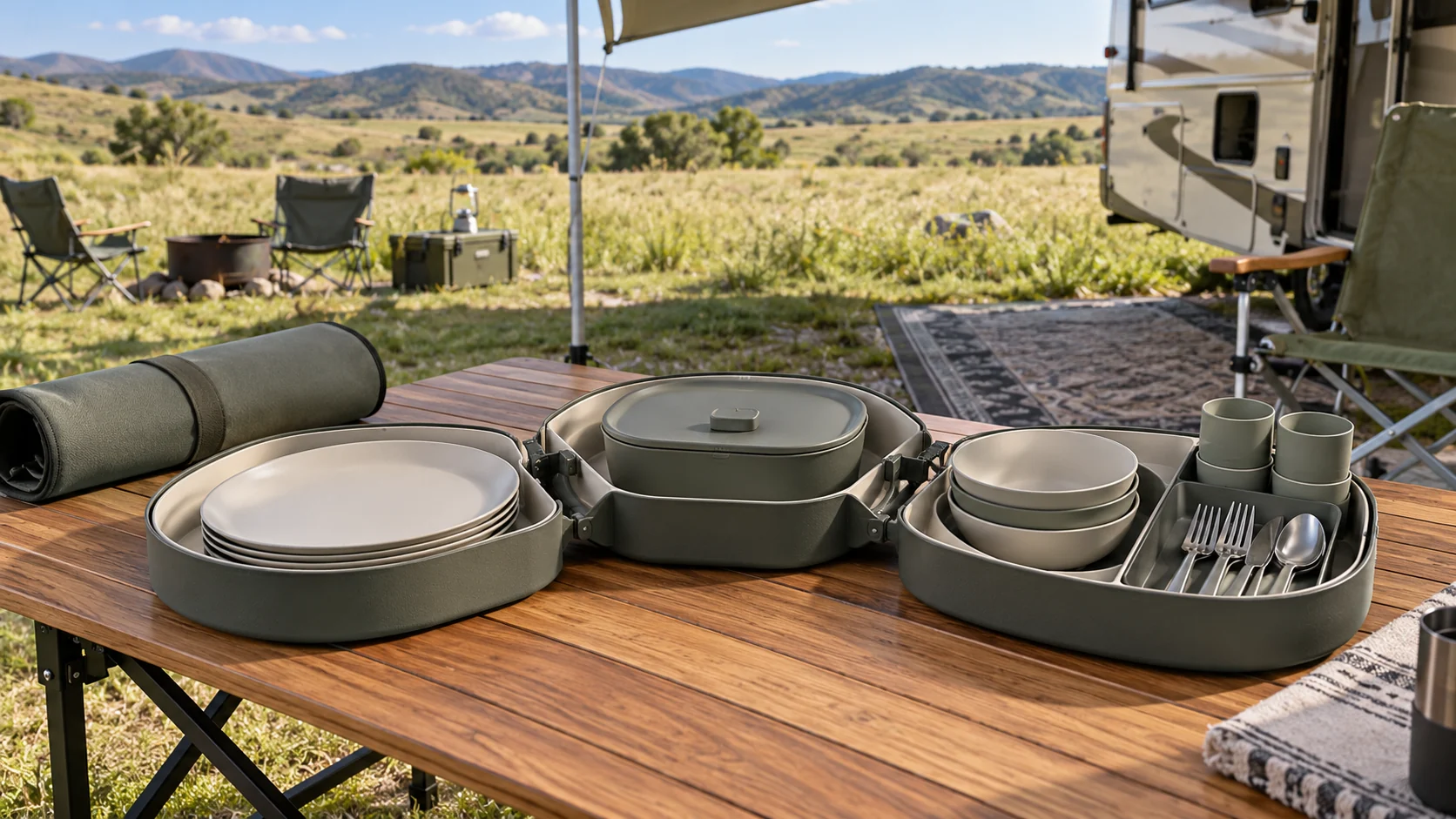
This concept is not a recolor, crop, mirror or background variation of earlier portable sets. Its distinguishing system feature is a sequence of three rigid shallow bays connected by two hinges: dinnerware, meal container and cup/utensil zones remain visible as separate modules when open, then fold into one aligned carry envelope for wrap-sleeve review. The component architecture, access sequence and closure interfaces differ materially from roll, cassette, drawer, cradle and single-case layouts.
PROCUREMENT FAQ
Is the Hinge-Chain set an existing production SKU?
No. It is a configuration concept for project evaluation. Availability, tooling and development route are To be confirmed for the project.
Can existing plates, bowls or cups be loaded into these bays?
Possibly, but geometry cannot be assumed. Compatibility to be confirmed by project sample and drawing.
Can buyers replace one linked bay later?
The service-part boundary, hinge interface and replacement method are To be confirmed for the project after the design is approved.
Is the hinge dishwasher safe or fatigue tested?
No claim is made. Materials, detachable parts, cleaning conditions and validation method require project-specific review.
Can Naike Dinner quote from the concept images alone?
No. A camping dinnerware set quotation needs the BOM, target dimensions, materials, markets, intended use, customization, packaging and evidence requirements.
Request a Hinge-Chain project review
Send your component matrix, user count, target bay envelope, material and market brief, use conditions, logo and packaging requirements. Unknown fields will remain To be confirmed for the project.
RELATED SOURCING PATHS
Compare Products and Plan Your Project
Review related product formats, then compare material, set configuration, logo, packaging, testing scope and order quantity with our B2B team.