Description
Last Updated:
CONFIGURABLE OUTDOOR DINNERWARE CONCEPT
Twin-Deck Slide-Out Four-Person Camping Dinnerware Set
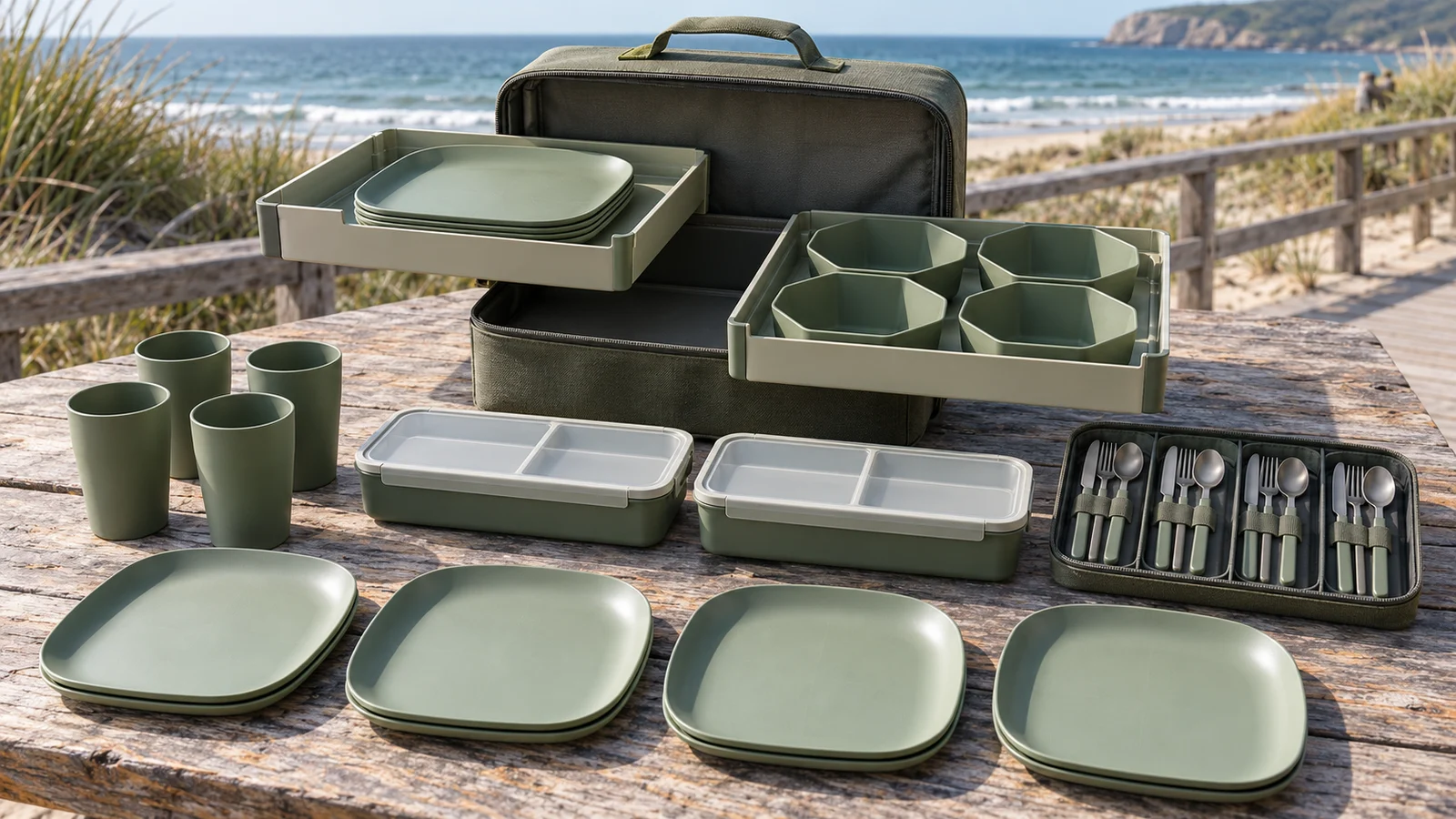
The Twin-Deck Slide-Out camping dinnerware set is a four-person development concept built around a rectangular semi-rigid case with two shallow parallel trays that extend sideways at different levels. Four rounded-square plates, four deep hexagonal bowls, four straight-grip cups, two long divided lunch boxes and four knife-fork-spoon groups in a slim cutlery cassette form the reference configuration. It is not a verified production SKU.
- Two parallel decks separate service pieces from meal containers
- Sideways tray travel keeps the center case footprint compact
- Slim cutlery cassette protects utensil groups from plate faces
- Materials, dimensions, rails and performance remain project decisions
PRODUCT PARAMETER
| Product concept | Twin-Deck Slide-Out four-person camping dinnerware set |
|---|---|
| Reference components | Rectangular semi-rigid case, two parallel slide-out trays, four rounded-square plates, four deep hexagonal bowls, four straight-grip cups, two long divided lunch boxes, slim cutlery cassette and four knife-fork-spoon groups |
| Material | To be confirmed for the project |
| Dimensions and weight | To be confirmed for the project |
| Color and finish | To be confirmed against approved samples |
| Logo and packaging | To be confirmed for the project |
| MOQ, price and lead time | To be confirmed for the project |
| Compatibility | Compatibility to be confirmed by project sample and drawing. |
REFERENCE CONFIGURATIONS
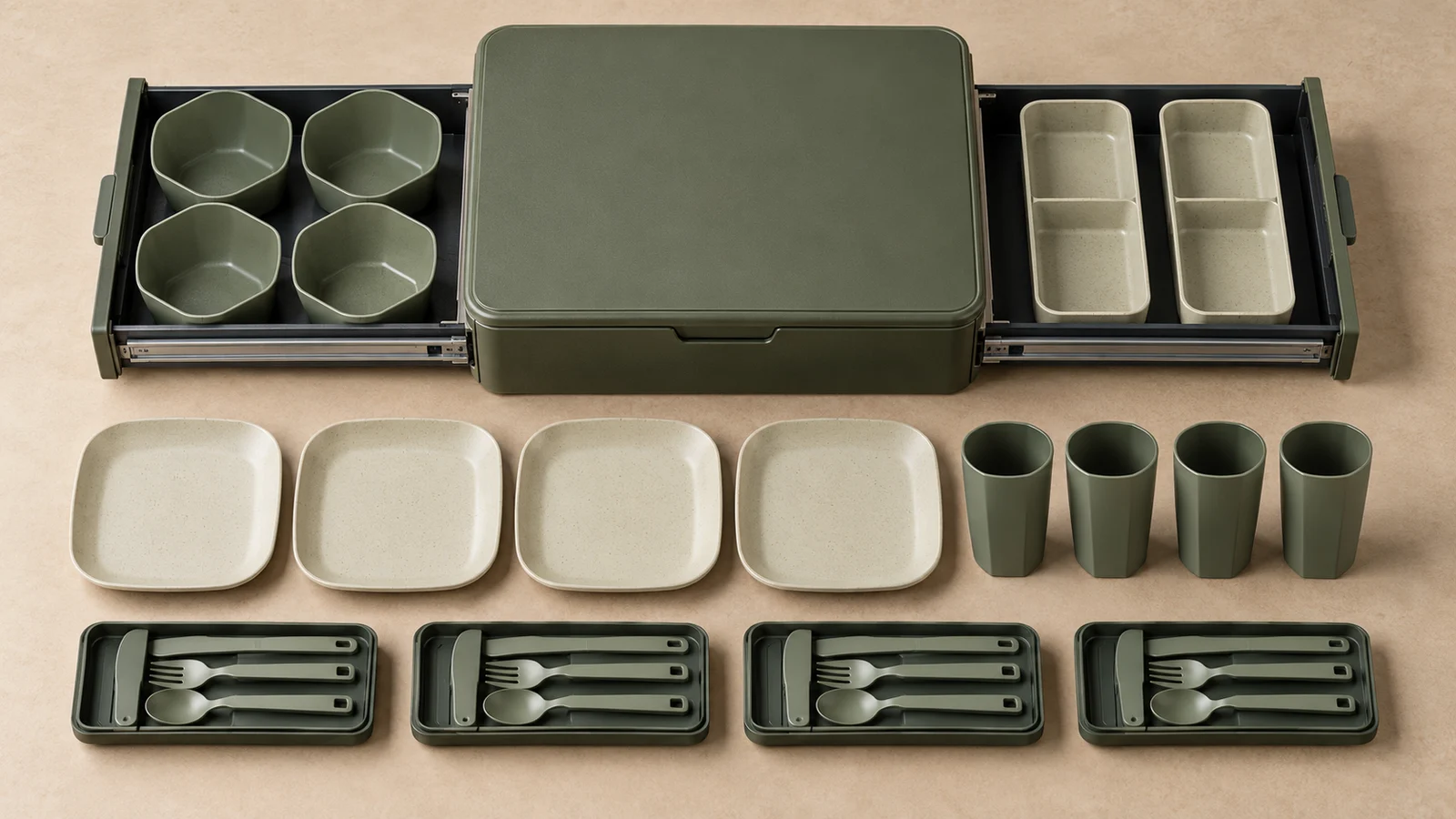
| Configuration | Buyer choice | Evidence before approval |
|---|---|---|
| Two-setting compact | One active deck with selected service pieces | Unused-deck restraint and case balance |
| Four-setting reference | Four coordinated place settings across both decks | Rail travel, stops, closure and loaded handling |
| Meal-container option | Two long divided boxes or alternate shared format | Tray envelope, latch clearance and cleaning access |
| Retail program | Counts, colors, branding, insert and outer pack | Approved matrix, samples, artwork and pack-out |
Images communicate the proposed organization, not a released specification. Approve an arrangement only when tray geometry, component envelopes, materials and sliding interfaces are documented and confirmed with representative samples.
Use rail travel as the primary packing control
The two decks depend on guided sideways movement and positive stops. Buyers should define travel direction, extension limit, retraction sequence, finger clearance, loaded support and the condition in which the main case may be carried. The concept image does not prove rail life, impact resistance, load capacity or repeated-cycle performance.
Record maximum plate stack height, bowl corner envelope, cup profile, lunch-box latch sweep and protected utensil length. Compare these values with tray depth, separator position, rail hardware, lid clearance and cassette travel. Compatibility to be confirmed by project sample and drawing.
Review both decks as one loaded system
The upper and lower decks cannot be approved independently. Extending one tray changes balance and may expose or obstruct the other. Review the set with both trays closed, each tray open alone, both trays extended and every component removed in the intended order. Observe rail binding, hard contact, tipping, pinch points and accidental release.
Rounded-square plates and hexagonal bowls create different corner contacts from round components. Define orientation marks or pocket geometry where rotation affects fit. The straight-grip cups must clear dividers without forcing, and the cassette must keep utensil edges away from food-contact faces.
The long divided lunch boxes are configuration placeholders. No leakage, thermal or sealing claim is made. Define closure, carrying orientation, food types, contact duration and verification before requesting those claims. This set is dinnerware and storage equipment, not cookware for direct heat.
Inspect Twin-Deck rails and separators
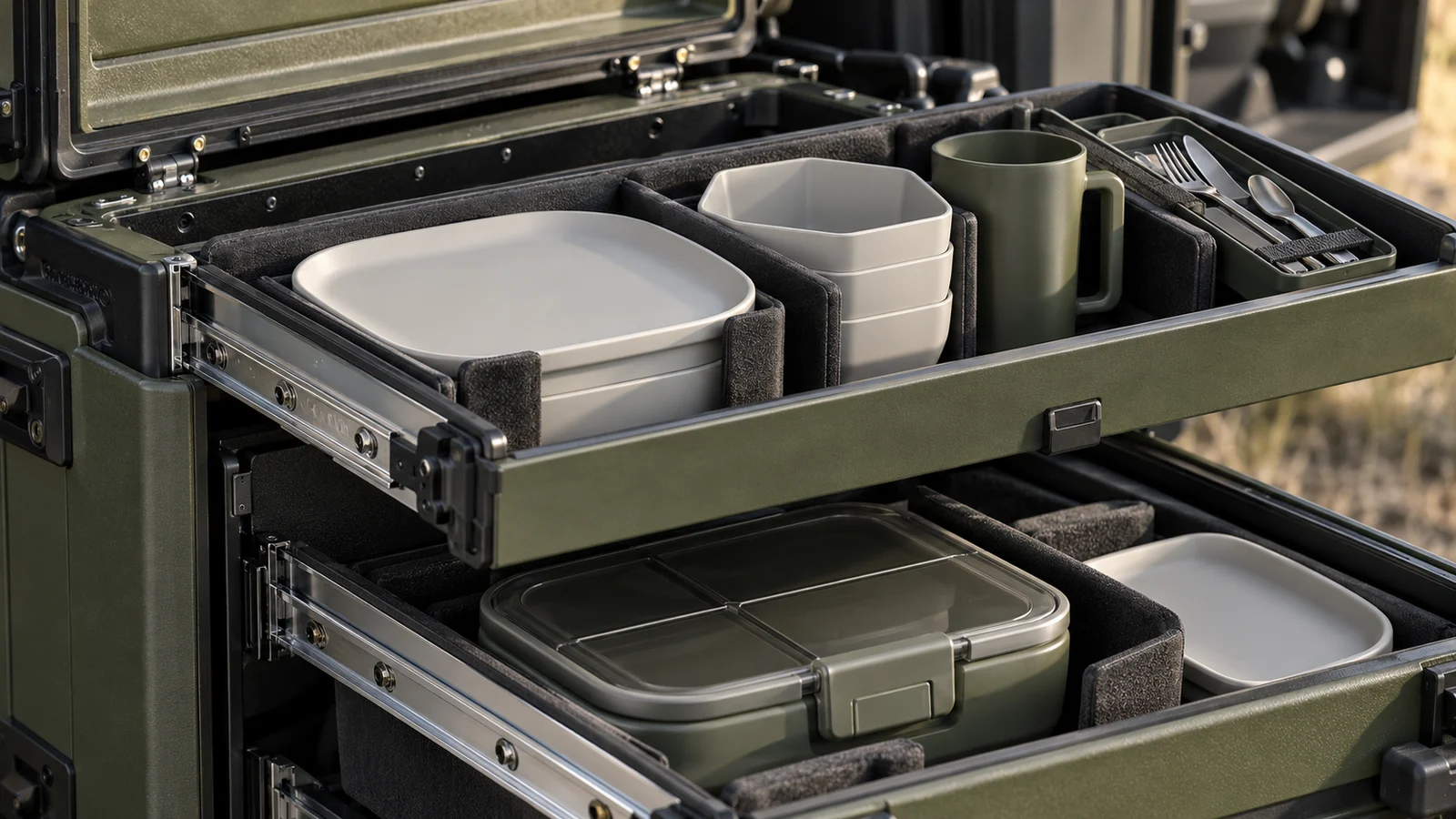
Control rail stops, tray clearances, padded separators, cassette retention and component contacts through drawings and complete loaded samples. Compatibility to be confirmed by project sample and drawing.
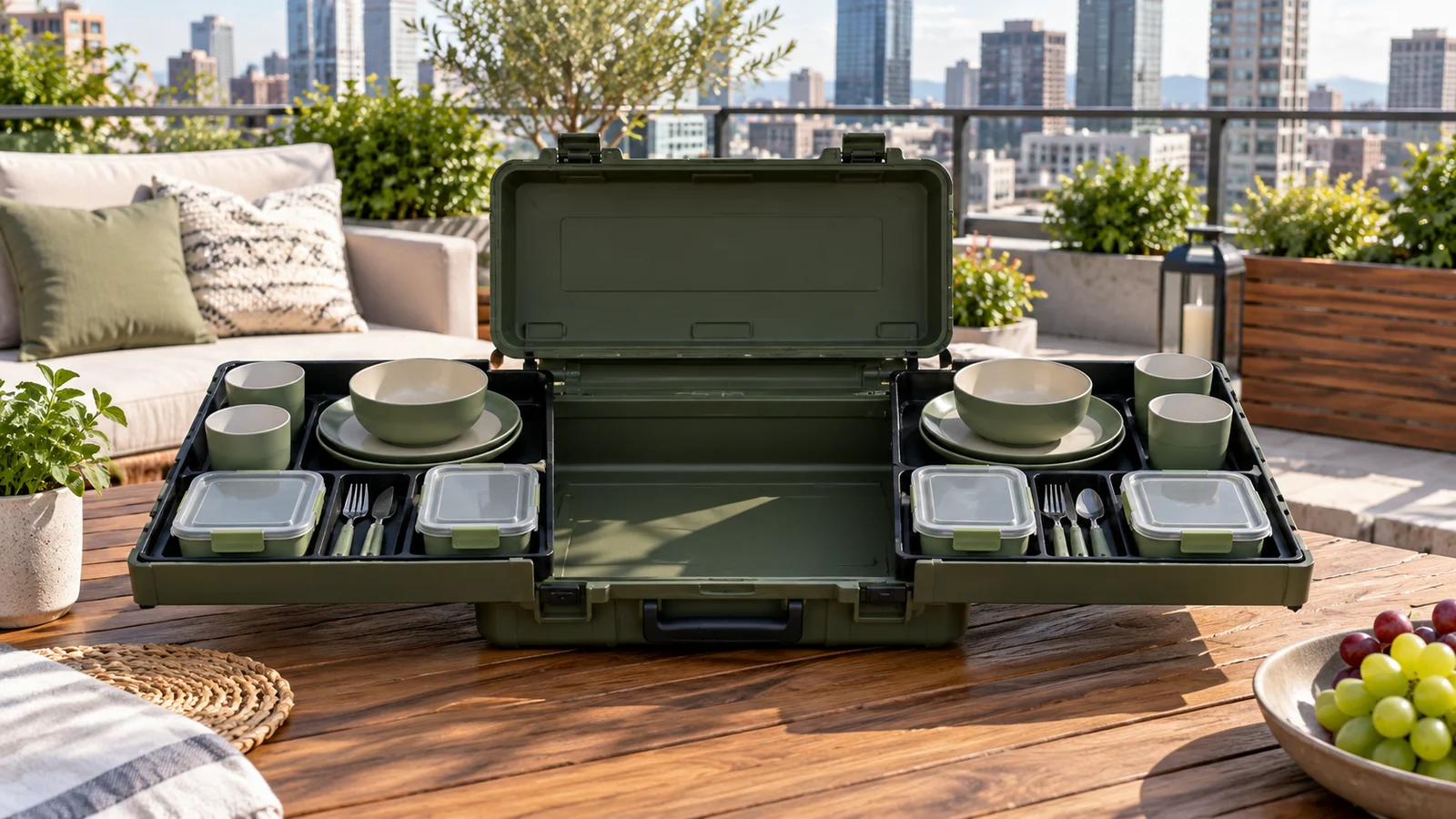
Application concept only; not a verified customer order, factory output or production SKU.
Customization and connected procurement choices
| Control | Options to review | Dependency |
|---|---|---|
| Set composition | Two/four settings, container count and shared pieces | Tray area, cavity depth and carry balance |
| Storage architecture | Deck height, rail direction, stops and cassette access | Component geometry and removal route |
| Service pieces | Square plate, hex bowl, straight-grip cup and cutlery | Nesting, orientation and contact protection |
| Branding | Case color, component finish, logo and packaging | Approved material, process and artwork |
| New geometry | Revised shell, tray, rail or component profile | Drawings, tolerances, samples and feasibility |
B2B development controls
- Freeze the component matrix before fixing deck and rail envelopes.
- Review the complete loaded case in closed, carried and every extended-tray state.
- Protect food-contact faces from utensil tips, rails and separator hardware.
- Check bowl-corner and cup access without forced rotation.
- Define rail stops, lunch-box latch clearance and return sequence.
- Approve logo and packaging only after material and process review.
- Keep dinnerware claims separate from cookware and direct heat.
Record component codes, drawing revisions, sample IDs, observed fit, rail issues, owners and decisions. If tray depth, rail hardware, plate profile, cup geometry or packaging insert changes, repeat the affected loaded-case observations. Do not infer capacity, tolerance, MOQ, price or lead time from concept imagery.
Material and compliance boundary
The renderings establish only the Twin-Deck organization idea. They do not verify resin or metal identity, regulatory status, migration, container sealing, rail strength or destination-market suitability. Define evidence from actual food types, exposure time, use temperature, washing method, decoration and destination rules. Every unresolved value remains “To be confirmed for the project.”
Use the modular component guide, case-fit checklist and pilot assembly guide. Primary context: FDA, EU framework regulation, and NIST traceability.
Procurement FAQs
Do the decks function as serving trays?
No food-contact or serving role is claimed. Any such use requires a defined material, geometry, intended use and evidence plan.
Can both decks remain open together?
The concept shows that state, but stability, support and load limits require project drawings and representative samples.
Are the lunch boxes leakproof?
No. State the intended orientation, closure, food type, test method and acceptance boundary before requesting a sealing claim.
Can existing components fit the decks?
Potential reuse can be reviewed. Compatibility to be confirmed by project sample and drawing.
When are rail materials approved?
Only after the rail system, load, finish, cleaning route and evidence are confirmed for the project.
Which inputs start a quotation?
Send setting count, component matrix, closed case envelope, deck priorities, target markets, food-use conditions, branding, packaging and evidence expectations.
Build a practical Twin-Deck camping dinnerware set
Share setting count, component references, case envelope, tray priorities, target markets, food-use conditions, logo and packaging requirements. Naike Dinner will identify drawings, samples and written confirmations required before approval.
RELATED SOURCING PATHS
Compare Products and Plan Your Project
Review related product formats, then compare material, set configuration, logo, packaging, testing scope and order quantity with our B2B team.