Description
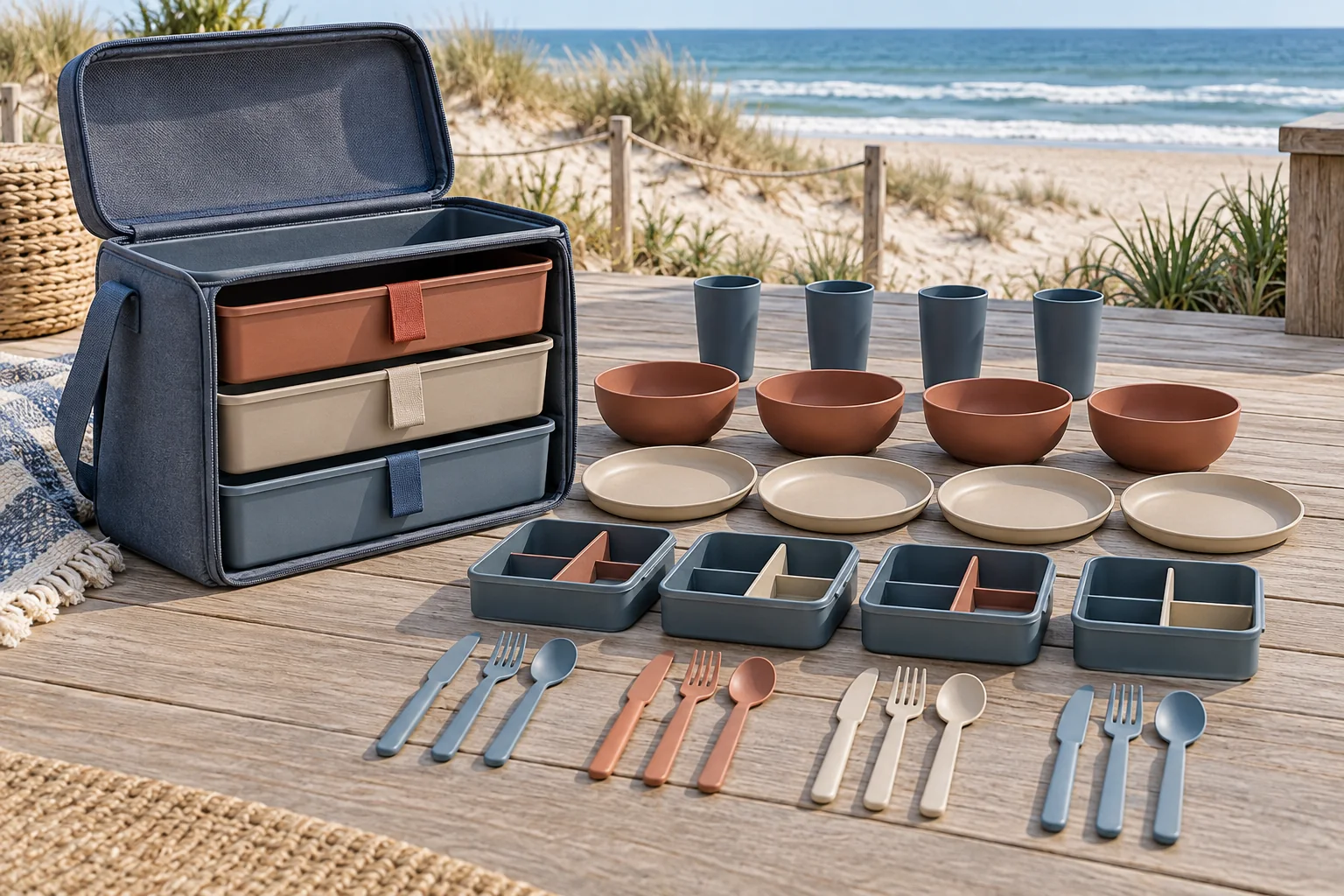
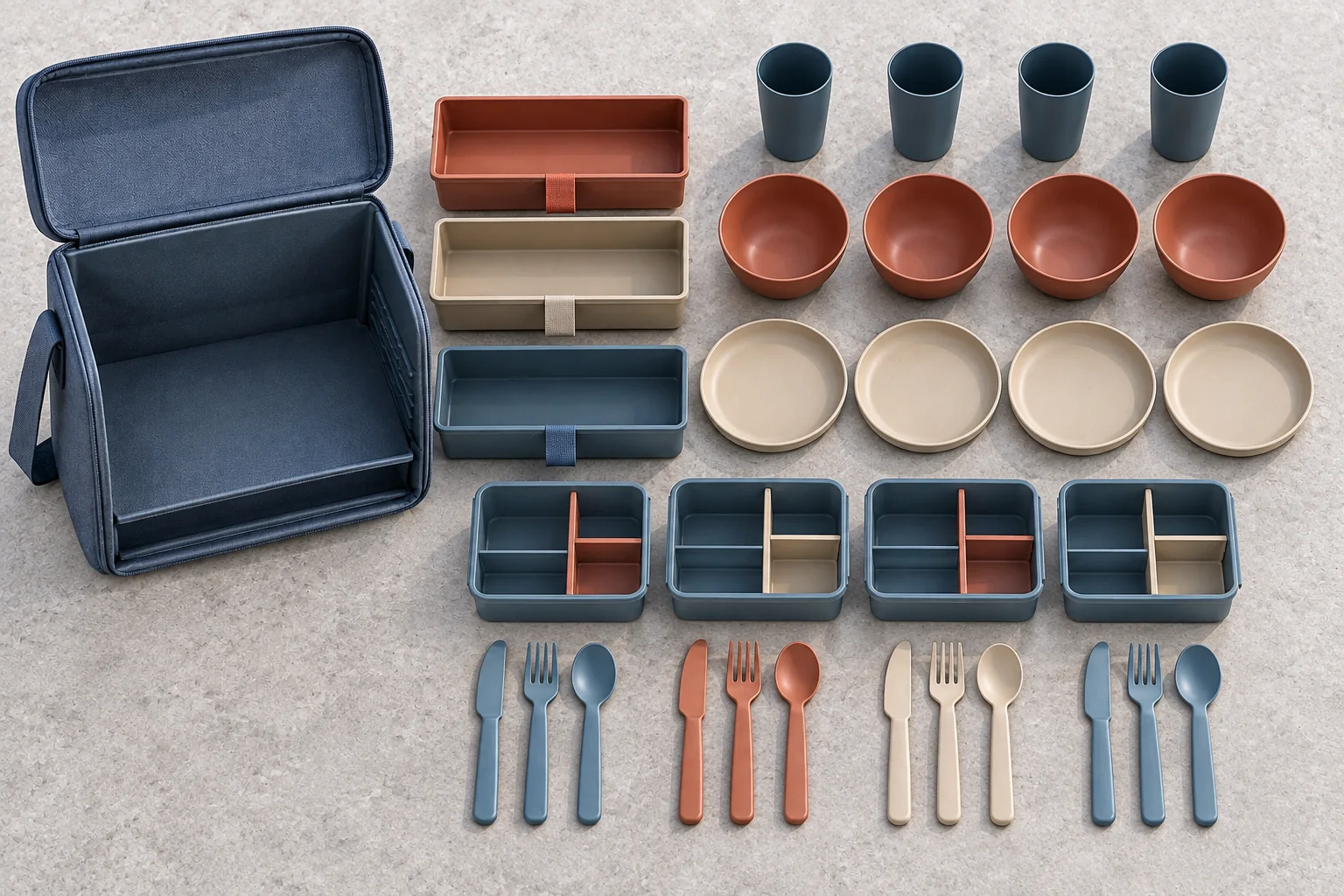
The lift-out tier camping dinnerware set is a configurable four-user concept organized in a rigid top-opening tote with three removable trays. The reference arrangement combines plates, bowls, cups, divided lunch-box forms and knife-fork-spoon groups. Final materials, dimensions, quantities, colors, closure, compatibility, packaging and performance are confirmed only through the project brief, drawings, samples and applicable evidence.
This page uses concept and application illustrations for B2B set development. It does not represent a verified stock SKU, finished customer order, factory photograph, test result or certification. Compatibility to be confirmed by project sample and drawing.
PRODUCT PARAMETER
| Product concept | Lift-out tier camping dinnerware set |
|---|---|
| Reference users | Four-user configuration shown; final user count to be confirmed for the project |
| Reference components | Shallow plates, deep bowls, straight-sided cups, divided lunch-box forms and knife-fork-spoon groups |
| Storage architecture | Rigid top-opening rectangular tote with three vertically stacked removable trays and pull tabs |
| Tray roles | Component allocation to be confirmed; trays may separate eating pieces, food containers and utensils after sample review |
| Material | To be confirmed for the project by component and intended use |
| Dimensions and weight | To be confirmed for the project from controlled drawings and packed sample |
| SKU | To be confirmed for the project |
| Colors and finish | To be confirmed for the project with approved color standard and surface sample |
| Logo and decoration | Artwork position, process and durability requirements to be confirmed for the project |
| Packaging | Retail or transport packaging to be confirmed after the packed envelope is frozen |
| MOQ, price and lead time | To be confirmed for the project; not represented on this concept page |
| Applicable markets | Europe, North America, Australia and comparable B2B programs subject to destination-specific review |
REFERENCE CONFIGURATIONS
Four Individual Settings
Four plates, four bowls, four cups and four utensil groups, with the lunch-box layer omitted when the buyer prioritizes dining pieces.
Meal-Prep Combination
Four place settings plus divided lunch-box forms. Divider layout, closure and food-use conditions remain project-specific.
Mixed Component Program
One tray can be reassigned to serving or accessory pieces when the buyer provides a menu map and approved component matrix.
The three configurations describe procurement directions, not available stock promises. The tray depth, divider pattern and component geometry must be developed together. A different cup or lunch box can change the complete stack height and case closure.
A top-lift architecture for controlled access
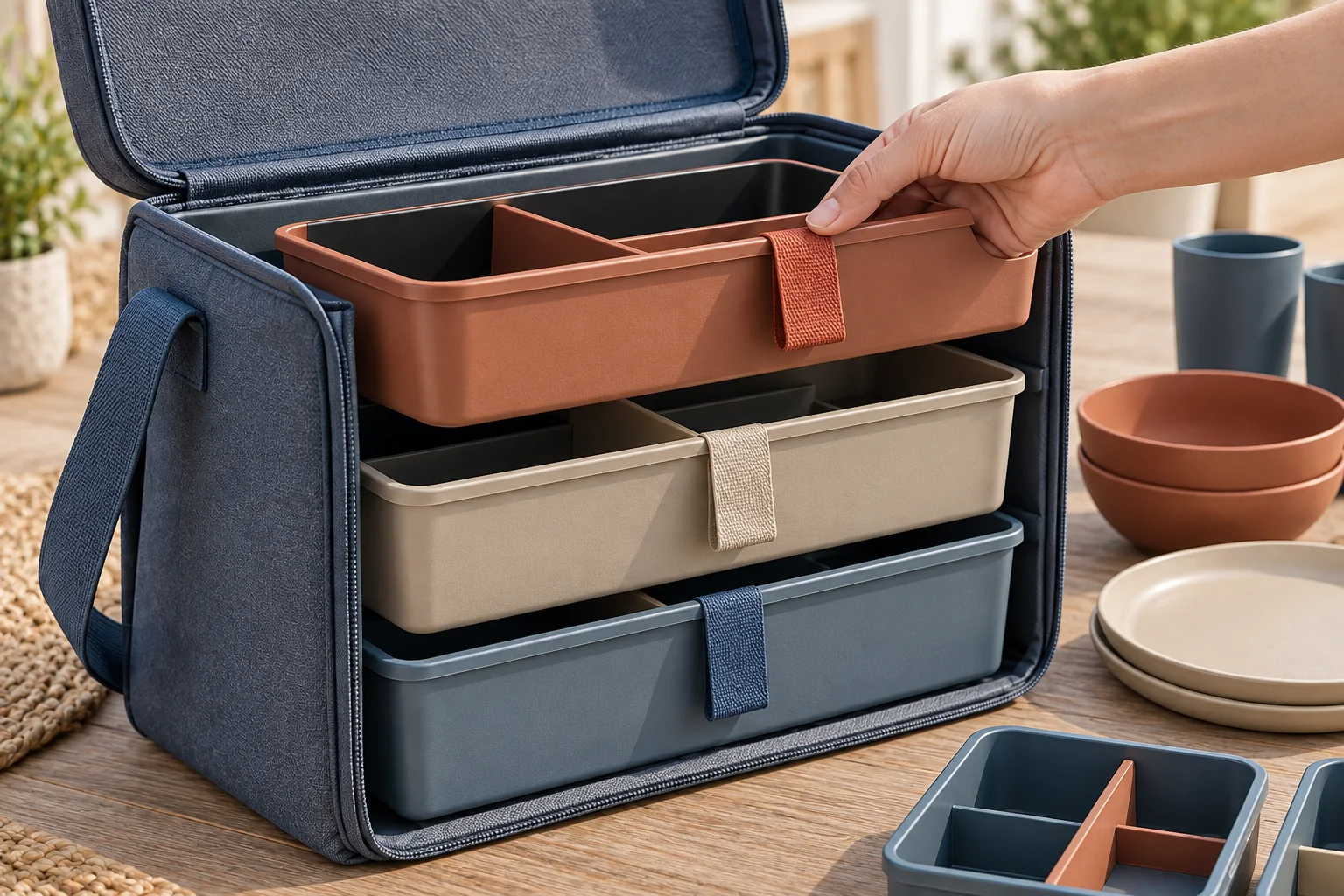
Unlike a side drawer or hinged panel, each tray is removed vertically through the top opening. This architecture gives the buyer a clear opportunity to assign one layer to a controlled component group. It also creates a strict sequence: upper trays must be removed before the lowest layer can be reached.
The sequence can be useful when the kit is unpacked completely at a table, but it may be unsuitable when users need instant access to one lower component. Ask the intended user to perform the real unpack, meal and repack sequence. Do not describe access as fast or convenient until the sample trial supports that statement.
For the lift-out tier camping dinnerware set, the most important approval evidence is a complete closed case followed by the documented removal sequence. Review the full stack at realistic tolerances rather than approving each tray as an isolated part.
Tray pull tabs are functional interfaces, not decorative straps. Their length, attachment, hand clearance and interaction with the closed lid need drawing control. The tray rim should not cut, pinch or scrape the textile lining during repeated removal.
Build a new set from component roles
Start with the meal plan and user count, then assign a role to each plate, bowl, cup, food container and utensil. The guide to defining a camping dinnerware component list helps separate essential pieces from components added only to increase the advertised count.
Place the most frequently used or first-needed items in the upper tray. Reserve the lowest layer for larger nested plates or bowls when their weight and diameter suit the case. Keep food containers separate from cutlery only when the cleaning, access and packing plan benefits from that separation.
A lift-out tier camping dinnerware set can also use tray colors or controlled component zones to support counting, but color alone must not carry a critical instruction. Confirm the intended work sequence in the pack-out document.
For cups, compare body envelope and handle interference before choosing a format. The published PP vs Tritan camping cups guide shows how material questions remain separate from format and fit. Compatibility to be confirmed by project sample and drawing.
Confirm the packed envelope with the method described in the camping tableware pack-volume guide. The tote dimensions should come from the approved stack, seam allowances and removal clearances rather than from a concept image.
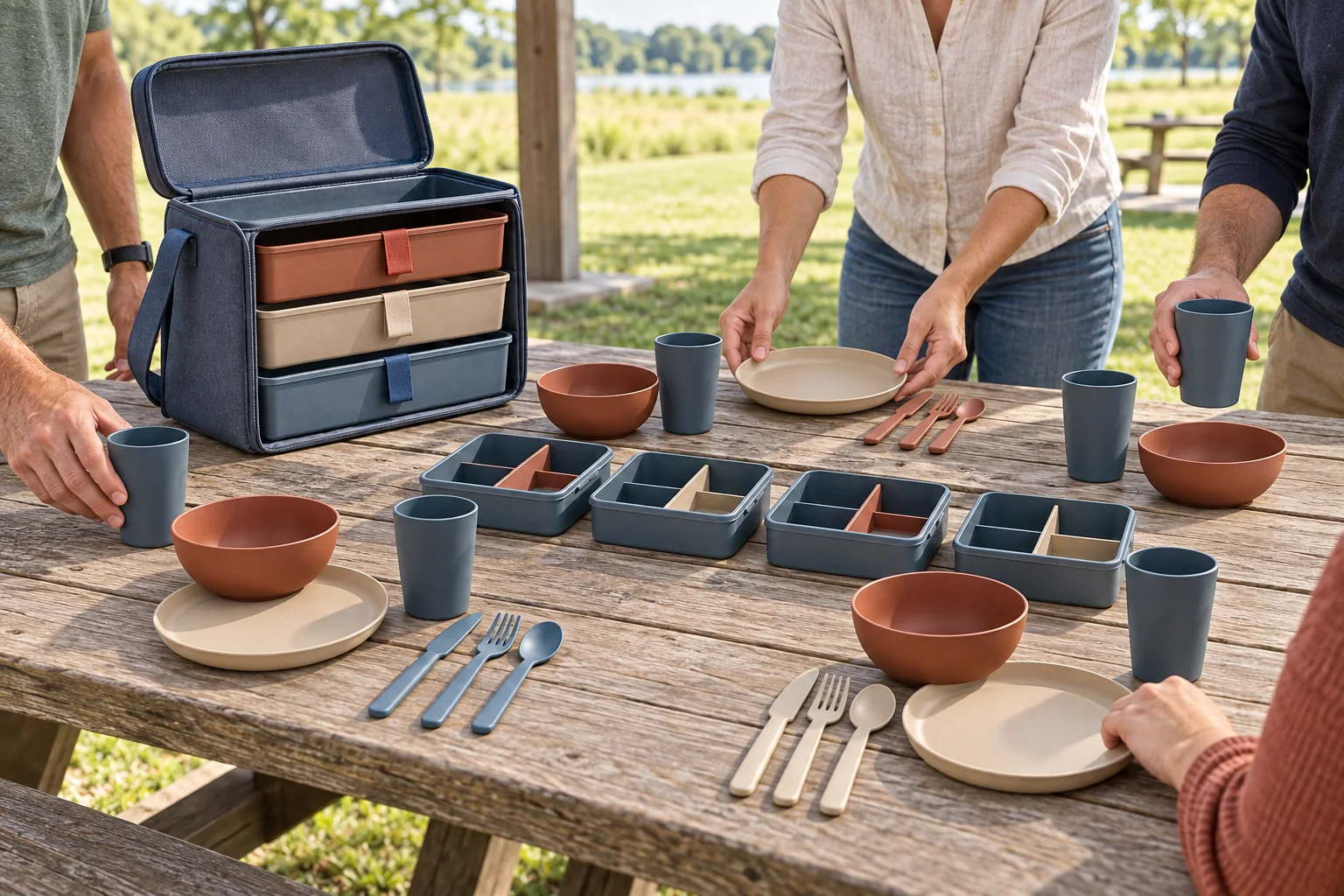
Set architecture and related procurement
| Layer | Possible role | Buyer decision |
|---|---|---|
| Upper lift-out tray | Cups, cutlery or first-use pieces | Confirm hand clearance, pull-tab load and lid clearance |
| Middle lift-out tray | Lunch boxes or bowls | Confirm divider geometry, cleaning and removal sequence |
| Lower lift-out tray | Nested plates and deeper bowls | Confirm stack height, mass distribution and base support |
| Textile tote | Carry, protection and component retention | Confirm seam, zipper, handle and cleanability requirements |
| Retail/transport pack | Presentation and distribution protection | Confirm only after final closed-case dimensions are measured |
Buyers considering another architecture can compare the current saddle-pocket group set. The lift-out concept is materially different because its removable trays stack vertically inside one top-opening case rather than separating round and irregular components into a central bay and side pockets.
Buyer control checklist
Component freeze
Approve a component matrix before fixing tray and tote geometry.
Layer sequence
Test which tray is removed first and where it rests during use.
Fit evidence
Retain a closed packed sample and controlled drawing revision.
Change impact
Recheck tray, tote and carton after any component-envelope change.
Material and compliance boundary
No material or compliance status is inferred from these images. The buyer should define intended foods, temperatures, contact duration, cleaning method, destination markets and any restricted substances before requesting evidence. Reports and declarations must identify the finished article or controlled material used for the approved sample.
The lift-out tier camping dinnerware set should therefore be treated as several food-contact articles plus a separate carry system, not as one generic material claim. Scope evidence by component and intended use.
For European projects, begin with the European Commission’s food-contact materials legislation overview. For United States programs, the FDA Food Code 2022 helps frame food-safety controls without certifying this product. For Australia and New Zealand, consult FSANZ food-packaging guidance.
These primary sources do not certify this concept. Ask for a written evidence matrix connecting each component, material, color or coating, intended use, test or declaration, report identifier and production revision. Packaging textiles and non-food-contact case parts should be scoped separately rather than presented as food-contact components.
Customization and project review
Possible project discussions include user count, component role, tray allocation, plate and bowl geometry, cup format, lunch-box divider concept, utensil profile, tote construction, colors, decoration zones and packaging. A new mold or modified geometry is not assumed to be feasible until drawings, tooling scope, material, tolerances and commercial requirements are reviewed.
When requesting a lift-out tier camping dinnerware set, identify which existing parts must be retained and which geometries may be newly reviewed. This keeps the development request specific without assuming tooling capability.
Provide the target channel, destination markets, intended meals and maximum pack envelope. If an existing component must be included, send a sample or controlled drawing. If all components are new, rank the features that can change and the features that must remain fixed.
Unknown SKU, size, color, weight, packaging, logo process, quantity, price and lead time remain “To be confirmed for the project.” This protects both buyer and supplier from treating a visual concept as a production commitment.
The lift-out tier camping dinnerware set brief should name every controlled input and every open question. A later change to one component must trigger a pack, tray and carton impact review.
Procurement FAQ
Is this lift-out tier camping dinnerware set a stock SKU?
No. It is a B2B configuration concept. Availability, final construction and all commercial terms must be confirmed for the project.
Can the tray sequence be changed?
Potentially, but tray depth, component mass, removal clearance and lid closure must be reviewed together. Compatibility to be confirmed by project sample and drawing.
Can buyers combine different plates, bowls and cups?
A mixed component matrix can be reviewed. Provide drawings or samples for every carryover item so the complete stack and tray fit can be checked.
Does the concept prove food-contact compliance?
No. Compliance depends on the final material, finished article, intended use and destination. Request evidence linked to the approved version.
Can a logo be added?
Logo position and process can be discussed after the material, geometry and artwork area are known. Durability requirements should be included in the approval plan.
What information is needed for a quotation?
Send user count, component matrix, intended foods and temperatures, target markets, carry limits, colors, artwork, packaging, evidence needs and forecast quantity. MOQ, price and lead time are then confirmed for the project.
Request a lift-out set development review
Send your component list, existing samples or drawings, user count, tray priorities, target pack envelope, colors, artwork, packaging and destination markets. We will identify the information needed to compare components and assess a controlled sample path.
Use the lift-out tier camping dinnerware set concept as a starting architecture, then approve only the project-specific version supported by drawings, samples and written evidence.
Send Your Component Matrix Request a Written Project ReviewRELATED SOURCING PATHS
Compare Products and Plan Your Project
Review related product formats, then compare material, set configuration, logo, packaging, testing scope and order quantity with our B2B team.