
Diagnosing Wheat Straw Tableware Quality Issues: Odor, Color & Brittleness
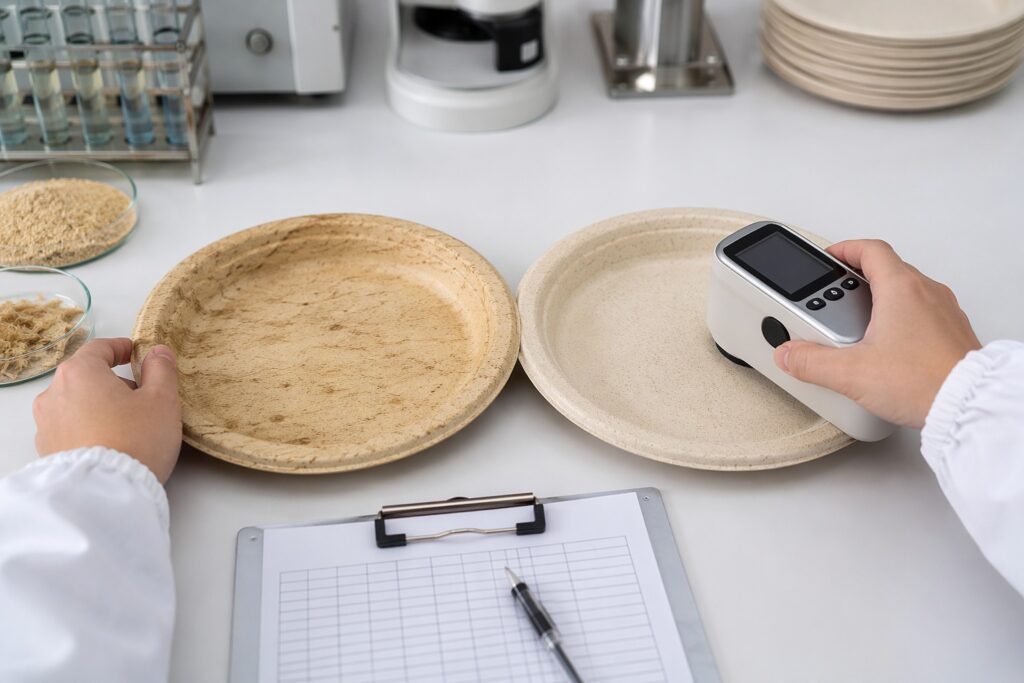
Every B2B tableware buyer eventually opens a container and finds something wrong.
A plate that smells like burnt plastic when heated. A bowl whose “sage green” is visibly different from the approved sample. A fork that snapped at the neck during the customer’s first meal.
These are not isolated manufacturing defects — they are symptoms of specific, diagnosable failures in the production process. In 15 years on the factory floor, I have learned that the buyers who handle these situations best are not the ones with the strongest legal contracts. They are the ones who can identify the root cause before the supplier’s sales team blames “natural material variation.”
This guide is a diagnostic manual. For each of the three most common wheat straw tableware quality issues — odor, color difference, and brittleness — I explain how the failure happens, how to confirm it, how the factory should fix it, and how to prevent it in future orders. If you are currently holding a sample that doesn’t match your approved Golden Sample, start with the diagnostic table below.
Before diving into individual problems, it’s worth understanding the full scope of what a professional supplier’s QC system should cover. Our factory audit guide details the complete documentation package that prevents these issues from reaching your container in the first place.
Quick Diagnostic Table
When a shipment arrives with quality problems, the first task is triage. Use this table to match symptoms to root causes before you contact the supplier.
| Symptom | Most Likely Root Cause | Severity | Section |
|---|---|---|---|
| Strong “burnt cereal” or chemical smell when heated | Injection temperature too high — fiber charring | Critical — potential food safety risk | § Odor |
| Musty, earthy smell even when cold | Inadequate fiber drying before molding | Major — sensory test failure | § Odor |
| Color visibly different from approved sample (ΔE > 5) | Wrong masterbatch batch or ratio | Major — brand integrity risk | § Color |
| Color looks correct under office light but wrong in store | Metamerism — pigment instability | Major — retail rejection risk | § Color |
| Plate cracks or chips when dropped from < 1 meter | PP ratio too low or no annealing | Critical — safety hazard | § Brittleness |
| Fork/spoon snaps at handle neck during normal use | Cooling imbalance + sharp neck radius | Critical — injury risk | § Brittleness |
Problem 1: Odor — When Wheat Straw Smells Wrong
Odor is the most alarming quality issue because it is sensory. The customer experiences it directly, immediately, and emotionally.
An odor complaint typically arrives as: “I microwaved the plate and my kitchen smelled like chemicals.” This is not a cosmetic defect. It is a potential food safety failure that demands immediate investigation.
Root Cause Analysis
Wheat straw composite contains two components that can generate odor under heat: the natural lignin in the wheat fiber, and the volatile organic compounds (VOCs) that remain in the PP resin if processing temperatures are incorrect. There are three distinct odor failure modes, each with a different fix.
Failure Mode A: Fiber Charring. The injection barrel temperature exceeds 195°C. At this temperature, the wheat straw fiber — specifically the lignin and hemicellulose — begins to thermally decompose. The result is a distinct “burnt popcorn” or “burnt toast” smell that intensifies dramatically when the product is heated in a microwave.
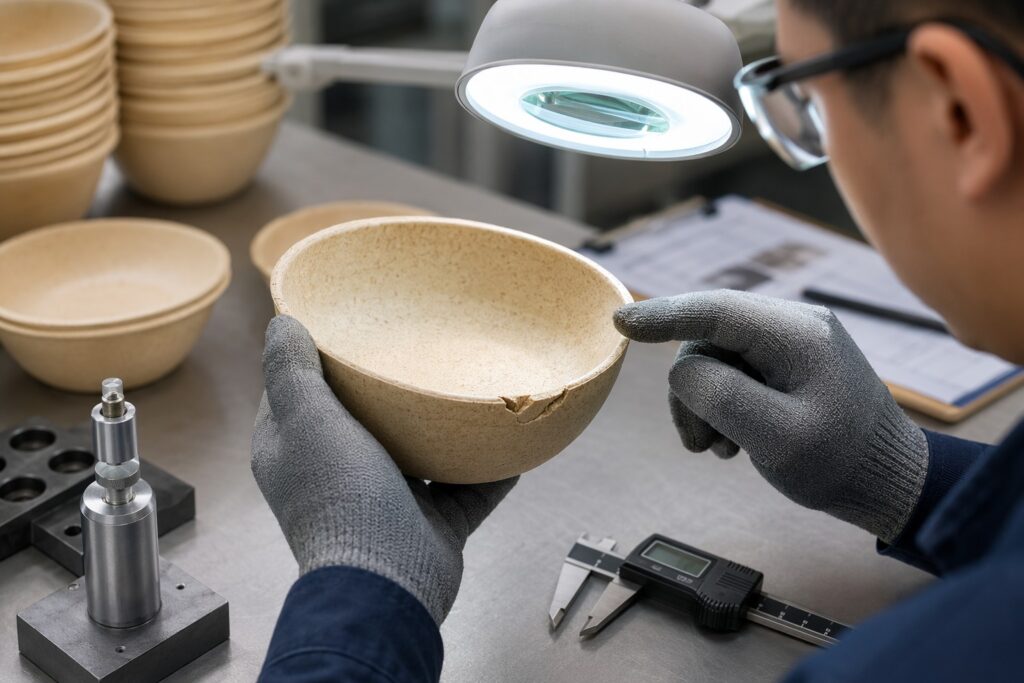
This is the most common odor issue in low-cost wheat straw products, and it is shockingly easy to diagnose. Break the plate in half and examine the cross-section under a magnifying glass. If you see dark brown or black specks distributed throughout the material — not just on the surface — the fiber charred during molding. Surface discoloration alone can be pigment; internal charring is always a temperature problem.
Failure Mode B: Incomplete Degassing. Before injection molding, the wheat straw composite granules must be dried at 80°C for a minimum of 4 hours, reducing moisture content below 0.05%.
If the drying time is cut short — a common shortcut in factories rushing to meet deadlines — residual moisture turns to steam inside the injection barrel. That steam carries volatile compounds from the natural fiber into the finished product. The result is a “musty,” “earthy,” or “grassy” smell present even at room temperature, which intensifies when heated.
Failure Mode C: Low-Grade Binder. Some factories use recycled or industrial-grade PP instead of food-grade virgin PP. Recycled PP may contain residual chemicals — lubricants, cleaning agents, or non-food additives from its previous use.
When heated, these chemicals volatilize and produce an acrid, chemical odor — distinctly different from the organic smell of charred fiber. This is the most serious odor failure because it indicates the product was manufactured with materials not approved for food contact. Under EU Regulation 10/2011, products manufactured with non-food-grade materials are non-compliant regardless of their migration test results.
What to Demand from the Supplier
For an odor complaint, do not accept “air it out for a few days” as a solution.
Demand a hot migration test at 70°C for 2 hours using the LFGB sensory protocol, conducted by an ISO 17025-accredited laboratory such as SGS or TÜV. The test must specifically evaluate odor transfer to food simulants under heat. If the test fails or the supplier cannot provide it, the batch is non-conformant and should be rejected.
The supplier must also provide the production batch records showing the injection temperature for every machine that ran your order. The records should show temperatures consistently between 175°C and 185°C. Any reading above 190°C confirms fiber charring as the cause.
Prevention
In your next purchase order, specify: “Injection molding temperature shall not exceed 185°C. Supplier shall provide batch temperature logs with the pre-shipment inspection. Products exhibiting odor when heated to 70°C shall be considered non-conformant.”
For a complete production documentation template, our wheat straw dinnerware set page includes the QC specifications we apply to every production batch.
Problem 2: Color Difference — When the Product Doesn’t Match the Sample
An odor color difference complaint is usually the first sign that a supplier’s process control is weak. Color matching in wheat straw composite is inherently more difficult than in pure plastic because the natural fiber base color shifts every pigment.
Root Cause Analysis
Failure Mode A: Masterbatch Ratio Drift. The color in wheat straw products comes from a masterbatch — a concentrated pellet of pigment in a PP carrier added to the raw material at a precise ratio, typically 2-4% by weight.
If the dosing equipment is not calibrated, or if an operator manually adjusts the ratio to “stretch” the masterbatch, the color shifts by 5-15%. This is the most common cause of batch-to-batch color variation, and it is entirely preventable through proper equipment maintenance.
Failure Mode B: Masterbatch Supplier Change. A masterbatch from Supplier A may use a different pigment chemistry than an identical-looking masterbatch from Supplier B. Even if both claim to produce “Pantone 555 C,” the actual color on a wheat straw base will differ.
Factories sometimes switch masterbatch suppliers to save cost without informing the buyer. The color shift is only discovered when the container arrives, and by then thousands of units are already manufactured.
Failure Mode C: Metamerism — The Lighting Trap. The wheat fiber’s natural golden undertone interacts with pigments in ways that create metameric color shifts. The plate looks correct under daylight (D65) but visibly different under retail fluorescent lighting (TL84) or warm home lighting (Incandescent A).
This is not a manufacturing error — it is a pigment selection error. The factory chose a pigment that matches under one light source but not under others.
For authoritative guidance on color measurement standards, ISO 3664 defines the viewing conditions for color evaluation. The same principles apply to physical product color matching for tableware.
What to Demand from the Supplier
For a color difference complaint, the supplier must provide a spectrophotometer measurement report comparing the production batch to the approved Golden Sample, with Delta-E values for D65 and TL84 lighting. The ΔE must be ≤ 3.0 under both light sources.
If the supplier cannot provide spectrophotometer data and is relying on “visual inspection,” their QC process is insufficient for professional color management. Demand the name of the lab that performed the measurement and the report reference number.
The supplier must also confirm — in writing — whether the masterbatch supplier or formula has changed since your Golden Sample was approved. An unauthorized change means the batch is non-conformant regardless of the ΔE reading.
Prevention
Require a “Masterbatch Lock” clause in your OEM agreement: “The masterbatch formulation and supplier approved for Golden Sample #XXXX shall not be changed without written buyer approval.” Also require ΔE measurement reports with every pre-shipment inspection, not just at the initial sample stage.
For more on the OEM agreement framework, see our custom color matching guide. If you’re stocking multi-color retail sets, our 12-piece dinnerware collection demonstrates the color consistency benchmarks we maintain across production batches.
Problem 3: Brittleness — When Products Crack, Chip, or Snap
Brittleness is the most dangerous quality issue because it creates sharp edges. A ceramic plate that chips is annoying. A wheat straw plate that shatters into sharp shards when dropped is a liability.
Brittleness failures are always traceable to one of three root causes: the material ratio, the production process, or the product design. Here is how to identify which one you’re dealing with.
Root Cause Analysis
Failure Mode A: Low PP Ratio. The PP binder provides flexibility and impact resistance. When the wheat straw fiber content exceeds 50%, the material becomes brittle — the fibers have insufficient plastic matrix to absorb impact energy.
This can happen because the factory deliberately uses a high fiber ratio to market “more natural content.” Or because the dosing equipment is inaccurate and the PP proportion drifts downward over successive batches. The diagnostic test is simple: drop the plate from 1.5 meters onto a concrete floor. It should bounce or land intact. If it shatters, the PP ratio is too low.
Failure Mode B: No Annealing. Injection molding introduces internal stress into the material. The outer surface cools faster than the core, creating tension that “freezes” into the solid plastic.
Annealing is a controlled slow-cooling process that relieves this stress. A factory that skips annealing to reduce cycle time will produce plates that are deceptively strong when new but develop stress cracks after a few weeks of use.
This failure is particularly insidious because the plate passes a drop test immediately after production but fails after the customer has used it for a month. The trigger is often a dishwasher cycle or a minor impact that a properly annealed plate would survive.
Failure Mode C: Sharp Internal Corners. Brittleness in cutlery is almost always a design problem, not a material problem. The transition from the fork head or spoon bowl to the handle creates a stress concentration.
If the radius at this transition is less than R3.0mm, stress concentrates at a single point and a crack initiates under normal bending force. This is governed by basic mechanical engineering principles — sharper corners create higher stress concentrations, as documented in ASTM material testing standards for polymer products.
What to Demand from the Supplier
For a brittleness complaint, demand three documents from the supplier:
A material composition test verifying the PP-to-fiber ratio against the agreed specification. An annealing process log showing the temperature curve for your production batch. And for cutlery, a measurement report verifying the neck radius meets the R3.0mm minimum.
If the batch is confirmed to have a PP ratio below specification, or the annealing process was not performed, the batch is non-conformant. The supplier bears full responsibility for replacement or refund. Our custom mold development guide covers how to specify these parameters in your mold contract from the beginning.
Prevention
Your purchase order should specify: “PP-to-fiber ratio: 65:35 ±2%. Annealing: required for all products, with batch-specific temperature logs provided. Cutlery neck transition radius: minimum R3.0mm.”
Our wheat straw composite material guide explains these specifications in full technical detail. For a ready-to-order product that meets all these specifications, browse our Premium 24-Piece Dinnerware Set.

B2B Response Protocol: What to Do When Quality Fails
Discovering a quality issue is stressful. The following protocol separates emotional reaction from effective action.
Within 24 Hours of Discovery
Document everything. Photograph the defect with a ruler or color reference card in the frame. Record the batch number, carton number, and the approximate percentage of product affected.
Do not discard any defective product — retain at least 20 samples as evidence. Send the supplier a formal “Quality Notification” email with the photographs, the batch numbers, and a clear description of the defect.
Keep the tone professional and factual. Do not make demands in this email — just document and notify. The purpose is to create a paper trail, not to negotiate.
Within 72 Hours
Agree on a diagnostic protocol. The supplier may request that you send samples back to their facility for root cause analysis. Alternatively, they may agree to an independent third-party test at a laboratory such as Intertek or TÜV.
If the order value exceeds $10,000, insist on an independent test. Do not allow the supplier to self-diagnose the failure. An independent report is the difference between a negotiable claim and an unprovable assertion.
Within One Week
Based on the diagnostic results, agree on a resolution. For confirmed material or process failures, the standard remedy is replacement of the defective product at the supplier’s cost, including freight. Alternatively, a credit against the next order.
For isolated defects affecting less than 2% of the shipment, a credit is typically more practical than a replacement shipment. The administrative cost of shipping a small quantity of replacements often exceeds the product value.
A note on legal recourse: most OEM contracts specify the governing law and dispute resolution mechanism. But the practical reality of international trade is that litigation is expensive, slow, and rarely recovers the full value of a defective shipment for orders under $100,000.
The strongest protection is not the contract. It is the pre-shipment inspection report from a recognized third-party laboratory. This provides objective evidence accepted by trade credit insurers and letter-of-credit issuing banks.
If your order exceeds 20,000,a20,000,a400 third-party inspection is the most cost-effective risk management tool in your entire procurement process. Our BSCI and ISO certification guide explains the role of third-party verification in supplier qualification.
Prevention for Future Orders
Update your purchase order specifications with the specific parameter that failed — temperature range, PP ratio, color ΔE limit, annealing requirement. Require batch-level verification for that parameter in the next pre-shipment inspection.
A practical tip from the factory side: the suppliers who respond fastest to quality complaints are those who value the long-term relationship. If you have placed three or more orders with a supplier and this is the first quality issue, the supplier has a strong incentive to resolve it quickly.
If this is the first order, the supplier’s response reveals everything about whether they are worth a second order. A supplier who deflects, delays, or disappears after a documented quality failure has already shown you what your future partnership will look like.
To understand what a fully transparent manufacturing partnership should look like, read about Naike Dinner and our approach to quality documentation.
Preventive Procurement Checklist
Use this checklist when evaluating a new supplier or renewing a contract. Each item maps to a specific quality issue and its corresponding process control.
- Temperature logs provided with every batch.Injection temperature recorded per machine, per shift. Any reading above 190°C flagged for QC review. Logs included in pre-shipment documentation package.
- Raw material drying records maintained.Wheat straw composite granule moisture content verified at ≤ 0.05% before molding. Drying time and temperature recorded per batch.
- Masterbatch locked per Golden Sample.Supplier confirms in writing that the masterbatch formula and source have not changed since sample approval. Spectrophotometer ΔE measurement provided with every shipment.
- Annealing process documented.Cooling curve data provided per production batch. Annealing logs included in QC documentation package.
- PP ratio verified.Material composition test report provided per production batch, confirming the 65:35 ratio within ±2% tolerance.
- Cutlery neck radius inspected.R3.0mm minimum verified on pre-production samples and random shipment samples.
- Hot migration sensory test current.LFGB or equivalent sensory test for odor and taste performed within 12 months, at 70°C for 2 hours, using the correct food simulants.
For complete supplier evaluation criteria beyond quality issues, our factory audit guide covers documentation, social compliance, and production capability assessment. If you’re evaluating suppliers for the first time, our guide to importing wheat straw tableware from China covers the full procurement workflow.
Conclusion
Wheat straw tableware quality issues are not random events — they are predictable outcomes of specific process failures.
An odor color difference complaint is always traceable to a temperature error, a drying shortcut, a masterbatch change, or an unqualified binder. Brittleness is always traceable to an incorrect PP ratio, a skipped annealing process, or a design with a sharp internal corner.
Every single one of these failures leaves evidence in the production records — if you know what to ask for. The B2B buyer who can read a temperature log, interpret a ΔE measurement, and verify an annealing curve does not need to threaten legal action. They can demonstrate, with data, that the supplier’s process deviated from the agreed specification.
That demonstration, made calmly and professionally, resolves most quality disputes within one week.
Need Help Diagnosing a Quality Issue?
If you have a shipment with odor, color, or brittleness problems and you are not sure how to proceed, send us photographs and batch numbers. We will help you identify the likely root cause and the specific documentation to request from your supplier.
Contact Our QC Team for Diagnostic Support
Browse the Wheat Straw Plates Wholesale Collection
CONTACT US
Can Wheat Straw Tableware Go in the Freezer?
Can wheat straw tableware go in the freezer? This evidence-led B2B guide explains frozen-storage conditions, material variables, freeze-thaw testing, compliance documents and the questions buyers should ask before approving a freezer-safe claim.

EU GPSR Wheat Straw Tableware: A Traceability Guide
A factory-side guide to GPSR traceability, technical documentation, responsible-person information, online listings and corrective-action planning for EU wheat straw tableware programs.
Does Wheat Straw Tableware Contain Gluten?
A factory-insider guide for B2B buyers evaluating wheat straw material sources, gluten-related claims, testing scope, food-contact compliance and supplier controls.
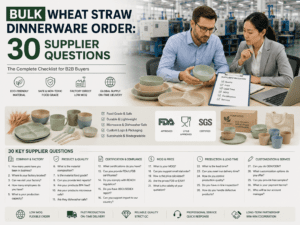
Bulk Wheat Straw Dinnerware Order: 30 Supplier Questions
Ask these 30 bulk wheat straw dinnerware order questions before you sign. Avoid costly mistakes with our supplier checklist. Send your inquiry with confidence now.
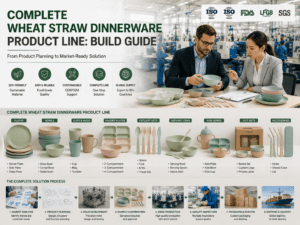
Complete Wheat Straw Dinnerware Product Line: Build Guide
Build a complete wheat straw dinnerware product line with plates, bowls, cups and cutlery. Learn assortment strategy, SKU planning and margin optimization. Get your line quote.
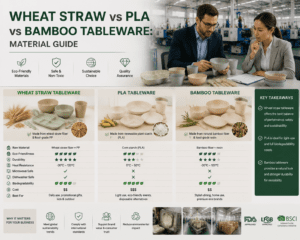
Wheat Straw vs PLA vs Bamboo Tableware: Material Guide
Compare wheat straw vs PLA vs bamboo tableware for B2B sourcing. Learn heat resistance, cost, and safety differences. Get material recommendations now.