Stainless Camping Plates
Flat, rimmed or divided formats with diameter, thickness and surface condition controlled.

Outdoor Material Solution | Wholesale OEM
Wholesale stainless steel camping plates, bowls, cups and mess kits for outdoor retail, RV and glamping projects, with agreed steel grade, thickness, finish, logo and storage packaging.

Stainless steel supports durable camp dining, but steel grade, construction and surface treatment should be defined before comparing prices.
Flat, rimmed or divided formats with diameter, thickness and surface condition controlled.
Stackable bowls for individual or family sets, evaluated for depth, stability and rim finish.
Single-wall formats with formed or welded handles and agreed capacity.
Forks, spoons and knives supplied loose, sleeved or integrated into a mess kit.
Plate, bowl and cup combinations with optional cutlery and pouch.
Stackable components with carry bag or hard-case development.
304, 316 and other designations should never be used as generic marketing labels. The selected grade must match the quotation and approved evidence.
| Specification field | How it is defined |
|---|---|
| Steel grade | 304, 316 or another agreed grade is recorded on the SKU; no grade is implied across the full range. |
| Thickness | Measured by component because plates, bowls, cups and cutlery may require different constructions. |
| Surface treatment | Brushed, mirror-polished, bead-blasted or powder-coated finishes require separate appearance criteria. |
| Rim and edge | Rolled, curled or polished edges are checked for burrs, deformation and cleaning access. |
| Joining method | Welds, rivets and handle attachments are evaluated for position, strength and surface condition. |
| Stacking and noise control | Taper, rim clearance, separators and storage design affect nesting and transit marking. |
Testing should follow the selected steel, finish, construction and destination. Salt-spray exposure is not a universal substitute for grade verification or real use conditions.
Review material certificates and use composition verification when required by the buyer protocol.
Check gauge, dimensions, capacity and unit weight against approved tolerances.
Define method and duration only when relevant to coated finishes, hardware or the agreed procurement specification.
Evaluate coating adhesion, abrasion or staining only for the actual surface claim.
Check dents, distortion, weld condition, sharp edges, polishing marks and component count.
Select migration or other tests according to destination and intended contact conditions.

Material selection should follow the use case, target price, performance requirement and evidence needed by the destination market.
Durability and stackable storage are primary.
Consistent finish and easy replacement support repeated service.
Private-label sets balance durability, price and shelf presentation.
Specifications, inspection and documentation drive acceptance.
Development proceeds from specification to evidence and approval so material claims, product performance and packaging remain aligned.

Use these internal links to compare the material within the complete outdoor sourcing structure.
Project purchasing control
For retail, RV, glamping and institutional programs, steel grade alone is not enough. Construction, thickness, finish, corrosion exposure and packaging protection influence cost and performance.
Specify grade, gauge, rim, welds, handles, surface treatment, dimensions and unit-weight tolerance for every SKU.
Define food-contact scope, finish checks, burr inspection, joint checks and corrosion testing only where relevant to intended use.
Provide annual demand, first-order quantity, laser-logo artwork, pouch or box format, carton weight and delivery window.
Not automatically. The buyer should define the grade needed for the product, destination and performance requirement.
It may be relevant for coated surfaces or hardware when the procurement specification defines a method and duration.
Some products can, but coating system, food-contact scope, adhesion and appearance criteria must be confirmed.
The approved specification records thickness by component with an agreed measurement method and tolerance.
Yes, subject to the steel finish, logo size, position, contrast and order quantity.
Fabric pouches, zippered bags and custom hard cases can be evaluated against set size and budget.
Send the component list, target market, material requirement, quantity, logo, packaging, tests and delivery target.
Durability and finish control
Stainless steel camping tableware is often selected for RV programs, glamping operators, rental fleets and outdoor retailers that value repeat use. The sourcing risk is assuming every shiny sample has the same steel grade, thickness or edge quality. The purchase specification should name the agreed grade, tolerance, surface direction, rolled-rim profile and logo process.
Plate diameter, base geometry and sheet thickness work together. Test stability on a flat table after the agreed impact and transport routine instead of relying on thickness alone.
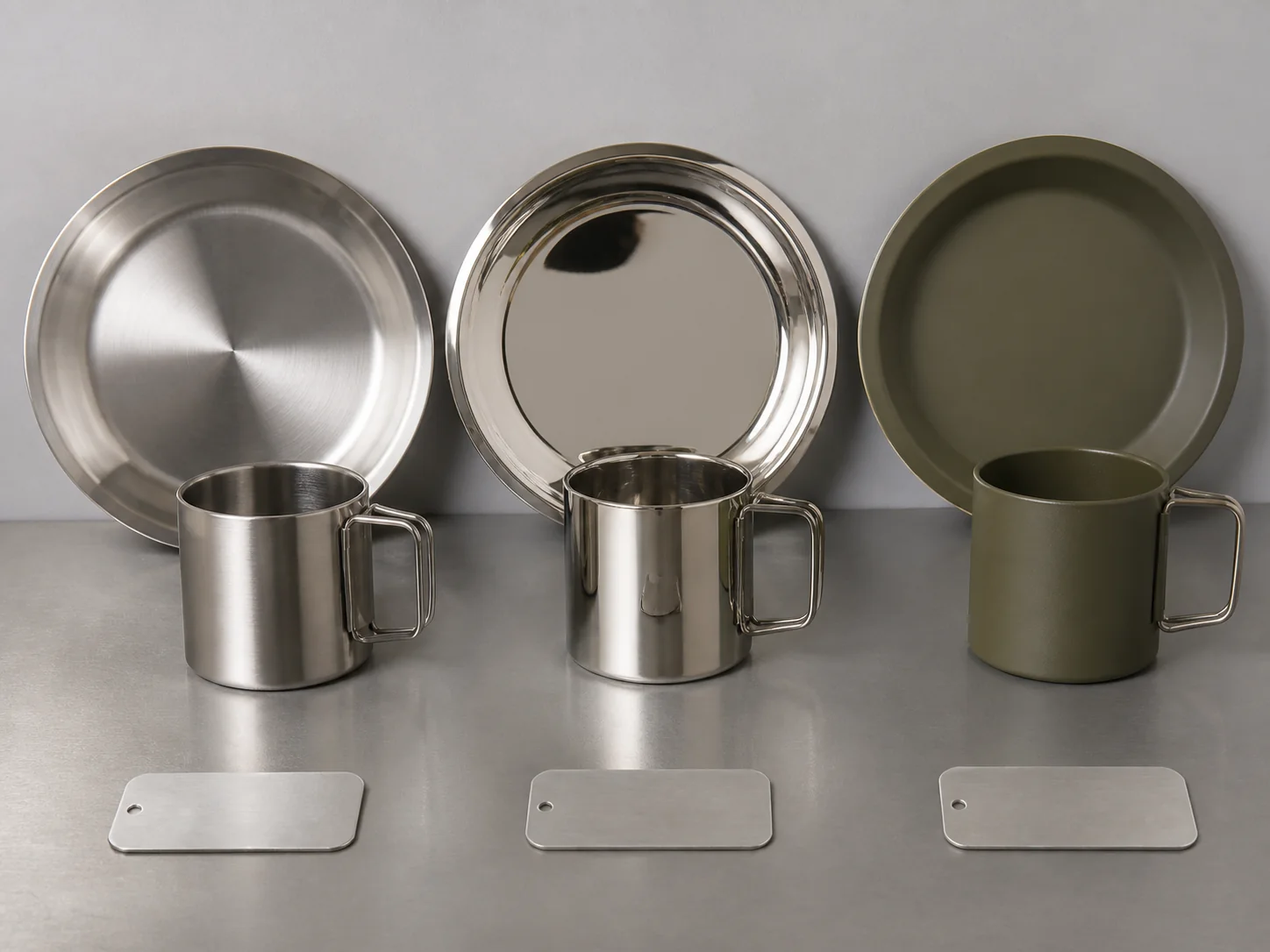
Brushed, mirror and powder-coated finishes require different appearance limits. Approve a physical master sample and define which handling marks are unacceptable.
Inspect rolled rims, utensil edges, mug handles and weld areas by touch as well as sight. These are direct user-contact features.
Choose corrosion or salt-spray testing only when it reflects the intended exposure. Record the solution, duration and acceptance criteria rather than publishing a broad “rust-proof” promise.
Record steel declaration, dimensions, net weight, capacity, wobble, surface appearance, logo position, edge finish, nesting fit and packaging protection. The result becomes a repeatable acceptance standard for later production lots.
See the camping plate geometry guide, configure a family dinnerware set, or compare all materials in the outdoor tableware hub.
For a comparable stainless steel mess kit quotation, buyers should state the intended user count, nominal steel grade, finished thickness and weight tolerance for every plate, bowl and cup. The brief should also define whether the product is drawn, stamped or welded; the approved edge profile; surface direction; logo method; and the packed storage system. Salt-spray testing is useful only when the selected method, duration and acceptance limit reflect the real environment. For RV rental, glamping and project procurement, replacement components and repeat-order finish control should be agreed before mass production. These details reduce hidden specification differences between samples that otherwise appear similar in photographs.