
Does wheat straw tableware contain gluten? The responsible factory answer is not a casual yes or no. Wheat straw fiber comes from the stalk left after grain harvesting, while gluten is associated with the grain and food ingredients made from gluten-containing cereals, but agricultural separation alone does not prove that every batch of straw-derived material is free from trace residues.
For a B2B buyer, the practical question is therefore not whether the product name sounds safe. The useful question is whether the supplier can document the raw-material source, cleaning process, composite formulation, cross-contact controls, test scope, and exact wording of any consumer-facing claim.
At Naike Dinner, we treat this as a specification and evidence problem rather than a marketing slogan. This guide explains how importers, retailers, children’s brands, foodservice distributors, and promotional-product buyers can evaluate a gluten-free wheat straw tableware request without confusing food-label rules with food-contact-material compliance.
Does Wheat Straw Tableware Contain Gluten in Normal Manufacturing?
In a controlled production system, the raw fiber should be sourced from cleaned wheat stalks rather than edible wheat flour or wheat-grain ingredients. The fiber is dried, milled, screened, and blended with a food-contact polymer and processing aids to form a moldable composite, as described in our guide to wheat straw composite material.
That production description supports a low-risk assessment, but it is not the same as an analytical result. Grain fragments can remain after harvest, shared agricultural equipment can introduce dust, storage can mix lots, and a material processor may handle several plant-based powders on the same line.
The finished article is also tableware, not food. The European Commission’s rules for the terms “gluten-free” and “very low gluten” are written for food information, while food-contact articles are evaluated under a different framework; buyers should not automatically apply a food-label threshold to a plate without defining why and how that threshold will be measured.
This distinction matters commercially. A supplier may be able to demonstrate compliant food-contact performance while being unable to support an absolute allergen-free marketing claim, and those two statements should never be treated as interchangeable.
Does Wheat Straw Tableware Contain Gluten? Four Answers to Separate
“No wheat flour is intentionally added” is a formulation statement. “The raw-fiber supplier operates an allergen-control program” is a process statement, while “the finished article tested below a stated reporting limit” is a laboratory statement.
“Safe for food contact” is a regulatory and migration statement. Each answer covers a different question, so a professional purchasing file should identify which answer the brand actually needs before requesting documents or approving artwork.
Why Wheat Straw and Wheat Grain Must Not Be Treated as the Same Input
A wheat plant produces grain heads and structural stalks. After threshing, the grain enters the food stream and the remaining straw may be collected for agricultural, packaging, building, or composite-material uses.
For tableware production, the useful portion is the fibrous stalk because it can be cleaned, ground, and dispersed through a polymer matrix. Buyers who need a broader introduction can first review what wheat straw tableware is and how it is made.
However, “different part of the plant” does not mean “guaranteed absence.” Harvesters, balers, transport sacks, grinders, and storage silos can all create opportunities for residual grain or dust to follow the straw into the next process.
A good material processor therefore controls reception and cleaning instead of relying on the crop name. Typical controls include visual foreign-matter inspection, sieving, washing or air separation where appropriate, controlled drying, magnets or metal detection, sealed storage, lot identification, and documented line clearance.
Why Molding Temperature Is Not Proof of a Gluten-Free Claim
Injection molding exposes the composite to heat and pressure, but processing temperature should not be used as a shortcut for allergen evidence. Heat may change proteins, yet a production team cannot assume that a thermal cycle makes every possible residue irrelevant without a validated method and a defined acceptance criterion.
This is one of the most common weak answers we hear during buyer audits: “The machine is hot, so there cannot be gluten.” It sounds technically reassuring but does not identify the starting contamination level, the transformation that occurred, or whether the chosen laboratory method can still detect the relevant target.
For procurement purposes, thermal processing is a manufacturing parameter, not a certificate. Record the barrel temperature and residence time for process control, but base any consumer-facing claim on a written risk assessment and suitable evidence.
Compare the Claims Before You Ask a Factory for Evidence
Many disputes begin because the buyer writes “must be gluten-free” in an email without defining the commercial or regulatory meaning. The supplier then sends a general food-contact report, while the buyer assumes the report confirms an allergen claim.
The comparison below separates four statements that often appear together in sourcing discussions. Use the narrowest statement that truthfully meets the needs of the destination market and customer.
| Proposed statement | What it actually addresses | Evidence a buyer should request | Typical risk |
|---|---|---|---|
| No wheat flour intentionally added | Declared formulation and purchasing controls | Bill of materials, supplier declaration, production formula | Does not rule out incidental agricultural or line cross-contact |
| Made with cleaned wheat straw fiber | Identity and preparation of the plant filler | Raw-material specification, process flow, lot traceability | “Cleaned” may be undefined unless the process and limits are written |
| Tested for gluten | A specific sample, method, laboratory and reporting limit | Full report naming the finished SKU, color, method and result | Can be misleading if the method is unsuitable for a composite article |
| Gluten-free wheat straw tableware | A broad consumer-facing absence claim | Market review, risk assessment, controlled supply chain and claim-specific testing | May imply a food-standard guarantee that the evidence does not support |
The claim should never be broader than the documents, sample identity, method scope, and reporting limit that support it.
The European Commission’s gluten-free food guidance confirms that harmonized “gluten-free” conditions apply to food information. A tableware buyer can use that framework to understand consumer expectations, but should obtain market-specific advice before placing the same wording on a non-food article.
Map the Gluten Risk Across the Wheat Straw Tableware Supply Chain
A reliable assessment follows the material from the field to the packed article. Testing only a polished sales sample can miss changes in the raw-fiber source, color masterbatch, production line, rework policy, or storage practice.
1. Agricultural Collection and Separation
The first question is how the straw is separated from grain and foreign matter. Buyers should ask whether the collector accepts mixed cereal residues, whether collection equipment is shared, and what incoming-material limit applies to visible kernels, husks, soil, and other contamination.
A simple statement that the input is “100% wheat straw” is not enough. The specification should define plant part, origin, moisture range, foreign-matter limit, storage condition, and the lot code that connects the shipment to the processor’s records.
2. Fiber Cleaning, Milling and Storage
At the fiber processor, the material may pass through cutting, cleaning, drying, milling, screening, and packing. The buyer should understand whether equipment is dedicated, whether food ingredients or other cereal powders are processed nearby, and how the line is cleared between materials.
Particle size also matters to product consistency even though it does not prove allergen status. A controlled mesh range helps the fiber disperse evenly, while excessive moisture or unstable particle distribution can create odor, bubbles, surface streaks, or brittle areas.
3. Compounding and Additive Control
The fiber is only one part of a commercial composite. The formulation may also contain polypropylene, pigments, coupling agents, stabilizers, lubricants, or other processing aids, and every intentionally used substance must be listed in the controlled bill of materials.
Buyers should require virgin food-contact-grade polymer where that is their specification and prohibit uncontrolled regrind. Our existing guide on wheat straw dinnerware safety explains why composition, migration testing, and intended conditions of use must be reviewed together.
4. Molding, Handling and Packing
During molding, cross-contact risk is usually lower than in agricultural handling, but line discipline still matters. Open containers, unlabelled additives, uncontrolled rework, food consumed in production areas, and poorly separated packing materials can undermine an otherwise good raw-material program.
A professional factory uses identified material bins, batch cards, approved color recipes, first-piece inspection, segregated rejected material, cleaning schedules, and lot coding. These controls also support broader quality claims because they allow a complaint to be traced back to a production window and raw-material batch.

Build a Verification Plan for Gluten-Free Wheat Straw Tableware
The verification plan should begin with the claim and intended user, not with whichever test a supplier happens to have. A children’s brand selling into specialist allergy-aware retail may need a different evidence package from a general promotional-products distributor that makes no gluten statement.
Step 1: Define the Intended Use and Claim
State whether the article will contact hot, cold, acidic, fatty, dry, or aqueous food, and record microwave, dishwasher, freezer, and repeat-use expectations. Then state the exact packaging wording under consideration and the countries where it will appear.
If the real goal is simply to reassure a buyer that wheat flour is not intentionally added, say that. Do not expand the specification into “certified gluten-free” unless a recognized program, applicable scope, and continuing controls are genuinely available.
Step 2: Review Documents Before Ordering a Test
Request the finished-product bill of materials, raw-fiber specification, supplier declaration, process flow, cross-contact risk assessment, line-cleaning procedure, and batch-traceability example. The names and lot codes should agree across documents instead of appearing as generic templates.
This document review often reveals whether testing is meaningful. If the factory cannot identify the raw-fiber supplier or connect the tested sample to a production lot, a laboratory result provides only a snapshot with no dependable control behind it.
Step 3: Agree on the Laboratory, Method and Reporting Language
Use a laboratory whose accreditation scope covers the relevant analytical work, and ask the laboratory to confirm that its method is suitable for a molded polymer-fiber composite. ISO/IEC 17025 provides the international framework laboratories use to demonstrate competence and valid results, but the laboratory’s actual accredited scope still needs to be checked.
Method selection must match the material and the claim being evaluated. Intertek’s official overview of food allergen testing notes that cereals containing gluten can be tested at low levels, but buyers should still ask the chosen laboratory to confirm suitability for a finished polymer-fiber tableware matrix rather than assuming that a food method transfers automatically.
The test request should identify the exact finished SKU, color, batch, sampling plan, extraction approach, target analyte, reporting limit, and result wording. A report for raw straw powder does not automatically support a finished blue plate, and a report for one color does not automatically cover every pigment system.
Do not ask the laboratory to certify a marketing sentence. Ask it to report what was tested, how it was prepared, what method was used, what the reporting limit was, and what result was obtained; the brand owner can then decide whether the proposed claim is supportable in its market.
Step 4: Convert the Result into Ongoing Production Control
A single passing sample is not a permanent property of every future order. Define what changes trigger re-evaluation, such as a new fiber supplier, a different harvest region, changed cleaning equipment, a revised polymer formula, a new pigment, production at another facility, or a long interruption between orders.
For continuing programs, agree on incoming checks, periodic document renewal, retained samples, lot records, and a risk-based testing frequency. Buyers can integrate these points into the broader documentation hierarchy described in our guide to verifying wheat straw tableware claims.
Keep Gluten Questions Separate from Food-Contact Compliance
A gluten assessment cannot replace migration testing, sensory testing, or a Declaration of Compliance where required. The reverse is also true: a migration report does not automatically answer an allergen-absence question unless the method and analyte specifically address it.
Under the EU framework, food-contact materials must be manufactured so that they do not transfer constituents to food in quantities that could endanger health, unacceptably change food composition, or deteriorate taste and odor. The European Commission’s food-contact-material legislation page summarizes these safety and inertness principles.
A complete buyer file may therefore contain separate evidence groups: composition and supplier declarations, overall and specific migration reports, sensory results, mechanical-use testing, traceability records, and claim-specific evidence. Keeping these groups separate makes audits faster and prevents a sales team from using one certificate to support claims outside its scope.
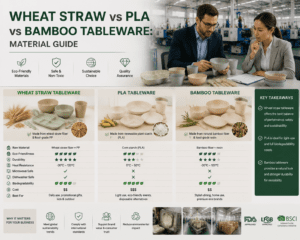
Material comparisons require the same discipline. Wheat straw, bamboo-filled plastic, PLA, melamine, and conventional PP have different formulation, use-temperature, durability, end-of-life, and compliance questions, which are reviewed in our wheat straw vs PLA vs bamboo tableware guide.
Three Commercial Scenarios and the Right Level of Evidence
Scenario A: General Retail with No Gluten Claim
A mainstream retailer may not need a gluten statement on the tableware at all. Its priority is usually a controlled bill of materials, food-contact compliance for the destination market, traceability, performance testing, accurate environmental claims, and consistent packaging.
In this case, the buyer can still ask whether wheat flour or grain ingredients are intentionally added and record the supplier’s answer. Avoiding an unnecessary front-of-pack claim reduces legal and reputational risk without lowering the underlying manufacturing standard.
Scenario B: Allergy-Aware Brand or Institutional Program
A specialist brand, school program, hospital supplier, or allergy-aware retailer may receive direct questions from consumers. It should define the concern with its compliance advisers, request a documented risk assessment, and determine whether finished-article testing is appropriate.
The final wording may be narrower than “gluten-free.” For example, a documented statement about intentional ingredients and controlled raw-material sourcing may communicate the available evidence more accurately, provided it has been reviewed for the target market.
Scenario C: Private Label with a Printed Gluten-Free Claim
This is the highest-risk scenario because the claim becomes part of the permanent artwork and may be repeated by distributors. The brand owner should approve the wording, market basis, evidence package, retest triggers, and complaint-response plan before plates, cartons, sleeves, manuals, or online listings are printed.
Artwork approval should be tied to a controlled sample and version number. When buyers develop custom wheat straw dinnerware sets, we recommend freezing the formula, color, artwork, packaging statements, and verification documents in the same approval record.
B2B Buyer Checklist for Wheat Straw Tableware Gluten Questions
Use this checklist during supplier qualification and before artwork approval. Record document names, revision dates, test-report numbers, and responsible owners in the purchase file instead of accepting answers only in chat messages.
| Check | Question | Why It Matters |
|---|---|---|
| Plant input | Is the filler made from cleaned stalk fiber, and how is residual grain controlled? | Separates a defined raw-material specification from a generic “wheat-based” description. |
| Formulation | Are wheat flour, wheat starch, grain powder, or other cereal-derived ingredients intentionally added? | Establishes what the supplier actually puts into the composite. |
| Supplier control | Can the factory identify the fiber processor and trace each delivery to a lot? | Allows test results and complaints to be connected to real production. |
| Cross-contact | Does the processor handle grain powders or food ingredients on shared equipment? | Identifies incidental-residue pathways that a formula sheet alone cannot show. |
| Claim wording | What exact statement will appear on packaging, listings, and sales documents? | Prevents evidence for a narrow fact from being stretched into an absolute claim. |
| Laboratory scope | Has an accredited laboratory confirmed that the chosen method suits the finished composite? | A familiar food method may not automatically perform the same way on a polymer-fiber matrix. |
| Sample identity | Does the report identify the finished SKU, color, batch, method, and reporting limit? | Stops one sample report from being used across unrelated variants. |
| Change control | Which supplier, formula, color, site, or process changes trigger document review or retesting? | Keeps continuing orders aligned with the approved evidence. |
| Food contact | Are migration, sensory, intended-use, and traceability documents reviewed separately? | Gluten-related evidence does not replace legal food-contact compliance. |
| Contract | Are the approved claims and evidence obligations written into the purchase specification? | Makes the requirement enforceable and assigns responsibility before production. |
Common Buyer Mistakes When Evaluating Gluten Risk
The first mistake is accepting a one-line supplier declaration with no formulation or lot reference. A useful declaration identifies the legal company, material code, manufacturing site, revision date, scope, responsible signer, and records supporting the statement.
The second mistake is using a food threshold as though it were automatically a legal tableware claim standard. Food-label rules help define consumer expectations, but the buyer still needs a defensible method, sample preparation, and market review for a food-contact article.
The third mistake is testing only raw fiber and applying the result to every finished product. Compounding, pigments, rework, shared equipment, and lot changes occur after the raw-fiber stage, so a finished-article claim should normally be connected to the finished article.
The fourth mistake is assuming a certificate lasts forever. Reports and declarations should be reviewed against change-control events and customer requirements, not recycled indefinitely after suppliers, materials, or production sites change.
The fifth mistake is promising medical safety. A tableware manufacturer can provide manufacturing records, product specifications, food-contact evidence, and defined analytical results, but should not diagnose individual sensitivity or tell consumers how to manage celiac disease.
B2B Buyer FAQ: Wheat Straw Tableware and Gluten
Is wheat straw naturally the same as wheat flour?
No. Straw is the structural stalk remaining after the grain is harvested, while flour is made from grain; they are different raw-material streams and serve different functions.
That distinction lowers the likelihood of intentional gluten-containing food ingredients in a properly specified straw-fiber composite, but it does not prove the absence of trace agricultural or processing residues. Buyers still need supplier controls and evidence proportionate to the claim they plan to make.
Can Naike Dinner guarantee zero gluten in every wheat straw product?
An absolute “zero” guarantee should not be issued without a defined method, reporting limit, representative sampling plan, controlled supply chain, and continuing verification. Laboratory reports normally describe results relative to a method and limit rather than proving the metaphysical absence of every molecule.
We can review the requested claim, confirm the intended formulation, document raw-material controls, arrange suitable third-party work when feasible, and manufacture against an approved specification. The buyer remains responsible for approving market-facing wording with its compliance advisers.
Does food-contact compliance prove that tableware is gluten-free?
No. Food-contact compliance evaluates whether a material is suitable for its intended contact conditions under applicable rules, commonly through composition review, migration testing, sensory evaluation, and supporting declarations.
A gluten-related claim is a separate question unless the specific test program addresses it. Keep both evidence packages in the technical file and avoid using one report as a substitute for the other.
Should every color and SKU be tested?
The answer depends on the risk assessment, formulation families, pigment systems, manufacturing controls, customer requirements, and laboratory advice. Buyers should not assume that a beige plate report automatically covers a dark bowl made on another line with another material lot.
A technical team may justify product grouping when formulations and processes are genuinely equivalent. That grouping rationale should be written, approved, and reviewed whenever a relevant variable changes.
What should appear in a supplier declaration?
The declaration should identify the supplier, factory, material or product code, covered SKUs, formulation statement, raw-fiber source, relevant controls, exclusions, revision date, and authorized signer. If it references tests, the report numbers and exact sample identities should be included.
Declarations should avoid vague phrases such as “eco safe” or “all natural.” Precise language is easier for buyers, laboratories, auditors, and regulators to interpret consistently.
What is the safest packaging wording for an untested product?
Do not use “gluten-free,” “zero gluten,” or an equivalent absence claim merely on assumption. If the formulation evidence supports a narrower factual statement, ask local counsel or the responsible compliance team whether that wording is appropriate for the destination market.
When evidence is incomplete, omit the claim and emphasize substantiated attributes such as the product composition, intended use, care instructions, reusable design, verified food-contact documentation, and traceable manufacturing process.
Conclusion: Does Wheat Straw Tableware Contain Gluten?
Does wheat straw tableware contain gluten? A properly controlled product is made with processed stalk fiber rather than wheat flour, but the product name alone cannot prove a universal absence claim across every farm, processor, formulation, factory, color, and batch.
The professional B2B approach is to separate formulation, process control, analytical testing, food-contact compliance, and marketing wording. Each part should have its own evidence, owner, revision date, and change-control trigger.
For buyers serving allergy-aware markets, the strongest file begins before sampling. Define the intended claim, identify the finished SKUs, review the raw-material and manufacturing controls, agree on a competent laboratory and suitable method, and write the continuing requirements into the purchase specification.
Naike Dinner can support that process from material declaration through sample approval and mass-production traceability. You can also review our factory and quality-control background before requesting documentation for a new private-label program.
Discuss Your Wheat Straw Tableware Specification
Tell us your destination market, intended use, product range, colors, claim wording, and required documents. We will review the specification before recommending samples, testing, packaging, and production controls.