
Wheat Straw Tableware Lead Time & Payment Terms Guide
A B2B procurement manager once told me: “I don’t lose money on the unit price. I lose money on the three months between sending the deposit and receiving the container.” That sentence captures why wheat straw tableware lead time and wholesale payment terms are not administrative details — they are profit and loss drivers.
Every day a container sits in production delay or port congestion costs you in three ways simultaneously: your capital is tied up in a deposit the supplier already holds, your inventory is not on shelves generating revenue, and your retail or distribution partners are calling you for delivery updates.
A 15-day lead time extension on a 40,000 order, at a 10164 in financing alone — and that is before accounting for lost sales, client penalties, and the opportunity cost of not placing the next order.
I have managed production schedules for wheat straw dinnerware factories for 15 years. I have negotiated payment terms with buyers from startup Amazon sellers wiring 5,000 deposits to multinational distributors opening letters of credit for 200,000.
The rules that govern payment terms and lead times are not legal requirements — they are outcomes of trust, volume, and negotiation leverage.
According to global trade pattern data tracked by UN Comtrade, importers who negotiate favorable payment terms consistently outperform competitors on working capital efficiency, regardless of the unit price they pay. This guide explains how to structure both to protect your capital and your timeline.

Payment Terms: What Each Structure Costs You
Wholesale payment terms determine how much capital you commit, when you commit it, and what happens if the shipment fails. A supplier who demands 100% upfront payment is transferring all risk to you. A supplier who accepts 30% deposit and 70% against a copy of the bill of lading is sharing risk reasonably. A supplier who offers open account terms is extending you credit — which only happens after a multi-order relationship with zero disputes.
| Payment Term | Typical Structure | Buyer Risk Level | When to Accept |
|---|---|---|---|
| 100% upfront T/T | Full payment before production | Very high | Never for first orders; only for small trial orders under $3,000 |
| 50/50 T/T | 50% deposit, 50% before shipment | Moderate-high | Small suppliers who need working capital; order value under $10,000 |
| 30/70 T/T | 30% deposit, 70% against B/L copy | Moderate | Most common structure for orders 5,000−5,000−100,000 |
| 30/70 T/T with balance against B/L | 30% deposit, 70% after shipment | Low-moderate | Standard for established supplier relationships |
| L/C at sight | Bank guarantees payment upon document presentation | Low | Orders above $50,000; first orders with a new supplier |
| L/C 60 days | Bank guarantees payment 60 days after B/L date | Very low | Long-term partnerships; improves buyer cash flow |
| Open account (O/A) | Payment 30-90 days after shipment | None (buyer) | Only after 5+ successful orders and verified financial stability |
The hidden cost of payment terms is the working capital cycle. Under 30/70 T/T, on a 40,000 order, you pay 12,000 at order confirmation. Thirty-five working days later, when the goods ship, you pay the remaining $28,000. Your capital is committed for approximately 35 days.
Under L/C 60 days, your bank issues the L/C at order confirmation (requiring a margin deposit, typically 10-20%), but you do not pay the invoice until 60 days after shipment — giving you approximately 95 days of working capital float. For a distributor turning inventory every 90 days, this cash flow difference can fund an additional product line.
For buyers placing their first order, we recommend starting with 30/70 T/T. It protects both parties: the supplier receives enough deposit to purchase raw materials, and the buyer retains leverage by holding the majority of payment until shipment evidence is provided.
Lead Time Deconstructed: Where the Days Go
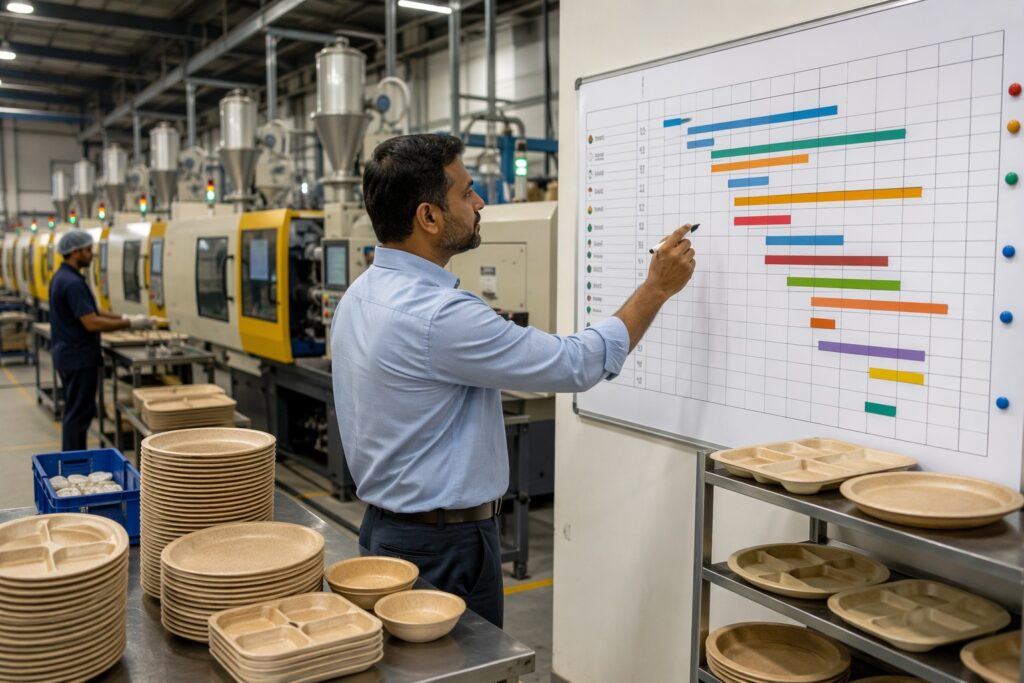
Wheat straw tableware lead time is not one number. It is the sum of five sequential stages, each with its own dependencies and failure modes. Understanding where the days go allows you to identify which delays are the supplier’s fault and which are inherent to the manufacturing process.
Raw material procurement: 5-8 working days. The factory orders food-grade PP resin, wheat straw fiber, and color masterbatch from their suppliers. Delay risk: low for standard colors (natural beige is always in stock); moderate for custom Pantone colors, which may require a special masterbatch production run.
Production scheduling and machine allocation: 2-5 working days. Your order enters the production queue. Delay risk: high during peak season (August-October for holiday orders, January-March for spring retail launches). A factory running at 95% capacity cannot absorb rush orders without displacing existing production.
Mass production: 12-18 working days for a standard 20,000-unit order. Each injection molding machine produces approximately 3,000-4,000 units per 24-hour shift. A factory with six machines allocated to your order can produce 20,000 units in approximately 1.5 shifts — but most factories run multiple orders simultaneously, so machine allocation is typically 2-3 machines per order, extending production to 12-18 days.
Quality control and third-party inspection: 2-3 working days. In-house QC inspects the production batch; a third-party inspector (SGS, Bureau Veritas, QIMA) conducts an independent AQL sampling following ISO 2859-1 sampling procedures. Delay risk: 1-3 additional days if the inspection identifies major defects requiring rework.
Container loading and customs clearance: 3-5 working days. Goods are palletized, loaded into a container, and cleared through Chinese export customs. Delay risk: moderate during peak shipping season (September-November) when container availability tightens and port congestion increases.
Total standard lead time: 25-35 working days for a 20,000-unit order of standard-color wheat straw dinnerware from an established supplier. Add 5-8 working days for custom-color production, 8-12 working days for custom mold development, and 3-5 working days for each additional round of sample revisions.
What You Can Control vs. What You Cannot
Every B2B buyer wants shorter lead times. But not every factor in the lead time equation is negotiable. Separating the controllable from the uncontrollable prevents you from demanding a 20-day lead time from a supplier who cannot physically deliver it — and prevents you from accepting a 45-day lead time from a supplier who could deliver in 30 days with better planning.
Factors you can shorten through negotiation or planning:
- Order confirmation speed. Many buyers lose 3-5 days between receiving a quotation and issuing a purchase order. If you know your specifications — product, color, packaging, logo — before you request the quotation, you can confirm the order within 24 hours and immediately enter the production queue. Our customers who submit a complete specification package with their initial inquiry typically reduce total lead time by 5-7 working days.
- Sample approval cycle. Pre-production samples must be approved before mass production begins. If you take 5 days to approve a sample that arrived in 3 days, your lead time extends by 5 days. Establish an internal SLA: samples are reviewed within 24 hours of receipt, and feedback is communicated in a single email, not a multi-day email thread. For our OEM partners, this single discipline typically cuts 4-6 working days from the project timeline.
- Color and packaging specification. Custom colors require masterbatch production, and custom packaging requires print plate preparation. If you select a standard color from the supplier’s catalog and use a standard packaging template, you eliminate 5-8 working days from the lead time. For custom projects, see our color matching guide for the exact timeline requirements.
Factors you cannot shorten:
- Injection molding cycle time. A wheat straw dinner plate requires 25-35 seconds of machine time per cycle, per cavity. You cannot speed up injection molding without compromising product quality — faster cycles cause short shots, warping, and fiber charring. A factory that promises to reduce cycle time below the material’s physical limit is lying or cutting corners.
- Ocean freight transit time. From Chinese ports to Los Angeles is 12-16 days. To Rotterdam is 25-30 days. To Sydney is 15-20 days. Air freight can reduce transit to 3-7 days but costs 3-5 times more per kilogram — rarely economical for dinnerware unless it is a emergency restock of a high-margin product.
- Customs clearance. Import customs processing takes 1-5 business days depending on the destination country, the completeness of your documentation, and random inspection selection. You can minimize delays by ensuring your commercial invoice, packing list, and certificates of origin are accurate, but you cannot eliminate the customs process.
Production Scheduling: The Peak Season Reality
The single most important factor in wheat straw tableware lead time that catches new buyers off guard is seasonality. A factory that delivers in 25 working days in March may require 40 working days in September — not because anything changed in the factory’s capability, but because every buyer in the world places holiday orders at the same time.
The wheat straw dinnerware production calendar has two peak seasons:
Peak 1: August-October (Holiday and Q4 Retail). Buyers across North America, Europe, and Australia place orders for Black Friday, Christmas, and year-end corporate gifting. Factory capacity utilization reaches 90-100%. Lead times extend by 30-50%. Container availability tightens and ocean freight rates increase by 15-30%.
Peak 2: January-March (Spring Retail and Easter). Retailers restock after the holiday season and prepare for spring product launches, Easter promotions, and the outdoor dining season. Capacity utilization reaches 80-90%. Lead times extend by 15-25%.
The off-peak windows — April-July and November-December — offer the shortest lead times, most flexible production scheduling, and lowest freight rates. If you have predictable annual demand, placing orders for delivery during off-peak months reduces your total landed cost by 8-15% compared to peak-season ordering.
Negotiation leverage during peak season: suppliers value order predictability over order size during peak months. A buyer who commits to a 12-month production forecast with quarterly purchase orders often receives priority scheduling — even for smaller orders — over a buyer who places a single large order without future commitment. Many of our OEM partners receive guaranteed production slots during peak season because they provide rolling 6-month forecasts.

B2B Buyer Checklist: Before You Confirm the Order
- Payment term is documented in the Proforma Invoice. The PI states the exact payment structure (30/70 T/T, L/C at sight, etc.), the deposit amount, the balance payment trigger (against B/L copy, against shipment notification), and the bank account details. Verbal payment agreements are unenforceable.
- Lead time is stated in working days, not calendar days. “30 days” is ambiguous. “25-30 working days from receipt of deposit and approval of pre-production sample” is enforceable. Always specify working days and always specify the trigger event.
- Delay penalty clause is included. The PI or sales contract should state: “If production exceeds the agreed lead time by more than 10 working days due to supplier’s fault, buyer is entitled to a 2% discount on the order value for each additional week of delay, up to a maximum of 6%.” Without a penalty clause, a delayed shipment costs you money and the supplier bears no financial consequence.
- Peak season acknowledgment. If your order falls within August-October or January-March, the PI should explicitly state that the quoted lead time includes any seasonal extensions. A supplier who quotes 25 working days in September without noting the peak season adjustment is either over-promising or underestimating their production load.
- Production schedule is shared. The supplier should provide a simple production schedule showing: raw material procurement dates, production start and end dates, QC inspection date, and estimated container loading date. This schedule should be updated weekly during production with actual vs. planned progress.
- Force majeure clause is defined. Standard force majeure clauses cover natural disasters, government actions, and port closures. They should not cover “production delays,” “raw material shortages,” or “machine breakdown” — those are business risks the supplier manages, not force majeure events.
- Partial shipment authorization. If your order is large enough to fill multiple containers, include a clause allowing partial shipments. This prevents a delay in the last 10% of production from holding up 90% of your order at the port.
For a complete view of what a professional wholesale order looks like from quotation to delivery, browse our wheat straw dinnerware catalog — every product page includes typical lead times and payment terms.
B2B Buyer FAQ: Payment Terms and Lead Times
Why do some suppliers demand 50% deposit while others ask for 30%? The deposit percentage reflects the supplier’s raw material cost as a proportion of the order value, their trust in you as a buyer, and their own working capital position. A factory with strong cash reserves can accept 30%. A factory operating on thin margins needs 50% to purchase PP resin and wheat straw fiber. For a first order with a new buyer, 30% is standard; 50% should trigger additional due diligence on the supplier’s financial stability.
Can I negotiate a discount for faster payment? Yes. Many suppliers offer a 2-3% discount for 100% upfront T/T payment. The discount compensates you for the additional risk of prepayment. Whether this is worth accepting depends on your confidence in the supplier, the order value, and your cost of capital. For a 30,000order,a330,000order,a3900 — but your entire capital is at risk until the goods ship. For a first order with an unverified supplier, the discount is rarely worth the risk.
What happens if my goods are ready but there are no available containers? Container shortages during peak shipping season are a well-known industry problem. Your contract should specify that the supplier is responsible for securing container space (under CIF or FOB terms where the supplier books freight). If containers are unavailable and the delay exceeds 7 working days, the supplier should explore alternative ports, alternative shipping lines, or — with your agreement — air freight for a portion of the order with the supplier covering the cost difference.
How do I verify that the supplier’s lead time estimate is realistic? Ask for their current production schedule. A factory running at 60% capacity can absorb your order in 15 working days. A factory running at 90% capacity needs 30+ working days. If the supplier refuses to share capacity data, assume they are over-promising. Additionally, ask for references from buyers who placed similar-sized orders during the same season — and call those references.
Is air freight ever economical for wheat straw dinnerware? Rarely. At approximately 4−4−6 per kilogram for air freight versus 0.15−0.15−0.30 per kilogram for sea freight, air freighting a 5,000 kg container of dinnerware costs 20,000−20,000−30,000 — often more than the product value itself. Air freight only makes sense for: emergency stock of a high-margin, fast-selling product; pre-production samples for time-sensitive retail buyer meetings; or small quantities (under 200 kg) where the sea freight minimum charge makes air freight comparable. For standard wholesale orders, sea freight is the only economically viable option.
For international trade, payment flows and documentation standards vary by market. Our wheat straw plates wholesale guide includes region-specific customs and payment considerations for North American, European, and Australian importers.
Common Lead Time Traps and How to Avoid Them
Even experienced buyers fall into predictable lead time traps. Three traps account for 80% of the delayed shipments I have observed in 15 years of factory management.
Trap 1: The “It ships in 25 days” misunderstanding. Always clarify: 25 working days or 25 calendar days? From receipt of deposit or from order confirmation? Including or excluding the pre-production sample approval cycle? A supplier who says “25 days” without qualification is being vague in a way that will almost certainly result in a delivery you consider late. Insist on the full timeline breakdown in the Proforma Invoice: “25-30 working days from receipt of deposit and approval of pre-production sample, excluding ocean freight transit time.”
Trap 2: Ordering during Chinese New Year without timeline adjustment. Chinese New Year (late January to mid-February) is a 2-3 week period when virtually all factories close and most workers travel home. Orders that enter production in early January and are not completed before the closure will sit partially finished for three weeks. Additionally, the weeks leading up to Chinese New Year are the busiest production period of the year as factories rush to complete orders before the holiday. An order placed in December for standard delivery will not ship until mid-February at the earliest. If your product launch timing depends on a January order, place the order in November or accept the reality of a March delivery.
Trap 3: Changing specifications after production begins. Every specification change — a different color, a different packaging tier, an additional logo position — resets the production clock. The 5,000 units already produced in the original color cannot be recolored. The printed packaging already manufactured for the original configuration cannot be relabeled. A mid-production specification change typically adds 10-15 working days and costs 5-15% of the order value in rework and waste. Freeze your specifications before production begins, and if a change is unavoidable, accept that the timeline resets from the date the change is confirmed — not from the original order date.
Conclusion
Wheat straw tableware lead time is a function of factory capacity, seasonal demand, and your own decision-making speed. Wholesale payment terms are a function of trust, order volume, and negotiation leverage. Together, they determine how much capital you commit, for how long, and with what risk — and that equation is as important to your business as the unit price of the product itself.
The most profitable importers I work with share three habits: they place orders during off-peak windows whenever possible, they provide rolling 6-month forecasts in exchange for guaranteed production slots, and they negotiate payment terms that align their cash outflows with their inventory turnover. None of these habits requires a larger order volume. They require better planning.
At Naike Dinner, we publish our standard lead times and payment terms for every product category. We provide weekly production schedule updates during every order. And we stand behind our delivery commitments with a delay penalty clause that aligns our incentives with yours.
Ready to Plan Your Production Timeline?
Request a detailed production schedule and payment term proposal for your specific product configuration and order volume.
Request a Production Timeline & Payment Proposal
Browse the Premium 24-Piece Wheat Straw Dinnerware Set
CONTACT US

Can Wheat Straw Tableware Go in the Freezer?
Can wheat straw tableware go in the freezer? This evidence-led B2B guide explains frozen-storage conditions, material variables, freeze-thaw testing, compliance documents and the questions buyers should ask before approving a freezer-safe claim.

EU GPSR Wheat Straw Tableware: A Traceability Guide
A factory-side guide to GPSR traceability, technical documentation, responsible-person information, online listings and corrective-action planning for EU wheat straw tableware programs.

Does Wheat Straw Tableware Contain Gluten?
A factory-insider guide for B2B buyers evaluating wheat straw material sources, gluten-related claims, testing scope, food-contact compliance and supplier controls.
Bulk Wheat Straw Dinnerware Order: 30 Supplier Questions
Ask these 30 bulk wheat straw dinnerware order questions before you sign. Avoid costly mistakes with our supplier checklist. Send your inquiry with confidence now.
Complete Wheat Straw Dinnerware Product Line: Build Guide
Build a complete wheat straw dinnerware product line with plates, bowls, cups and cutlery. Learn assortment strategy, SKU planning and margin optimization. Get your line quote.
Wheat Straw vs PLA vs Bamboo Tableware: Material Guide
Compare wheat straw vs PLA vs bamboo tableware for B2B sourcing. Learn heat resistance, cost, and safety differences. Get material recommendations now.