Description
CONCEPT CONFIGURATION · PROJECT REVIEW REQUIRED
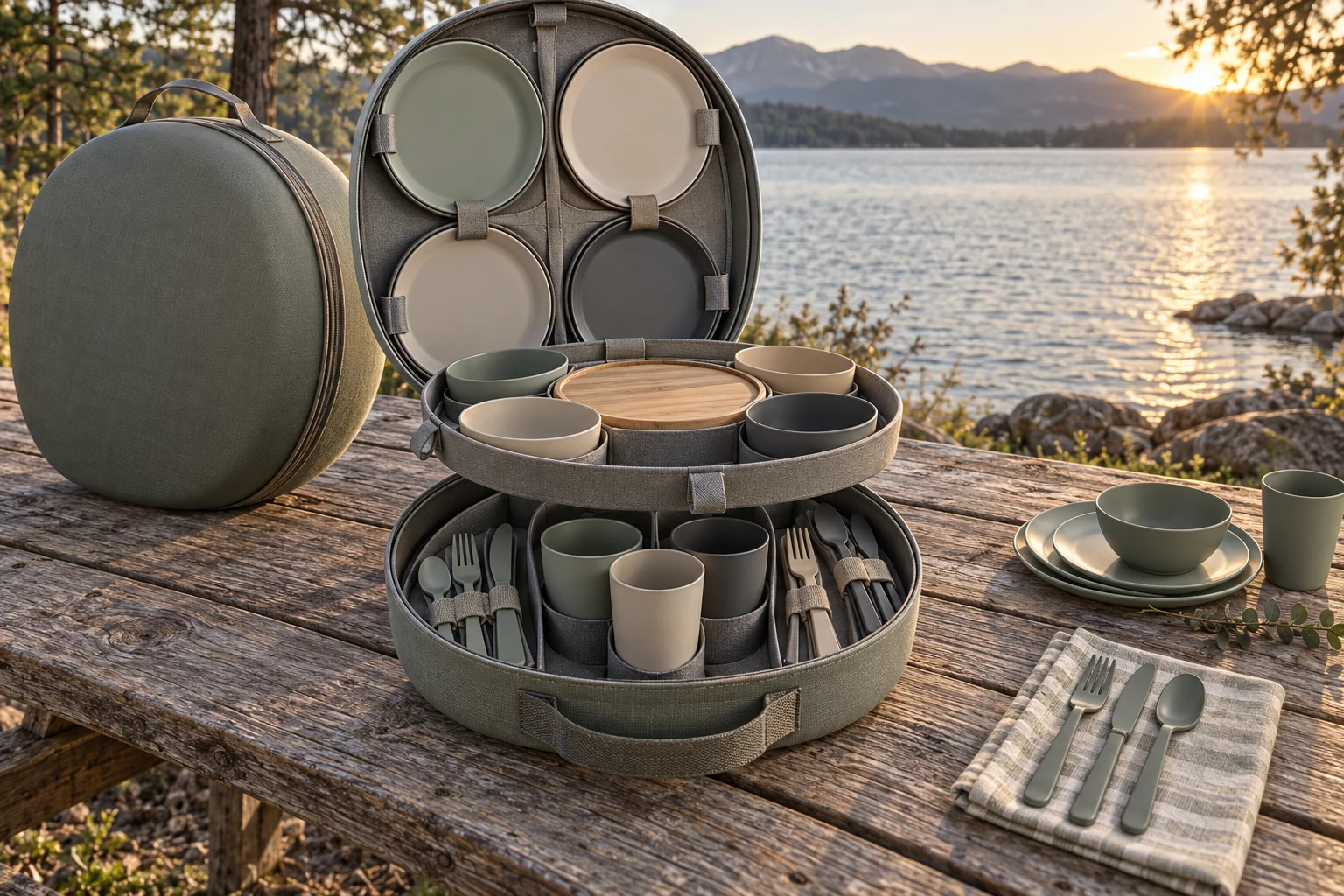
This four-person camping dinnerware set concept separates the component groups into two removable circular retention rings around a shallow central service deck. The rings lift independently for count and table access, while the deck can hold a separately reviewed lunch-box or shared component module. It is a sourcing concept, not an existing production SKU.
PRODUCT PARAMETER
| Product form | Four-person portable dinnerware set with twin removable retention rings |
|---|---|
| Reference groups | Upper ring, lower ring, plates, bowls, cups, cutlery, service deck, carry shell and optional lunch-box module |
| Materials | To be confirmed for the project |
| Dimensions / packed envelope | To be confirmed for the project |
| Component compatibility | Compatibility to be confirmed by project sample and drawing. |
| Decoration / color | To be confirmed for the project |
| Packaging / carton | To be confirmed for the project |
| MOQ / price / lead time | To be confirmed for the project |
| Compliance / evidence | Finished-component, decoration, use-condition and target-market scope to be confirmed |
REFERENCE CONFIGURATIONS
Use this camping dinnerware set configuration table to separate the ring, deck and complete-carry decisions.
| Configuration | Illustrative grouping | Project decision |
|---|---|---|
| Lower ring | Radial positions for four plates and bowls | Diameter, edge contact, tab access and retention |
| Upper ring | Four cup positions and four cutlery channels | Release sequence, count visibility and nesting clearance |
| Service deck | Shallow shared surface or optional module envelope | Food-use scope, locating groove and removal clearance |
| Complete carry | Both rings nested around the deck inside one shell | Load path, packed height, strap and transport protection |
Reference configurations are planning inputs only. Counts, fit and compatibility remain subject to drawings and project samples.
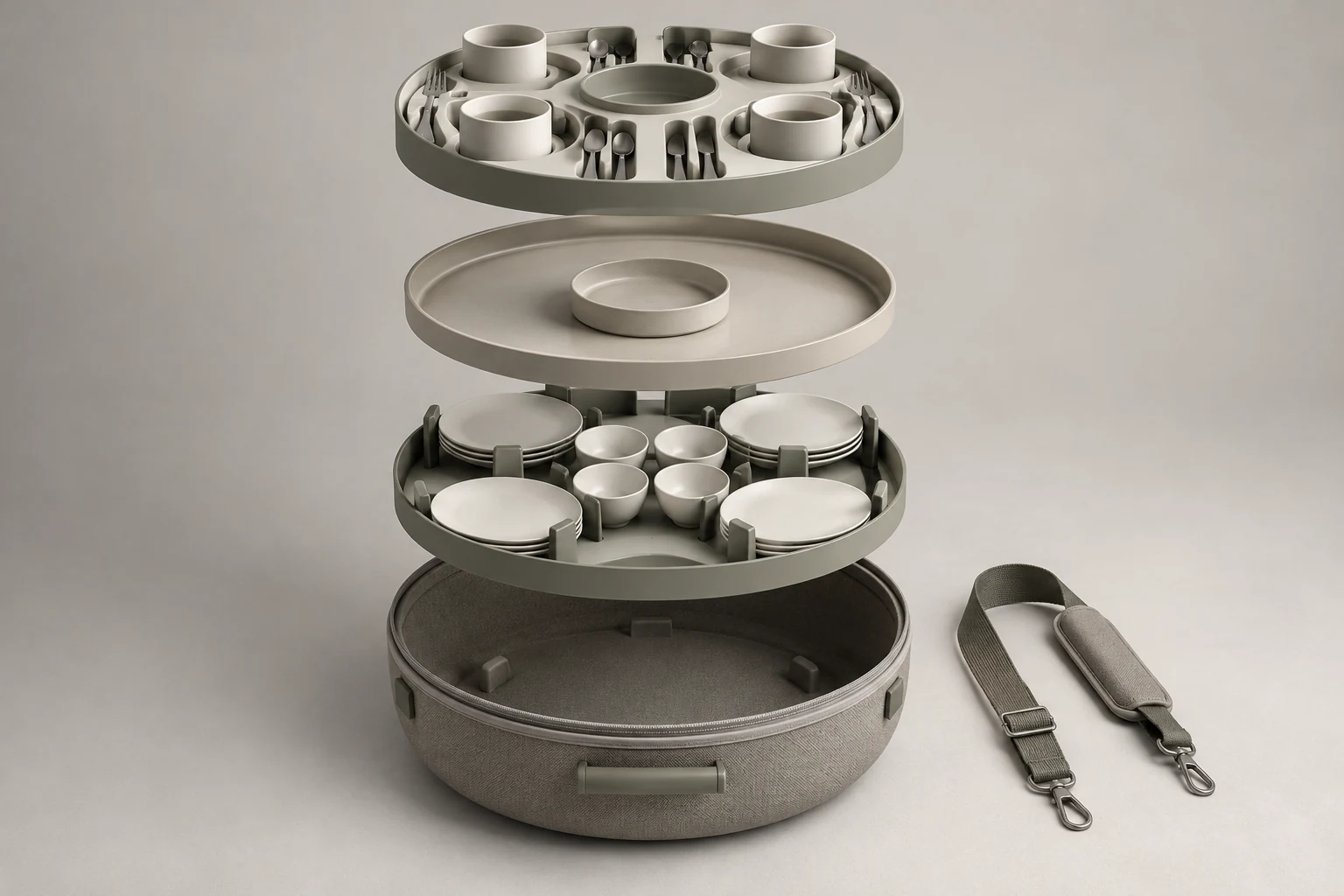
TWIN-RING DECK CAMPING DINNERWARE SET ARCHITECTURE
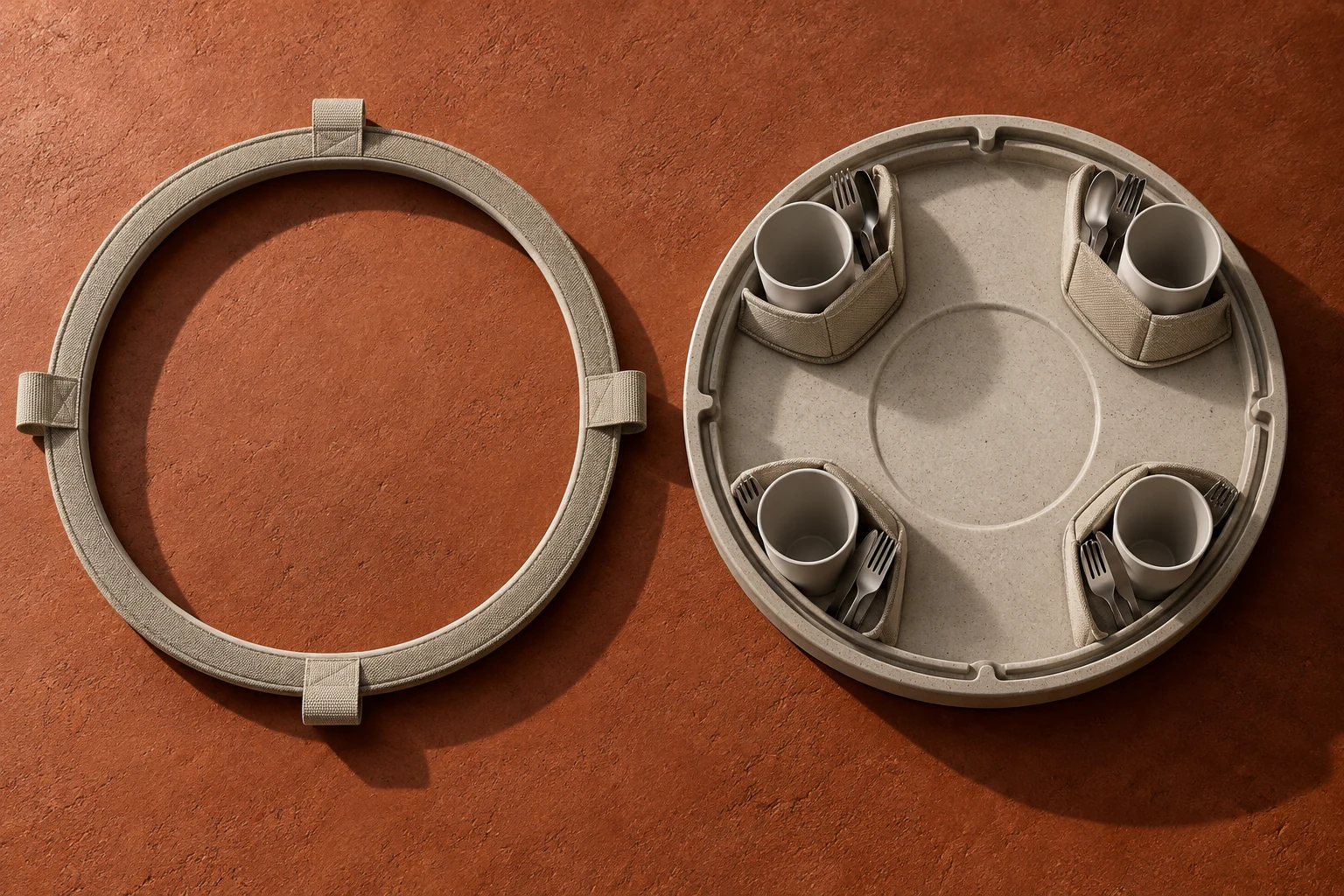
The camping dinnerware set design difference is its concentric removable structure. It is not a recolor or a revision of the recent pannier, drum, accordion, wedge, cage, frame, chain or drawer concepts. Each ring is a complete radial retention element; neither becomes a hinged panel, fabric pocket bank or fixed cassette. Removing the upper ring exposes the lower group without unloading the entire shell.
Potential access and count benefits are hypotheses for sample review. Check grip tabs, ring stiffness, component contact, lift clearance, deck location and the loaded shell before approving the camping dinnerware set architecture.
WHAT TO SEND FOR A PROJECT REVIEW
- Required user count and controlled component BOM
- Component drawings, samples or target envelopes
- Preferred division between upper ring, lower ring and deck
- Food use, cleaning method and target market
- Logo artwork, decoration locations and packaging channel
- Sample purpose, decision owners and open compatibility questions
DEVELOPMENT CONTROL
| Control point | Required record | Do not assume |
|---|---|---|
| Ring-to-component fit | Component revision, pocket drawing and sample observation | One ring fits future component changes |
| Ring lift sequence | Tab position, clearance and loaded handling review | Easy release under all loads |
| Service deck | Envelope, locating method and contact review | Leakproof, insulated or cookware performance |
| Carry shell | Packed height, closure, strap path and contact map | Capacity, comfort or protection without testing |
| Artwork and packaging | Released files tied to BOM and sample revision | Artwork transfers unchanged across parts |
MATERIAL AND COMPLIANCE BOUNDARY
No material, certification, dishwasher, microwave, leakproof, insulation, load, durability or environmental claim is made. For the destination market, map the intended use to each final food-contact part and its exact decoration. The US FDA food-contact notification inventory, European Commission food-contact materials overview and EU General Product Safety Regulation define questions, not evidence for this unspecified configuration.
Use the finished-component evidence index, BOM revision register and pilot assembly observation process during project review.

PACKING AND SAMPLE APPROVAL
Approve each ring separately, then review the full camping dinnerware set. Record component contacts, lift clearance, count visibility and the order used to return both rings around the service deck. The camping dinnerware set pack-out and transport checks must use the final component revision and defined load state.
PROCUREMENT FAQ
Are the two rings interchangeable?
To be confirmed for the project. Pocket geometry, diameter and artwork may differ across the camping dinnerware set.
Can the deck be used as a plate?
Not assumed. Food-contact use, material, geometry and evidence must be reviewed for the project.
Is a lunch-box module included?
It is an optional reference envelope. Inclusion and all specifications are To be confirmed for the project.
Do the rings guarantee fast counting?
No. Count visibility must be observed with the final components and sample.
Can existing dinnerware fit?
Compatibility to be confirmed by project sample and drawing.
REQUEST A TWIN-RING DECK SET REVIEW
Send the controlled camping dinnerware set BOM, component drawings or samples, preferred ring split, deck scope, destination market, artwork and packaging brief. Naike can return project-specific questions before quotation or sample planning.
Reviewed . Concept scope only: drawings, values and supplier capabilities remain unconfirmed until project review.
RELATED SOURCING PATHS
Compare Products and Plan Your Project
Review related product formats, then compare material, set configuration, logo, packaging, testing scope and order quantity with our B2B team.