Description

REMOVABLE FRAME CARRIER CONCEPT
Custom Roll-Top Frame Camping Dinnerware Set
This roll-top frame camping dinnerware set combines a soft adjustable-height carrier with a removable rectangular compartment frame. Buyers can review coordinated plates, bowls, cups, divided lunch boxes and protected utensil groups as one project-controlled assortment rather than selecting unrelated pieces after the carrier is fixed.
The images describe a development direction, not a confirmed stock SKU. Final counts, dimensions, materials, frame loading, food-contact evidence, logo method, packaging and production feasibility are To be confirmed for the project.
Submit a set-development briefPRODUCT PARAMETER
| Concept | Soft roll-top carrier with a removable rectangular frame, adjustable closure and assigned component zones |
|---|---|
| Reference roles | Plates, bowls, cups, divided lunch boxes, forks, knives, spoons and protective sleeves; final quantities follow the signed component matrix |
| Material | To be confirmed for the project |
| Dimensions and weight | To be confirmed for the project |
| Colour and finish | To be confirmed for the project |
| Logo | Patch, print, molded or component marking method to be confirmed after surface and carrier review |
| Packaging | To be confirmed for the project |
| MOQ, price and lead time | To be confirmed for the project |
| Target markets | Europe, North America, Australia and comparable B2B channels, subject to configuration-specific evidence |
REFERENCE CONFIGURATIONS
Complete place-setting program
Review matched plate, bowl, cup and utensil roles for each user, then add divided lunch boxes or shared pieces according to the buyer brief.
Frame-assisted transport
The removable rectangular frame can be studied as a shape-control and compartment system while the roll-top adjusts to the verified loaded height.
Channel-specific assortment
Family retail, vehicle camping, park dining and outdoor catering can use different component matrices without presenting one concept image as a fixed specification.
Compatibility to be confirmed by project sample and drawing. The illustrated component count is a reference arrangement and must not be used as a production commitment, test result or customer-order record.
A flexible carrier supported by a removable frame
The defining architecture is a soft roll-top body around a lift-out rectangular frame. The textile carrier can close at different verified load heights, while the frame keeps assigned zones from collapsing into one another during packing. The development question is whether the frame adds useful separation without creating excessive mass, inaccessible corners or a cleaning burden.
This architecture is materially different from prior drawer, fan, clamshell, bridge-latch, corner-pod, saddle and rigid tote concepts. Its controlled variables are the roll length, closure path, frame footprint, divider pattern, base support, utensil sleeves and the relationship between soft walls and nested dinnerware. Photographs cannot establish any of those dimensions.
Freeze the component matrix before sizing the bag
List every personal and shared role, quantity, approximate envelope and removal priority. A carrier should be sized from the approved loaded arrangement, not from a marketing piece count. Lids, sleeves, spacers and frame parts must be counted separately so the buyer can compare a complete system with other proposals.
Use the camping dinnerware component guide to mark missing roles, then create a project-specific rigid and collapsible component matrix when deciding whether the carrier needs to accommodate mixed constructions. Do not release an external bag size until the role-and-count sheet is signed.

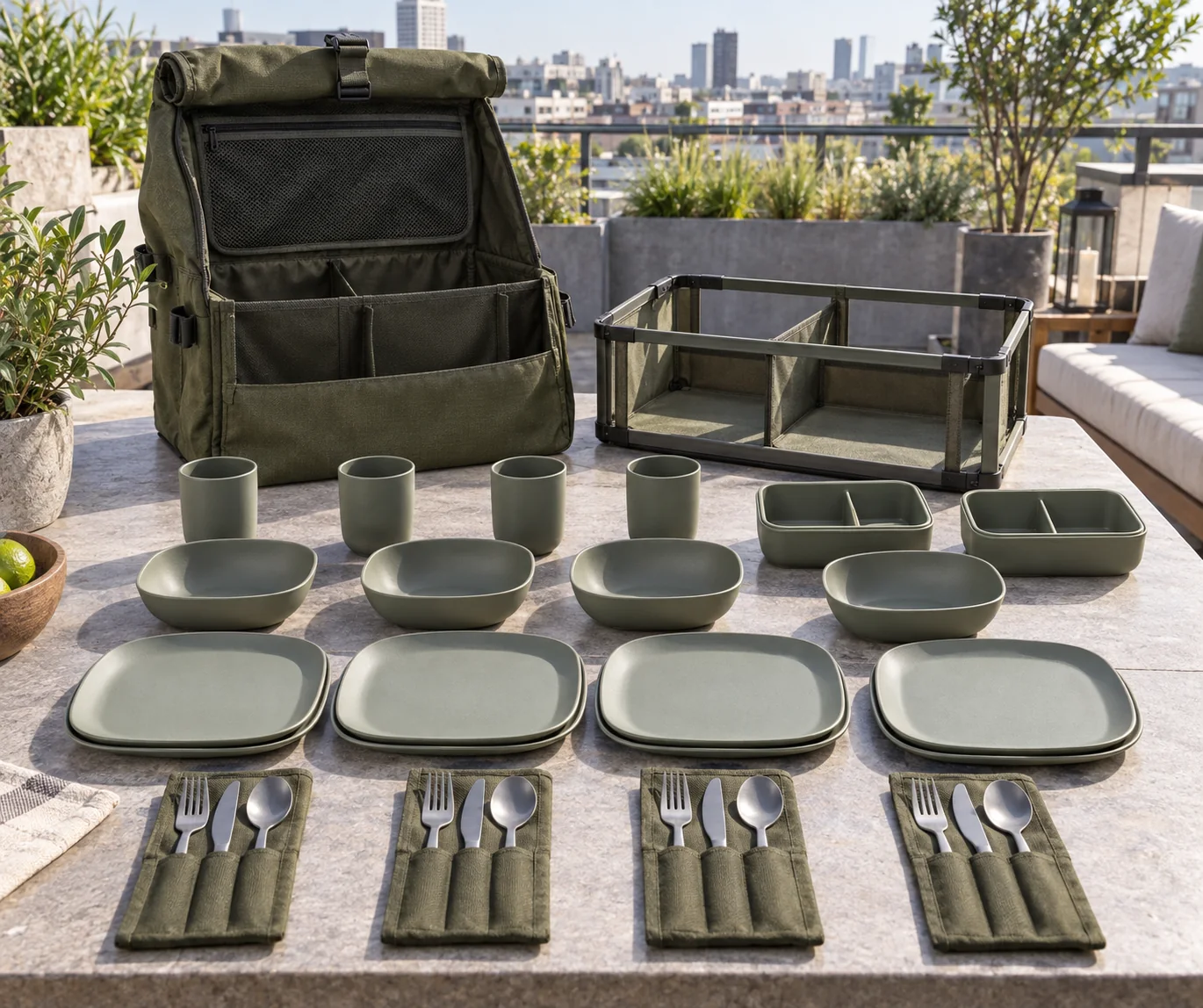
Conceptual application scene: complete place-setting roles, lunch boxes, carrier and frame are visible for configuration review. It is not evidence of weathering, heat resistance or a delivered order.
Roll closure, frame and sleeve development
The roll closure must be reviewed at the minimum and maximum approved load. Check buckle access, strap path, fabric bunching, standing stability and whether closure pressure deforms the highest component. The frame should lift out without snagging, expose corners for cleaning and return to one repeatable orientation.
Utensil sleeves require drainage, visual inspection and restraint suited to the selected handles. A pocket that fits one concept fork may not fit a later handle or knife guard. Load the complete set, move it through the intended carry sequence and document every contact point. Compatibility to be confirmed by project sample and drawing.

Procurement specification block
Loaded envelope
Measure the closed carrier at a defined roll count and compare it using the pack-volume worksheet.
Frame allocation
Number each compartment and map it to the component matrix, assembly instruction and inspection sheet.
Contact control
Apply the rattle and contact checklist to rigid frame corners, stacked parts and utensils.
Nesting logic
Use the nesting versus stacking review before finalizing rim and base clearances.
Buyer control checklist
| Control | Buyer question | Required record |
|---|---|---|
| Component matrix | Does every listed piece have a user, role and assigned zone? | Dated matrix and configuration photo |
| Roll closure | Does the selected roll count close without distorting the load? | Loaded-envelope record |
| Frame removal | Can the frame be removed, cleaned and reinstalled consistently? | Observed workflow and drawing |
| Retention | Do utensils, boxes and nested stacks remain controlled during transport? | Loaded handling review |
| Change control | Which checks repeat after a component, frame, fabric or artwork change? | Revision notice and approval plan |
Materials and compliance boundary
Material choices must be evaluated against food type, temperature, contact time, cleaning, age group and destination market. Buyers can use the European Commission food-contact overview, FDA Food Code and FSANZ packaging guidance to frame questions, but these public sources do not approve the illustrated assembly.
Build the project evidence file around the final materials, pigments, decoration, food conditions and cleaning instructions for every food-contact component. Carrier fabric and frame materials require their own declarations appropriate to their function. No item on this page is claimed suitable for a stove, burner, oven, campfire or direct flame.
Customization and tooling review
Buyers may adjust component quantities, plate and bowl profiles, cup form, lunch-box divisions, utensil handles, frame zones, fabric construction, closure hardware, colours, logo positions and retail packaging. A change that affects molded geometry, frame joints or carrier panels requires a new feasibility, tooling and fit review. No molding capability, tool cost or schedule is promised by this concept page.
Approve the functional load, removal order, cleaning access and closed envelope before releasing artwork. A thicker logo patch, changed rim or new utensil handle can alter clearances. Keep the component drawing, bag pattern, frame revision and golden sample under one project code.
Sample approval sequence
Begin with the empty carrier and frame. Verify orientation, removal, roll path and access to each zone. Add one component family at a time, then load the complete matrix. Record the outer dimensions, mass, extraction order, contact points, wash-and-dry workflow and repacking steps for the exact revision.
Approve colours, logo artwork and retail graphics only after functional fit is stable. If the buyer later changes a plate, cup, lunch box, utensil sleeve or frame divider, repeat the affected clearance, transport, cleaning and evidence checks. A concept image is never the master specification.
Procurement FAQ
Is this roll-top frame camping dinnerware set a stocked product?
No stock claim is made. Availability, final construction and commercial terms are To be confirmed for the project.
Can the component count change?
Yes, as a development request. The buyer must then reassess the frame allocation, loaded height, closure path, carrier balance and packaging.
Can existing plates, bowls and cups be combined?
Candidate components can be checked against the frame, sleeves and carrier envelope. Compatibility to be confirmed by project sample and drawing.
Can the frame be removed for cleaning?
The concept is intended for removable-frame review, but the actual removal method, joints, drainage and cleaning instructions require engineering and sample confirmation.
Can logos be placed on the bag and dinnerware?
Possible positions and methods can be evaluated after materials, surfaces, flex zones and market requirements are defined. No logo method is confirmed in advance.
What is needed for a quotation?
Provide the user count, component matrix, target carrier envelope, material direction, colours, logo zones, markets, packaging and document expectations. A written quotation should separate confirmed items from open development decisions.
Develop a roll-top frame configuration
Share the component roles, quantities, packing sequence, carrier target, market list, artwork, packaging and evidence brief. Project review can then separate reusable parts, new geometry, open engineering questions and claims requiring finished-article evidence.
Request a component and carrier review
When comparing this roll-top frame camping dinnerware set with another architecture, describe the access, protection or pack-volume problem and submit the controlled configuration brief.
RELATED SOURCING PATHS
Compare Products and Plan Your Project
Review related product formats, then compare material, set configuration, logo, packaging, testing scope and order quantity with our B2B team.