Description
PORTABLE SET DEVELOPMENT CONCEPT
Drum-Sleeve Four-Person Camping Dinnerware Set
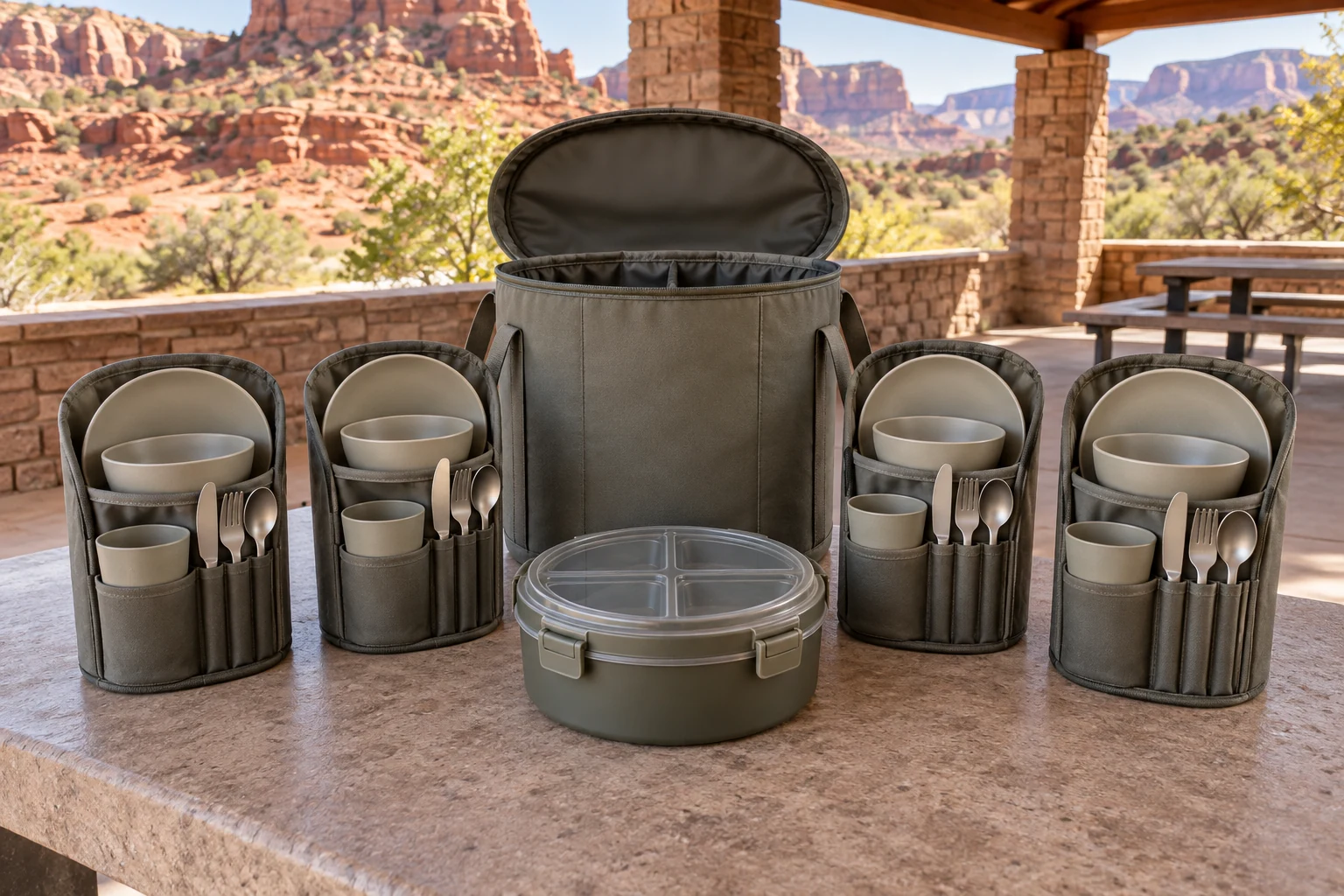
This camping dinnerware set concept uses a tall cylindrical carry shell with four removable vertical place-setting sleeves arranged around a central lunch-box well. A roll-down top collar closes the loaded carrier without turning the components into a horizontal stack.
- Four removable sleeves separate each diner’s plate, bowl, cup and cutlery group
- A central floor well reserves a distinct location for the lunch-box module
- Vertical loading changes access, balance and case-fit decisions
- Compatibility to be confirmed by project sample and drawing.
PRODUCT PARAMETER
The Drum-Sleeve camping dinnerware set remains a development concept until the finished components, carrier and project evidence are approved.
| Product concept | Four-person portable camping dinnerware set with cylindrical carrier and removable vertical place-setting sleeves |
|---|---|
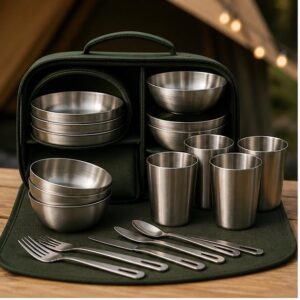
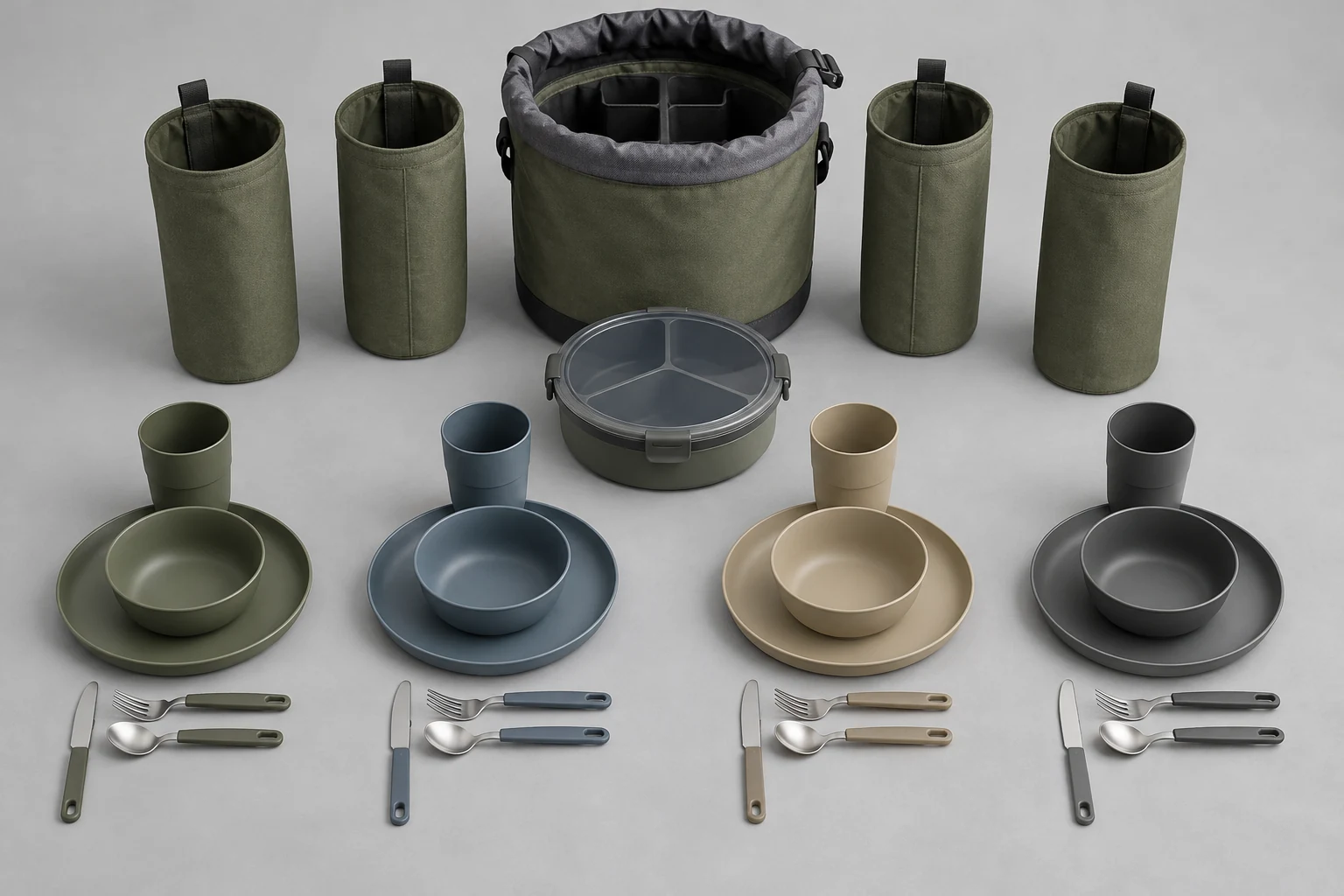
| Reference components | Four plates, four bowls, four handleless cups, four fork/spoon/knife groups, one divided lunch box, four removable sleeves and outer carrier |
| Material | To be confirmed for the project |
| Dimensions and weight | To be confirmed for the project |
| Color / finish / logo | To be confirmed against approved project samples and artwork |
| MOQ / price / lead time | To be confirmed for the project |
| Compatibility | Compatibility to be confirmed by project sample and drawing. |
| Packaging | To be confirmed for the project |
REFERENCE CONFIGURATIONS
Use the configuration table to define how each removable sleeve and the central module contribute to the saleable set.
| Configuration | Reference combination | Review focus |
|---|---|---|
| Four personal sleeves | Each sleeve carries one plate, bowl, cup and knife/fork/spoon group | Component envelope, insertion order, retention and identification |
| Central lunch module | Four perimeter sleeves around one divided lunch box in a floor well | Clearance, lid protection, weight position and removal access |
| Channel pack | Loaded carrier, roll-down collar, handle, instructions, protection and carton | Standing stability, compression, scuff contact and carton orientation |
All combinations are reference concepts. Final counts, materials, geometry, sleeve construction, closure and packaging require project confirmation.
DRUM-SLEEVE CAMPING DINNERWARE SET ARCHITECTURE
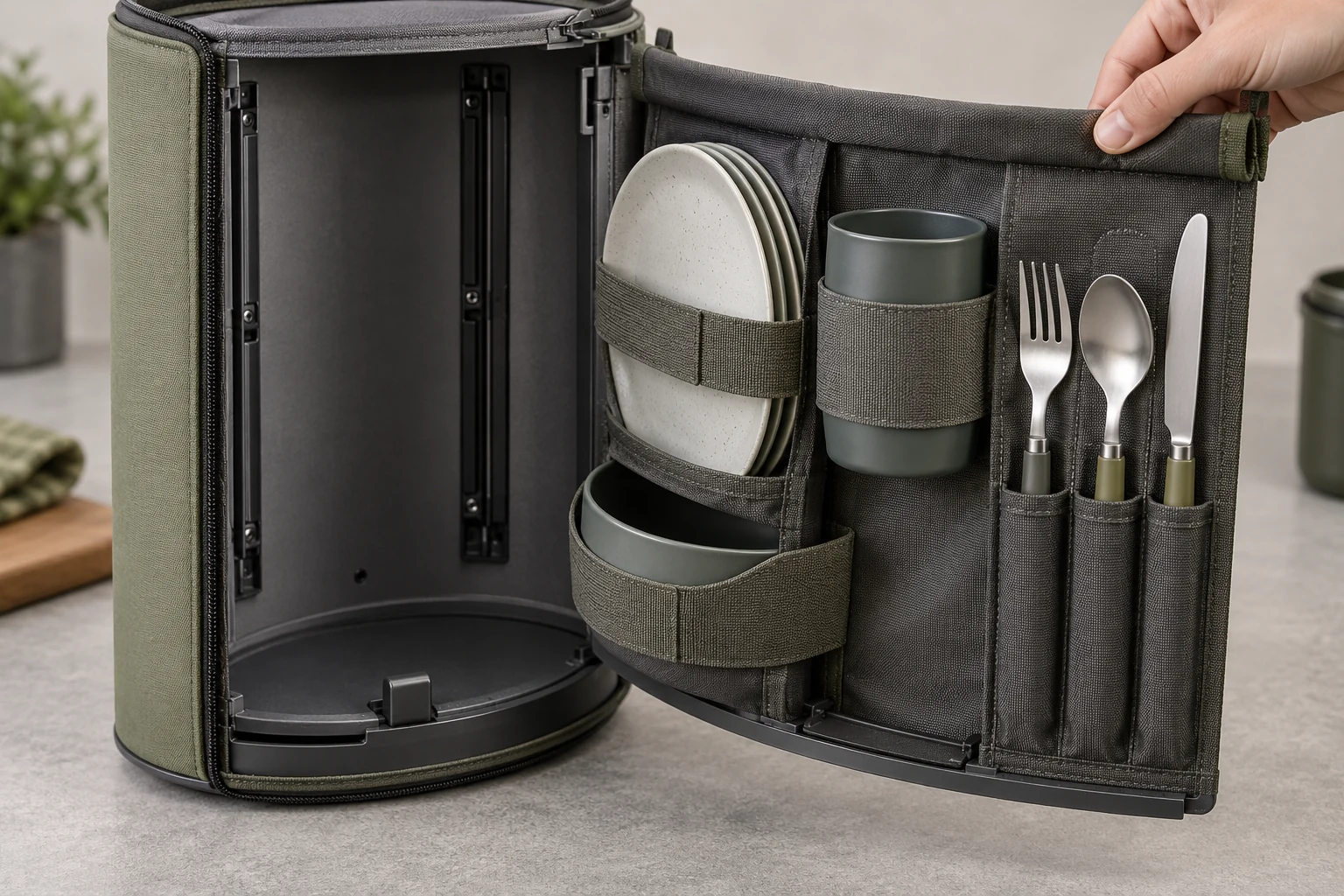
The cylindrical outer shell uses four vertical guide positions rather than drawers, flat leaves, radial trays or a rigid plate rack. Each personal sleeve lifts independently from the open top. A base stop supports the loaded sleeve, while separate pockets or loops can position the plate, bowl, cup and cutlery group. The lunch box remains in a central well below or between the sleeve handles, depending on the approved envelope.
This architecture creates distinct questions about center of gravity, standing stability, component contact, sleeve handle clearance and removal order. It is not a claim that the carrier is waterproof, washable, insulated, drop-proof or approved for direct food contact.
WHAT TO SEND FOR A PROJECT REVIEW
| Buyer input | Why it matters |
|---|---|
| Controlled BOM and four-person component count | Defines sleeve allocation and the central module |
| Component drawings or physical samples | Supports sleeve width, guide clearance, stops and loaded height review |
| Target carrier diameter, height and carry method | Controls shell geometry, collar, handle and standing footprint |
| Food use, cleaning and target market | Frames material and finished-component evidence questions |
| Logo, colors, retail packaging and destination | Defines artwork, sample and quotation scope |
DEVELOPMENT CONTROL
Develop the dinnerware, sleeve, carrier and packaging from one controlled project package.
- Freeze the component revision and personal-place-setting count.
- Measure the plate, bowl, cup, cutlery and lunch-box envelopes.
- Define sleeve walls, guide interfaces, base stops, handles and component restraints.
- Review loaded balance, standing stability, removal order and collar closure with a project sample.
- Approve color, decoration, pack-out and instructions against the same revision.
- Record substitutions through a change-impact review before release.
No tooling, sewing, molding, capacity or manufacturing capability is asserted on this concept page. Custom carrier or component development requires project evaluation.
MATERIAL AND COMPLIANCE BOUNDARY
Evidence questions should be mapped to each finished dinnerware component and its intended food, temperature, contact duration, cleaning method, color, finish and decoration. The US FDA food-contact notification inventory, the European Commission food-contact materials overview, and Regulation (EC) No 1935/2004 are primary references, not certificates for this concept.
The outer carrier, sleeve lining, thread, closures, printed areas, adhesives, lunch box and dinnerware may require different evidence. Dishwasher, microwave, leakproof, heat-resistant, biodegradable, compostable and cookware claims are not assumed. Dinnerware is not cookware unless a specific finished product and evidence scope support that use.
PACKING AND SAMPLE APPROVAL
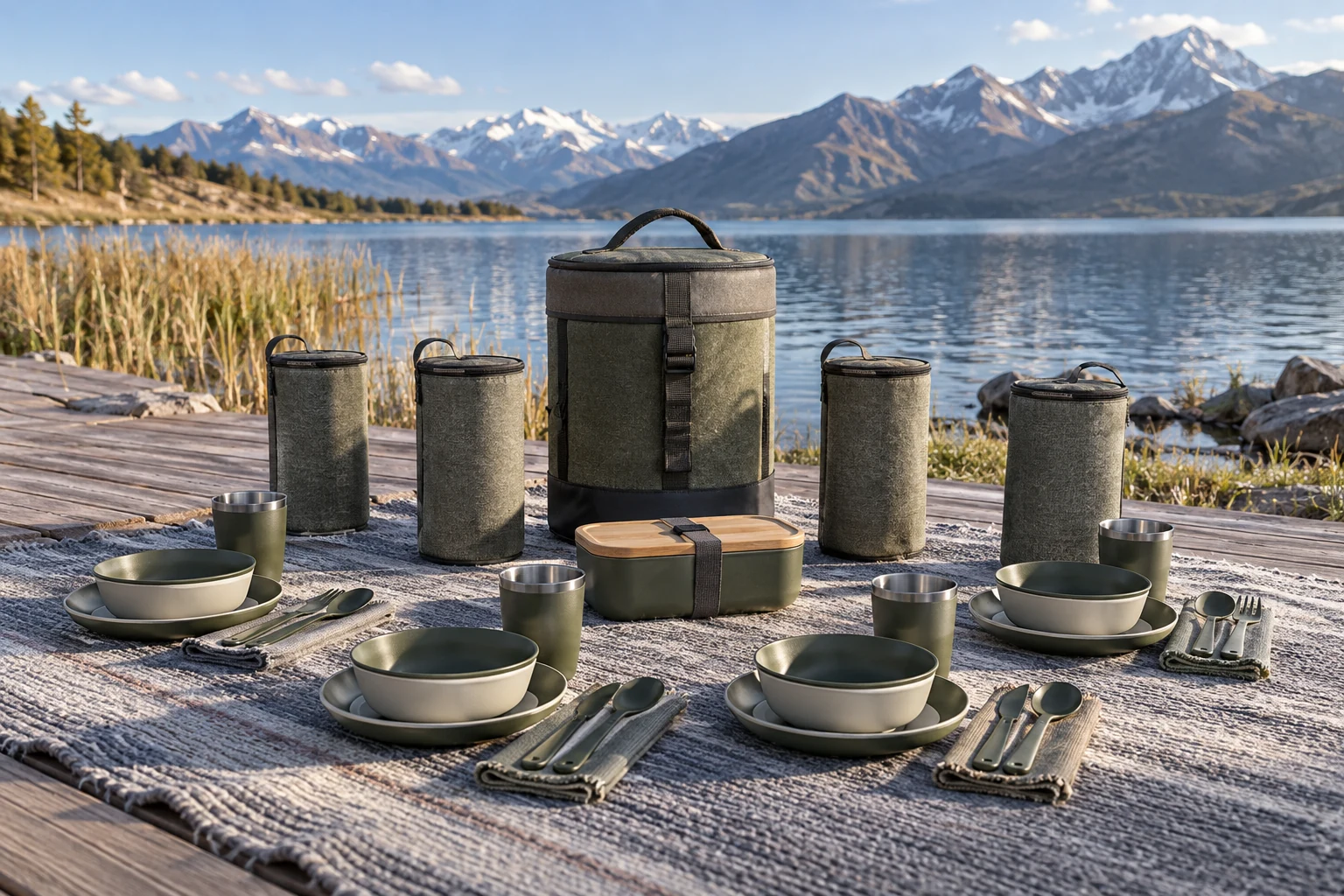
Approve the set in four states: empty carrier, individual loaded sleeves, complete upright carrier and channel pack. Observe whether components migrate downward, plate edges contact cups, utensils reach food-contact surfaces, sleeve handles collide, the central module blocks removal, or the top collar compresses the load.
Use the case-fit checklist, the pilot assembly guide, and the pre-shipment inspection release sheet when converting the concept into a controlled project.
PROCUREMENT FAQ
Is the cylindrical carrier a current production SKU?
No. It is a development concept for discussing vertical place-setting sleeves and a central lunch-box well.
Are the sleeve sizes fixed?
No. Sleeve width, height, guides, stops and restraints are To be confirmed for the project from the approved component and carrier drawings.
Can existing dinnerware be loaded into the sleeves?
Existing components may be evaluated, but fit and retention cannot be assumed. Compatibility to be confirmed by project sample and drawing.
Can the central lunch box be omitted?
That configuration may be evaluated, with a revised balance, inner support, closure and packaging review.
What are the MOQ, price and lead time?
To be confirmed for the project after the BOM, materials, carrier construction, decoration, packaging and development scope are reviewed.
REQUEST A DRUM-SLEEVE SET REVIEW
Send the controlled BOM, component drawings or samples, target carrier envelope, use conditions, market, decoration and packaging brief. Naike can organize the specification and compatibility questions for this vertical-sleeve concept.
Contact Naike Dinner · Send drawings and BOM · Discuss carrier and packaging
Reviewed . Concept page; all specifications remain project-specific.
RELATED SOURCING PATHS
Compare Products and Plan Your Project
Review related product formats, then compare material, set configuration, logo, packaging, testing scope and order quantity with our B2B team.